WHAT IT IS
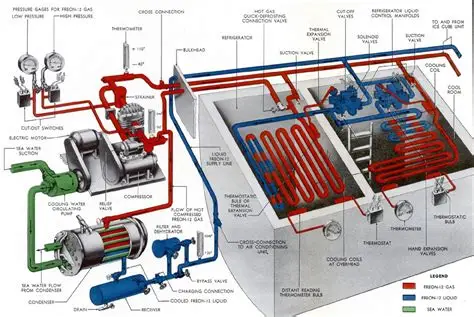
World War II U.S. Navy refrigeration is mechanical vapor-compression using dichlorodifluoromethane — Freon-12, R-12 — as the working fluid. A compressor, a seawater-cooled condenser, a receiver, a thermal expansion valve and an evaporator move heat out of a meat room, a magazine or a cargo hold and dump it overboard. The Navy training film said the theory is simple: liquid refrigerant flashes through a restriction, boils by stealing BTUs from the space, the vapor is squeezed hot, seawater knocks the heat out, and the liquid goes around again.
That plant shows up in four jobs: ship’s stores (meat, butter, vegetables, ice), magazine cooling on gun ships, cargo refrigeration on AF / Type R reefers, and the small York plants on fleet submarines. Ice-cream machines and concrete “ice cream barges” are the same cycle with a scraper barrel on the evaporator end.
WHY FREON, NOT AMMONIA OR CO2
Shore ice plants ran ammonia. Old passenger ships and some merchant reefers ran carbon dioxide. The wartime Navy rejected both for combatant and most auxiliary work. Ammonia fumes are toxic and slightly flammable in a closed hull. CO2 works only at very high pressure; the iron is heavy and bulky. Freon-12 boils far below ice temperature, stays liquid only under pressure, is non-flammable in ordinary use, and lets the compressor, condenser and piping stay compact enough for a destroyer or a Gato. Bureau of Ships and the postwar NAVPERS fireman texts state R-12 as the standard shipboard refrigerant. Training films say the same in so many words.
York and Carrier built most of the named Navy plants. North Carolina-class provision rooms used Carrier reciprocating sets. The same ship’s 16-inch magazine plants were York. Fleet-boat air-conditioning and stores used York-Navy Freon-12 two-cylinder 4×4 machines rated about 4 tons of refrigeration each. C-2 reefer conversions for frozen meat used York centrifugal compressors driven by ship’s steam — a merchant-scale plant, not a battleship ice machine.
HOW THE CYCLE WORKS
Start with liquid R-12 in the receiver, high pressure, warm. It passes a strainer, then a solenoid the thermostat opens, then the thermal expansion valve (TXV). The TXV is a metered hole. Pressure drops. The liquid flashes to a spray and enters the evaporator coils in the cold room or in the magazine overhead. Boiling takes latent heat from the air or from the steel. The vapor leaves slightly superheated so no liquid slug hits the compressor — a drop of liquid Freon will wreck a reciprocating machine.
The compressor — usually a single-acting reciprocating unit, belt- or motor-driven, two or four cylinders on combatants — squeezes the gas. Temperature and pressure rise (near-adiabatic, with the usual heat leaks). Discharge goes into a shell-and-tube condenser. Seawater from a circulating pump runs through the tubes; Freon condenses on the shell side, gives up superheat and latent heat, and becomes liquid again. The warm seawater goes overboard. That is the only “exhaust.” There is no rooftop fan coil. Zinc pencils in the water boxes eat the galvanic attack so the brass tubes last.
Liquid leaves the condenser into the receiver — a tank that keeps a reserve so a sudden load does not starve the TXVs. A dehydrator / drier takes water that would freeze in the valve. Packless valves and a Navy Type Q manifold let the ice-machine gang isolate, evacuate and charge from a weighed 12-lb drum. High- and low-pressure cutouts stop the compressor if the head pressure climbs or the suction collapses.
A “ton of refrigeration” is the heat to melt a short ton of ice in 24 hours — 12,000 BTU/h. A battleship stores plant is tens of tons. A submarine air-conditioning pair is 8 tons at 330 rpm. A York machine on an ice-cream barge was rated 50 tons.
SHIP’S STORES ON A COMBATANT
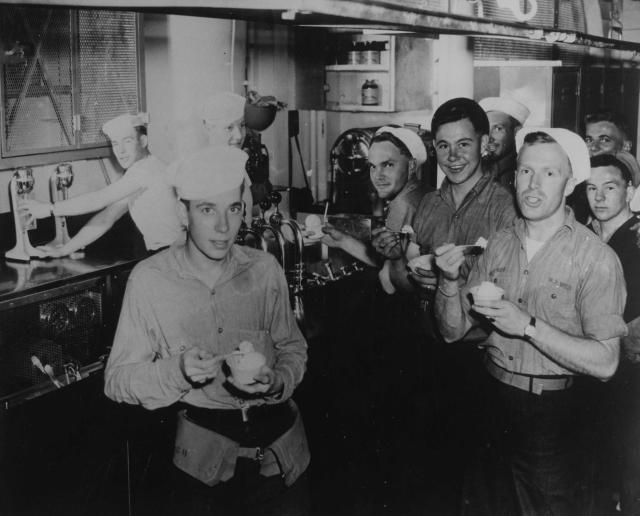
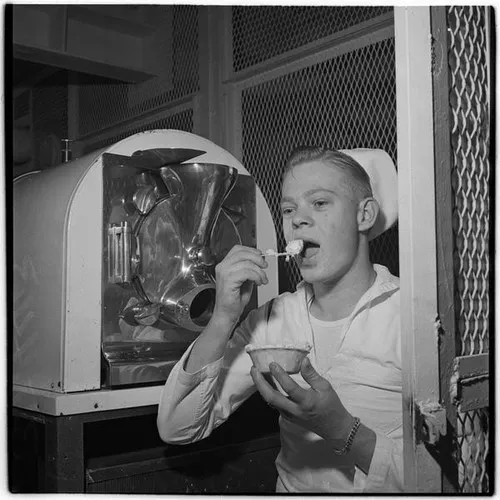
On North Carolina the cold rooms sit on third deck: fruit and vegetable spaces at about 40 °F, meat rooms at about 15 °F, butter-eggs-milk at 32 °F, a thaw room at 40 °F, plus the ice-making set. Two Freon circuits, three compressor–condenser pairs — run 1 and 3, keep 2 as spare; any pair can feed either circuit. Evaporators are coils in the insulated rooms (radiant / gravity on some layouts, forced air on others). Solenoid plus TXV plus remote bulb on each room. Ice cubes from a dedicated evaporator barrel. The ice-cream machine is a five-gallon General Electric freezer: mix in, blades scrape the wall at about 23 °F while Freon from the same kind of compressor cools the jacket. Dry or fluid mix; later in the war canned ready mix.
Texas-generation ships had larger ice-machine rooms relative to stores. Freon let later battleships shrink the machinery and grow the meat rooms. That is the “power of Freon” the museum walk-throughs keep repeating.
MAGAZINE COOLING
Powder and projectiles want a stable, cool compartment, not a meat locker. Sixteen-inch magazines on a fast battleship are insulated and fitted with overhead evaporator coils and drip pans — radiant cooling, little or no blast of air through the powder. Design evaporator temperature around 35 °F without forced draft; the room itself is held near 90 °F or below on the published North Carolina description, with redundant plants so one hit or one seized compressor does not cook a magazine. Two coil sets per space, two Freon sources. Plant numbers encode deck, frame and side: 3-122-1 is third deck, frame 122, starboard. Annular handling spaces outside the magazine get the same Freon through armored or expanded-metal guarded lines — strainer, solenoid, TXV. Blow-out ventilation (inlet and natural exhaust with double-flap valves) is a separate air problem: men and ether fumes, not the refrigeration cycle.
REEFERS AND THE LOGISTIC FLEET
Combatants carry days or weeks of meat. Theatres live on AF stores ships and Maritime Commission Type R reefers — R1-M-AV3 Adria class and R2-S-BV1 Alstede class, plus C-2 conversions. York put steam-turbine centrifugal compressors on the 1943 C-2 meat ships: fourteen compartments at 15 °F, about 502,000 cubic feet on the 14,000-ton class, two insulated cargo blocks. Centrifugals had been luxury-liner air-conditioning gear; the conversion was the first wide use of that compressor for cargo freeze. Holds are not loaded warm and pulled down in an hour — the coil area is sized for already-frozen cargo. United Fruit and WSA agents ran many of the hulls. Concrete BRLs (Hydrogen, Calcium, Antimony) added a floating warehouse: two 50-ton York ice machines, 1,500 tons frozen meat and 500 tons chill cargo at 15 °F, plus an ice-cream plant at about 500 gallons a shift. Tow it to the anchorage; the fleet comes alongside.
SUBMARINES
NAVPERS 16163 (1945) is the fleet-boat book. Two separate Freon-12 systems: refrigeration for the box and air-conditioning for the people. York-Navy 4-inch by 4-inch two-cylinder enclosed compressors, shell-and-tube four-pass condensers, receivers, finned evaporators in casings, plus a conning-tower coil. Air-conditioning about 8 tons with both machines at 330 rpm. Same cycle, smaller iron, zincs in the condensers, packless valves so a leak does not gas the boat. The box keeps the patrol’s meat; the AC plant is why a 75-day war patrol is livable in the tropics.
WHAT THE GANG ACTUALLY DID
Evacuate with the vacuum pump, weigh in Freon from the drum on a scale, watch suction and discharge gauges, change zincs before they disappear, keep water out of the drier, never slug the compressor, and chase leaks with soapy water or a halide torch. A dirty strainer starves the TXV. A failed solenoid cooks a room. A fouled condenser raises head pressure and shuts the machine down on the high-pressure cutout. Seawater is both the heat sink and the corrosion problem.
LIMITS
R-12 is later an ozone problem; in 1944 it was the safe shipboard choice. The plant does not make a ship independent of reefers. A hit in the ice-machine room or a seized circulating pump stops the cold. Magazine cooling is temperature control, not a firemain. Ammonia stayed on some merchant and foreign plants where the Navy would not accept the gas in a warship.
IN ONE SENTENCE
WW2 U.S. Navy ship refrigeration is a Freon-12 vapor-compression loop — compressor, seawater condenser, receiver, TXV, evaporator — built by York and Carrier to pull heat from stores, magazines, reefer holds and submarine boxes and throw it overboard, the reason a battleship had 15 °F meat rooms and a Gato had butter on day seventy.