WHAT IT IS
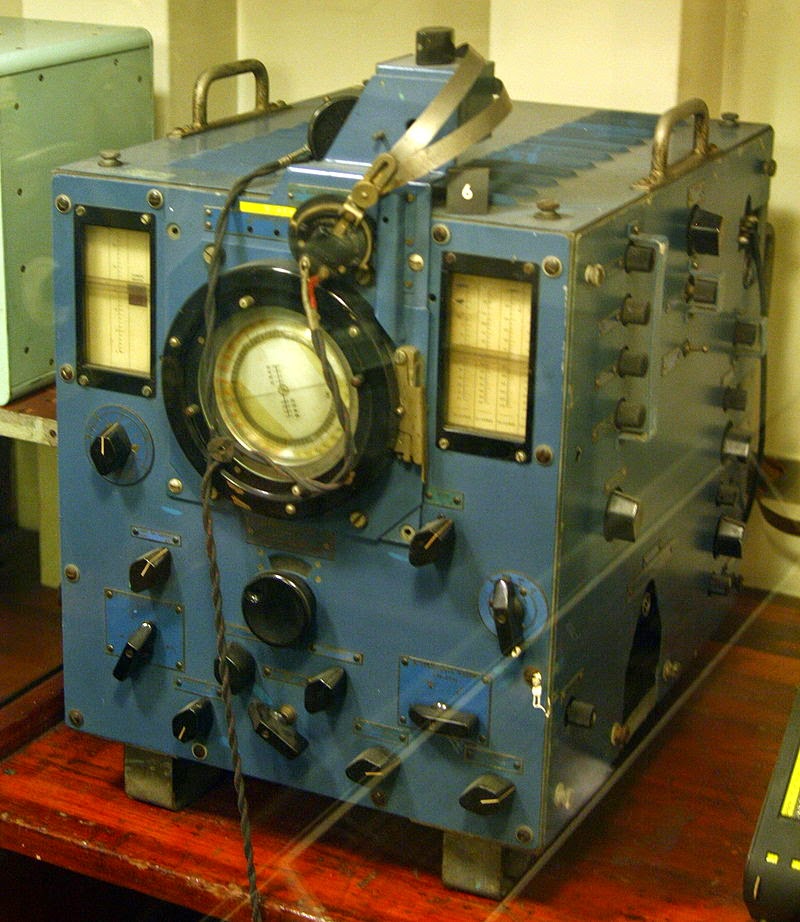
Kurier is a one-way burst modulator that keys an existing U-boat HF transmitter so a Kurzsignal or Wetterkurzsignal leaves the antenna in about a quarter-second instead of the usual ten to twenty seconds of Morse. It is not a new radio. It is an Impulsgeber — pulse giver — bolted onto Spez 406 / T200FK39 class sets. The Allies’ HF/DF (Huff-Duff) could sit on a 20-second crawl. It could not rotate a goniometer onto a 250–450 ms splash. That was the whole point.
The box is Telefunken KZG 44/2 (Kurzzeichengeber, year 1944, model 2; XXI lists also say KZG II/44). Shore end: three Philips CR101 receivers into an oscilloscope, later a KGR-1 light-beam recorder on photosensitive paper on a rotating drum. Traffic still went through Enigma M4 first. Kurier compresses time. It does not replace the cipher.
HISTORY
BdU never accepted that M4 was being read. It did accept, by 1943, that land and ship HF/DF was killing boats. Estimates later put something like a quarter of U-boat losses as having an HF/DF component. In spring 1943 Dr. Bendt at Telefunken sketched a pulse scheme. Baurat Vollmeyer ran prototypes: Holzkirchen transmit to Dannau on the Baltic, then a receiver at Bernau. Professor Karl Küpfmüller took the programme from December 1943.
First boat trials showed the windshield-wiper motor that spun the drum changed speed with heat and wet in a pressure hull. A synchronous motor fixed the timing. Production KZG 44/2 appeared early 1945. About 30 units were finished. Trials or fits are listed on at least 19 boats: U-285, 325, 416, 482, 680, 864, 866, 878, 880, 925, 977(?), 978, 979, 1055, 1221(?), 1223 and three unnamed. Four sets are firmly associated with Kiel fitting. One source says front-line use may have happened on a single boat. U-234 carried a set to sea and did not fire it. The war ended before Kurier became the fleet method.
HOW THE DRUM WORKS
An aluminium disc about 30 cm across. Around most of the rim: 25 fixed soft-iron slugs plus 84 (sometimes counted as 85 total elements) hinged or sliding slugs the Funkmaat sets by hand. Flat = no pulse. Out = pulse. A rotating arm carries a pickup coil. One revolution, one message, then the driver stage of the transmitter is locked off so the burst cannot repeat.
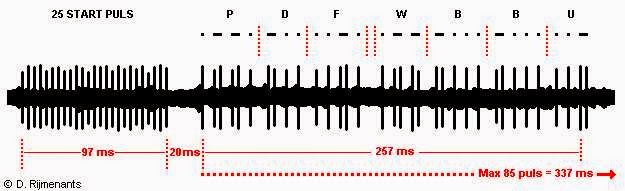
Each slug makes a ~1 ms pulse. Spacing is 4 ms centre-to-centre (1 ms on, 3 ms off) — 250 Hz, 25 percent duty. The coil output is a rough triangle; a two-stage amplifier squares it to ≥120 V positive pulses that lift the transmitter PA (or driver) off a standing negative bias. Bias taps of −90 / −120 / −150 / −180 V exist so the same Geber can key different service transmitters.
Signal structure:
1. Start / index: 25 fixed pulses × 4 ms = 97 ms. Tells the shore recorder to spin.
2. Gap: 16–20 ms with no slugs (cards differ by a few milliseconds).
3. Payload: Morse of the already-Enigma’d Kurzsignal. Dot = one slug. Dash = two adjacent slugs. Letter gap = two empty slots. Maximum payload window 337 ms (84 × 4 ms + last pulse).
Longest legal shot: 97 + 20 + 337 = 454 ms. Never half a second. A seven-letter Wetterkurzsignal plus preamble fits with room.
WHAT GOES ON THE DRUM
Not a war diary. The Kurzsignalbuch four-letter groups and the Wetterkurzschlüssel seven-letter weather word. Example path: observe weather → pack to seven letters (PDFWBBU scheme) → Enigma M4 → Morse dots and dashes → set slugs → one spin. Shore decodes pulses to letters, then M4, then the codebook. Frequency is not left on the printed watch list; an Umsetztafel offsets the carrier by on the order of 60–400 kHz (other notes say ±200 kHz) so a Huff-Duff net cannot sit on a known channel and wait.
Kurier is one-way boat-to-Germany. Orders still come down Goliath VLF and the HF Appell broadcasts. The boat still has to copy those on Köln / Main / T3PLLä38.
SHORE RECEIVE
Three Philips CR101s on three antennas, scope for the operator, KGR-1 converting pulses to a light trace on rotating photo paper. The 97 ms index starts the drum so the payload lines up. U.S. Naval Technical Mission in Europe report 529-45 (“Marine Kurier”) hauled captured Geber hardware to the Naval Research Laboratory after the surrender.
WHY IT MATTERED — AND WHY IT DID NOT
A 20-second Morse weather shot is a bearing. A 0.45-second pulse is a click. That is a real counter to ship and shore HF/DF of 1943–44. It does nothing to Ultra. The letters on the drum are still M4. It does nothing for the return path: the boat must still raise an antenna to hear BdU. It does nothing if the Funkmaat sets the slugs wrong or the synchronous motor is cold. Production of 30 sets and trials on ~19 hulls in the last winter of the war is not a fleet fit. Huff-Duff and escort carriers had already broken the surface-radio habit before Kurier left the bench.
A related Telefunken “3-F-Kurier” three-frequency idea existed on paper; the Navy did not field it.
HOW IT SITS WITH THE FUNKRAUM
T200FK39 / Spez 406 still make the watts. Lo40K39 is still the spare. Köln still copies the Appell. Enigma still sits on the bench. Kurier is the last box in that room — a mechanical burst keyer meant to make the existing 200 W transmitter too short to hunt.
STATUS
Experimental, 1944–45. Not operational as a service-wide procedure. Captured sets documented in Allied technical reports. No postwar navy used the drum.
IN ONE SENTENCE
Kurier is Telefunken’s KZG 44/2 30 cm slug drum that keys a U-boat HF transmitter into a 1 ms / 4 ms Morse burst no longer than 454 ms — Enigma first, Huff-Duff the target, thirty sets and a handful of 1945 trial boats, too late to save the Funkraum habit that had already been DFed to death.