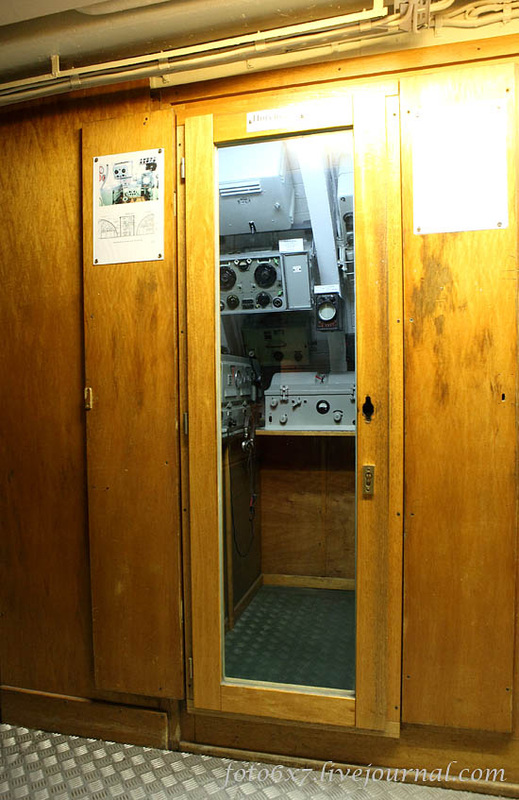
WHAT IT IS
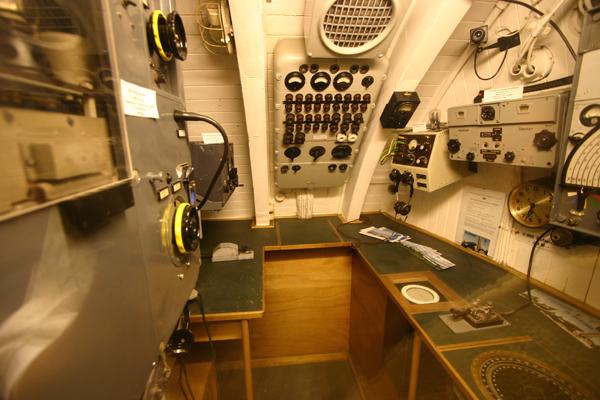
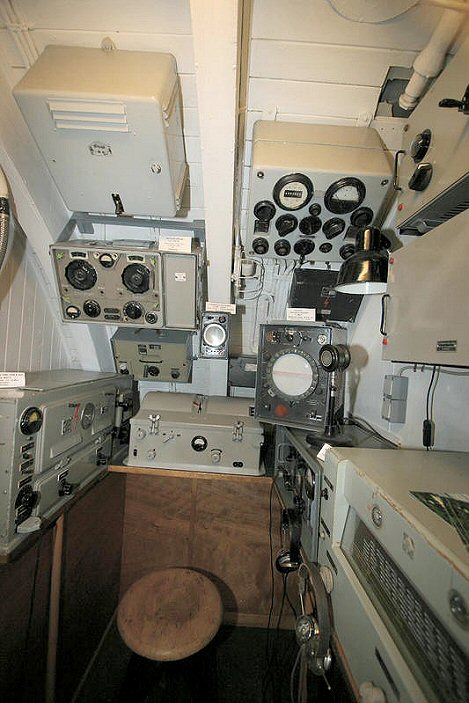
A German U-boat did not carry “a radio system” with a single type name. It carried a Funkraum — a radio room — stuffed with Telefunken and Lorenz boxes, a DF loop, a jump wire, an Enigma M4, and late in the war a Kurier burst drum. The traffic that ran the Battle of the Atlantic was HF Morse to and from Befehlshaber der Unterseeboote (BdU). Boats almost never talked boat-to-boat unless Control ordered it. Telefunken owned the U-boat contract; Lorenz owned most surface-ship sets and supplied the 40 W backup transmitter and the VHF voice box.
The suite changed by year and type, but a mid-to-late-war VII or IX looked like this: 200 W HF main transmitter, 40 W HF spare, 150 W MF beacon transmitter, VHF 10 W transceiver, primary HF receiver (E437S, T9K39 Main, or E52 Köln), all-wave / VLF receiver for Goliath and beacons, a broadcast set, and the cipher machine on the same bench.
TRANSMITTERS
Telefunken Spez 406S/36. Early and mid-war main HF set. About 3.75–15 MHz, 200 W. Ship-to-shore encrypted Morse. Master-oscillator / power-amplifier, no crystal lock in the later American sense — stability good enough for a pre-briefed frequency and a short call.
Telefunken T200FK39. Later Fernverkehrs-Kurzwellensender. 3–23 MHz, 200 W. A1 (CW), A2 (MCW) and A3 (phone) on the card. This is the main long-haul box on late IX and XXI fits. Type IXD often carried two 200 W HF transmitters.
Lorenz Lo40K39 (Lo 40 K39a/f). Backup HF. 5–16.7 MHz (some cards 3–16.5), 40 W. The set you used if the 200 W pot failed or if you wanted a shorter, weaker crawl. XXI kept it as the emergency FKW.
Telefunken Spez 2113. 300–600 kHz, 150 W. Medium-frequency beacon transmitter. Homing and rendezvous, not the daily KTB. Used to pull another boat or an aircraft onto a surface meeting. XXI dropped the long-wave transmitter.
Lorenz Lo10UK39 / Lo1UK35. 10 W VHF. Lo10UK39 about 37.8–48 MHz; Lo1UK35 about 41.55–45.75 MHz. Early war: ship-to-ship voice on workups. Later: a receiver to sit on Allied convoy TBS. Not the Atlantic command circuit.
Fieseke & Höpfner NS2 / Philips NS2a. 8 W on 500 kHz / 600 m. Liferaft emergency beacon, hand-crank, automatic SOS, box-kite aerial. Last radio on the boat.
RECEIVERS
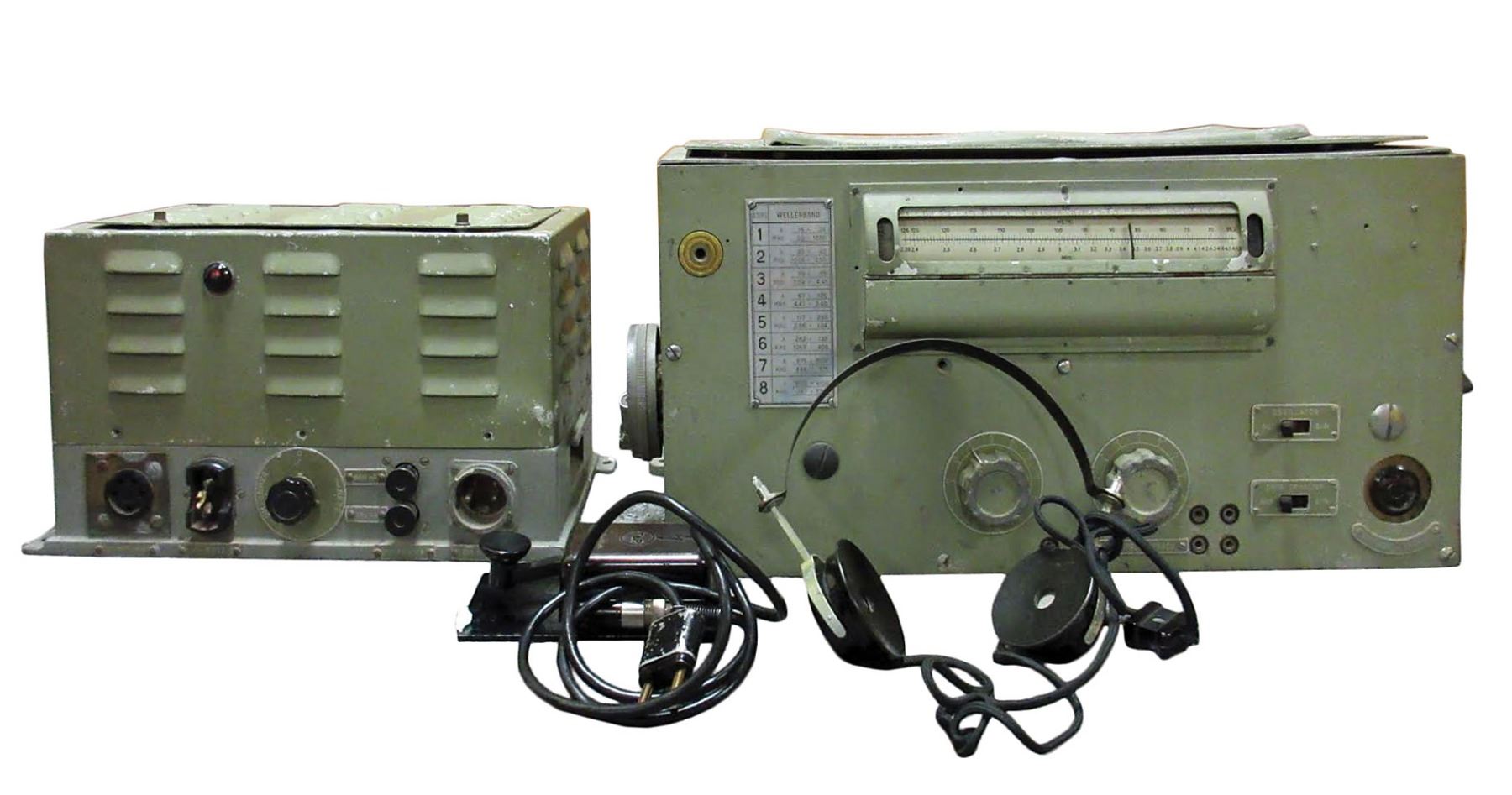
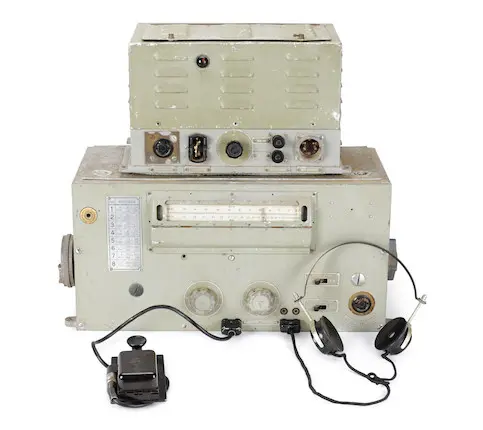
Telefunken E437S (“Brotkasten”). 1.5–25 MHz. Early/mid primary HF. The bread-box.
Telefunken T9K39 “Main” (E517S). 1.5–25 MHz. Successor primary. On XXI listed with the PV187 “Preßkohle” near-field DF adapter for 1.5–3 MHz convoy-voice peilung.
Telefunken E52 “Köln” (T8K44). 1.5–25 MHz in five bands (about 1.48–25.2 MHz). Late-war superhet, A1/A2/A3. Widely called the best small HF receiver Germany fielded. This is the set a 1944 IXC or XXI Funkmaat wanted on the main watch.
Telefunken E381S. 15 kHz–20 MHz all-wave. Backup HF, beacon watch, and VLF receive on the DF loop while the boat was shallow.
Telefunken T3PLLä38. 15–33 kHz and 70–1200 kHz. The Goliath receiver. Hauptfrequenz 16.55 kHz. Usable roughly to 15–26 m keel depth depending on water and sea. Early DF cousins: Spez 697N, E405N (navy-modified EP2).
Telefunken ELA 1012a/b and Radione R2. Broadcast / news. DF-loop antenna. Record-player jack on the ELA; could feed the boat’s announcing circuit. R2 often lived in the officers’ space as a portable.
ANTENNAS AND THE ROOM
Jump wire and telescopic HF mast for surface transmit. Retractable DF loop (Peilrahmen) starboard on later towers — bearings, beacon work, and the VLF path when dived. Power from the Funkschalttafel (AC/DC) and a ~1.5 kW transmit rotary converter in the auxiliary-machine space. The Funkmaat sat with the Enigma, the Kurzsignalbuch, the Wetterkurzschlüssel, and water-soluble key sheets. Sound room (GHG) is next door and is not radio.
KURIER — LATE BURST
From December 1943 Telefunken under Küpfmüller built Kurzzeichengeber KZG 44/2 (KZG II/44 on XXI lists): a ~30 cm drum with 85 soft-iron slugs that fired ~1 ms pulses. A seven-letter weather short signal plus preamble could leave the antenna in well under a quarter-second, frequency-offset by a secret table (~60–400 kHz). Still Enigma-encrypted first. About 30 units built; trials on roughly 19 boats from autumn 1944 (U-285, 325, 482, 864, 866 and others). Too late to replace Morse as the fleet method.
WHAT IS NOT THE FUNKRAUM CIRCUIT
FuMB Metox / Naxos / Borkum / Tunis — radar warning. FuMO Seetakt / Hohentwiel / Berlin — own radar. Enigma M4 — cipher, not a transmitter. GHG — hydrophones. Those boxes shared the boat; they did not carry BdU’s war.
HOW BDU RAN THE FLEET
Centralized command. A boat rarely sailed with a complete written operation order. BdU (first Germany, then the French Atlantic bunkers, staff work also through the Koralle station) sent the war by radio after the boat was at sea: patrol square, shift of square, convoy heading, refuel rendezvous with a XIV, “report weather,” “keep contact — do not attack yet,” pack assembly, abort, return. The boat sent back position, sinkings, remaining torpedoes and fuel, damage, and weather. In one week around convoy SC 118 (February 1943) British intercept sites logged 262 U-boat transmissions. U.S. archives hold on the order of 49,000 U-boat-related messages for the Atlantic war.
Shore broadcast was repeated on several HF waves (Amerika I/II style nets used pairs such as 5.65 / 7.65 MHz by night and higher ~10.5 / 12.2 MHz by day — examples, not a frozen list) and on VLF so a boat that had been deep could catch Tagesappell and Vortagsappell — today’s and yesterday’s traffic — when it next came to antenna depth. Goliath (Lorenz-built, ~1 MW class VLF near Calbe / Goliath site, in service spring 1943) was the “stay down and still hear Control” transmitter. Nauen and Kootwijk were older VLF/LF cousins. A boat could copy Goliath while snorkel-shallow; it still had to come up or use the mast to talk back on HF.
Traffic types, compressed on purpose:
Kurzsignale (Kurzsignalbuch). Four-letter groups for stock phrases: contact on a convoy, grid position, fuel state, “am being attacked by aircraft” (UJKZ), “am being attacked by surface craft” (ULJA), Schnorkel-bombing variants (UJVK, UJWL, UJXM…), damage and dive status. January 1945 Current Order 82 told boats to keep the transmitter warmed on the surface and at periscope depth and to fire the air-attack group the instant the bridge shouted “Aircraft,” no further permission. The book was treated as compromised after U-110 (May 1941); meeting-point methods were changed and boats were addressed by commander name instead of number.
Wetterkurzschlüssel (WKS). A whole observation packed into seven letters (example form PDFWBBU / coded strings such as MZNFPED), then Enigma, then a WW preface on the air. Ten to twenty seconds of Morse instead of a page of prose. Those groups also fed the naval weather broadcast. Capture of the WKS (U-110, later U-559) was a Hut 8 gift.
Longer FT (Funktelegramm). After the short group, or instead of it: damage narrative, new-weapon report, request for a cow, “cannot dive.” Still M4, still HF.
Wolfpack tactics only work if the first boat holds contact and BdU vectors the rest. That is a radio problem, not a periscope problem. BdU believed M4 was unbreakable in useful time and that a short HF crawl could not be DFed systematically. Both beliefs were wrong. Huff-Duff fixed the transmitter; Ultra read the text. The Funkraum was how the Navy fought — and how the boats were found.
WHY THE SUITE MATTERED
Without HF, there is no Rudeltaktik and no mid-ocean VII. Without Goliath / T3PLLä38, a snorkel boat in 1944 cannot copy orders without showing the jump wire. Without Kurzsignal and WKS, every weather and contact report is a long tune for a destroyer’s HF/DF. Kurier was the admission that Morse itself had become a weapon against the sender. The boxes in the Funkraum are therefore not “comms gear.” They are the command system of the U-boat arm — and its largest electronic signature.
STATUS
Wartime only. Surviving hardware is in museums and collections (U-505’s room is the public example; many racks are incomplete). Goliath’s concrete still exists. No navy runs this suite.
IN ONE SENTENCE
U-boat Funkraum is the Telefunken/Lorenz HF suite — 200 W T200FK39 or Spez 406, Lo40K39 spare, E52 Köln or Main receiver, T3PLLä38 for Goliath, Enigma M4 and Kurzsignal books — the centralized radio by which BdU steered the packs and by which Allied HF/DF and Ultra sank them.