WHAT IT IS
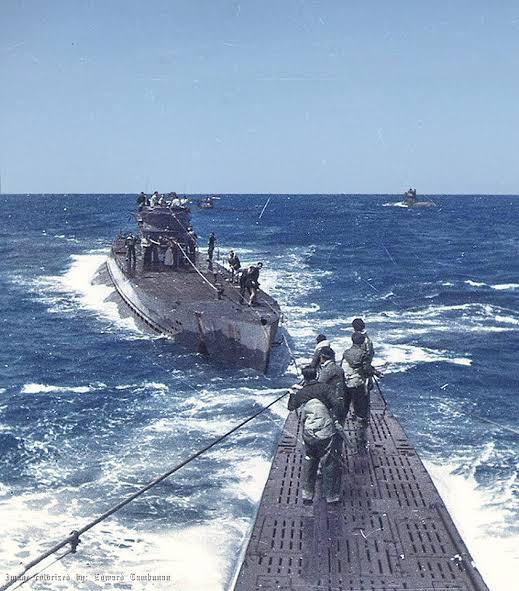
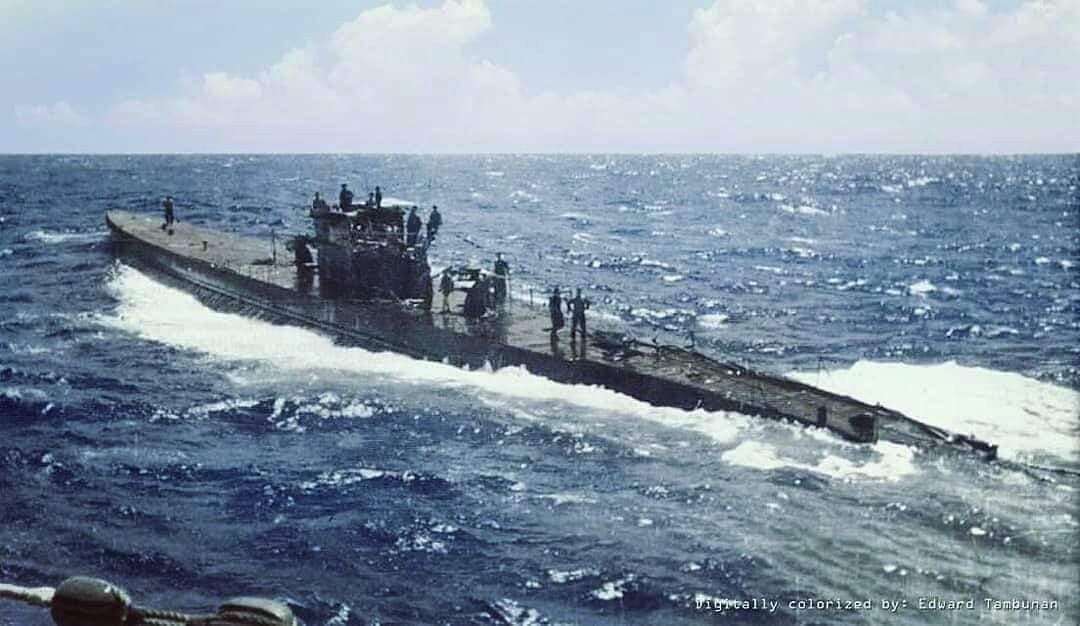
Type XIV is the Kriegsmarine’s purpose-built supply U-boat. Sailors called it the Milchkuh — milk cow. It is not an attack boat. There are no torpedo tubes. The hull is an IXD idea cut down to VII length and fattened so the casing can hold fuel, oil, food and four spare fish for other boats. Ten were commissioned: U-459–464 and U-487–490. All ten were sunk. None survive.
Displacement 1,668 t surfaced, 1,932 t submerged, about 2,300 t total. Length 67.10 m overall, pressure hull 47.5–48.5 m. Beam 9.35 m overall, 4.90 m pressure hull — much fatter than a VII or IX. Draft 6.51 m. Height 11.70 m. Crew 53–60 (six officers and about 47 enlisted on the tight card). Test depth about 240 m; the pressure hull was 21.5 mm steel instead of the usual 18.5 mm because the cargo was light oil, so the designers spent mass on depth.
HISTORY
Surface supply ships and friendly harbours became death traps in 1939–41. Dönitz asked for a 2,000 t underwater tanker so a Type VII could fight off New York or Freetown without swimming home dry. Designers shortened an IXD, widened the upper deck for hose and crate work, deleted the tubes, and kept an IX-style bridge. Deutsche Werke Kiel built U-459–464 (1940–42). Germaniawerft Kiel built U-487–490 (1941–43). First boats were in service in 1941.
They earned their keep in 1941–42: a VII topped off in mid-Atlantic could stay in the Paukenschlag area instead of burning the return trip. Allied HF/DF, centimetric radar and escort carriers then made a fat, slow, unarmed tanker on the surface a priority kill. By mid-1943 the cows were being slaughtered as they rendezvoused. Dönitz cancelled the follow-on Type XX transport. All ten XIV were gone before the war ended. Crew loss on the type is usually put near 289 of roughly 530–576 men who served in them.
HOW THEY WERE BUILT
Two Kiel yards, ten hulls, shared VIIC machinery pieces and an IX tower. No bow or stern rooms for tubes — that volume is tankage and stores. Outer casing is a working deck: fuel hoses, oil, crates, a small bakery, refrigerated lockers. Four G7 torpedoes rode in external below-deck canisters for issue to combat boats, not for the cow to shoot. Diving and turning were poor. The boat was a warehouse that could submerge.
ENGINES AND PERFORMANCE
Two shafts. Diesels 2,800–3,200 hp combined. Electrics about 750 hp. Surface 14.4–14.9 kn. Submerged 6.2 kn. Range 12,350 nmi at 10 kn surfaced (about 9,300 nmi at 12 kn on some cards), 55 nmi at 4 kn dived. That is enough to reach a mid-ocean square, feed several VIIs or an IX, and come home — if the boat is allowed to stay up long enough to pump.
WHAT IT CARRIED
Cards do not all print the same tons. Wikipedia-class figures: about 613 t of fuel oil for other boats, 13 t of lubricating oil, four spare torpedoes. German handbook figures often cited in U-boat lexica: about 432 t fuel, 45 t provisions, four torpedoes. Either way the payload is diesel, oil, bread, canned food and a handful of fish — not a combat load. A bakery on board was the luxury item: fresh bread for a VII crew that had been on tins for a month.
Transfer was a surfaced, daylight or dusk evolution: boats lashed or kept station, hoses across, crates by hand and boom. It was slow and loud. After 1943 it was usually the last thing those crews did.
WEAPONS
None offensive. Flak only: typically two 3.7 cm SK C/30 (forward and aft of the tower on many fits) and one 2 cm C/30 on the after platform; some descriptions swap counts. No 10.5 cm gun, no tubes, no mines. The four canister torpedoes were cargo.
CREW LIFE
Same steel tube as any U-boat, plus the knowledge that every combat boat in the grid wanted a meeting and every Allied aircraft wanted that meeting. The cow had to stay up to work. There was no shot to fire back except Flak. Patrols were not “easy tanker duty.” After the first year they were suicide with a bakery.
HOW IT DIFFERS FROM VII, IX AND IXD
VII: hunter, 67 m long and thin, 14 torpedoes, needs a cow to stay west. IXC: hunter, 76.8 m, 22 fish, long legs of its own. IXD2: hunter-transport, 87.6 m, 24 fish, 31,500 nmi. XIV: 67 m long and 9.35 m wide, zero tubes, 12,350 nmi, exists to feed the other three. Type XX would have been a larger transport; it was never built.
USE CASE
Force multiplier for distant Type VII and IX patrols in 1941–42. Once radar and air closed the rendezvous, the type had no second job. A milch cow that dived well still could not refuel anyone while dived.
STATUS
Ten built, ten sunk, 1941–44. No museum XIV.
IN ONE SENTENCE
Type XIV Milchkuh is the ten-boat, 67 m × 9.35 m unarmed tanker U-boat — 1,668 t on the surface, 12,350 nmi at 10 kn, hundreds of tons of oil and four spare torpedoes for other boats — the mid-ocean cow that made Paukenschlag possible and that Allied air and radar wiped out in 1943.