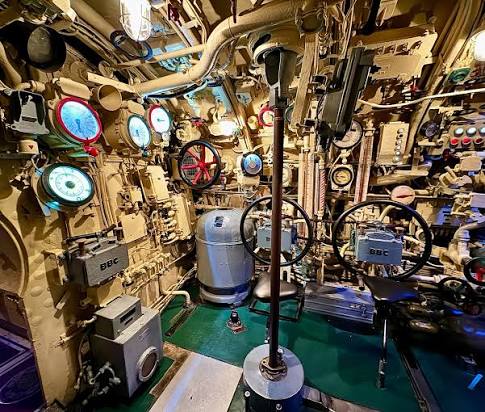
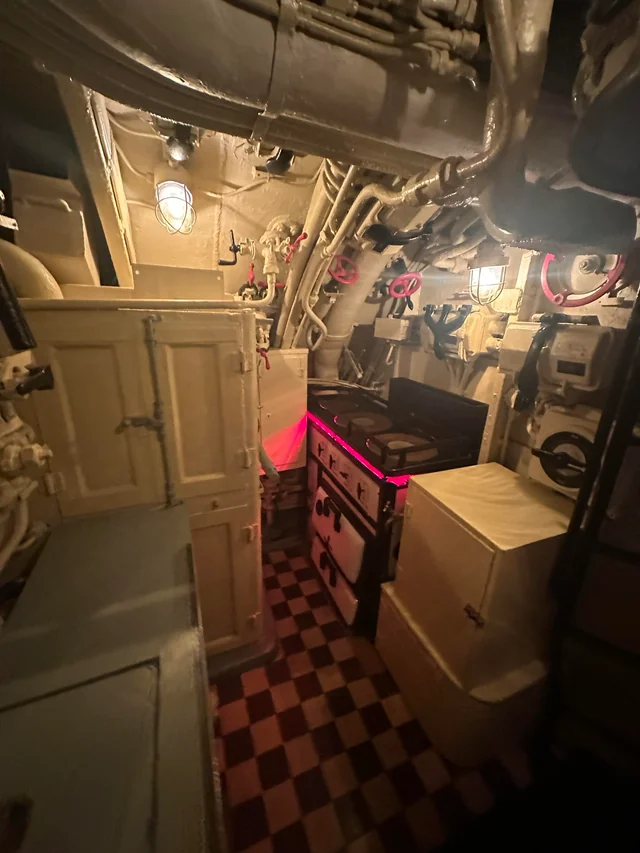
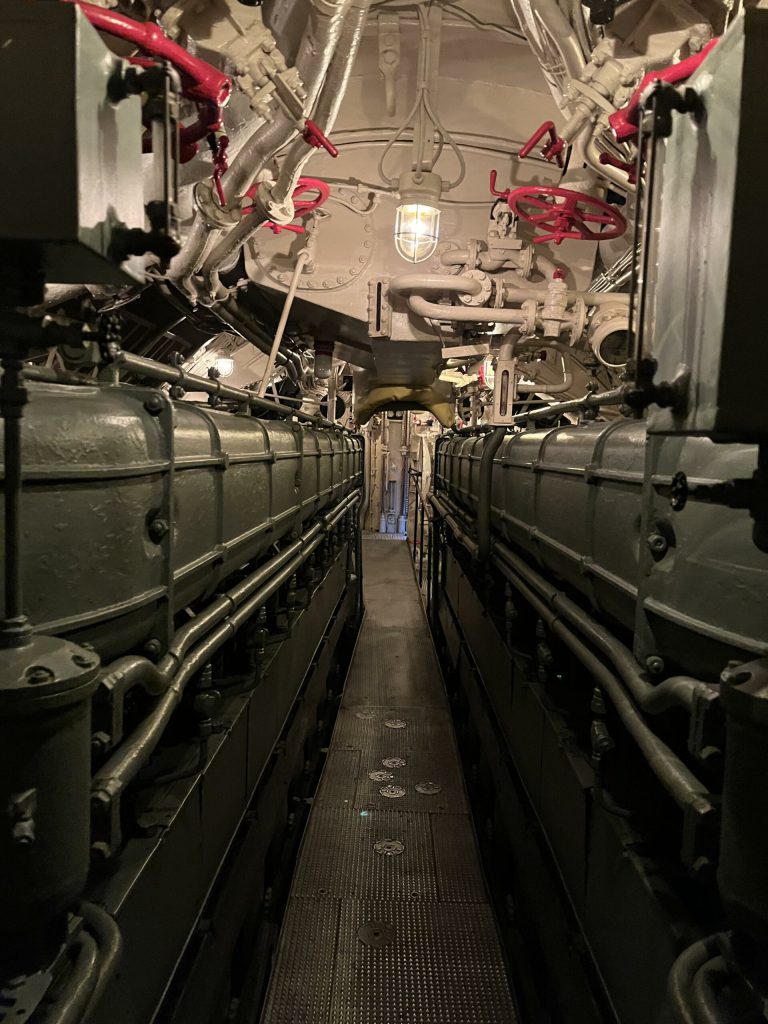
WHAT IT IS
Type IXC is the main production mark of Germany’s ocean U-boat. It is a twin-shaft, double-hull diesel-electric cruiser built to reach the American seaboard, the Caribbean, West Africa and, with a milch-cow refill, the Indian Ocean. Fifty-four were commissioned. The near-twin IXC/40 added eighty-seven more. Together they are the long-range half of the Battle of the Atlantic. Type VII was the North Atlantic pack boat. IXC was the distant raider.
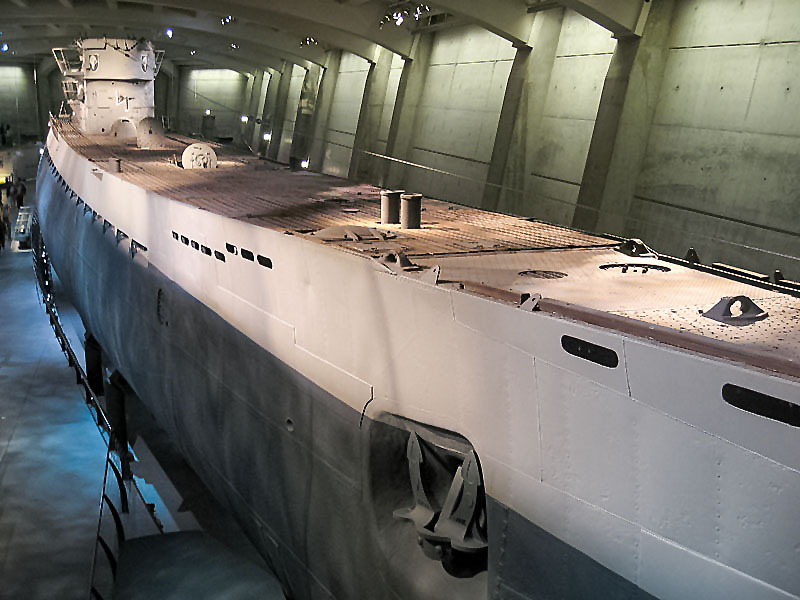
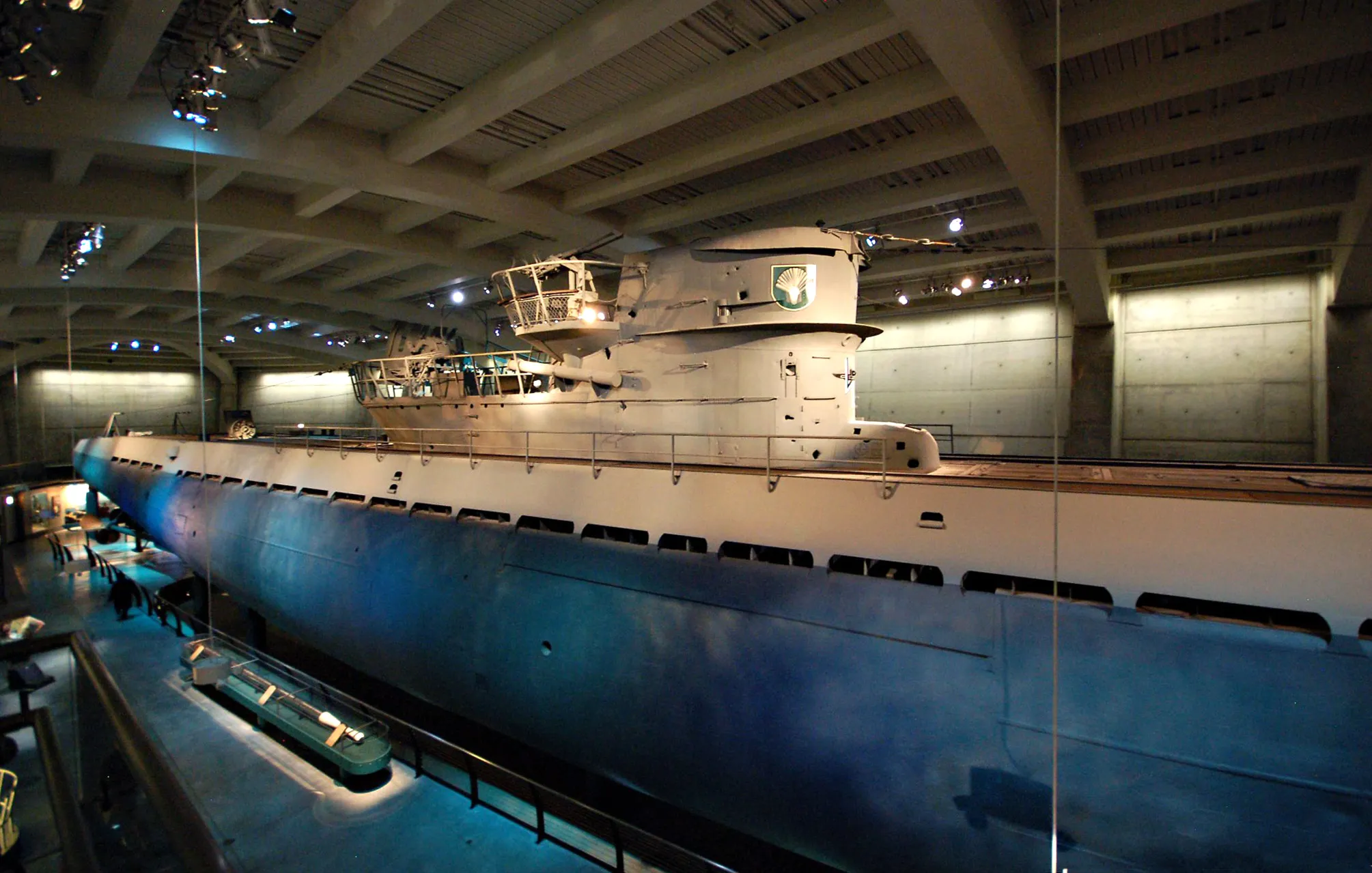
Displacement about 1,120 t surfaced, 1,232 t submerged, 1,540 t total. Length 76.76 m overall, pressure hull 58.75 m. Beam 6.76 m overall, 4.40 m pressure hull. Draft 4.70 m. Height 9.40 m. Crew 48–56. Test / design depth on the order of 200–230 m. Surviving museum hull: U-505 in Chicago.
HISTORY
Type I was too few. Type VII owned the Western Approaches. Dönitz still needed a boat that could stay on station off Freetown, Recife or New York without a Type XIV tanker. Type IXA (eight boats, 1937–39) set the two-shaft cruiser layout. IXB (fourteen) added fuel. IXC took another ~43 t of oil in the saddle tanks between pressure hull and outer casing and dropped the control-room periscope, leaving two tower scopes. Range jumped to about 13,450 nmi at 10 kn surfaced on the uboat.net card (other tables quote ~11,000 nmi at 12 kn — same boat, different speed point).
IXCs were laid 1939–42 and commissioned into 1942. They opened Operation Paukenschlag off the U.S. East Coast in early 1942, worked the Caribbean and Gulf, sank independently in the South Atlantic, and later ran to Penang and Japan as combat and transport boats. Laconia (U-156) and the capture of U-505 are the public names. From 1943 most lost the 10.5 cm deck gun, grew Flak platforms, and some received Schnorchel. After mid-1943 an IXC on the surface in the Bay of Biscay was a target, not a hunter.
HOW THEY WERE BUILT
Unlike Type VII, which came from many yards, all Type IX hulls came from three: AG Weser (Bremen), Deutsche Werft (Hamburg), and Deschimag / Seebeckwerft (Bremen–Bremerhaven). IXC blocks included U-66–68, U-125–131, U-153–166, U-171–176, U-501–524. Riveted and welded pressure hull of circular sections, outer casing for tanks and free-flooding spaces, saddle fuel tanks that are the whole point of the C mark. Building time was longer and cost higher than a VIIC. That is why the Atlantic never filled with IXs the way it filled with VIIs.
ENGINES AND MOTORS
Direct-drive, two shafts. Each shaft: one nine-cylinder MAN diesel clutched to a main motor clutched to the screw. Surface rating about 4,400 hp combined (roughly 2,170 hp per MAN on U.S. postwar surveys). Each main motor about 500 hp as a motor, ~710 hp as a generator. Battery: two groups of 62 cells (124 total) sized for the one-hour submerged rating of both motors. Design surface speed 18.3 kn (some plant notes say a 19 kn sustained target). Submerged 7.3 kn for one hour. Submerged endurance about 63 nmi at 4 kn. Charge time on the order of seven hours. One-shaft charge while the other diesel pushed gave about 13.5 kn.
This is not a Walter boat and not an Elektroboot. Surfaced it is a diesel ship. Dived it is a battery boat with a few hours of useful speed. Schnorchel, when fitted late, let the diesels breathe at periscope depth — noisy, and still not XXI underwater performance.
WEAPONS
Six 53.3 cm tubes: four bow, two stern. Twenty-two torpedoes — six in the tubes, the rest in the bow and stern rooms and under the deck plates. Mix of steam G7a and electric G7e, later T5 Zaunkönig acoustic tails against escorts. Mine load when the boat was fitted for it: 44 TMA or 66 TMB in place of some fish. U-162–170 and U-505–550 (35 boats) were not fitted as minelayers.
Deck gun: 10.5 cm SK C/32 Utof L/45, 110 rounds — used on independent distant patrols in 1940–42, then landed as aircraft made the casing a death trap. Light Flak started as 3.7 cm and 2 cm; later boats and rebuilds stacked more 2 cm and 3.7 cm on enlarged Wintergarten platforms. No homing missile, no ballistic rocket. The weapon was the torpedo and the patrol endurance to place it.
CREW LIFE
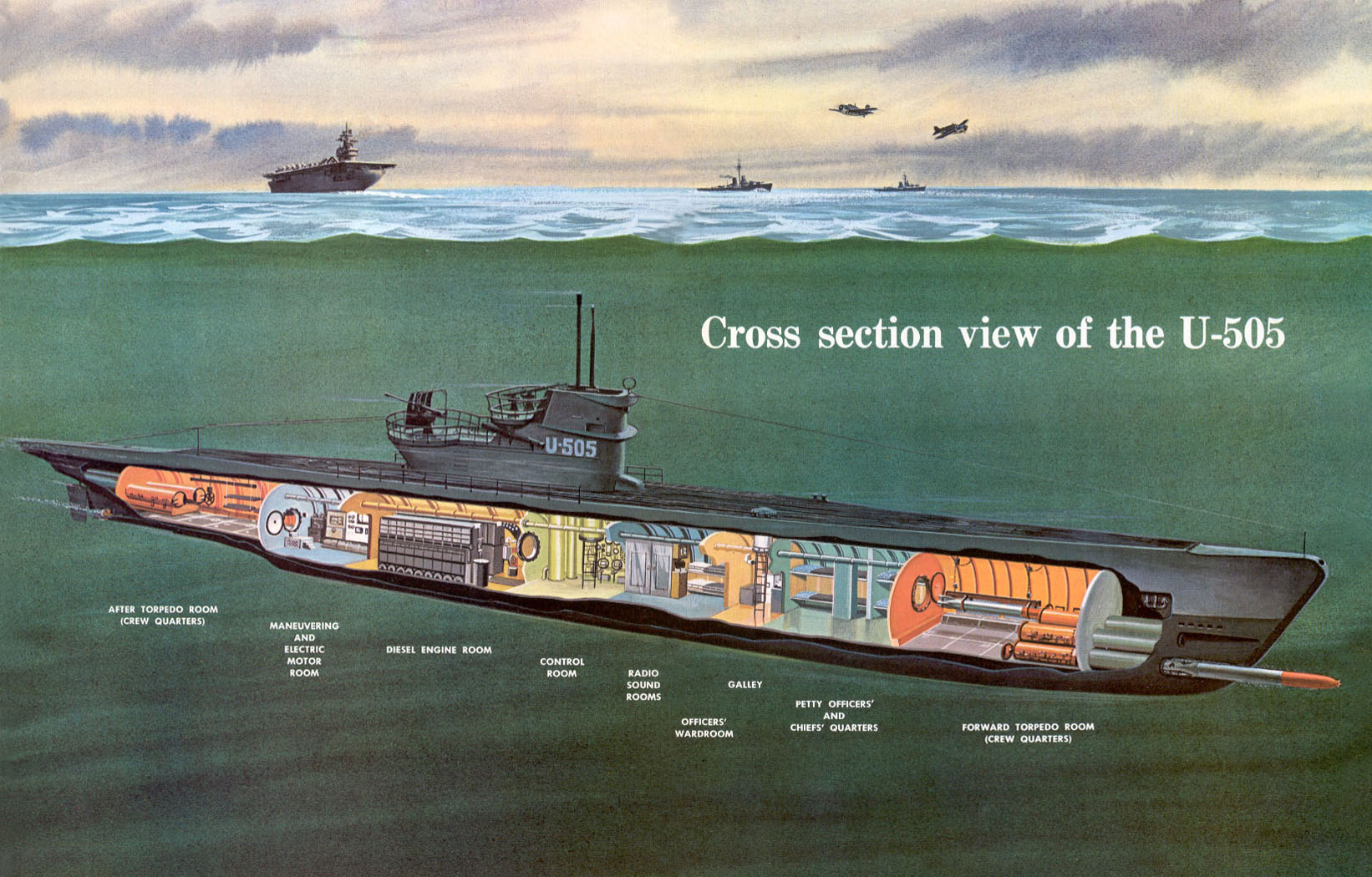
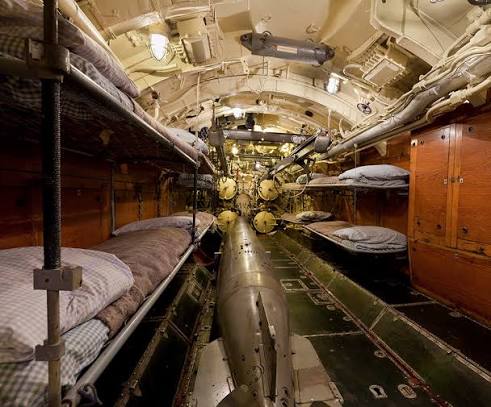
Forty-eight to fifty-six men in a 4.4 m pressure hull for twelve to sixteen weeks. Hot bunking, diesel stink, condensation, canned food after the fresh stores went in the first fortnight. The IX was roomier than a VII — two more tubes aft, more tankage, a slightly less crushed control-room — but it was still a steel tube. Officers in the bow: commander, IWO, IIWO, LI (chief engineer). Radio and hydrophone shack amidships. Petty officers and seamen packed around the E-motors and the stern tubes. Heads and galley were compromises. In the tropics the boat was an oven; in the North Atlantic the casing iced. Patrol rhythm: surface at night to charge and make miles, dive on aircraft or escorts. After 1943 the surface hours shrank and the crew lived on the motors and, if fitted, the snorkel.
HOW IXC DIFFERS FROM THE OTHER BOATS
Type VII / VIIC. The VII is shorter (~67 m), lighter (~769 t surfaced), cheaper, quicker to dive, tighter turning, five tubes (four bow, one stern), 14 torpedoes. Range ~8,500 nmi at 10 kn — enough for the Western Approaches, thin for the Caribbean without a cow. VII is the wolfpack boat. IXC is the lone long-haul boat: six tubes, 22 fish, ~13,000 nmi class range, slower dive, bigger silhouette on radar.
IXA / IXB. Same family. IXA ~8,100 nmi at 12 kn, 1,032/1,153 t, three periscopes including a control-room scope. IXB more fuel (~165 t vs 154), ~8,700–12,000 nmi depending on the table. IXC is the fuel stretch (~208 t, +43 t over B) and the two-scope tower.
IXC/40. Same length, beam up a few centimetres, fuel ~214 t, range ~13,850 nmi / 10 kn, surface speed card 19 kn, total displacement ~1,545 t. Eighty-seven boats. From outside, a modeller cannot tell C from C/40.
IXD1 / IXD2. Ten metres longer (~87.6 m), 1,600 t class, range out to ~23,700 nmi. D1 tried Daimler-Benz MB 501 high-speed diesels and cooked itself; most were converted back. D2 is the Far East / Monsun combat-transport. Different ship.
XIV milch cow, XB minelayer, XXI Elektroboot. XIV fuels the IX; it does not fight. XB is a mine bunker. XXI is a battery-heavy submerged boat that the IXC is not — higher underwater speed and endurance, no deck-gun war, too late to replace the C-boats in numbers.
USE CASE
Independent patrols against independently routed shipping on distant stations; occasional pack work when an IX was in the same grid as VIIs; minelaying on boats wired for TMA/TMB; late-war transport runs to the Indian Ocean. Strength is fuel and spare torpedoes. Weakness is dive time, size on 10 cm radar, and a submerged battery that is still 1930s. Against a 1944 escort group with HF/DF, radar and hedgehog, an IXC that stayed up to use the deck gun was already lost.
STATUS
All wartime. Most of the 54 IXCs were sunk. U-505 is the intact exhibit. IXC/40 wrecks (U-534 and others) are separate marks. No navy still operates the type.
IN ONE SENTENCE
Type IXC is the 76.8 m, 1,120 t, two-MAN ocean U-boat with six tubes, 22 torpedoes and ~13,450 nmi at 10 kn — the fifty-four-boat fuel stretch of IXB that fought off America and Africa while the Type VII held the North Atlantic, and the hull U-505 still is.