WHAT IT IS
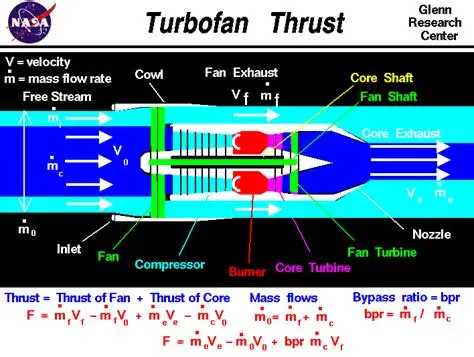
Bypass ratio (BPR) is the mass of air that goes around the core divided by the mass of air that goes through the core. Write it BPR = m_dot_bypass / m_dot_core. A 4.5:1 engine sends 4.5 kilograms of cold fan air aft for every kilogram that is compressed, burned, and shoved through the turbines. That cold stream is most of the thrust on a modern airliner fan. The hot jet is mostly there to spin the fan.
A turbojet has BPR = 0. Everything goes through the fire. A low-bypass fighter fan is ~0.3–1. A Tu-154M D-30KU-154 sits around 2.4–2.5. A PS-90A sits around 4.4–4.5. A PD-14 is drawn at ~8. A geared PW1100G is 12. Those numbers are why those engines sound different, drink different, and need different cowls.
TWO STREAMS
A turbofan splits the inlet. The inner stream is the gas generator: compressor, burner, turbines. The outer stream is the bypass duct. The low-pressure turbine takes energy out of the core gas and spends it on a big fan. The fan raises the pressure of a lot of air a little. That is a more efficient way to make cruise thrust than blasting a small mass of air to a very high velocity — propulsive efficiency. The waste heat and the scream live in the core jet. Dilute it with cold fan air and both fall.
Mixed-flow engines (D-30KU, many PS-90 installs) dump both streams into one nozzle. Separate-flow engines keep a cold annulus and a hot bullet. The physics of BPR does not care which ducting you chose. The cowling diameter does: high BPR means a fat fan.
WHY HIGHER IS USUALLY BETTER — AND WHEN IT IS NOT
At airliner Mach (0.78–0.85) you want a large mass at modest jet velocity. Raise BPR and cruise TSFC drops, community noise drops, and takeoff noise drops. That is the entire civil-engine story from JT8D to LEAP.
The bill: a bigger fan is heavier, draggy, and wants a slower shaft. The LP turbine has to extract more work. Ground clearance becomes a 737-MAX problem. At high Mach or high altitude the fat fan is a liability — fighters and Concorde stayed low-bypass or zero-bypass because a huge fan chokes and drags when the flight is a rocket. Afterburners live on the core. High BPR and reheat do not date.
There is also a core-size floor. If you keep takeoff thrust fixed and raise BPR, the core shrinks. Small cores are hard to make efficient and hard to keep cool. That is why a 16-ton PS-90 at BPR 4.5 and a 14-ton PD-14 at BPR 8 are different machines, not a PS-90 with a bigger hat.
THE LADDER THAT MATTERS HERE
Turbojet — BPR 0 — early jets, Concorde Olympus in cruise logic.
Low bypass ~0.3–1 — fighters (F101 ~2.1 is already “leaky turbojet” language), some business jets.
Medium / “third generation” ~2–3 — D-30KU-154 ~2.5, D-30KP ~2.2. Tu-154M, Il-62M, classic Il-76. This is the sound of a 1970s Soviet ramp: still a lot of hot jet, Chapter 2/3 fight.
High bypass ~4–6 — PS-90A ~4.5, CFM56 ~5–6.6, SaM146 ~4.4. Tu-204, Il-96, 737 Classic/NG, first Superjet. The 1990s civil standard. Stage 3 became possible without a hush kit the size of a truck.
Very high bypass ~8–12 — PD-14 ~7–8.6 on the brochure, GEnx/Trent/GE90 ~8–11, LEAP ~9–11, PW GTF ~9–12.5. MC-21’s reason to exist, 787/A350/A320neo world. Geared fans exist because a 3-metre fan does not want to spin at turbine rpm.
FUEL: THE NUMBER YOU ACTUALLY BUY
TSFC (thrust-specific fuel consumption) is kilograms of fuel per hour per kilogram of thrust — or lb/lbf·h in Western sheets. Same idea.
D-30KU-154 cruise TSFC ~0.70 kg/kgf·h D-30KP-2 ~0.72 PS-90A ~0.595 PD-14 brochure ~0.53 CFM56-5 / LEAP sit in the mid-0.5s and below on modern cards
That is why a Tu-154B burned ~6,000+ kg/h and a Tu-204 with two PS-90s was sold at ~3,200 kg/h. Bypass is not the only reason (OPR and TIT moved too) but it is the visible one. Rostec’s own generation talk: PS-90A doubled D-30KU bypass, nearly doubled compressor ratio, raised turbine temperature ~200 K, cut cruise SFC ~15%.
NOISE AND THE FAN FACE
Jet noise scales brutally with exhaust velocity. High BPR lowers that velocity for a given thrust. Fan noise and buzz-saw then take over — which is why liners, chevrons, and lower tip Mach matter on a LEAP and why a D-30 still sounds like a blowtorch. ICAO Chapter 2 vs 3 vs 4 is largely a bypass-and-liner story on these types.
Fan diameter is the photograph of BPR. D-30KU fan ~1.46 m. PS-90A fan 1.90 m. PD-14 fan ~1.90 m class but much more of the flow is bypass, so the core is slimmer. PW GTF fans are dinner plates. The 737 had to grow legs because BPR 9 does not fit a 1960s pylon height.
GEARED VERSUS DIRECT
On a conventional two-spool (PS-90, CFM56) the fan and the LP turbine share a shaft. Raise BPR, the fan wants to slow down, the turbine wants to speed up. Compromise. A gearbox (PW GTF) lets each run at its own rpm. Russia’s PD-14 stayed ungeared; PD-8 likewise. That is a design choice, not a moral one. Gears buy BPR. They also buy a gearbox.
FOUR ENGINES AND BYPASS
An Il-96 with four PS-90As at BPR 4.5 can still lose a twin A330 on fuel, because four medium fans are four cores to feed. Bypass did not save the four-holer. Twins plus ETOPS did. The Il-76MD-90A derates the same family to 14,500 kgf (A-76) so a high-bypass fan can live on a 1970s transport without rewriting the wing. Same BPR idea, different rating.
HOW TO READ A SPEC CARD
BPR is a design point, usually takeoff or a stated cruise. It moves a little with throttle and altitude. Do not treat 4.5 and 5.4 on two PS-90 tables as a fight — sheets disagree. Pair BPR with OPR (overall pressure ratio) and TIT (turbine inlet temperature). All three rose together from D-30 to PS-90 to PD-14. BPR alone is the diameter. The other two are the fire.
IN ONE SENTENCE
Bypass ratio is how many kilos of cold fan air you send aft for each kilo through the burner — the number that turned the D-30’s 2.4 into the PS-90’s 4.5 and the PD-14’s 8, cut the fuel bill, fattened the cowl, and is why a Superjet does not sound like a Tu-154.