WHAT IT IS
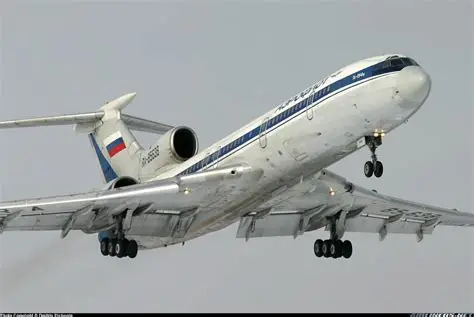
The Tu-154 is the Soviet Union’s standard medium-range jet airliner of the 1970s–90s: a low-wing, T-tail, rear-engined trijet for 152–180 passengers. OKB Tupolev designed it to replace the Tu-104 on domestic trunk routes and to do the job the Boeing 727 did in the West — fast, six-abreast, able to use mid-length concrete. NATO reporting name is Careless.
Three engines sit at the tail: two in pods, one in the fuselage with an S-duct intake in the fin root. That layout keeps the wing clean, cuts cabin noise from the fans, and keeps the airplane flyable if one engine dies. It also puts a lot of weight aft and makes a hot, busy tail. First flight 3 October 1968 (some Western lists print the 4th). Aeroflot passenger service 9 February 1972 after mail flights in 1971. Built at Kuibyshev / Samara (Aviakor) from 1970 until airframe 998 in February 2013. Totals in print run 923 (Russian Wikipedia) to about 1,025–1,026 (English tallies). Tupolev’s own archived page said 930. Use “about a thousand” unless you are counting a specific factory log.
It was the workhorse of Aeroflot and of every Comecon and client-state airline that bought Soviet. By the late 2000s Russian airlines had mostly parked it for noise, fuel, and Chapter 3/4 airports. What still flies in 2026 is military, government, and a handful of holdouts (Air Koryo among them).
WHY THREE ENGINES AT THE BACK
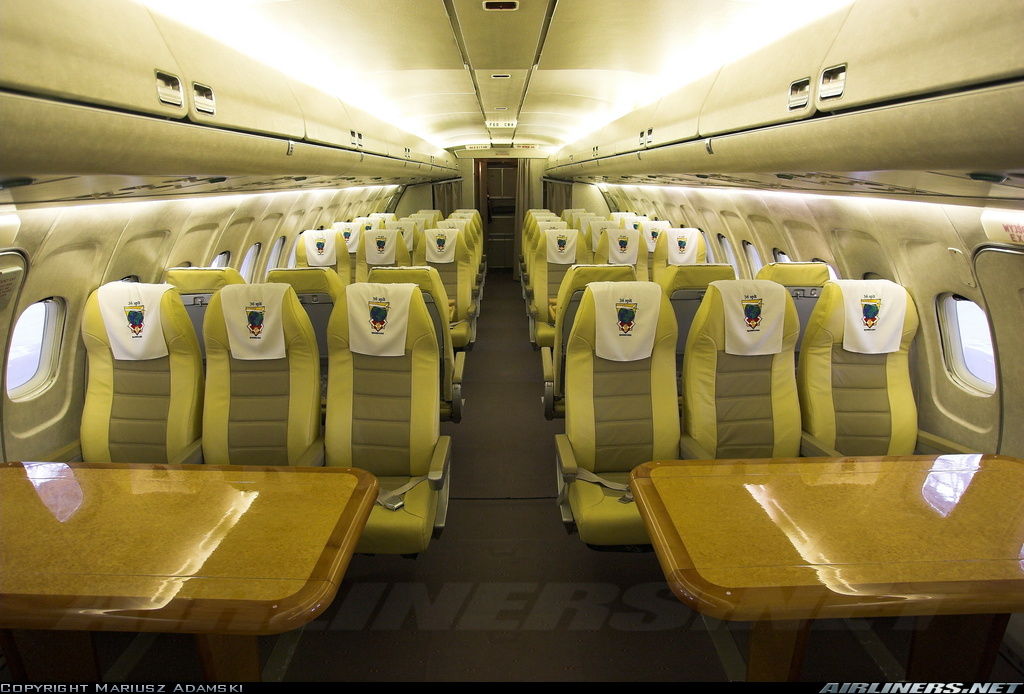
1960s medium-haul jets split two ways: two big fans on the wing (later 737/A320 world) or three at the tail (727, Trident, Tu-154). Soviet runways, winter, and engine reliability of the NK-8 generation argued for three. One dead still leaves two. The clean wing takes slats and triple-slotted flaps for short-field work. The T-tail keeps the stabilizer out of the wing wash — and gives a deep stall to respect. Fuselage diameter 3.8 m, cabin ~3.58 m, six-abreast economy.
Chief designer path: Tupolev bureau; project lead later Aleksandr Shengardt for the M. Engines: Kuznetsov NK-8-2 / NK-8-2U on A/B; Soloviev (Aviadvigatel) D-30KU-154 / D-30KU-154-II on M.
AIRFRAME
Length ~47.9–48.0 m. Span 37.55 m. Height 11.4 m. Wing area 201.45 m² (B) / 202 m² (M). Sweep, slats, powerful flaps. Tricycle gear, four-wheel main bogies, each bay closed by a door and two pairs of doors. Fuel ~39.75 t in wing and centre tanks (A added centre-section tanks). Max payload 18 t on both main marks. Empty ~51–52 t on B, ~55 t on M. MTOW climbed from 90 t on the first 154s to 94 t (A), 98–100 t (B), 100–104 t (M, depending on brakes and a bureau permit).
Crew: five on B (two pilots, navigator, flight engineer, plus radio on early sets) and three on M once the Jasmine nav suite and ABSU-154-3 took the extra seats. Cabin 164–180 one-class; mixed layouts down to ~114–158.
ENGINES
NK-8-2 — original. ~9,300–10,500 kgf class depending on dash. Noisy, thirsty, Chapter 2.
NK-8-2U — A/B standard. 3 × 10.5 t takeoff. Higher bypass than the first NK-8-2. Still the sound of a 1970s Aeroflot ramp.
D-30KU-154-II — M standard. 3 × 11 t. Same family as the Il-62M’s D-30KU, tuned for the trijet. Fuel burn drops ~15–20% versus B in bureau tables (40.0 g per passenger-km on B, 31.05 on M; hourly ~6,200 kg vs ~5,400 kg in one Russian sheet, ~6,500 vs ~5,500 in another). Noise to ICAO Chapter 3. That engine is why the M lasted into the 2000s and why a twin PS-90 “Tu-154M-2” was drawn and never built — two modern fans would have been the real next step and the money went elsewhere.
B VERSUS M (BUREAU CARD)
Crew 5 / 3 Engines NK-8-2U 3×10.5 t / D-30KU-154 3×11 t MTOW 98–100 t / 100–104 t Payload 18 t / 18 t Seats 164–180 / 164–175 Cruise 900 km/h / 935 km/h Ceiling 12,300 m / 12,100 m Range with 18 t 2,650 km / 3,900 km Range with 14.5 / 12 t 3,400 / 5,200 km Max fuel range — / 6,500 km TO run 2,200 m / 2,500 m Fuel 39.75 t both
Max speed ~950 km/h on B, ~935 on M. Mmo about 0.86–0.88. Practical ceiling ~12,100 m. These are handbook numbers; winter, derate, and short strips change them.
VARIANTS
Tu-154 — first series, NK-8-2, 164 seats, MTOW ~90 t. ~42–49 built. Wings later replaced to the strengthened standard.
Tu-154A — 1974. NK-8-2U, centre fuel, extra exits, better wing when rebuilt. MTOW 94 t. ~63 new. First real production shape.
Tu-154B — late 1975. Stronger wing, more fuel in the fuselage, tail exits, MTOW 98 t, ABSU-154-2 autoland ICAO Cat II. ~105 new; almost all earlier 154/A brought up to B. Chapter 2 noise.
Tu-154B-1 / B-2 — B-2 is the numerous late B: up to 180 seats if you pull the galley, 311 B-2s in one Western count. Same five-crew cockpit.
Tu-154S / T — freighter conversions of B airframes. Side cargo door. About nine S conversions in English lists.
Tu-154M (drawn as Tu-164). Deep B-2 rebuild: D-30KU-154, cleaner wing and stab, Jasmine / I-21 INS and ABSU-154-3, Cat IIIA autoland on later fits, three-crew. First flight often given 1982; Tupolev says first production M 16 July 1984; series from 1986; mass build to 1998 then trickle to 2013. ~320–325 Ms, of which 98 exported in Tupolev’s tally of 166 export 154s of all marks. Chapter 3. Last passenger sub-type Tu-154M-100 at 104 t.
Tu-154M2 — two PS-90A, paper only.
Tu-155 / Tu-156 — cryogenic testbeds. One 154 airframe with a hydrogen (and later LNG) engine in the starboard pod. Not an airline variant.
Military and special: VIP, Open Skies / reconnaissance conversions, Russian Aerospace Forces transports, PLAAF examples. Same airframe, different insides.
SYSTEMS
B fleet: electromechanical instruments, ABSU-154-2. M: Jasmine flight-nav complex, later GPS/GLONASS, TCAS, TAWS, modern radio altimeters on upgraded ships. Hydraulic flying controls. APU in the tail. The airplane was certified for bad weather by the standards of its decade; Cat II on B, Cat IIIA advertised on late M. Life on M in one Russian note: 30,000 hours or 20 years — paper life, not a promise every hull got there.
HOW IT WAS USED
Aeroflot’s medium trunk: Moscow to the union republics, Siberia, Black Sea, East Europe. Export to LOT, Malev, Balkan, CSA, Interflug, CAAC, Cubana, Syrianair, Iran, North Korea, and a long list of post-Soviet startups. 166 airframes abroad in Tupolev’s count. After 1991 the type scattered into dozens of small airlines, then shrank as EU noise rules and cheap 737/A320 hours arrived. Iran kept Ms running longer than most. Air Koryo still puts them on the timetable.
Russian civil passenger service effectively ended in the 2010s for scheduled work. Rossiya Special Flight Detachment and the VKS kept airframes for government and military lift. Chinese air force examples remain in public orders of battle.
WHAT WENT WRONG — SHORT
The type flew millions of hours and also filled accident reports: weather, crew, maintenance after the USSR broke, a few design-era issues (T-tail stall discipline, tail-engine fire, runway performance on hot/high or contaminated strips). Famous hull losses are public record (Smolensk 2010 is the political one; Sochi 1981, Irkutsk, and others sit in the safety boards). This page is the airplane, not the court. The hull is strong; the 1990s industry around it was not always.
COMPARED WITH THE 727
Same idea, different factories. 727 is lighter on the engines and won the world market. Tu-154 is heavier, faster in cruise on paper, built for Aeroflot’s network and Soviet concrete, and stayed a trijet after Boeing had already moved on to twins. Fuel and noise, not wingspan, retired it from Europe.
STATUS
Out of production since 2013. Limited service: Russian Aerospace Forces (largest remaining fleet in recent Russian lists), Rossiya SLO, PLAAF, Air Koryo, and odd government hulls (Kazakhstan listed in one 2026 dump). Civil airline use is a remnant. Airframes sit as monuments at museums (Kyiv’s 85020 among them) and as parts donors. The sound of three D-30s at the fence is now a military or Pyongyang noise, not a Domodedovo noon departure.
IN ONE SENTENCE
The Tu-154 is Tupolev’s thousand-ship medium trijet — NK-8 then D-30KU in the tail, 164–180 seats, Samara-built from 1970 to 2013 — that did for Aeroflot what the 727 did for the West and now flies only where Chapter 4 and cheap twins never arrived.