WHAT A SPOOL IS
A spool is one compressor (or fan) mechanically locked to the turbine that drives it, on one shaft, spinning as one rigid rotor. Air goes through the compressor. Fuel burns. Hot gas hits the turbine. The turbine turns the shaft. The shaft turns the compressor. That closed mechanical loop is the spool.
A single-spool turbojet is the oldest layout: one compressor, one turbine, one shaft. A two-spool engine splits that work onto two concentric shafts — a high-pressure (HP) core spool inside, a low-pressure (LP) spool outside that usually carries the fan. A three-spool engine adds a third concentric shaft and a third turbine so the intermediate-pressure (IP) compressor can run at its own speed, not slaved to the fan and not slaved to the HP core.
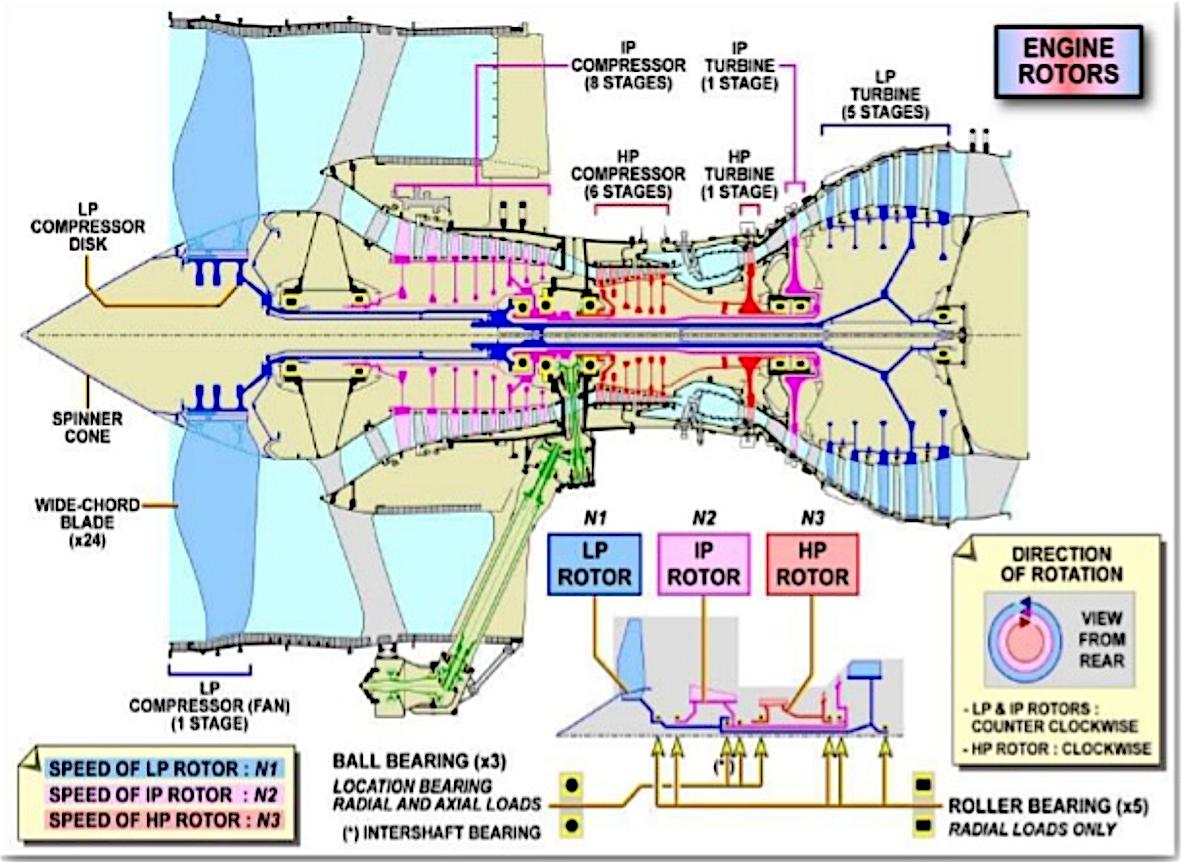
The shafts nest: LP is the long inner shaft from the rear low-pressure turbine forward to the fan; IP is a hollow shaft around it; HP is the short, fat outer core shaft. They do not touch. Each has its own bearings and its own redline.
WHY TWO SPOOLS WERE NOT ENOUGH FOR SOME DESIGNERS
A compressor blade makes pressure in proportion to how fast it moves through the air. A big-diameter fan wants to turn slowly so the blade tips stay subsonic. The small-diameter high-pressure compressor deep in the core wants to turn fast. Put fan and “booster” stages on the same LP shaft, as a two-spool engine does, and those inner booster stages are stuck at fan rpm. They are then either too slow to compress well, or you add stages, variable stators, and bleeds to keep them from stalling.
Rolls-Royce’s answer on the RB211 (late 1960s, Lockheed L-1011) was to cut the booster off the fan shaft and give it to a new IP spool driven by its own turbine. Kuznetsov did the same family of trick on the military side with NK-32 (Tu-160) and related three-shaft afterburning fans. Progress / Lotarev used it on D-36, D-436, and the giant D-18T. The Garrett ATF3 is a three-spool oddity whose third spool is not even concentric — ignore it for the standard picture.
WHAT THE AIR SEES
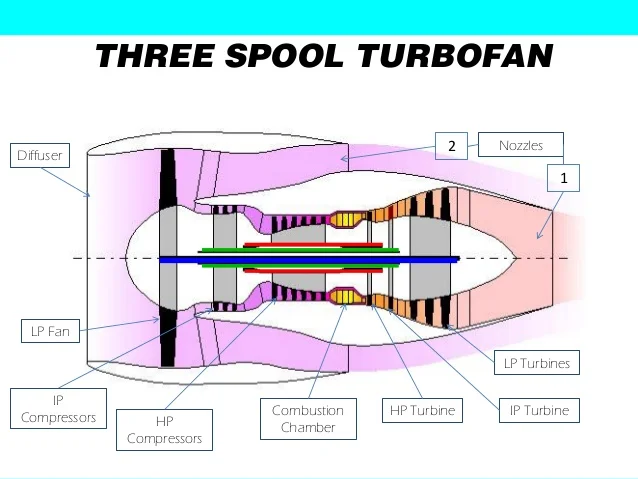
Front to back on a civil three-spool high-bypass turbofan (RB211 / Trent type):
1. Fan (LP) — huge, slow, most of the thrust is the cold bypass stream that never sees the core. 2. Intermediate-pressure compressor (IP) — several stages, medium diameter, medium rpm, raises pressure into the core. 3. High-pressure compressor (HP) — small, fast, finishes the squeeze. 4. Combustor. 5. High-pressure turbine (HPT) — usually one stage on a Trent; drives only the HP compressor. 6. Intermediate-pressure turbine (IPT) — usually one stage; drives only the IP compressor. 7. Low-pressure turbine (LPT) — several stages; drives the fan.
NK-32, covered in its own article in this database, is the same idea at low bypass with an afterburner on the back: 3-stage fan, 5-stage IP, 7-stage HP, then 1 HP + 1 IP + 2 LP turbine stages, then the common reheat pipe and variable nozzle. Bypass ratio ~1.4 instead of the 8–10+ of a Trent. The third shaft is doing the same matching job. The afterburner is extra heat after the turbines, not a fourth spool.
WHAT YOU GAIN
Each compressor runs nearer its own best speed. That means more pressure rise per stage, so fewer stages for the same overall pressure ratio. Fewer stages means a shorter, stiffer rotor. Stiffer rotors rub less, surge less, and hold their efficiency longer in service — the usual Rolls-Royce claim for why Trents deteriorate slowly. Variable geometry and bleed can be lighter because the IP and HP are not being dragged through each other’s bad speed range. Starting can be easier: the starter only has to spin the small HP spool. Thrust growth is easier: swap fan diameter and retune the LP turbine without rebuilding the whole core. That is how one RB211 architecture became a Trent family from roughly 240 kN to over 400 kN.
WHAT YOU PAY
A third shaft, a third turbine disk, a third set of bearings, seals, and oil jets. More parts. More concentricity to hold. Shop visits that need the HP module usually mean splitting the whole engine; the hot spool sits in the middle. Weight of the extra turbine is real, even if the shorter compressor buys some of it back. Two-spool makers (GE, Pratt, CFM) argue they get the same fuel burn with better materials and 3-D aerodynamics and without the third rotor. History’s score is mixed: three-spool engines are not automatically more efficient in the year they enter service; they are a different way to keep compressors matched as fans get bigger and cores get hotter.
TWO-SPOOL, THREE-SPOOL, AND “BOOSTER”
A two-spool high-bypass engine still has extra compressor stages behind the fan. Those stages ride the LP shaft and are called a booster or LPC. They do IP work at LP speed. A three-spool engine is what you get when that booster is cut free and given its own turbine. There is no fourth spool in production turbofans. Geared turbofans (PW1000G and kin) stay two-spool and put a gearbox between fan and LP turbine so the fan can turn even slower than the LPT — a different answer to the same tip-speed problem.
N1, N2, N3
Cockpit and maintenance language follows the shafts. On a three-spool engine N1 is fan / LP rpm, N2 is IP rpm, N3 is HP rpm. Example magnitudes on an old RB211-524: N1 100% around 3,900 rpm, N2 around 7,000, N3 around 10,600. Numbers change with the mark. The point is the spread: the core is spinning two to three times faster than the fan. A two-spool engine only has N1 and N2.
WHO BUILDS THEM
Civil production three-spool large fans are a Rolls-Royce speciality: RB211 then Trent 500 / 700 / 800 / 900 / 1000 / XWB / 7000. Soviet / Ukrainian / Russian three-spool cores include Lotarev / Progress D-36, D-436, D-18T (An-124 / An-225) and Kuznetsov NK-32 / NK-25-adjacent military fans. Most American large fans stayed two-spool. That is a school-of-design split, not a national physics law.
HOW IT SITS WITH THE NK-32 PAGE
NK-32 is a three-spool engine used as a low-bypass afterburning combat motor. The third shaft is why a 1.4-bypass fan can still post a decent subsonic cruise SFC while the HP spool screams at fighter-like rpm. The 25,000 kgf afterburner is not the three-spool trick. The three-spool trick is the matching that lets that core exist at all without a compressor the length of a freight car.
IN ONE SENTENCE
A three-spool jet engine is a turbofan with three nested shafts so the fan, the intermediate compressor, and the high-pressure core can each turn at the speed that suits them — shorter, stiffer, more parts — the architecture of the RB211/Trent family and of Kuznetsov’s NK-32.