WHAT IT IS
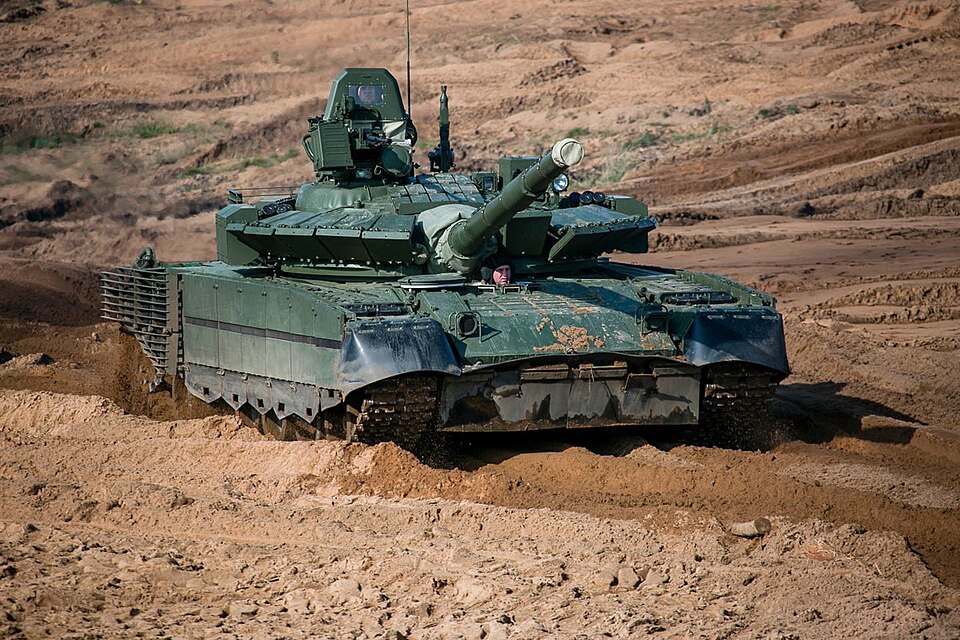
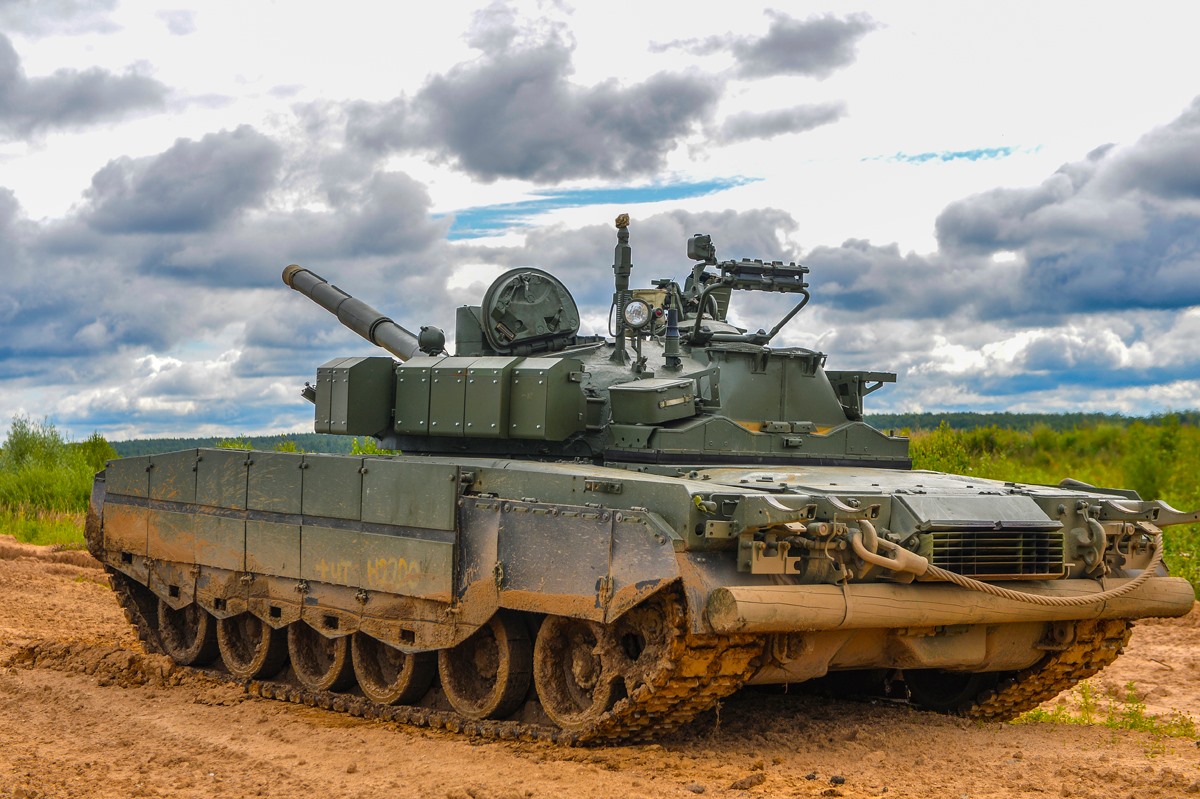
The T-80BVM is a Russian factory modernization of existing T-80BV main battle tanks. It is not a new hull family. Omsktransmash (Omsk, part of Uralvagonzavod / Rostec) takes stored or service T-80BV vehicles — the 1985 Kontakt-1 ERA version of the Leningrad gas-turbine T-80B — and rebuilds them with Relikt explosive reactive armour, a 125 mm 2A46M-4 gun, Sosna-U gunner sight, 9K119 Refleks / Refleks-M gun-launched ATGM, an upgraded GTD-1250 class turbine, and a revised autoloader that will take the longer Svinets APFSDS rounds. Crew remains three: commander, gunner, driver. Combat weight in handbook figures is about 45.7–46 t.
The point of the programme is to bring a cold-weather, high power-to-weight turbine tank up toward T-72B3 / T-90M fire-control and protection practice without designing a new vehicle. It is cheaper than Object 219M / “Bars” class deep rebuilds that never reached series. It is more expensive to run than a T-72B3. First public prototype: Army-2017. First series deliveries: 2018–2019. Operator in production intent: Russian Ground Forces and Naval Infantry. Ukraine has captured examples and has also operated its own T-80BV stock; those are not factory BVM rebuilds from Omsk.
PLACE IN THE T-80 LINE
T-80 (accepted 1976, LKZ Leningrad) is the Soviet gas-turbine MBT line that grew out of T-64 practice: compact hull, carousel autoloader, three-man crew. T-80B (1978) added the 9K112 Kobra gun missile and a better fire-control set. T-80BV (1985) added Kontakt-1 ERA. T-80U (Omsk) and T-80UD (Kharkiv diesel) are later branches, not the BVM parent. BVM is specifically a BV hull and turret brought forward. Command tanks keep the K suffix when extra radios are fitted (T-80BVK → a BVM command fit if rebuilt).
New T-80 production stopped in Russia in 2001. The BVM programme is storage regeneration plus modernization. A 2023 political announcement spoke of restarting new T-80 manufacture later in the decade; that is not the same as the current Omsk rebuild line, and it is not confirmed as series metal in open sources as of the mid-2020s.
PROTECTION
Base armour is the late-Soviet T-80B/BV package: cast / welded composite turret and laminated hull glacis. BVM replaces Kontakt-1 with Relikt third-generation ERA on glacis, turret face, and side screens. Relikt is designed against tandem HEAT and is claimed in Russian briefings to cut APFSDS residual penetration by about half relative to an unprotected plate; treat that as a manufacturer claim, not a public test series. Soft ERA or slat / lattice on the sides appears on many field vehicles. Arena-M hard-kill APS was discussed for the upgrade and was not part of the first series package.
From 2022 the field kit grew. Omsk added factory roof modules (Russian slang krisha / mangal — “roof” / “brazier”) with ERA elements against top-attack ATGM and FPV drones. Crews add Kontakt-1 leftover bricks, rubber, cages, and electronic warfare boxes (Triton-class counters appear in 2025 photo analysis). Captured “porcupine / hedgehog” vehicles show mesh over almost the whole silhouette. Extra mass, extra height, worse commander view, and a larger radar / visual target are the trade. NBC overpressure of the parent T-80 family is retained.
ARMAMENT AND FIRE CONTROL
Main gun: 125 mm 2A46M-4 smoothbore, two-plane stabilizer (2E58 class in upgrade lists). Elevation typically −5° / +14°. The older 2A46M-1 is still cited on some spec sheets; M-4 is the BVM standard in Russian Wikipedia and Omsk-facing descriptions. Ammunition: APFSDS including 3BM59 Svinets-1 (tungsten) and 3BM60 Svinets-2 (depleted uranium) once the autoloader is rebuilt for the longer projectile; HEAT; HE-FRAG; gun-launched 9M119 / 9M119M Refleks-M (about 5 km). Total 125 mm stowage is usually given as 45 rounds, of which 28 sit in the hull carousel — the same carousel geometry that makes a penetrating hit into the fighting compartment catastrophic. Coaxial 7.62 mm PKT / PKTM. Roof 12.7 mm NSVT or, on some fits, Kord. Smoke: 902-family dischargers, layout shifted when ERA was first added in 1985 and shifted again under Relikt.
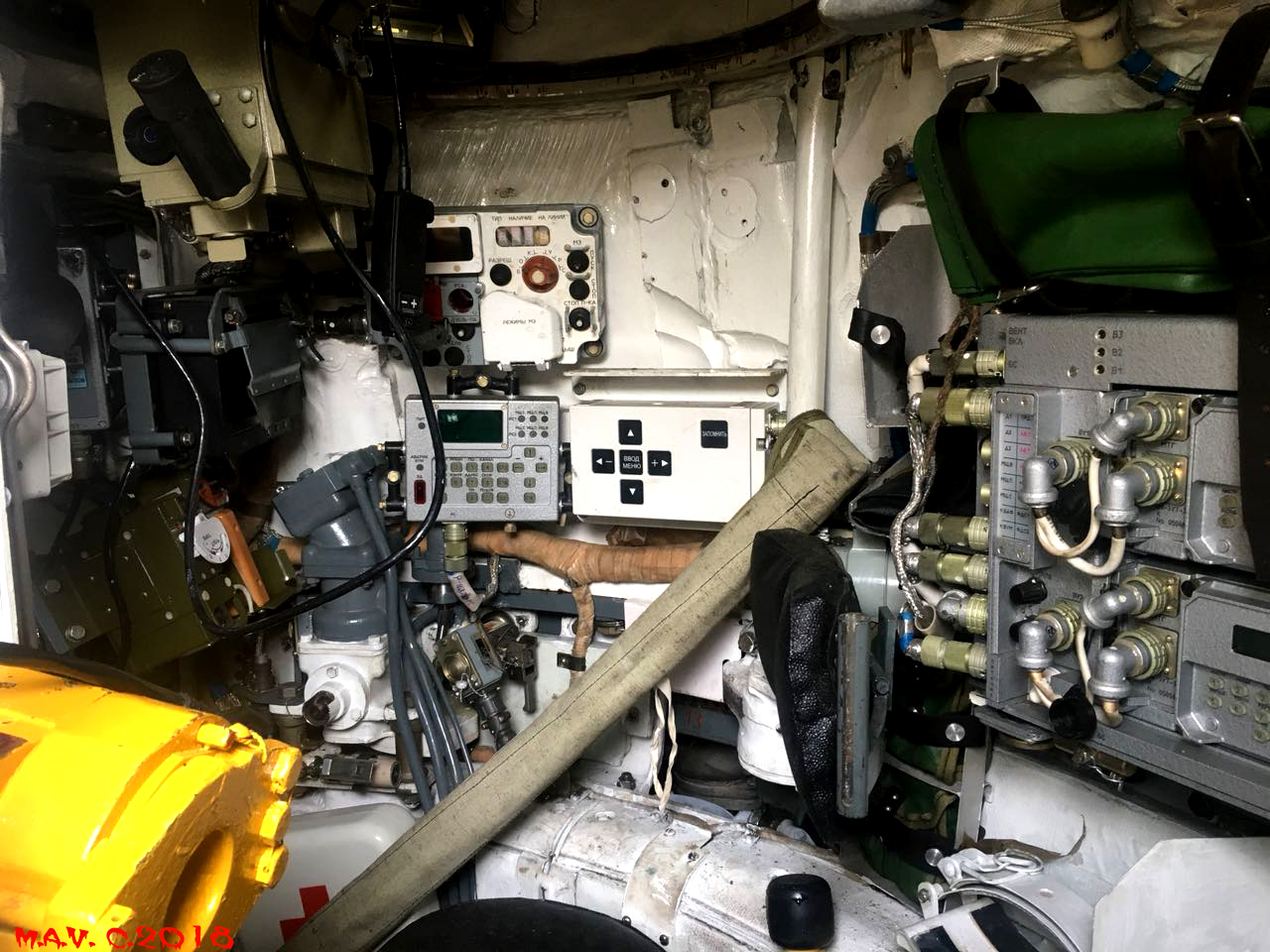
Gunner sight: Sosna-U multi-channel (day optic, thermal, laser rangefinder / missile guidance), the same family used on T-72B3. Some late or “mobilized” vehicles have been photographed with simpler sights when Sosna-U supply was tight. Commander does not automatically get a T-90M-class independent panoramic thermal on the early BVM; later incremental kits vary. Radio commonly listed: R-168-25U-2 Akveduk. Irtysh is named as the fire-control umbrella in some English summaries.
MOBILITY
Engine: Klimov / UEC-Klimov GTD-1250 gas turbine, 1,250 hp. GTD-1250TF is the economy / boost designation used on later briefings (claimed better specific fuel use; some texts mention a 1,400 hp short boost — not a separate in-service engine family). The turbine starts in severe cold in about a minute; that is the Arctic argument versus V-92S2F diesel T-72 / T-90. Cost is fuel burn, hot exhaust, intake icing discipline, and workshop hours. Internal fuel on the order of 1,100 litres plus external drums. Road speed in tables is 70 km/h or, in some Russian rows, 80 km/h; off-road figures cluster around 40–48 km/h. Reverse is about 11 km/h — better than early T-72 reverse, still not a Western two-speed sprint. Road range about 335 km internal, about 440–500 km with drums, depending on which table is copied. Power-to-weight at 46 t and 1,250 hp is about 27 hp/t. Torsion-bar suspension, six road wheels, rear drive. Ford 1.2–1.8 m; deep wade with snorkel kit to about 5 m.
DIMENSIONS
Handbook cluster: length hull about 7.0–7.01 m; length gun forward about 9.55–9.65 m; width about 3.38 m without extra side modules (field kits go wider); height to turret roof about 2.20–2.22 m; ground clearance about 450 mm. Ground pressure of the parent family is about 0.9 kg/cm². Exact millimetres shift with Relikt boxes, cages, and drums.
HISTORY
Omsk showed the demonstrator at Army-2017. The first Ministry of Defence modernization contract is dated to that forum. Series vehicles appeared in 2018; acceptance / first operational year is given as 2018 or 2019. Early firm orders in open reporting totalled about 112 vehicles across 2019–2020 contracts, then more in August 2020 and August 2022. Production estimates in secondary sources after the 2022 war run from “a couple of hundred” to “200–300.” UVZ / Omsk statements from 2024–25 describe continuing batches with factory roof kits and “200+ engineering changes” since 2022. Those are plant claims, not an audited census.
Pre-2022 the type sat mainly with northern and eastern units that wanted the turbine in the cold. Open order-of-battle notes: about four units with BVM before the full-scale Ukraine war, on the order of twenty-three units identified with the type by 2025. That growth is regeneration from storage, not a new factory type.
COMBAT USE
T-80BVM has been used by Russian forces in Ukraine from 2022. Strengths reported by crews and analysts are acceleration, cold start, and a quieter / different acoustic signature than the diesels. Weaknesses are the same as the rest of the T-64/72/80 carousel family: ammunition under the turret floor, limited gun depression, thin roof against top-attack, and fuel hunger on long road marches. Field cages and Relikt do not make the vehicle immune to FPV drones or modern ATGM.
Visually confirmed loss lists (Oryx-class tallies) are a floor, not a complete book. By late 2024 one widely cited running count put T-80BVM destroyed / captured in the low hundreds when BVM and “BVM obr. 2022” rows were added together, inside a T-80 family total already over a thousand. Those numbers move monthly and exclude undocumented kills. Ukraine has captured BVMs, including cage-fitted vehicles, and has used captured T-80s as a pool alongside its own pre-war T-80BV.
WHAT IT IS NOT
It is not T-80U, T-80UD, T-80UE-1, or T-84. It is not T-90M. It is not Armata. It is not a new-production T-80 with a clean serial hull — current BVM metal is rebuilt BV. Arena APS on the brochure is not the standard field fit. Sosna-U on every hull is not guaranteed on 2022–24 “mobilized” machines. 80 km/h and 70 km/h both appear in official-looking tables; pick one and you will be contradicted by the other page.
CAVEATS ON THE NUMBERS
Weight 45.7 vs 46 vs 47.4 t, width 3.38 vs 3.6 m, speed 70 vs 80 km/h, range 335 / 440 / 500 km, gun M-1 vs M-4, and ammunition 45 vs “28 in the carousel” are all in circulation. This article keeps the cluster and does not pretend a single factory data plate was published. Relikt reduction of APFSDS penetration “by 50 percent” is a briefing phrase. Production totals after 2022 are estimates. Loss tables are open-source photo counts.
STATUS
In production as a modernization at Omsktransmash through the mid-2020s. In Russian army and marine service. Active inventory figures in 2025 secondary sources are on the order of a few hundred BVM among a larger mixed T-80BV/U pool. Storage of unrebuilt T-80B/BV still exists. Factory roof armour and drone-counter kits are now part of the delivered standard, not just field improvisation.
IN ONE SENTENCE
The T-80BVM is Omsk’s Relikt / Sosna-U / 2A46M-4 / GTD-1250 rebuild of the 1985 T-80BV — a three-man, 46-tonne gas-turbine tank meant to fight in the cold at T-72B3 fire-control standard — now the main living T-80 in Russian service and a high-loss type in Ukraine.