WHAT IT IS
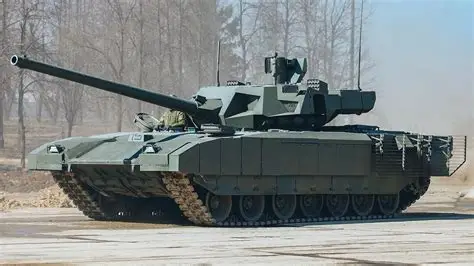
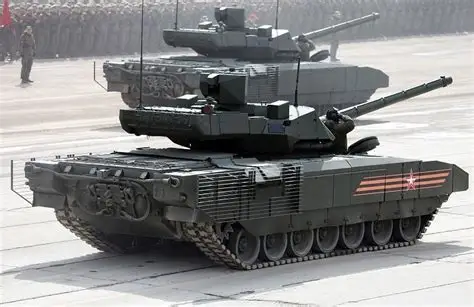
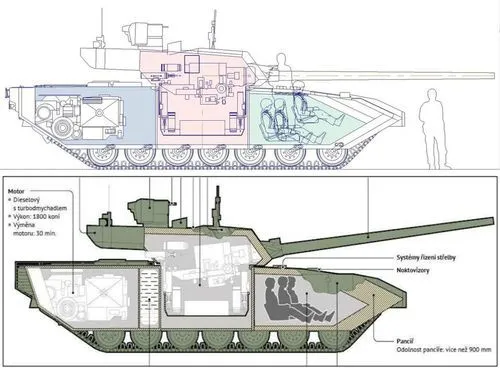
T-14 (Russian: Т-14 «Армата») is a Russian main battle tank on the Armata heavy tracked platform, Object 148, built by Uralvagonzavod. Three crew sit in an armored capsule in the front of the hull. The turret is uncrewed. The gun, autoloader, and ready ammunition are outside the capsule. That split is the design. Everything else — gun, engine, Afganit, Malakhit — is arranged around it.
Public debut was the 9 May 2015 Moscow parade. The original state plan called for about 2,300 tanks by 2020. The order was cut to a test batch. Open estimates a decade later put the fleet at roughly twenty hulls, mostly prototypes and pre-production. UVZ general director Aleksandr Potapov, speaking before the plant’s 90th anniversary in October 2026, said Armata is still in staged troop operation and is being reworked against experience from the Ukraine war. Rostec head Sergei Chemezov said in March 2024 that the tank was too expensive for mass issue and that the war would be fought with T-90M and rebuilt T-72s.
HOW THE LAYOUT DIFFERS
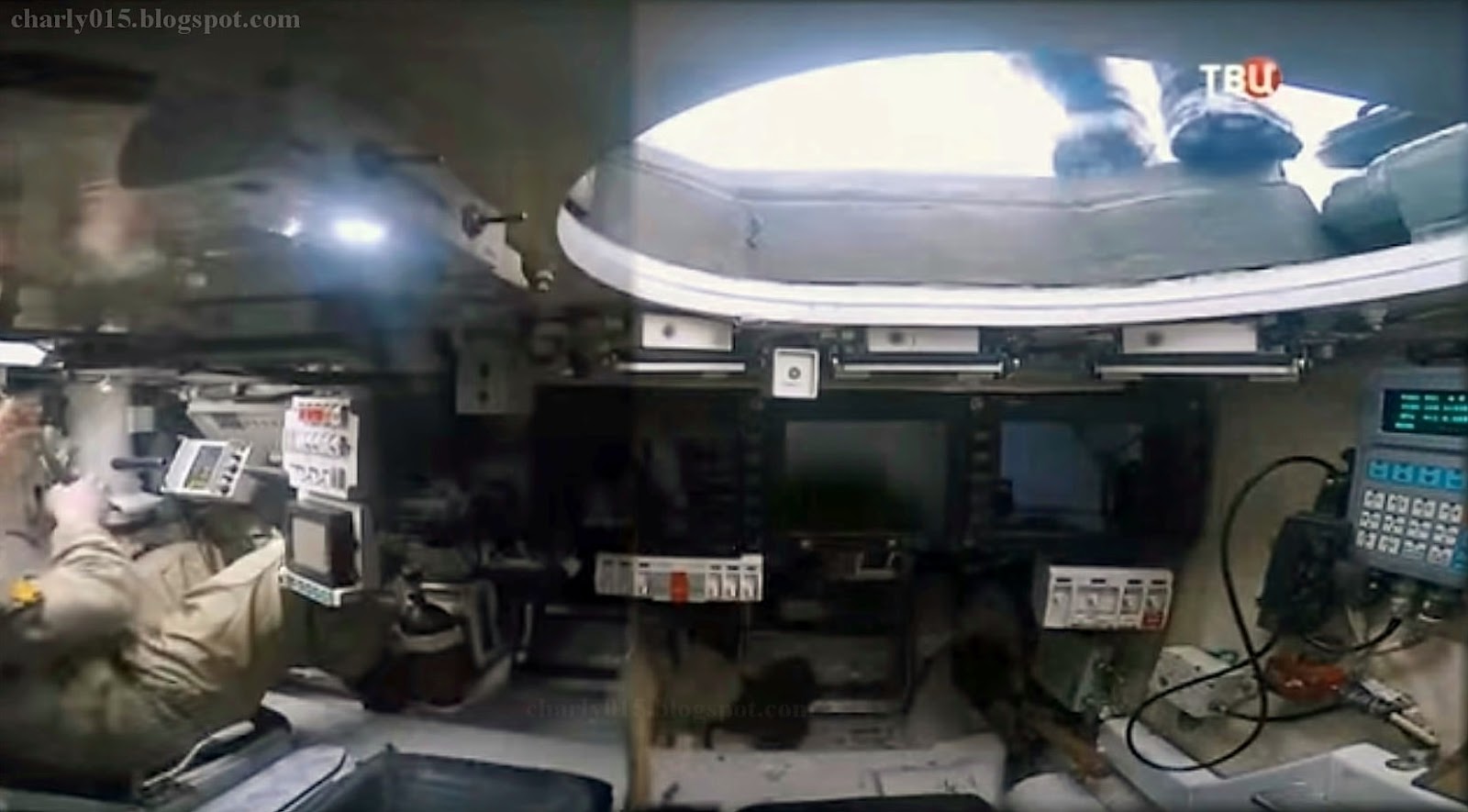
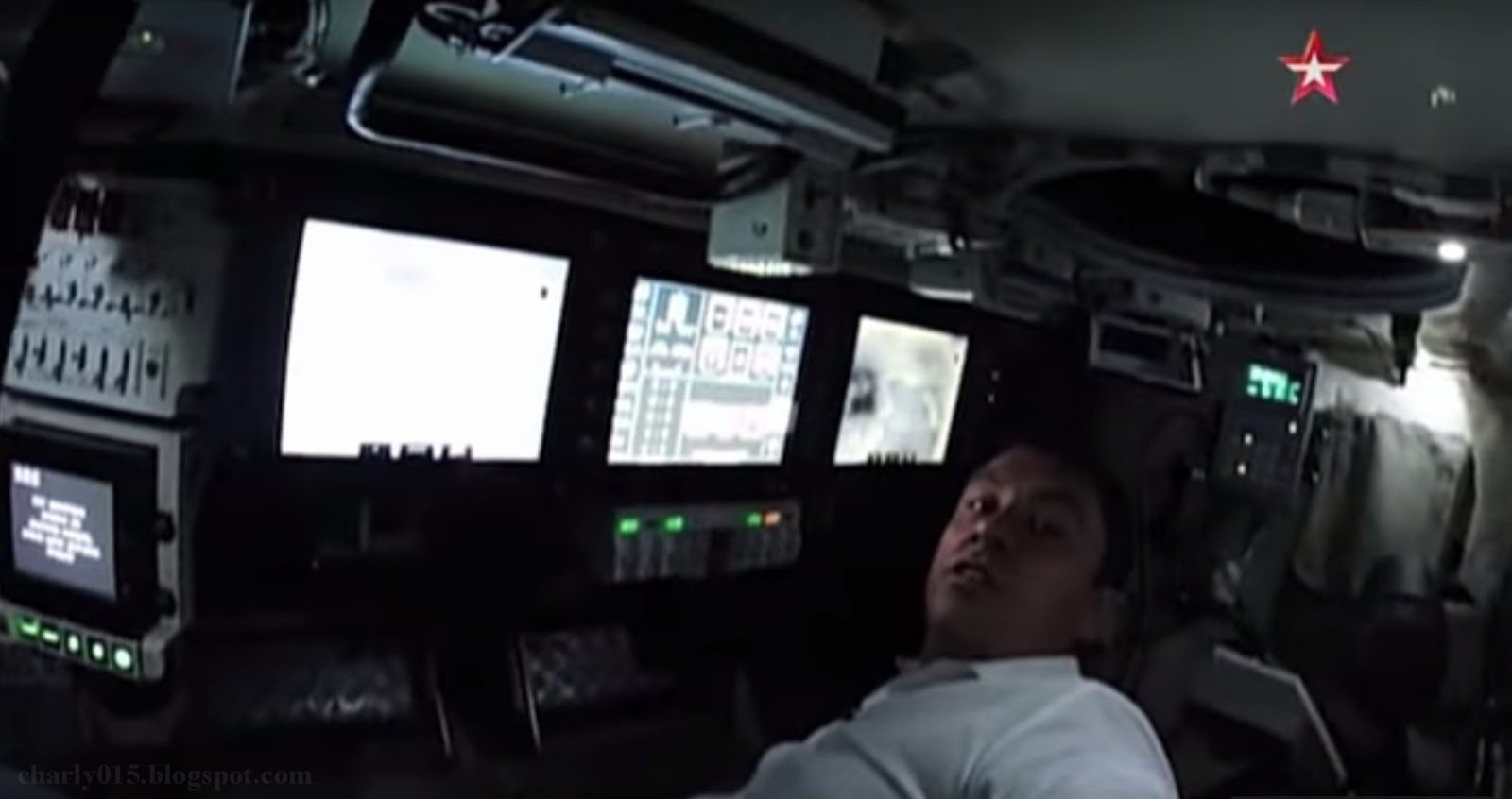
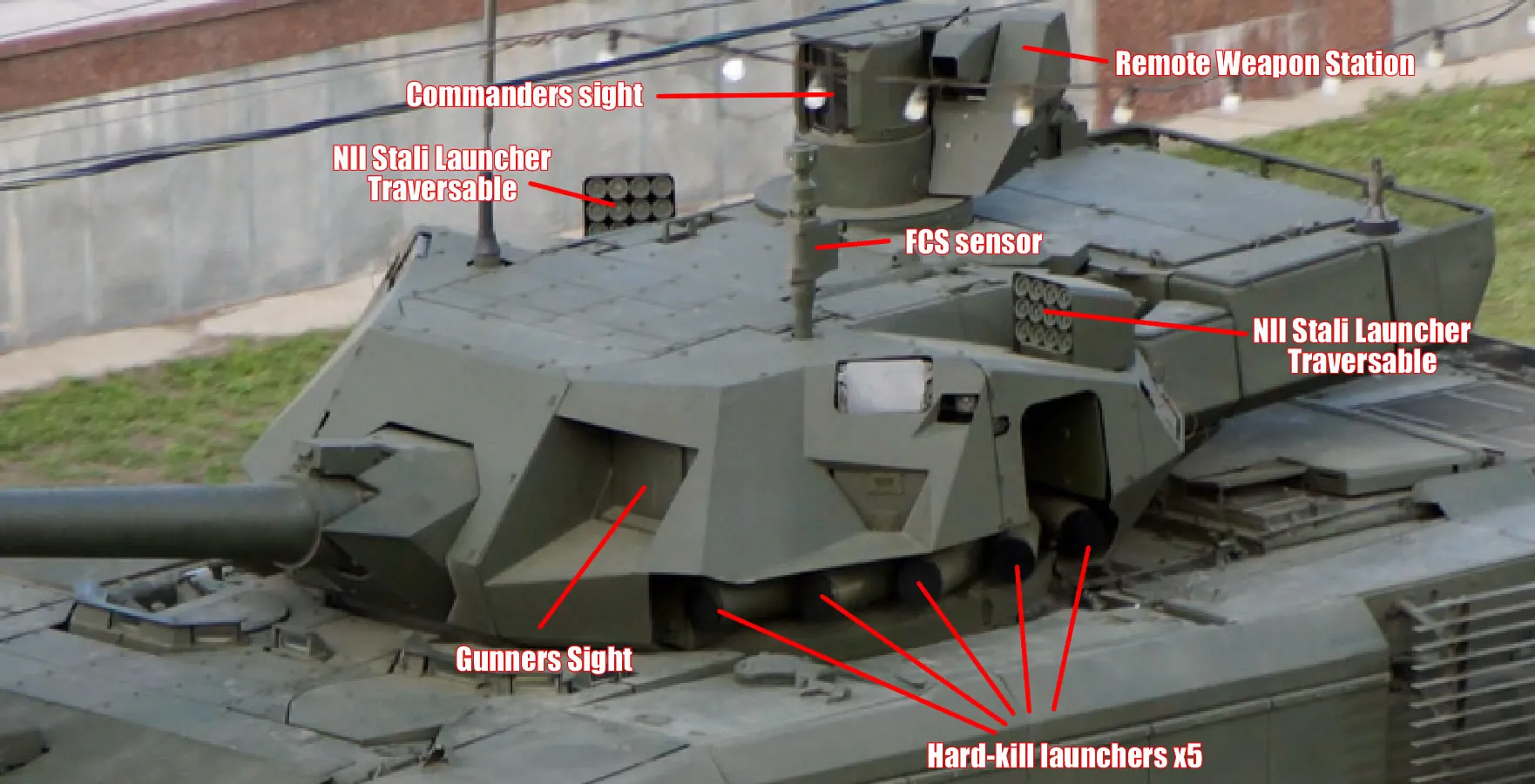
A T-72, T-80, or T-90 puts the commander and gunner in the turret, above the carousel. A penetration of the turret is a crew kill. T-14 moves all three men — commander, gunner, driver — into a forward hull capsule with its own armor, isolated from the ammunition and from the engine. The turret is a rotating module: 125 mm gun, autoloader, coaxial machine gun. Sights and the roof machine gun are remote. The crew fights through screens.
Consequences that are real, not brochure:
A turret hit does not automatically kill the crew. It can still kill the gun, the autoloader, and the sights, which leaves a capsule with no weapon.
The hull is larger than a T-90. Published length is about 10.8 m gun forward, width about 3.5 m, height about 3.3 m. Weight cards run 48–55 t.
There is no manned hatch in the turret roof for the commander to put his head out. Situational awareness is cameras and the panoramic sight.
The autoloader is in the unmanned volume. Published load is about 45 rounds, with a portion in the mechanized rack. A 152 mm gun has been discussed for years and was claimed again in a September 2026 Zvezda/Rostec segment. The tanks that have been shown firing, including at Tsentr-2026, have the 125 mm.
Western unmanned-turret work (several U.S. technology demonstrators, the Abrams M1E3 path) is the same idea. None of those is a fielded battalion either. T-14 is the one that was paraded as a production type and then stayed a trial type.
ARMAMENT
Main gun: 2A82-1M 125 mm smoothbore, a new tube rather than another 2A46. Higher chamber pressure is the design claim, so it can use longer-rod APFSDS (Vacuum-1 is the named round) and still fire the existing gun-launched missiles, 9M119M Invar family and the later Sprinter. High-explosive and airburst rounds are in the ammunition work Potapov mentioned in 2026. Coaxial: 7.62 mm PKTM. Roof: 12.7 mm Kord on a remote station.
A 152 mm option (sometimes tied to a 2A83-class tube, and in the 2026 TV claim able to fire Kornet and Krasnopol-class rounds) is a development statement. It is not the gun on the trial vehicles that have been filmed.
PROTECTION
Three layers are named.
Hull and turret steel, including the 44S-sv-Sh grade associated with the Armata family, plus the crew capsule as a separate armored volume.
Malakhit dual-explosive reactive armor, the generation after Kontakt-5 / Relikt, fitted as built-in modules rather than hung tiles only.
Afganit active protection. Hard-kill launchers around the turret base, soft-kill smoke and, on the design card, a millimeter-wave element intended to break an incoming top-attack or a guided round. Radar panels on the turret front are part of that suite. Claimed engagement counts and the ability to stop a long-rod APFSDS are manufacturer figures. No public instrumented trial against a modern APFSDS has been released.
Afganit does not cover the roof against a small diving drone the way a cage or a separate top-attack interceptor would. That gap is why later Russian tanks grew grilles and why a 2015 APS design is not a 2024 counter-FPV design.
AUTOMOTIVE
Engine: Chelyabinsk 12N360 (also A-85-3A, 2V-12-3A). X-12 diesel, 34.6 litres, designed 1,200–1,800 hp, with the tank normally discussed at about 1,500 hp and sometimes derated toward 1,200 hp for life. Compact block, claimed 30-minute pack change, lower cooling-air demand than the old V-2 family. Transmission is automatic and reversible: eight forward and eight reverse on the project card, reverse speed claimed 40–50 km/h. That reverse rate is what Russian coverage of Tsentr-2026 pointed at when a T-14 pulled out, fired, and backed into cover without turning.
Road speed is listed at 80–90 km/h. Range about 500 km. Ground pressure and trench/ford cards are the usual heavy-platform set and are not better documented than the weight.
SENSORS AND NETWORK
Commander and gunner use electro-optical sights with thermal channels. The design includes a turret radar associated with Afganit and with air/ground tracking claims (Russian press has repeated “40 ground / 25 air, out to 100 km,” which is a tracking-radar boast, not a gunnery range). ESU TZ is the tactical data layer for passing a target to another vehicle. A small mast UAV (Pterodaktil) has been shown on some hulls as a reconnaissance add-on. None of this is unique in kind. The unmanned turret makes the crew wholly dependent on it.
HISTORY
Armata began as a clean-sheet heavy chassis to replace the T-72/T-90 industrial line with one hull for a tank, a heavy IFV (T-15), a recovery vehicle (T-16), and a related artillery carrier. Ural Design Bureau of Transport Machine-Building did the work under UVZ. Parade practice at Alabino in 2015 showed the family with covers on. One T-14 stopped on Red Square that May and was towed, which fixed the reliability story early.
The 2,300-by-2020 figure was cut, first to a hundred-tank test batch, then in practice to the low tens. Serial production at the rate the parade implied did not start. From 2022 the plant’s output that mattered was T-90M and T-72 rebuilds. T-14s have appeared at Army forums, at the 2020s parades in smaller numbers, on ranges, and at Tsentr-2026. Claims of frontline use in Ukraine have not been matched by verified wrecks or gun-camera from the type. Chemezov’s 2024 line — good tank, wrong price for this war — is the industrial position. Potapov’s October 2026 line — still in troop trials, ammunition being improved, SVO lessons being folded in — is the current official status.
TRIALS AND THE 2026 CARD
What is documented in 2026 is range and exercise use, not a battalion. Tsentr-2026 footage showed a T-14 with T-90Ms, including the reverse-out shoot. UVZ says staged military operation continues and that a multi-type ammunition set already exists, with more in work. A September 2026 television item described a Rostec upgrade path: new domestic electronics, a 152 mm gun, Kornet and Krasnopol-class rounds, another UAV, an unmanned option. Treat that as a proposal reel. The hulls in the exercise videos still have the 125 mm unmanned turret of the original design.
NOT THESE
T-90M — manned turret, 2A46-class gun, the tank actually being built.
T-15 — Armata-chassis heavy IFV, different mission, Epoch-type turret.
T-16 — Armata recovery vehicle.
Object 195 / T-95 — the cancelled 152 mm unmanned-turret predecessor. Not this tank.
2S35 Koalitsiya — 152 mm SPG. Related industrial generation, not an Armata tank.
CAVEATS
Weight (48 vs 55 t), horsepower (1,200 / 1,500 / 1,800), road speed (80 vs 90), and round count move between cards. Afganit versus kinetic penetrators is unproven in public. The 152 mm T-14 is a claim. “In service” in aggregator tables means the Russian Army has the trial vehicles, not that a regiment has them.
STATUS
Low-rate trial and evaluation, October 2026. Not the bulk of the Russian tank fleet. That remains T-72B3, T-80BVM, and T-90M.
IN ONE SENTENCE
T-14 Armata is UVZ’s unmanned-turret tank — three men in a front hull capsule, 2A82-1M 125 mm, 12N360, Malakhit and Afganit — paraded in 2015 for a 2,300-tank buy, still a roughly twenty-hull trial fleet in 2026 while the war is fought with T-90M and T-72.