WHAT IT IS
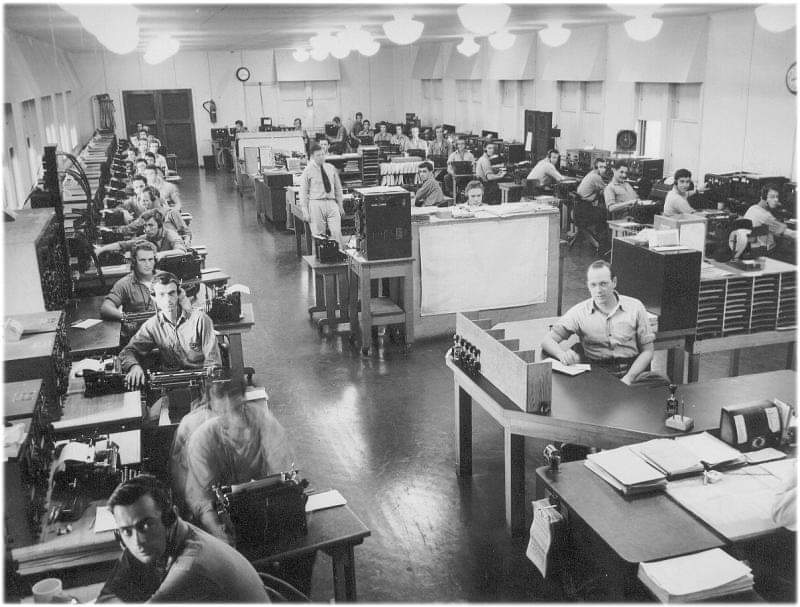
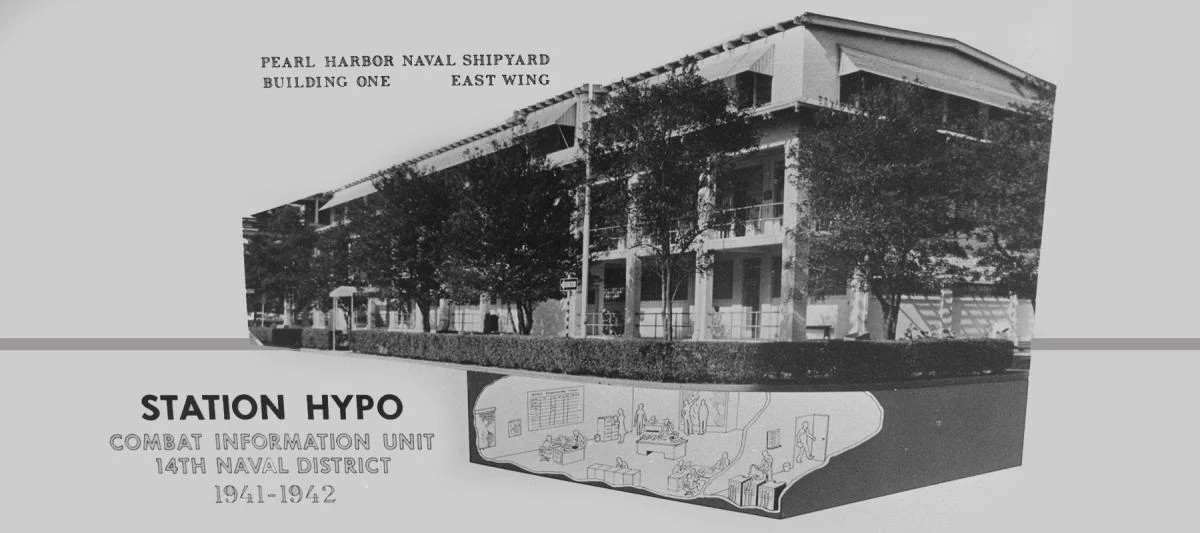
Station HYPO was the U.S. Navy’s signals-intelligence and cryptanalytic unit at Pearl Harbor in 1941–42. Officially the Combat Intelligence Unit of the 14th Naval District, it later became Fleet Radio Unit Pacific (FRUPAC). The name HYPO is the old phonetic for “H,” taken from the Heʻeia radio station on Oahu that fed it intercepts. It reported to OP-20-G in Washington and worked the Imperial Japanese Navy’s operational systems, above all the additive cipher the Americans called JN-25.
It sat in the basement of the Old Administration Building (Building 1) at the Pearl Harbor submarine base — the “dungeon.” One entrance, an armed Marine on the door. The officer in charge from June 1941 was Lieutenant Commander Joseph J. Rochefort, a Japanese linguist and cryptanalyst. His chief cryptanalyst was Thomas Dyer. The product went to Admiral Chester Nimitz through Edwin T. Layton, the Pacific Fleet intelligence officer and a Rochefort contemporary from language training in Japan.
THE NETWORK
OP-20-G, the Navy’s code and signal section under the Chief of Naval Operations, ran three analytic centers and a string of intercept sites.
HYPO — Pearl Harbor. Fleet support and, after December 1941, the unit closest to the fighting.
CAST — Cavite, then the tunnels on Corregidor. Evacuated as the Philippines fell; part of its people and material reached Australia and became FRUMEL in Melbourne.
NEGAT — Washington, stood up in early 1942 from OP-20-G assets when CAST was threatened and the load grew.
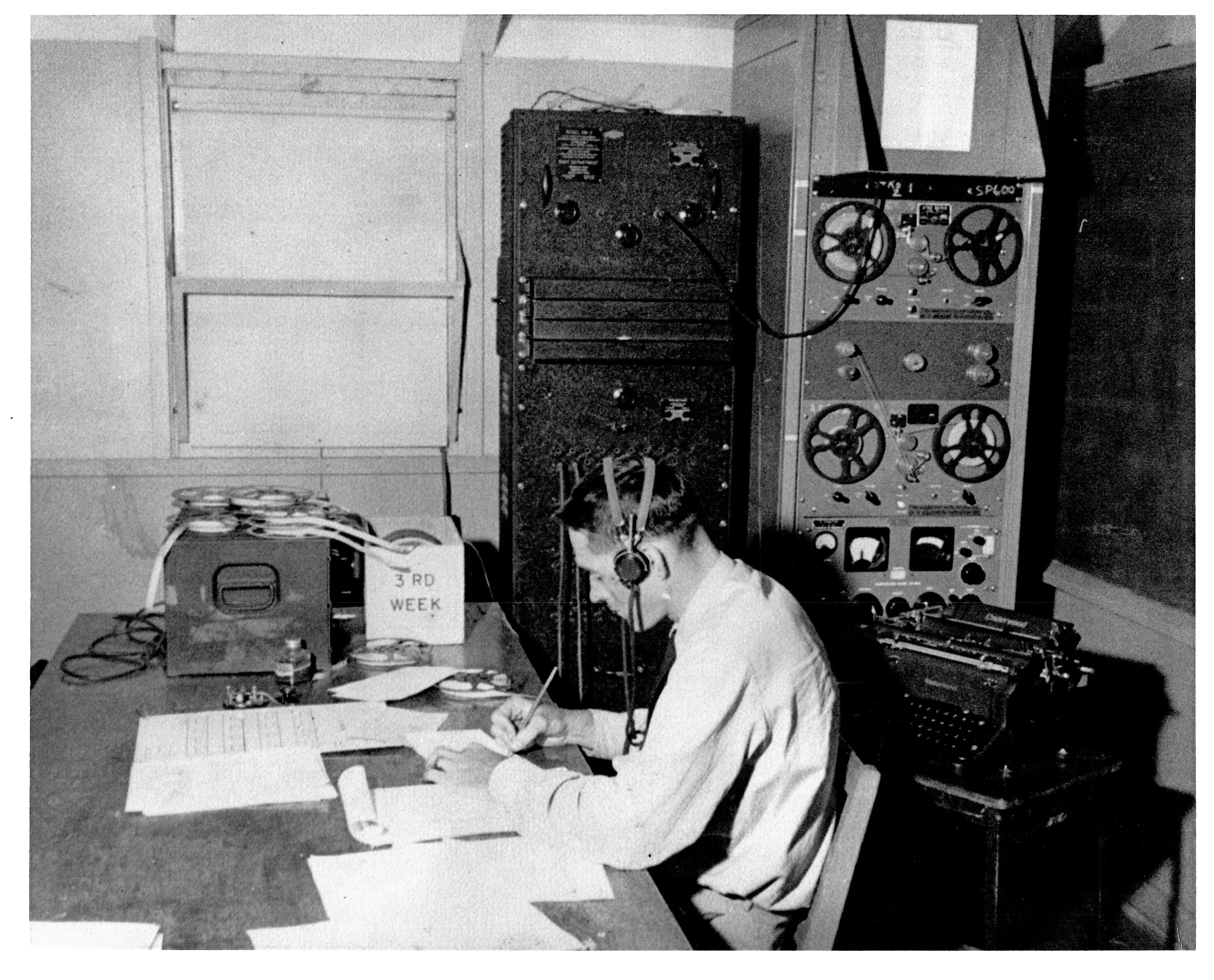
Intercept and direction-finding stations (Guam before the war, Bainbridge Island on Puget Sound, and others) collected the raw Morse. HYPO did not own every antenna. It owned the basement where the traffic was booked, the additives were stripped, and the Japanese was read.
WHAT THEY ATTACKED
JN-25 was the IJN’s main operational code: a codebook of five-digit groups superenciphered with an additive book. Breaking it meant recovering both the code groups and the current additives, then translating. Before Pearl Harbor the volume was low and HYPO had not made the system readable. The unit lived on diplomatic traffic, ship-movement observations, and traffic analysis. That was not enough to warn of the 7 December strike.
After the attack the IJN’s operational tempo rose and so did the traffic. By the spring of 1942 HYPO was reading useful portions of JN-25b within hours of intercept on some messages. The work was hand methods plus IBM tabulators. Nimitz sent men off the damaged battleship California to be trained as machine operators. Rochefort ran the basement with almost no uniform discipline — bathrobe, long watches, results over rank.
MIDWAY
In May 1942 the readable traffic showed a major operation aimed at a place the Japanese called “AF,” with a date window in early June and a carrier force. HYPO assessed AF as Midway. A Japanese weather flight had already associated AF with the atoll in March. OP-20-G in Washington, with support from the CAST remnant, leaned toward the Aleutians or a less central target and a later date.
Rochefort proposed a check. Midway was told, by the underwater cable, to send a radio message in the clear reporting that its salt-water evaporator had failed. Within about two days Japanese traffic reported that AF was short of fresh water. That fixed the designator. Nimitz accepted HYPO’s reading over the Washington alternative and placed Enterprise, Hornet, and Yorktown northeast of Midway. The battle of 4–7 June 1942 cost Japan four fleet carriers. Yorktown was lost. The carrier balance in the Pacific turned.
The decrypts did not give every detail of the plan. They gave the target, the rough timing, and the weight of the force. That was enough for an ambush.
AFTER MIDWAY
Nimitz recommended Rochefort for the Distinguished Service Medal. The Navy Department refused, citing shared credit with Washington and the Philippines. Rochefort was transferred out of cryptanalysis. In the same season Laurance Safford, the prewar builder of the intercept service, was sidelined. OP-20-G centralized Pacific naval decrypt under Washington sections run by John Redman and Joseph Wenger. HYPO was reorganized, renamed FRUPAC, and moved in time to a purpose-built building. The basement unit that had called Midway did not keep its original form or its original chief.
Rochefort retired as a captain, was denied the medal twice in life, and died in 1976. The Distinguished Service Medal was awarded posthumously in 1985–86.
METHOD, NOT MAGIC
HYPO’s edge was continuity and language, not a single machine. The same officers had studied the IJN for years. They recognized who was talking, how a staff wrote, and which designators repeated. Traffic analysis (who called whom, how often, from which circuit) carried them when the additives were dark. The water-plant message was a controlled plaintext injection — a classic confirm — not a lucky guess. CAST and Washington recovered code groups too. The argument in 1942 was whose reading of the same material Nimitz should trust. He trusted the basement.
NOT THESE
Station CAST — Corregidor / Philippines analytic center.
NEGAT — the Washington center stood up in 1942.
FRUMEL — Melbourne, the post-evacuation Pacific unit in Australia.
OP-20-G — the Washington parent organization. HYPO was a field station under it.
The “On the Roof Gang” — the prewar intercept-operator school. Collectors, not the Pearl Harbor cryptanalysts.
CAVEATS
Credit for JN-25 recoveries was disputed at the time and still is. HYPO did not “break the code” alone, and it did not read every message. The water ruse is documented in Navy and historical accounts; small details of timing vary. The post-Midway treatment of Rochefort is a matter of record and of lasting argument inside the cryptologic community.
STATUS
Wartime unit. Disbanded in its original form after the 1942 reorganization. The name is kept by Navy cryptologic associations.
IN ONE SENTENCE
Station HYPO was Joseph Rochefort’s basement cryptanalytic cell at Pearl Harbor — the Combat Intelligence Unit that read enough JN-25 in May 1942 to prove “AF” was Midway with a faked water-plant message, put Nimitz’s carriers on the flank, and was then broken up and recentralized in Washington.