WHAT IT IS
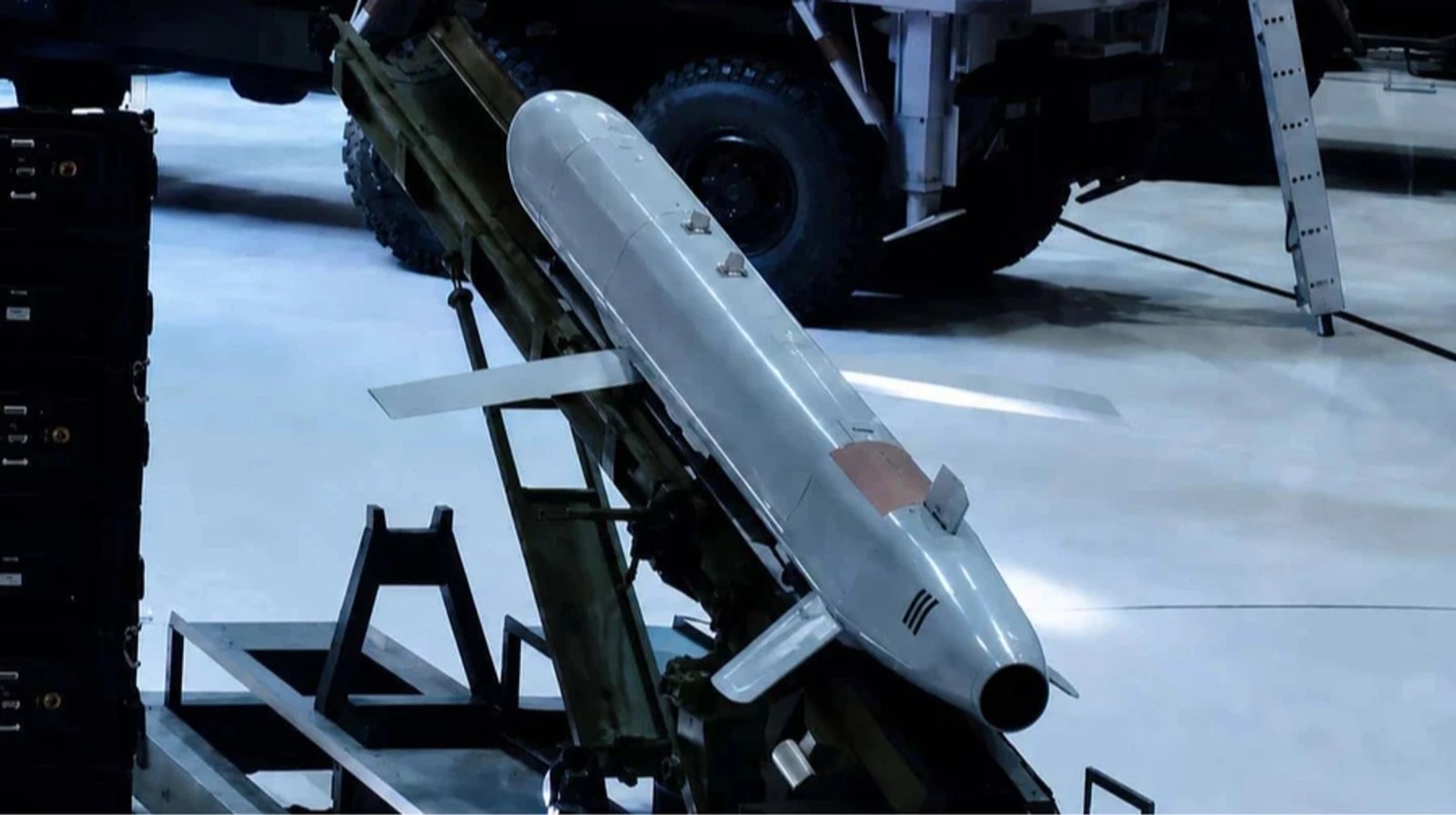
The S8000 «Бандероль» (Banderol; also written С8000, С-8000, "Banderol" or "BanderoL" in the Ukrainian intelligence release) is a small, low-cost, jet-powered, uncrewed strike weapon developed by the Russian group «Кронштадт» (Kronshtadt, Kronstadt; AO «Кронштадт», a sanctioned Russian unmanned-aircraft company better known for the Orion, «Орион», and Inokhodets, «Иноходец», drones). It is usually described as a "cruise missile" (крылатая ракета) in Ukrainian intelligence material, Russian Wikipedia and most media, and as a "loitering munition", "quasi-cruise missile" or "drone-missile" by other sources. The Institute for the Study of War (ISW) uses the term "quasi-cruise missile" for this class of inexpensive jet-powered weapon. There is no single agreed category, and this page uses "missile" because that is the term used by the Ukrainian Defence Intelligence (ГУР / HUR / DIU), the principal source of technical data.
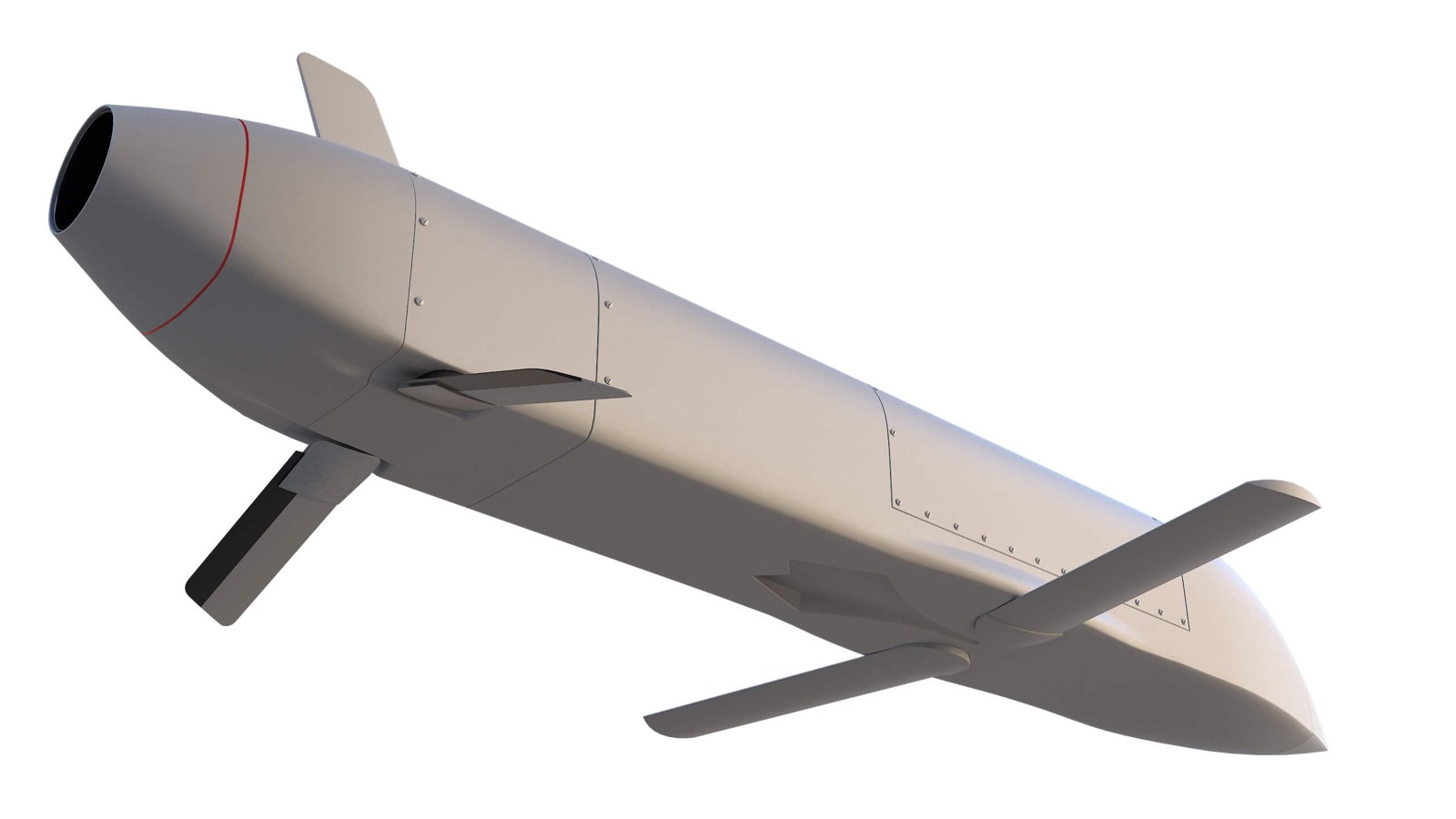
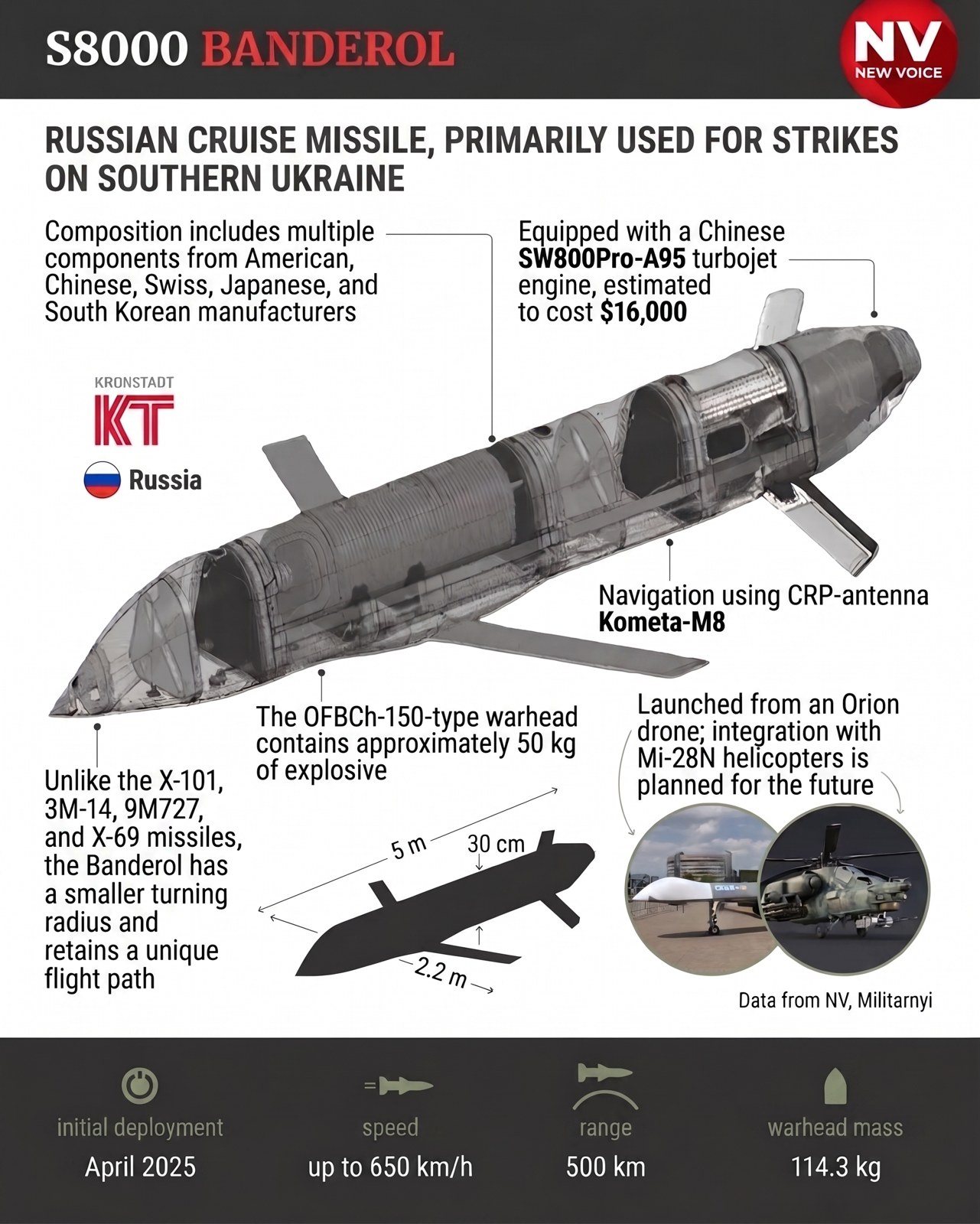
The weapon is about 5 m long, about 30 cm in body diameter, with a folding wing of about 2.2 m span. It is powered by a small Chinese-made turbojet (Swiwin SW800Pro-A95) of the type sold for large radio-controlled model aircraft, uses aviation kerosene, and carries a high-explosive fragmentation warhead that Ukrainian intelligence designates ОФБЧ-150 (OFBCh-150). It is launched from the air (from the Orion drone, and reportedly from Mi-28 helicopters) and, since mid-2026, apparently from a simple ground launcher. Its significance is not technical novelty but economics: it is a cruise-missile-class weapon, with a warhead of more than 100 kg, built largely from commercial parts and priced, according to Ukrainian estimates, at a small fraction of the cost of a Kh-101 or Kalibr.
This page is a compiled reference. The sourcing on this weapon is thin and mostly Ukrainian. No Russian official technical specification for the S8000 under that name has been published in the sources consulted. Almost every figure below comes from the Ukrainian Defence Intelligence (HUR) "War & Sanctions" portal, from Ukrainian Air Force and Ministry of Defence statements, from Ukrainian and Western media, and from open-source analysts. Each figure is therefore marked with its source and, where figures disagree, both are shown. The weapon is still new, the information changes quickly, and this page reflects reports available up to mid-October 2026.
Related article in this database: the Kh-101 / Kh-102 article describes the large Russian air-launched cruise missile that the S8000 is often compared with. It is mentioned here as plain text for comparison only.
KRONSHTADT AND THE ORIGIN OF THE PROGRAM
Kronshtadt (Кронштадт) is a Russian defence group based in Saint Petersburg, known for large uncrewed aircraft: the Orion («Орион», medium-altitude long-endurance strike and reconnaissance drone, also known by the export-style name Inokhodets-RU / Sirius in some reports), Helios and Altius-U (these names are listed by the Polish defence magazine MILMAG). HUR names the company as the "main manufacturer and designer" of the S8000 and lists Kronshtadt as sanctioned. HUR states that the Orion, made by the same company, is the main carrier.
Public history of the weapon, according to the sources available:
First reports (April 2025): Ukrainian radio-electronic-warfare specialist Serhii «Flash» Beskrestnov and Defense Express reported in April 2025 that Russia had for several weeks been using a new jet-powered weapon called "Banderol" against Odesa Oblast. By 29 April 2025 Beskrestnov counted about ten cases and said the Kronshtadt design bureau had built it (UNIAN, Defense Express, as cited by drone-warfare.com). The speed estimate of 400–500 km/h first appeared in that April 2025 estimate.
Russian showing (26 April 2025, single-source): MILMAG states that the S8000, "then still unnamed", was publicly shown on 26 April 2025 during a visit by Dmitry Medvedev, Deputy Chairman of the Security Council of the Russian Federation, to the Kapustin Yar missile test range. This claim comes from one Polish outlet and could not be confirmed from a second source here.
HUR publication (12 May 2025): the Defence Intelligence of Ukraine released the technical card of the missile and a series of component pages on its War & Sanctions portal (section "Components in weapons"). It stated that Ukrainian intelligence had identified more than 20 key components and about 30 companies involved in production or supply (HUR via Ukrainska Pravda and UNN). Russian Wikipedia says Ukrainian intelligence obtained samples "in more or less intact form", citing The War Zone.
2026: the weapon appears much more often in Ukrainian Air Force reports; HUR said in July 2026 that serial production had begun (Militarnyi, 29 July 2026); the Air Force began counting "Banderol/Dan-T" as a combined category from 13 September 2026 (drone-warfare.com, citing the Air Force).
Name: the name «Бандероль» means "parcel" or "package sent by post" in Russian. The index S8000 is the one used in Kronshtadt tender documentation (a February 2025 tender for components bore the designation S8000, according to The Insider's reporting of OSINT project Nordsint) and the same index was adopted by HUR. No Russian official has been found in the sources consulted confirming the name publicly in an official specification.
DESIGN AND DIMENSIONS
The figures in this section come from the HUR War & Sanctions card for the S8000 unless another source is named. They are Ukrainian intelligence estimates from examination of recovered wreckage, not manufacturer data.
Length: about 5 m (HUR). Russian Wikipedia gives 4.9 m.
Body diameter: about 30 cm (HUR).
Wing: a folding wing mechanism is listed among the components. HUR's table gives "Size: about 2.2 m" without a label; Defense Express and Russian Wikipedia read this as wingspan (2.2 m). Lenta.ru describes a "folding wing with a span of 2.2 metres".
Fuel: 50–65 kg of aviation kerosene (HUR).
Launch mass: not given on the HUR card. The consultant blog by Ivan Tesolkin gives 200–250 kg, and Rosoboronexport data for the Dan-T (a related weapon, see below) gives a maximum take-off weight of 268 kg (Janes). The 200–250 kg figure is a secondary, unexplained estimate and should be treated as unconfirmed.
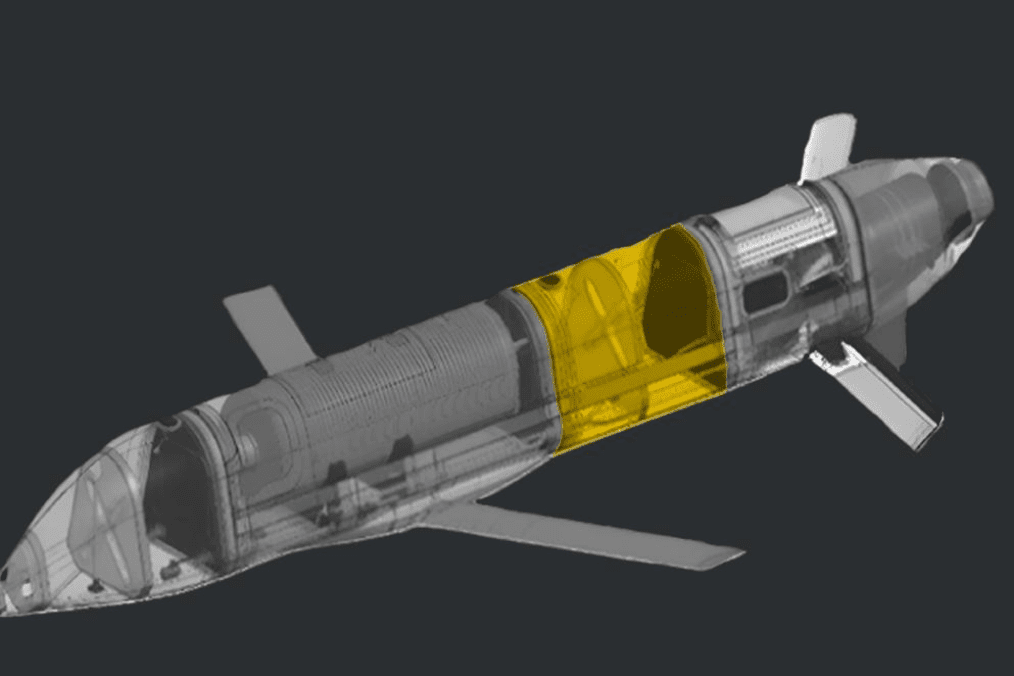
Layout (HUR component list): flight controller, telemetry module, folding wing mechanism, control surfaces (stabilisers) moved by servo drives, fuel tank, turbojet engine, warhead, air-pressure measuring unit (air-data), battery pack and the anti-jamming satellite-navigation antenna.
The airframe construction is not described in any source consulted beyond the remark by Tesolkin (a commentator, not an official source) that a composite structure makes it a "weak radar reflector, though not stealthy". Russian Wikipedia says the small size and construction reduce radar visibility, but that sentence is tagged "source?" (unsourced) on Wikipedia, so it is not confirmed. No radar cross-section figure has been published in any source found.
ENGINE
Engine: Swiwin SW800Pro-A95 turbojet, manufacturer Swiwin (People's Republic of China). Data from the HUR component page, published 12 May 2025:
Length 455 mm, body diameter 208 mm, width with mounts 275 mm.
Weight 8.5 kg.
Maximum thrust 81.6 kgf (about 0.8 kN) at 65,000 rpm, fuel consumption at maximum thrust 1.85 kg/min.
Thrust in a "probable cruising mode" 65 kgf at 60,000 rpm, fuel consumption 1.5 kg/min. HUR itself calls this cruise setting "probable", so it is an analyst estimate.
HUR lists the importers into Russia as LLC IQ Components and Trek JSC, and foreign suppliers as Align Trading Company Limited, Hytera Communications Limited and Hadsund International Technology Limited. These are HUR's statements of the supply chain and are not independently confirmed here.
Price: HUR (as reported by Ukrainska Pravda and UNN) estimated the engine at about US$16,000 on the AliExpress marketplace. This is an estimated retail price in a hobby market, not a procurement price paid by Russia.
This engine class is an aeromodelling turbojet: it was designed for heavy radio-controlled model jets and small civilian drones. Its use in a military weapon is the basis of the media nickname "AliExpress missile" (Kyiv Post). Russian Wikipedia also states that the engine is available through AliExpress.
Engine arithmetic is useful for sanity checks. With roughly 65 kgf of thrust at the assumed cruise setting and 1.5 kg/min fuel consumption, 50–65 kg of fuel would give 33–43 minutes of flight at cruise. At 520–560 km/h (HUR cruise figures) that gives roughly 290–400 km. This simple calculation is not from any source and ignores climb, descent and launch effects; it is shown only to illustrate that the 500 km figure is a best case and that the practical-range figures of 350–400 km quoted by HUR representatives in July 2026 are plausible. It must not be treated as a performance estimate.
NAVIGATION AND GUIDANCE
No source in this survey gives an official description of the guidance method beyond the component list. What is known comes from the HUR component pages:
Anti-jamming antenna: an "interference-proof CRP antenna Комета-М8" (Kometa-M8). CRP is the Ukrainian abbreviation for a controlled-reception-pattern antenna (КРПА in Russian: антенна с управляемой диаграммой направленности). Manufacturer VNIIR-Progress JSC (ВНИИР-Прогресс), Russia. HUR lists the involved companies as Pantes LLC, PSB Technologies LLC and Aviv Group LLC. HUR (via Ukrainska Pravda) states the same Kometa-M8 antenna is also used in the Geran (Герань) loitering munitions and in the UMPK and UMPB guided glide bombs. The antenna is the one Russian-made major component in the HUR list. The Kometa family forms nulls in the direction of jamming sources so the satellite receiver can keep tracking GLONASS/GPS signals.
Inertial unit: HUR describes an inertial navigation system of probable Chinese origin (Ukrainska Pravda), and its component pages list an InvenSense (TDK, United States) ICM-42688-P six-axis MEMS motion sensor (three-axis gyroscope and three-axis accelerometer), with a date code of week 20 of 2021 and supplier JSC Chip and Dip. Russian Wikipedia repeats these items. A MEMS sensor of this class is a consumer and industrial part; the quality of the inertial navigation as a whole cannot be derived from the sensor alone.
Satellite navigation: MILMAG says guidance is by inertial navigation and the GLONASS satellite system, and Rosoboronexport says the related Dan-T uses GNSS/INS. The satellite constellations used by the S8000 itself are not stated by HUR.
Terminal guidance: no source consulted reports a seeker, camera or terminal homing sensor on the S8000. The missile is described as aimed at fixed, pre-surveyed targets (see USE). The Ukrainska Pravda piece contrasts it with the Kh-101, which "features sophisticated electronics, including ... an optical guidance system", implying the Banderol lacks it, but this is a journalist's comparison and not a technical finding.
Accuracy: the consultant blog by Ivan Tesolkin gives a circular error of 20–30 m. No source and no method are given for that number, and it is not confirmed by any Ukrainian or Russian official source found. Evidence of accuracy is indirect: the weapon has been used against fixed port and logistics sites (see USE). The accuracy of the weapon is therefore unknown.
Datalink: HUR lists an RFD900x telemetry modem (RF Design, Australia, or its Chinese copy) in the missile. The presence of a long-range radio modem indicates that some form of telemetry or command link may exist, but HUR does not say whether the missile can be retargeted in flight. Whether any in-flight control exists is unconfirmed.
Maneuvering: Ukrainian sources report that the missile can make sharp turns. Beskrestnov (cited by the Kyiv Independent) said it can reportedly perform a U-turn within a radius of 2.5 km. Kyiv Post, citing Ukrainian reports, says the turn radius is smaller than that of the Kalibr (3M-14) and Iskander-K (9M727). Tesolkin adds that a 90-degree turn above 250 km/h was "recorded"; no primary source for this is given. These are Ukrainian statements and have not been independently measured in published data.
Altitude: Kyiv Independent reports a typical flight altitude of 400–2,000 m with descent to about 200 m before the target (Ukrainian sources). Ukrainska Pravda gives 200–2,000 m (Air Force spokesman Yurii Ihnat as the source). Russian Wikipedia says most of the flight is at low and very low altitude, with a sentence tagged "source?". The altitude profile is therefore reported differently: low-altitude terrain following is not established by the Ukrainian figures, which include altitudes up to 2,000 m.
WARHEAD
HUR publishes a component page for the warhead, designated ОФБЧ-150 (OFBCh-150; осколочно-фугасная боевая часть, "high-explosive fragmentation warhead"; the number 150 appears to be a class designation). According to HUR's page, as summarised by drone-warfare.com and MILMAG:
Total warhead mass: 114.3 kg.
Explosive mass: 49.5 kg.
Explosive: HMX (octogen) with aluminium powder; MILMAG adds that the mixture uses DOS-type plasticizer (the text in the retrieved extract was partly cut off, so this detail is uncertain).
Where figures conflict:
"Up to 150 kg" is the figure HUR gave in its 12 May 2025 announcement (Ukrainska Pravda, UNN) and again in a Telegram post on 31 August 2026 (drone-warfare.com). Russian Wikipedia also says "up to 150 kg". bne IntelliNews (1 August 2026) repeats 150 kg for the 2026 model.
114.3 kg is the figure on the HUR component page and is repeated by Militarnyi, Euromaidan Press and The Insider. Ukrainska Pravda (August 2026) gives 114 kg.
The Aviationist attributes 120–140 kg to HUR (a third value).
Explosive fill: HUR 49.5 kg; Ukrainian analyst Viktor Kevliuk puts it at 29.5 kg (LB.ua, 17 September 2026, as cited by drone-warfare.com).
The most likely reading is that "150" in the designation OFBCh-150 and in the early press statement describes the warhead class or a maximum, while 114.3 kg is the measured mass of the recovered warhead. That is an interpretation, not a stated fact, and the page does not resolve the conflict. The related Dan-T has a Rosoboronexport-stated maximum warhead of 130 kg (Janes), which is yet another number and applies to a different designation.
Fuzing and fragmentation details are not published in any source consulted. The warhead is a blast and fragmentation type; Tesolkin's remark that it is "built for area and fire" is an opinion.
SPECIFICATIONS AS REPORTED
All values below are reported figures and not verified by test; Russian official data do not exist for this designation in the sources found. The first value is the HUR card unless noted.
Developer and manufacturer: Kronshtadt (Кронштадт) JSC, Russia (HUR). Final assembly at Dubna (Moscow Oblast) is stated only by the Tesolkin consultancy blog, which also says the site is next to the Raduga plant that builds the Kh-101; no other source for the Dubna claim was found, so it is treated as unconfirmed.
Length: about 5 m (HUR); 4.9 m (Russian Wikipedia).
Diameter: about 30 cm (HUR).
Wingspan: about 2.2 m (HUR, "size"; Defense Express, Lenta.ru).
Engine: Swiwin SW800Pro-A95, 81.6 kgf maximum (HUR).
Fuel: 50–65 kg kerosene (HUR).
Maximum speed: 620–650 km/h (HUR card; Militarnyi 2026; Lenta.ru says up to 650).
Cruise speed: 520–560 km/h (HUR card).
Other speed statements: 500 km/h (HUR announcement of 12 May 2025; Russian Wikipedia "up to 500"); 550–600 km/h (HUR representative, July 2026, per drone-warfare.com; bne IntelliNews, 1 August 2026, for the 2026 model); "up to 600 km/h" (Ukrainian Ministry of Defence, 5 September 2026; Ihnat); 400–500 km/h (The Aviationist, attributed to HUR; first from Beskrestnov in April 2025).
Range: 500 km (HUR card and most media). Ukraine's later statements: 350–400 km (HUR representative, July 2026, per drone-warfare.com) and 350–450 km (bne IntelliNews, 2026 model). Ground-launched range is expected to be lower (see LAUNCH PLATFORMS).
Warhead: 114.3 kg total with 49.5 kg explosive (HUR component page); "up to 150 kg" (HUR announcement).
Guidance: inertial plus satellite with anti-jamming antenna (HUR component list).
Unit cost: see COST.
Production: see PRODUCTION.
Foreign components: more than 20 key components (HUR 2025), 24 components from seven countries (drone-warfare.com summary of the HUR card), 21 dual-use components from abroad with 25 Russian subcontractors (MILMAG). The counts differ because each source counts "components" differently.
COMPONENTS AND FOREIGN-PARTS FINDINGS
The HUR "War & Sanctions" portal is the main source. HUR stated that the electronics come from the United States, China, Japan, Switzerland, South Korea and Australia, with the antenna from Russia, and the HUR announcement said the components are not military items. The principal components named on the HUR pages and in the press reports of 12 May 2025 (Ukrainska Pravda, UNN, Militarnyi, Euromaidan Press):
Engine: Swiwin SW800Pro-A95 (China), see ENGINE.
Telemetry: RFD900x radio modem, RF Design (Australia) or its Chinese copy.
Inertial/motion: InvenSense ICM-42688-P (TDK, United States).
Microcontrollers: STMicroelectronics STM32F427 and STM32F103 (Switzerland, per Tesolkin's reading of the HUR list).
Servo drives: Dynamixel MX-64AR (Robotis, South Korea), imported, according to HUR, by TK Mir LLC.
Batteries: US18650VTC cells, listed by HUR as Murata (Japan; HUR's page gives the supplier JSC Chip and Dip). Murata took over the former Sony battery business, which explains the product code.
Wireless chip: Silicon Labs EFR32 FG13 system-on-chip (United States).
Power regulators and other chips: LM2576, LM2596 (Texas Instruments and others), XL4015 (XLSEMI, China), LM358, NE555, MAX2235 RF amplifier, interface chips, memory and optocouplers. HUR said that "almost two dozen" microchips came from United States, Chinese, Swiss, Japanese and South Korean makers.
Cable assemblies: a connecting cable loop from Ningbo Connfly Electronic Co., Ltd. (China), supplied by JSC Chip and Dip.
Anti-jamming antenna: Kometa-M8 (VNIIR-Progress, Russia).
Russian suppliers named by HUR: JSC Chip and Dip (described by UNN as one of the largest Russian electronics distributors) for most chips, IQ Components and Trek for the engine, TK Mir for servos.
Date codes: HUR gave production dates for some chips. The ICM-42688-P chip is dated May (week 20) 2021. Tesolkin writes that date codes on the listed chips run from 2021 to early 2024. The point made by commentators is that parts were bought after the 2022 export-control measures; this is an inference from date codes, which show manufacture dates, not purchase dates or routes.
The Insider, reporting the analysis of OSINT project Nordsint of public Kronshtadt tenders, says that in February 2025 the company posted a tender for components with the S8000 index, including cable assemblies for the Kometa-M8, a radio modem and a wing-deployment mechanism, and that in April 2025 it ordered quantities of 200 (the quoted text is cut off in the retrieved summary). Nordsint inferred an initial plan of about 250 missiles a month from the tender volumes (an OSINT inference).
Caveats on the foreign-parts findings: the presence of a foreign-made component in a wreck does not show how or when it reached Russia, and almost none of the listed components is subject to direct sanctions. Many are generic commercial parts of the kind sold in large volume. HUR and commentators describe supply through intermediaries; the sources do not show who in each producing country sold the parts, and the manufacturers have not been shown to have acted improperly. The HUR statement that more than 20 key components and about 30 companies were identified is an official Ukrainian claim.
LAUNCH PLATFORMS
Orion drone (primary): HUR calls the Orion UAV the main carrier. Army Recognition (13 July 2026) analysed footage that appeared to show an Orion carrying one blurred S8000, stressing that the footage did not confirm range, accuracy, survivability or production scale. Euromaidan Press notes that only nine Orion losses are confirmed in the war and that the Orion has to be flown into range first, which Ukraine can sometimes observe in advance.
Mi-28N / Mi-28NM helicopter: the HUR card lists the Mi-28N as a future carrier ("in the future"); the May 2025 announcement said adaptation was under way. Lenta.ru (7 September 2026) reports an image from the Telegram channel «Война история оружие» showing a small cruise missile identified as the Banderol on the right pylon of a Mi-28NM with Russian Aerospace Forces markings; Lenta adds there is also a version that the missile shown is the similar Dan-T. The Kyiv Independent reported earlier that Russian state media photos showed test launches from Mi-8 helicopters and ground launchers, but that there was no confirmed evidence at that time of operational use from them. HUR told Ukrainska Pravda (August 2026) that missiles are most often launched from Mi-28N helicopters operating from Crimea. This is a Ukrainian intelligence statement and was not independently verified.
Ground launcher: a photo published on 28 July 2026 by the Ukrainian blogger Colonel GSh (Полковник ГШ) Telegram channel, reported by Militarnyi, Euromaidan Press, MILMAG and Kyiv Post, shows a compact rail launcher, apparently suitable for a pickup-type vehicle or trailer. Some images carried RIA Novosti watermarks (Kyiv Post). HUR reported in July 2026 that Russian forces use ground launchers in occupied Crimea (as cited by ISW). Analysis by Army Recognition, Euromaidan Press and Militarnyi suggests a ground launch would need a booster or catapult, would reduce the range compared with air launch, and removes the early warning given by an Orion take-off. The booster type is not confirmed (Euromaidan Press says a small solid-fuel booster is "probably" used). Kyiv Post headlines the launcher as a "catapult" type; the sources disagree on the launch method, and no source documents it.
Fighters and other aircraft: Russian Wikipedia says the Banderol "could probably" be launched from most Russian fighters and fighter-bombers, tagged "source?". No source found shows this. Rosoboronexport states for the Dan-T that it is intended for use from aircraft and helicopters, including foreign ones (Janes).
Ships: ISW reports a Ukrainian analyst's assessment that Russia could increasingly launch Dan-T from ground systems and ships in 2027. This is a forecast, not an observation.
RANGE, SPEED AND PROFILE
Range: the official-looking number is 500 km (HUR card). Different Ukrainian sources give lower operational figures: 350–400 km (HUR representative, July 2026), 350–450 km (bne IntelliNews on the 2026 model), "about 500 km, which is why Russia frequently launches them from Crimea toward Odesa" (Militarnyi). Tesolkin writes that ground-launch range is reduced by 100–200 km "by the Air Force"; a search of the Kyiv Independent and Ukrainska Pravda reports of Air Force statements (Ihnat) did not find that specific quotation, so it should be treated as unverified.
Speed: Ukraine's Ministry of Defence (5 September 2026) said the missile's speed of up to 600 km/h compares with about 400 km/h for jet-powered Shahed-type drones, and that this and its altitude make it harder for interceptor drones and mobile fire groups. The ordinary propeller-driven Geran-2 (Shahed-136 type) cruises at about 180 km/h according to Tesolkin; that figure is in line with common open sources but is not from HUR.
Practical consequence: speeds above 500 km/h are beyond what mobile fire groups with machine guns and propeller-driven interceptor drones can easily handle, as Ukraine's Defence Ministry and Air Force statements say; it can be engaged by anti-aircraft guns (see INTERCEPTIONS), missile systems and fighter aircraft. Ihnat told Suspilne that missiles flying at 600 km/h or more "can only be intercepted by air defence systems or fighter aircraft" (Ukrainska Pravda).
HOW IT DIFFERS FROM THE KH-101, KALIBR AND KH-69
These comparisons are drawn from the media and from the sources cited above, not from a single technical study.
Kh-101 (Х-101): a large, strategic-bomber-launched cruise missile with, per Russian sources, a sophisticated navigation suite including an optical terminal stage and a long range. Ukrainska Pravda gives a unit cost of around US$2 million for the Kh-101 and US$1.5 million for the Iskander-K, against US$50,000–150,000 for the Banderol. Those cost figures are journalist figures, not official prices. The database has a Kh-101 article for the specification details.
Kalibr (3M-14) and Iskander-K (9M727): Kyiv Post, citing Ukrainian reports, says the Banderol has a smaller turn radius than both. The sources do not provide a measured turn radius for the Kalibr, so the statement is relative.
Kh-69: this is a stealthy Russian air-launched cruise missile of about 300 km range; none of the sources consulted compares the Banderol with it in detail, and no Kh-69 figures are given here for that reason. It is mentioned only because the request for this page named it; any comparison should be made from the Kh-69 sources themselves.
Differences, as reported: speed is subsonic for all of them, but the Banderol is slower than the large missiles (Banderol 520–650 km/h against roughly 800–900 km/h typical of heavy subsonic cruise missiles; the latter figure is a general approximation, not from the sources above). The Banderol is small, simply navigated, carries a smaller warhead than a Kh-101 or Kalibr (a Kalibr land-attack variant is usually quoted at about 450 kg; that number is not from the sources above), and is cheap enough to be used in numbers. Ukrainska Pravda says the Banderol has "the key characteristics of a cruise missile" and "performance parameters comparable to those of the Kh-101 and Iskander-K" in flight altitude and speed range; this comparison is from the journalist and is generous, since the speed and range are lower.
Air-defence implications cited by Ukrainian officials: Khrapchynskyi (Kyiv Independent) suggested Russia may use the missile to tie up air defences assigned to cruise missiles; Ihnat said that it was too early to speak of overloading. Both statements are opinions of Ukrainian officials.
COST
All cost figures are estimates; no official price has been published in the sources consulted.
US$50,000–150,000: Ukrainska Pravda (August 2026) and analyst Can Kasapoğlu (Hudson Institute, 9 September 2026), who does not state the basis.
US$150,000–300,000: bne IntelliNews (1 August 2026), reporting on the GUR statement about the 2026 model.
US$50,000–300,000: Tesolkin (consultancy blog), combining ranges.
Engine alone: about US$16,000 (HUR, retail marketplace price).
The ranges are wide and the sources do not explain their basis. The engine price is a retail figure and the missile price depends on whether a Russian procurement price, a component-cost estimate or a market guess is meant. The comparison with a Kh-101 (about US$2 million, Ukrainska Pravda) holds under any of the ranges. The cost-exchange problem for the defender, often raised in Ukrainian and Western commentary, is that a Western-supplied surface-to-air missile can cost more than the missile it shoots down. Ukraine's Brave1 defence cluster said in early September 2026 that Ukrainian developers had created a lower-cost interception system for the Banderol that was already in use (The Insider); no details were found.
USE IN UKRAINE
Ukrainian reports describe the following; none is confirmed by Russian official statements, and Russian authorities have not described most strikes.
2025: first reports in April 2025 around Odesa Oblast; about ten cases by 29 April 2025 (Beskrestnov, UNIAN). From spring 2025 the weapon was used in small numbers.
Mid-2026: Air Force reports count more Banderols. On 1–2 June 2026 they were listed among 656 strike drones in one night without a separate count. On 15–16 July 2026 the Air Force counted five Banderols in one attack. On 9–10 August 2026 three launched from Black Sea airspace (drone-warfare.com). The Kyiv Independent quotes Ihnat that use rose from one or two a day to three and then to cases of up to 11 in a single day.
Targets: Ukrainska Pravda says targets are primarily static: port infrastructure, terminals, logistics hubs and food warehouses, with Crimea as a major launch site and Odesa as the most affected city. Russian Wikipedia states that according to Ukrainian sources up to 80% of strikes on port facilities and logistics hubs in Odesa Oblast during three summer months of 2026 were by these missiles, and that the Daily Telegraph also credits the weapon with a decisive role in blocking port infrastructure. This is a Ukrainian-source claim reported on Wikipedia, and the Telegraph's text was not seen in this survey.
Pechenihy (18 August 2026): The Insider and Russian Wikipedia (citing Reuters) report two S8000 missiles striking the centre of Pechenihy in Kharkiv Oblast, killing 10 people and injuring 17–18. The identification of the weapon as the S8000 comes from Ukrainian authorities.
Kyiv: Euromaidan Press says Russia has used the Banderol in its largest combined strikes on Kyiv.
Frequency: The Insider says that in September 2026 the S8000 appeared almost daily in Ukrainian Air Force reports. The Ministry of Defence of Ukraine said on 5 September 2026 that air defences intercepted 101 Banderols in August and that Russia uses them "virtually every day".
Combined category: from 13 September 2026 the Air Force combines "Banderol/Dan-T" in one count, so figures after that date cannot be separated by type.
Moldova: on 17 August 2026 the Ukrainian Air Force said a Banderol crossed toward Moldova; Moldovan police found turbojet components but said the aircraft type could not be determined (drone-warfare.com). On 3 October 2026 Moldova reported five weapons (three missiles and two drones) exploding on its territory; police experts said they found components "similar to those identified in the S8000 Banderol hybrid model", and President Maia Sandu said "5 Russian air attack weapons, including Banderol missiles and drones" had exploded. The identification rests on this statement and "similar" components; how many of the five were Banderols is not stated.
Russian official statements: Rostec's statement about the Dan-T ("hundreds of successful launches against enemy targets", per Janes) is the only Russian official claim about combat use found, and it names the Dan-T and not the Banderol.
INTERCEPTIONS
Ukrainian Air Force reports list launches and shootdowns. Examples (drone-warfare.com, citing the Air Force): 3 launched and 3 destroyed on 9–10 August 2026; 10 launched from Sea of Azov airspace and 7 destroyed on 16–17 September 2026; 8 launched from Belgorod Oblast airspace and 8 destroyed on 21–22 September 2026. The Ministry of Defence said 101 intercepted in August 2026.
Interception rate: Tesolkin says "over 80% by Ukraine's account" and cites an Interfax-Ukraine report of 2 September 2026 that was not seen here. The Air Force's own figures appear to show high but not complete interception in the examples above. The Air Force figures count "destroyed" targets, which can include suppressed or electronically defeated drones, and they come from Ukraine alone; they are claims.
Guns: Defense Express reported on 20 July 2026 that the 121st Separate Territorial Defence Brigade said its crews shot down a Banderol and a Kh-59 near Odesa with Bofors L70 40 mm guns; no dates were given.
Fighter aircraft: Militarnyi reported on 2 October 2026 that a Ukrainian Mirage 2000-5F destroyed a Banderol with its 30 mm DEFA cannon, the first such kill by a Western-supplied aircraft. This traces to a post on X by an unofficial account (French Aid to Europe). Glavcom reported on 3 October that neither Ukraine's nor France's defence ministry had confirmed it. Treat as unconfirmed.
Other measures: Ukrainian Air Force spokesman Ihnat said such missiles can only be intercepted by air-defence systems or fighter aircraft; interceptor drones in the 370 km/h class (Tesolkin) are slower than the missile. A cheaper dedicated interceptor was announced by Brave1 (The Insider, September 2026), without public details.
RELATION TO GERAN AND THE LOW-COST STRATEGY
The Banderol fits a pattern of inexpensive mass-produced Russian strike weapons: the Geran-2 (Герань-2, Shahed-136 type), the jet-powered Geran-3, and various small jet weapons such as the Dan-T, Dan-M and Gerbera. HUR notes that the Kometa-M8 antenna is shared with the Geran and with UMPK/UMPB glide-bomb kits. ISW (late 2026) says Russian developers are prioritising jet-powered loitering munitions and quasi-cruise missiles for late 2026 and 2027, citing President Zelensky's statement that Russia plans to spend US$12 billion on jet-powered drones and loitering munitions, and Beskrestnov's statement that developers ordered as many cruise-missile-like loitering munitions as jet-powered Geran/Shahed drones, to come online in five to six months, and that they are trying to modify Banderol, Dan-T, Dan-M and Gerbera-5 to reach up to 750 km/h, fly low and manoeuvre. These are Ukrainian statements about Russian plans and are not confirmed.
The difference from a Geran-2 is speed and warhead size: the Geran-2 is slower and cheaper, the Banderol is faster (about three times by Tesolkin's comparison), carries a warhead of similar order to the larger Geran variants and costs more. Tesolkin writes that a basic Shahed carries about the same amount of explosive as the Banderol's 49.5 kg of explosive; that remark is general and not from an official source, and warhead sizes of Geran variants vary.
The Dan-T: Rosoboronexport displayed the Dan-T air-launched weapon at the El Alamein Airshow (8–10 September 2026). Its published figures were 130 kg maximum warhead, 268 kg maximum take-off weight, GNSS/INS guidance, 500 km/h maximum speed and 450 km maximum range (Janes). Janes says it looked almost identical to the S8000 and inferred an export version. Hudson Institute's Kasapoğlu calls it a derivative. www1.ru quoted a Russian expert calling it the export Banderol, while TASS quotes the same expert saying it is visually similar with different specifications. Other analysts describe a rework of the Dan-M target drone, and Rostec says its own specialists developed the Dan-T without naming the Banderol (drone-warfare.com). The relationship is unresolved. The Air Force's combined category since 13 September treats them as one group.
PRODUCTION
HUR told Militarnyi on 11 August 2026 that Russia can produce up to 80 Banderols per month, with enterprises working three shifts (Militarnyi, The Insider). HUR also estimated that the Russian production plan for 2026 was close to 1,000 (The Insider, Ukrainska Pravda). Russian figures have not been published.
Other estimates: Nordsint's analysis of tenders suggested a planned rate of about 250 per month in early 2025; if maintained, about 4,450 could have been produced by the end of September 2026 (The Insider, as an OSINT estimate; HUR's estimate is far lower). Viktor Kevliuk estimates Kronshtadt capacity at 60–90 per month (LB.ua, via drone-warfare.com). Beskrestnov reports a Russian plan for 120 per month, enough for four launches a day (ISW). Tesolkin writes about 80 a month, "two or three a day across three shifts", repeating HUR.
Cross-check: 101 interceptions in August 2026 (Ukrainian MoD) and 80 per month produced are of the same order, which is consistent with most production being used shortly after manufacture, but no source makes that comparison directly, and interception figures do not equal launches.
bne IntelliNews reported on 1 August 2026 that Russia began mass production, with the 2026-model variant "modernised and significantly different from the 2025 version" (GUR statement). The difference between the 2025 and 2026 versions is not described in detail in the sources found beyond higher reported speed (550–600 km/h) and ground launch.
RUSSIAN STATUS AND MODERNIZATION
Russian official information on the S8000 is almost absent in the sources consulted. What is documented:
Service status: Ukrainian sources report front-line use since spring 2025 and serial production from mid-2026. Rosoboronexport told Janes (8 September 2026) that all four air-launched weapons displayed, including the Dan-T, were in service with the Russian Aerospace Forces (ВКС) and had been used in combat, without giving dates. That statement concerns the Dan-T, which Janes judges to be an export version of the Banderol; the S8000 designation itself was not used by the Russian side in that statement.
Public displays: Russian state media photos of the missile on a rail launcher and of an Orion carrying one missile (Army Recognition, 13 July 2026), and an image on a Mi-28NM (Lenta.ru, 7 September 2026). No Russian ministry statement describing the weapon by name was found.
Modernization (all Ukrainian or analyst statements): the "2026 model" variant (GUR, via bne IntelliNews); ground launchers (July 2026); a reported Russian aim of improved speed up to 750 km/h, low-level flight and manoeuvre (Beskrestnov, via ISW); and an export derivative (Dan-T) under Rostec/Rosoboronexport. Russian policy is stated by Zelensky and ISW as an expansion of jet-powered weapons in 2026–2027. No official Russian modernization programme for the S8000 has been found.
Component risks: HUR and commentators say production could be slowed if sanctions on component supply are tightened (bne IntelliNews). The shared supply chains with the Geran and the glide-bomb programmes (Kometa-M8) are a point made by HUR. What fraction of components is now domestic is unknown.
WHAT IT IS NOT
It is not a Kh-101, Kalibr or Iskander-K: it has a much smaller warhead and lower speed and range, and no source describes a seeker or optical terminal guidance.
It is not a stealth missile: Russian Wikipedia's statement about reduced radar visibility is unsourced and no radar cross-section has been published.
It is not a Western or Chinese design: the airframe and system are attributed by HUR to Kronshtadt; only components and the engine are foreign.
It is not a nuclear-capable weapon: no source gives any such use.
It is not confirmed to be able to attack moving targets or to be retargeted in flight: the datalink hardware exists on the component list, but no source describes such use. Reported targets are fixed.
It is not the same as the Geran-2 / Shahed: it is faster, jet-powered, and has a larger warhead.
It is not clearly the same thing as the Dan-T: the relationship is disputed.
CAVEATS AND OPEN QUESTIONS
Source concentration: nearly all technical data come from one Ukrainian intelligence source (HUR) and from media quoting it. HUR has a wartime interest, and its published figures are inconsistent between its own pages (speed 500 vs 620–650 km/h; warhead 150 vs 114.3 kg).
Press repetition: many outlets repeat the same HUR numbers, which makes the numbers look more independently confirmed than they are.
Tesolkin consultancy blog: this website gives precise numbers (launch mass 200–250 kg, 20–30 m accuracy, 2.5 km turn radius, Dubna assembly, 80 per month) but several lack primary sources. They are used here only with that label. Some blog dates fall in October 2026 and the text cannot be dated more precisely.
Unconfirmed claims: the Mirage cannon kill, the 26 April 2025 Medvedev showing at Kapustin Yar, the Dubna assembly site, the 100–200 km ground-launch range loss, the 80% share of port strikes, and Mi-28 launch (reported by HUR and one photo).
Counting problems: interception figures are Ukrainian, loss and launch counts blur Banderol with Dan-T and with jet drones, and "destroyed" may include electronic defeat.
Missing data: no radar cross-section, accuracy, flight-test data, fuzing, seeker, datalink behaviour, exact launch mass, exact unit price, or Russian official specification was found.
Fast change: figures and designations (Dan-T, 2026 model) are changing, so the details here may be out of date quickly.
STATUS
As of mid-October 2026: in use and in serial production according to Ukrainian intelligence; used in Ukrainian Air Force reports almost daily from September 2026; launched from Orion drones, reportedly Mi-28 helicopters and a ground launcher; estimated output of about 80 a month (HUR, August 2026) with higher Russian plans reported; relationship to the export Dan-T unresolved; no Russian official technical data. Most data should be treated as Ukrainian-sourced estimates.
IN ONE SENTENCE
The S8000 «Бандероль» is a small jet-powered Russian cruise missile or drone-missile of about 5 m length developed by Kronshtadt, powered by a Chinese Swiwin SW800Pro-A95 hobby-market turbojet, carrying a reported 114.3 kg warhead (some sources say up to 150 kg) to a claimed 500 km at 520–650 km/h, launched from Orion drones, reportedly from Mi-28 helicopters and from a ground launcher, first reported in April 2025, used almost daily in 2026 mainly against ports and logistics sites, with a reported unit cost of roughly US$50,000–300,000 and estimated output of about 80 a month, according to Ukrainian intelligence and open-source analysts.