

WHAT IT IS
Okno (Russian: «Окно», literally “Window”; the name is the acronym Оптический Контроль Небесной Области — Optical Control of the Celestial Region) is a Russian military optical-electronic complex for space surveillance. GRAU index 54Zh6. It is also called the Nurek (Norak) complex after the nearest city, and is sited on Mount Sanglok (Sangloh / Sanglokh) in the Pamir of Tajikistan. Unit 52168 of the Russian Aerospace Forces (Space Forces lineage) operates it. The mountain site is Russian state property; personnel live in a garrison in Nurek. Elevation of the telescopes is 2,216 m.
Okno is not a radar and not a missile-warning radar. It is a passive optical station that records sunlight reflected from satellites and debris, at night, under clear sky. In Western terms it is the Russian counterpart to the U.S. Ground-Based Electro-Optical Deep Space Surveillance (GEODSS) sites. It feeds the Sistema Kontrolya Kosmicheskogo Prostranstva (SKKP), the Russian Space Surveillance System, whose catalogue is kept at the 821st Main Centre for Reconnaissance of Situation in Space (GTsRKO) at Noginsk-9.
The three names on this page are one site, not three systems. Okno is the designator. Nurek is the town and the common military nickname. Sanglok is the mountain. Okno-M is the modernized configuration after the 2014 state trials. Okno-S is a separate, poorly documented Far-Eastern project and is treated below as such.
PLACE IN THE SKKP
The SKKP has existed since 1962 as the Soviet, then Russian, strategic network that detects artificial Earth satellites, identifies them, determines orbits, and maintains a national catalogue analogous to the U.S. space catalogue. It draws on dedicated space-surveillance sensors and on selected radars of the missile-attack warning network. Dedicated optical and radio-optical sites include Okno and the Krona radio-optical complex in the North Caucasus (Zelenchuk). The command post of the PKO/KKP organization is at Noginsk-9. Jane’s estimated in 2007 that the network made on the order of 50,000 observations per day and held about 5,000 catalogued objects; later Russian unit statements around Okno itself have cited on the order of 9,000 objects in the complex’s working list. Those figures are snapshots, not a current official census.
Radar early-warning stations produce six-dimensional state vectors (position and velocity) from smoothed plots and send them to the centre. Okno supplies optical angles and photometry — direction and brightness versus time — from which orbits of high objects are computed. High-orbit and geostationary work is the reason Okno exists. Large phased-array warning radars see low Earth orbit well and see geostationary poorly. Passive optics at a dark, high, dry site reverse that balance.
PRINCIPLE
The complex is passive. It does not illuminate the target. Telescopes collect sunlight scattered from a satellite or fragment. Computers reject stars by comparing angular rate, brightness, and path against a stellar background. Remaining moving sources are correlated with the catalogue or opened as new objects. Photometry (brightness versus phase angle and time) supports classification: size class, attitude motion, and in some cases a judgment of function.
Night operation is inherent. Cloud, moon, twilight, and light pollution reduce or stop work. The Sanglok site was chosen for a large number of photometric nights, a stable transparent atmosphere, and distance from city glow. The same physics limits any GEODSS-class station. Ministry statements after the 2014 upgrade still describe night-only tracking.
Published altitude bands have moved with modernization. The long-standing handbook range is 2,000–40,000 km, i.e. from high LEO / MEO through geostationary. A 2015 Ministry account of Okno-M used 120–40,000 km. A 2016 deputy Space Forces statement claimed detection beyond 50,000 km after the same upgrade. A 2020 Red Star interview likewise cited 120–50,000 km. Object-size claims in Tajik press interviews have included 6–7 cm. Treat the 2,000–40,000 km / GEO band as the original design envelope; treat 120 km and 50,000 km as post-modernization talking figures that are not independently verified in open technical literature.
SITE LAYOUT
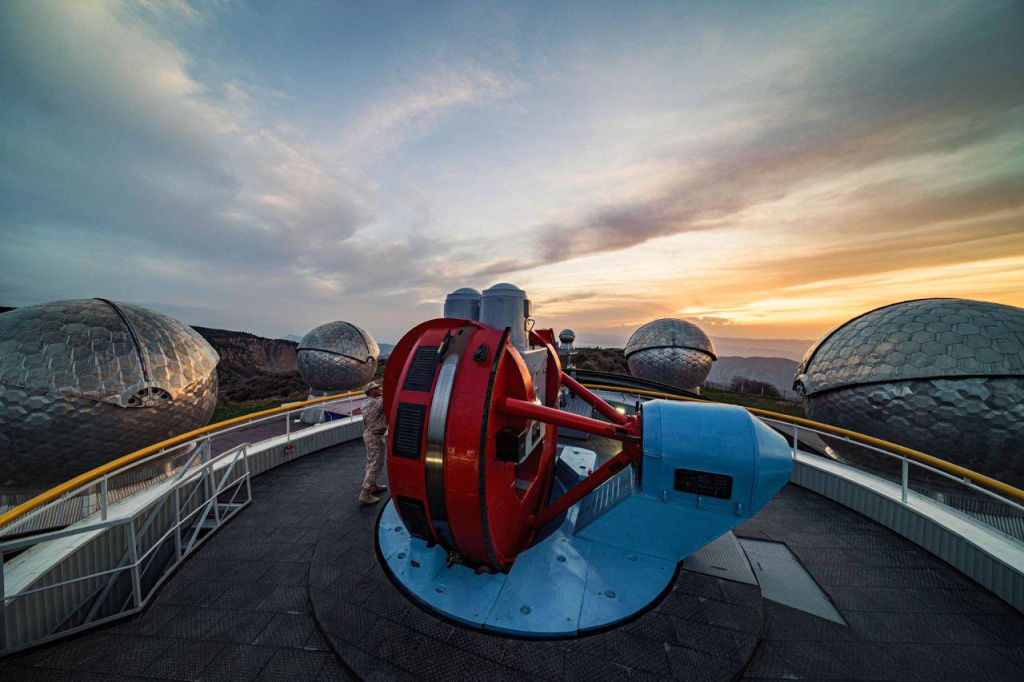
Two physical places: a military town in Nurek, and the mountain observatory at about 2,200 m near the village of Khodzharki, adjacent to the civilian Sanglok astronomical observatory. Open descriptions of the original complex list ten large folding domes housing optical-electronic stations of several types, grouped as a detection cluster (six telescopes in one common account) and a tracking / photometry cluster, each with a control centre, plus an eleventh smaller dome whose role is unpublished and is usually guessed as seeing / meteorological instrumentation. Each “gun” in a 2007 Red Star account weighed 44 tonnes and could slew between look directions in about a second.
The 2014–15 modernization added four optical-electronic stations, new television detection apparatus, and a computing suite built on a Russian component base. The Ministry described the completed Okno-M as four times more capable than the predecessor and as able to run unattended on previously catalogued and newly found objects. Standby power draw was compared, in the same briefing, to a 150-apartment block.
A mid-2010s Russian Wikipedia-class composition line still used for the site is: four detection stations, two tracking stations, and a command-computing post. That is a staff table, not a visitor’s count of domes.
HISTORY
Concept work on a dedicated optical SKKP sensor is dated in popular Russian accounts from the early 1960s and was expensive enough to stall. An advanced project of more than fifty volumes was completed in 1972 with some thirty participating organizations. The Ministry of Defence approved the tactical-technical assignment for article 54Zh6 in early 1975. Lead plant: Krasnogorsk Mechanical Plant named for S. A. Zverev (KMZ). Chief designer associated with the line: V. S. Chernov. Construction near Nurek began in 1980.
By mid-1992 electronics and part of the optics were installed. The Tajik civil war stopped the work. Construction resumed in 1994. Experimental combat duty is dated 1999. Formal commissioning / combat duty dates in open sources scatter across December 1999, July 2002, and March 2004 — the last coinciding with the property settlement. Designers received a Russian State Prize in science and technology in 2004.
In 2004 ownership passed from Tajikistan to the Russian Federation in exchange for writing off about $242 million of Tajikistan’s then $299 million debt to Russia. The mountain site is therefore a Russian military facility on foreign soil under a bilateral arrangement, not a Tajik-operated observatory.
State trials of the modernized complex finished in late 2014. Combat service of the upgraded set is dated 1 December 2014. Full capacity of Okno-M was announced in July 2015. A Ministry summary at that time attributed to the site, since 1999, more than 10 million detections/measurements, about 5,000 newly tracked high-orbit objects, monitoring of 560 insertions, more than 200 foreign spacecraft manoeuvres, and participation in 25 emergency evaluations. Those are official cumulative claims, not a third-party audit.
Soviet planning originally envisaged several Okno-class complexes, including sites in other republics and in Cuba. Only the Nurek mountain was built.
OKNO-S
Okno-S is a reported second optical complex intended to cover longitudes the Tajik site cannot see, especially the Pacific geostationary arc. Design work at KMZ is dated from 1980, initial design 1985. Open-source location estimates place it on Gora Lysaya (“Bald Mountain”) near Spassk-Dalny in Primorsky Krai, north of Vladivostok; published coordinates differ among researchers (one commonly repeated estimate is near 44.76°N, 131.71°E; others exist because several hills share the name). Sean O’Connor and others have suggested a GEO-only envelope of about 30,000–40,000 km. Official confirmation of full operational status has been thin. This page treats Okno-S as a planned or partial Far-Eastern complement, not as a documented twin of Nurek.
WHAT IT DOES NOT DO
It does not replace Krona. Krona is a radio-optical complex with UHF and centimetric radars plus optics; it characterizes objects, including in daylight radar modes, from the North Caucasus. It does not replace Don-2N or the Voronezh early-warning radars. Those are missile-attack and ABM sensors. It does not see through cloud or in daylight as a search system. It does not, by itself, maintain the national catalogue; Noginsk-9 does that. It is not an anti-satellite weapon. Data from SKKP can support launch safety, conjunction warning, and, in doctrine, targeting support for an ASAT programme; the telescopes are sensors.
STATUS
Okno-M remains in service as of the mid-2020s as the principal Russian high-orbit optical node, manned by contract personnel numbered in the hundreds at the Nurek garrison. Additional Russian optical-laser SKKP sites have been stood up on Russian territory (an Altai optical-laser centre at Savvushka / Zmeinogorsk district was announced as entering service in 2016). Those sites reduce, but do not eliminate, the unique longitude and climate value of Sanglok. The political fact is unchanged: the most capable published Russian GEO-optical window still sits on a Tajik mountain under a debt-for-base settlement.
IN ONE SENTENCE
Okno, also called Nurek and sited on Sanglok, is Russia’s 54Zh6 night-only passive optical space-surveillance complex in Tajikistan — a GEODSS-class high-orbit “window” that feeds the SKKP catalogue at Noginsk-9 and was rebuilt as Okno-M in 2014–15 — while Okno-S remains a thinly confirmed Far-Eastern counterpart.