WHAT IT IS
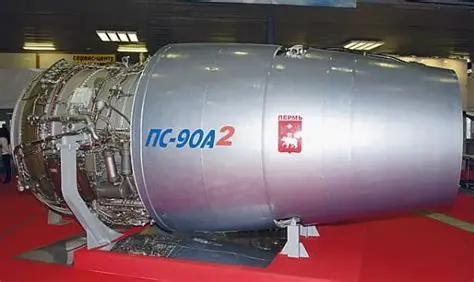
The PS-90A is Russia’s standard high-bypass commercial turbofan of the 1990s–2020s: two-spool, ~16,000 kgf (157 kN / 35,300 lbf) takeoff, bypass about 4.5, fan 1.90 m. Designed at Perm under Pavel Soloviev’s bureau (today UEC-Aviadvigatel), built at Perm Motors. First run 1987. Service from 1992–93 on the Il-96-300 and then the Tu-204/214. It is the engine that made those two airframes possible and the engine that still hangs on the Il-76MD-90A.
PS is Pavel Soloviev. 90 is the late-1980s program year, not a thrust class. Fourth generation in Soviet speech: double the bypass of a D-30KU, nearly double the overall pressure ratio, turbine inlet up ~200 K, cruise SFC down ~15% versus that third-generation family. It is not a CFM56 and it is not a PD-14. It is the bridge between them.
WHY IT EXISTS
Il-86 and Tu-154M burned too much and made too much noise for the ICAO world that was coming. MAP wanted one new fan for a new twin (Tu-204) and a new four-holer (Il-96), both flying in the same decade. Soloviev’s shop had the D-30KU/KP experience and the industrial base in Perm. The PS-90A is that common core: same 16-ton class on two 204s or four 96s.
ARCHITECTURE
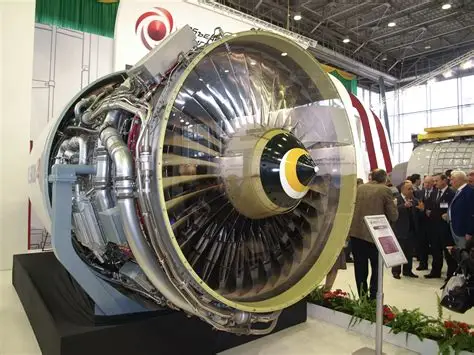
Two shafts. Single-stage fan plus two booster stages on the LP. 13-stage HP compressor. Annular / tubo-annular combustor. Two-stage HP turbine (directionally solidified blades, powder-metal disks in the later telling). Four-stage LP turbine. Mixed exhaust, cascade reverser, honeycomb liners. Dual-channel FADEC on the later marks (the A was already “electronic” by 1980s Soviet standards; A2 brought a more Western FADEC mix).
Numbers that stay on the factory card:
Takeoff 16,000 kgf (ISA, sea level; emergency / bump 17,500 on A/A2/A3) Cruise 3,500 kgf at 11 km / M 0.8 Cruise SFC ~0.595 kg/kgf·h (some sheets 0.58–0.60) OPR ~35.5 on A (A1 ~38, A-76 ~29, A2 ~33.5) Bypass ~4.4–4.5 Airflow ~504 kg/s TIT ~1,640 K on A (A1 hotter, ~1,840 K on one table) Length 4,964 mm Fan 1,900 mm Dry 2,950 kg (A2/A3 ~3,000) Delivered ~4,160–4,400 kg with reverser and kit Start band −47 to +45 °C Airfield to 3,500 m Ceiling ~13,100 m
On a Tu-204 the bureau used to say the A made 13% less thrust than an RB211-535E4 and 8% less fuel. That was the sales sentence in the 1990s.
VARIANTS
PS-90A — baseline. Il-96-300, Tu-204-100, Tu-214. 16,000 kgf. The engine you actually see.
PS-90AE — export / equipment-standard letter on some lists; same thrust class.
PS-90A1 — uprated 17,400 kgf takeoff, OPR ~38, low-emission combustor, second-generation liners. Il-96-400 / 400T / 400M. Certified ~2007. Cruise thrust on one sheet drops to 3,300 kgf; SFC a hair worse (0.604).
PS-90A-76 — Il-76MD-90A / Il-76TD-90A. Derated 14,500 kgf takeoff so the old 76 airframe and the new high-bypass fan agree; emergency 16,000. OPR ~29. Same cruise 3,500. ~15% better SFC than the D-30KP it replaces. Certified / in service from 2003 in Russian notes. This is the volume military customer.
PS-90A2 — Perm + Pratt & Whitney 1990s partnership. Western bits from the US/France/Germany/Sweden in the original mix. AP-33 cert 2009. Stage 4 noise. First Russian commercial fan advertised ETOPS-180. On-condition maintenance. Same 16,000 / bump 17,500–18,000. Dry 3,000 kg. Bureau claims 1.5–2× durability, half the wrench time. Aimed at Tu-204SM and as a drop-in for A. American involvement died after export-control fights (Iran sale attempts). The remaining A2 is a Russianized descendant of that paper.
PS-90A3 — 2011 cert (NLGS-3 / ICAO 2008 emissions). A2 virtues without as much Western content: 16,000 / 17,500, SFC 0.6, 3,000 kg dry. Sold for Il-96-300 and the 204/214 family as a cheaper life-cycle A. Tu-204SM also listed.
PS-90A-42 — A2 for the Beriev A-42 SAR project. Paper / special.
PS-90A-154 — side-mount kit drawn for a twin-PS-90 Tu-154M2 that was never a production airplane.
Smaller paper marks (A10, A12, AM) lived in 1990s thrust-class studies. Ignore them unless you are reading an old prospectus.
WHAT IT HANGS ON
Two on: Tu-204, Tu-214, Tu-204SM (A2/A3). Four on: Il-96-300 (A), Il-96-400/400M (A1), Il-76MD-90A and civil TD-90A (A-76).
That is the entire modern Russian high-bypass fleet that is not a PD-14 or a PD-8. When UAC says “import-substituted Tu-214” or “new Il-96-300 for SLO,” the fan is still this family.
VERSUS D-30 AND PD-14
D-30KU/KP: third generation, bypass ~2.4, the Il-62M / Il-76 / Tu-154M sound. PS-90A was built to retire that noise and that fuel bill on new types — and only half-succeeded, because the airframes arrived in the 1990s collapse.
PD-14: next Perm generation for the MC-21, higher bypass, new core. PD-8 is the regional shrink for the SJ-100. Both use the industrial habits the PS-90 taught Perm. Neither is a PS-90 with a new name.
LIFE AND LIMITS
Early A time-on-wing was short by CFM standards; that is why A2/A3 exist. Russian tables still print first-removal cycle counts that look harsh next to a CFM56-7 (A ~1,255 cycles on one sheet; A-76 much longer in hours). On-condition talk is A2 language. Winter start to −47 °C is the Siberian sentence every Perm brochure repeats. Stage 3 was the A; Stage 4 is A2/A3 / late hush kits.
It is a competent 16-ton 1987 fan still in production because Russia has no other certified engine in that class hanging on flying airframes. That is a compliment and a trap.
STATUS
In production at Perm for Il-76MD-90A volume and the trickle of Tu-214 / Il-96 state orders. A1 for the 400M. A3 as the “domestic life-cycle” civil mark. The westernized A2 as originally drawn is a 2009 certificate, not a 2026 supply chain. Until PD-14 is on a working MC-21 line in numbers, the PS-90A family is still the sound of Russian long metal.
IN ONE SENTENCE
The PS-90A is Perm’s 16-ton, 4.5-bypass fourth-generation fan — Soloviev’s replacement for the D-30KU — that powers the Tu-204/214, the Il-96, and the re-engined Il-76, and remains the only Russian commercial engine in that class that is actually on the wing.