WHAT IT IS
A portable cassette player is a battery box that pulls Compact Cassette tape past a stereo playback head at 1⅞ inches per second (4.76 cm/s) and feeds headphones. It is not a boombox (those have speakers and usually record). It is not a Walkman by legal necessity — Walkman is Sony’s trademark — but after July 1979 every pocket player lived in that shadow.
The cassette itself is Philips’ 1963 compact format: two miniature reels in a 10.2 × 6.3 × 1.27 cm shell, 3.81 mm tape, four tracks (stereo pair each way). C30 / C60 / C90 / C120 are minutes of total time, both sides. The player only has to do three mechanical jobs well: constant capstan speed, stable head contact, and enough torque on the take-up reel that the pack does not loop into the door.
HOW THE TRANSPORT WORKS
A DC motor, usually with a mechanical or electronic governor, turns a belt. The belt turns a brass or sintered flywheel pressed onto the capstan — a ground steel shaft a few millimetres across. A rubber pinch roller clamps the tape against the capstan. Linear speed is set by capstan diameter × rpm, not by how full the take-up reel is. That is the entire invention that made cassettes listenable. Reel-to-reel portables that drove the take-up hub directly changed pitch as the pack diameter grew.
The flywheel is there so footsteps and belt scatter do not become wow. On a table deck one flywheel is enough. In a coat pocket, rotating the player around the flywheel axis makes the wheel fight the turn (same physics as a gyro). Speed hunts. Sony and others answered with a second flywheel geared or belted the other way — the “anti-rolling” trick. Auto-reverse machines get a second capstan/flywheel for free because they already pull both directions.
Take-up is a slipping clutch on the take-up spindle so torque stays roughly constant as the pack grows. Supply-side back tension is a felt pad, a spring idler, or a light brake. Fast-forward and rewind dump the capstan and drive the reels through idlers or a second belt. Auto-stop is a lever that feels the supply spindle stall, or a cam that loads the motor once per revolution until the tape ends and the load signature changes. That cam is also a classic source of rhythmic wow on cheap belt decks.
The head is a stereo playback core in the centre window of the shell. An erase head only exists if the unit records. Bias and EQ (120 µs ferric, 70 µs chrome/metal) are playback-equalizer choices; a player that only plays still needs the right EQ curve or the top end is wrong.
THE WALKMAN CUT
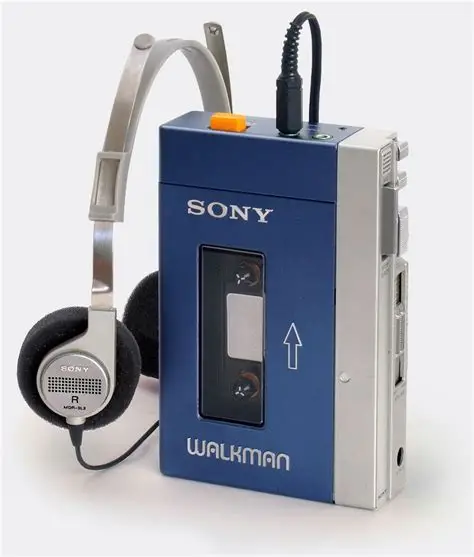
Sony TPS-L2, on sale in Japan 1 July 1979, about $150 / £100 with MDR-3L2 phones. Body taken from the TCM-600 Pressman mono journalist recorder: record amp, erase head, speaker, and counter deleted; stereo head and two headphone jacks fitted. Blue-and-silver metal, 88 × 133.5 × 29 mm, 390 g, two AA cells, ~8 hours, 20 mW/channel class. A “Hotline” mic button let two listeners talk without pulling the phones. Early units said STEREO on the door; WALKMAN came later. Export names Soundabout and Stowaway lost.
Ibuka wanted opera on flights. Takashino’s group prototyped in days off the Pressman tooling. Andreas Pavel’s earlier Stereobelt patent (1977) became a decades-long fight Sony eventually settled. Every Japanese audio house had a clone within two years: Toshiba Walky, Panasonic, Aiwa, Sanyo, Sharp. The category, not the trademark, ate the 1980s.
WHAT GOT ADDED
Dolby B (and later C on better decks) — complementary high-frequency compressor on record, expander on play. Cuts hiss that a 4.76 cm/s narrow track otherwise wears as a coat. A player without Dolby playing a Dolby cassette sounds dull unless you cheat the tone control. Modern revival units often skip Dolby because the encoder chips are out of production.
Auto-reverse — either a four-channel head with two gaps and a direction change, or a two-channel head on a small turntable that flips 180°. Second pinch roller uses the erase-head window. Alignment is never as good both ways; Nakamichi’s expensive decks motor-trimmed it. Car decks made reverse standard so the driver never flipped a tape in traffic.
AMS / blank-scan — look for a stretch of silence and stop at the next tune. Crude, tape-hiss dependent, still loved.
Quartz-locked / FG servo motors instead of a mechanical governor. Lower wow on the WM-D6C “Walkman Professional” class that journalists actually recorded on.
DBB, Mega Bass, graphic sliders — loudness contours to make 20 mW and foam pads sound like a room. Harmless.
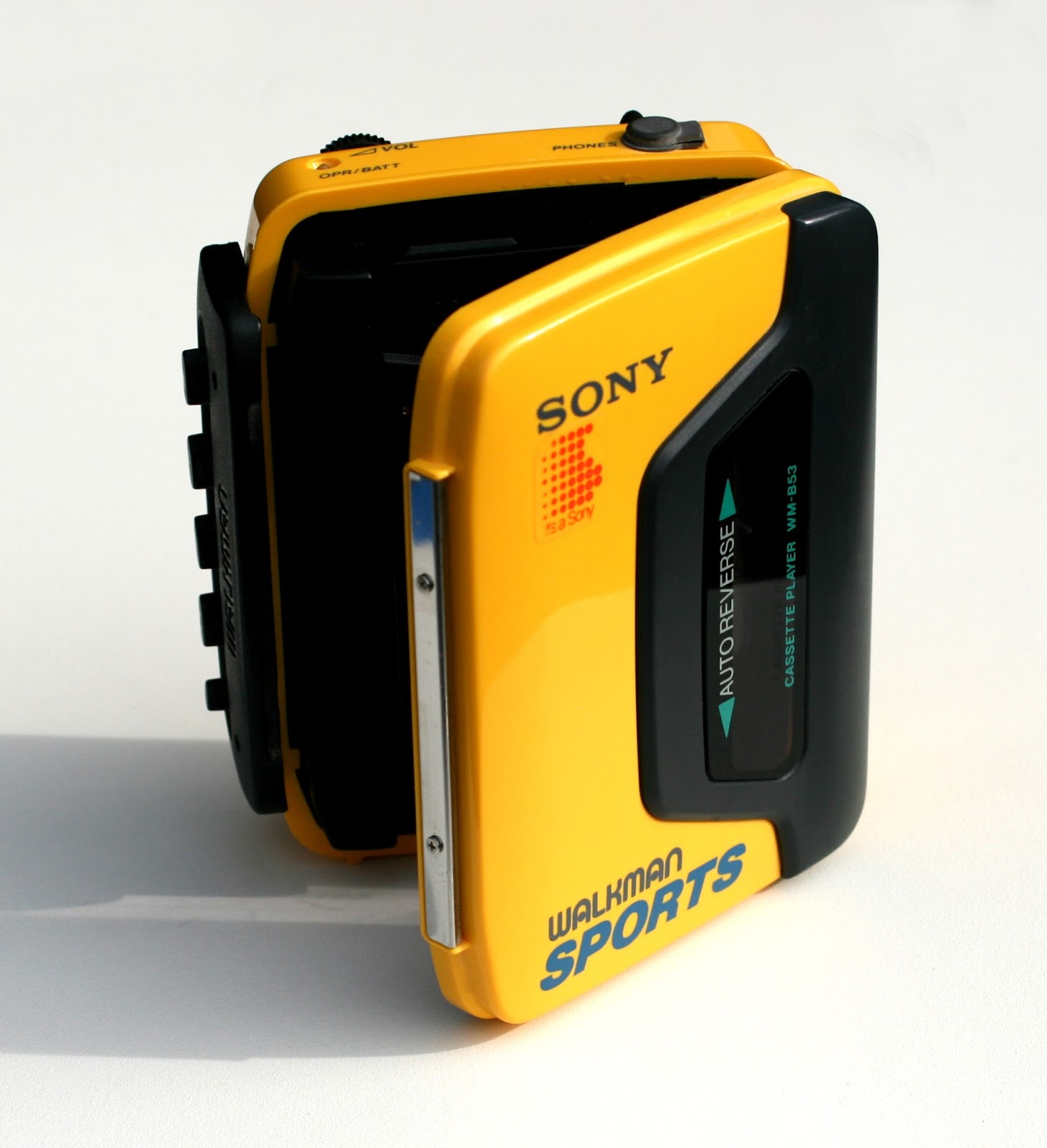
Solar, rechargeable packs, water-resistant shells, radio tuners, TV-band Walkmans, recording Walkmans (WM-D6, TCM series). The slimline plastic players of the mid-90s got the mechanism down to a credit-card stack and a belt that died in five years.
TAPE AND HEADS
Type I ferric, Type II chrome / cobalt-doped, Type IV metal. Portable players rarely had a Type IV EQ switch; they assumed I or II. Head wear is real: the gap opens, treble falls, then you replace a head that is no longer stocked. Pinch rollers glaze and flat-spot. Belts turn to tar. That is the entire restoration industry.
Wow and flutter on a healthy pocket player sits around 0.1–0.3% WRMS if you are lucky; a good home deck is better. Signal-to-noise with Dolby B on Type II is listenable. It is not a DAT or a CD. It is a physical medium with a personality, which is why it came back.
WHO MADE THEM
Sony (Walkman), Aiwa (often the better-sounding Sony cousin), Panasonic RQ, Toshiba, Sharp, Sanyo, Hitachi, Pioneer, Kenwood. Western badges on Japanese transports. Soviet and East-bloc copies of the same Japanese “tennis swing” mechanism. Car aftermarket: Alpine, Clarion, Pioneer in-dash. By the late 1990s the race was MiniDisc and then flash. Sony stopped making cassette Walkmans in 2010.
REVIVAL
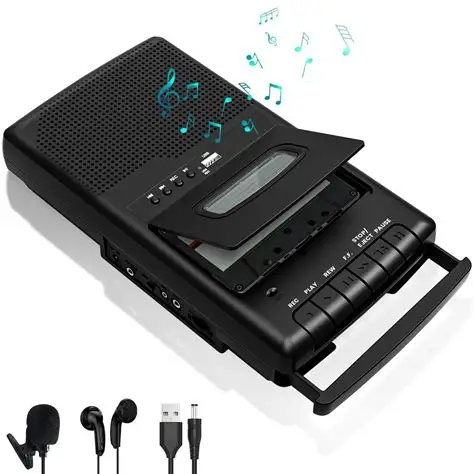
We Are Rewind WE-001 (TPS-L2-shaped metal), FiiO CP13, various no-name Bluetooth cassette boxes. New-old-stock belts and rollers keep 1980s metal Walkmans alive. The format’s limit is the same as 1979: 1⅞ ips, 3.81 mm, two channels, and a rubber wheel.
CAVEATS
Walkman is Sony’s word. Pavel’s patent is a real legal history, not a “Sony stole it” slogan. Output milliwatts and battery life vary by model; TPS-L2 figures above are that one machine. Dolby on a playback-only Walkman is a decoder, not magic.
STATUS
Dead as a mass product, alive as a format. The mechanism — capstan, pinch roller, slipping clutch, two AA cells — has not been improved in a way that matters. Headphones got better. The tape did not.
IN ONE SENTENCE
A portable cassette player is a pocket capstan deck that runs Compact Cassette at 1⅞ ips into headphones — invented as Sony’s 1979 TPS-L2 Walkman off a Pressman recorder, copied by every audio house on earth, and still a belt, a flywheel, and a pinch roller.