WHAT IT IS
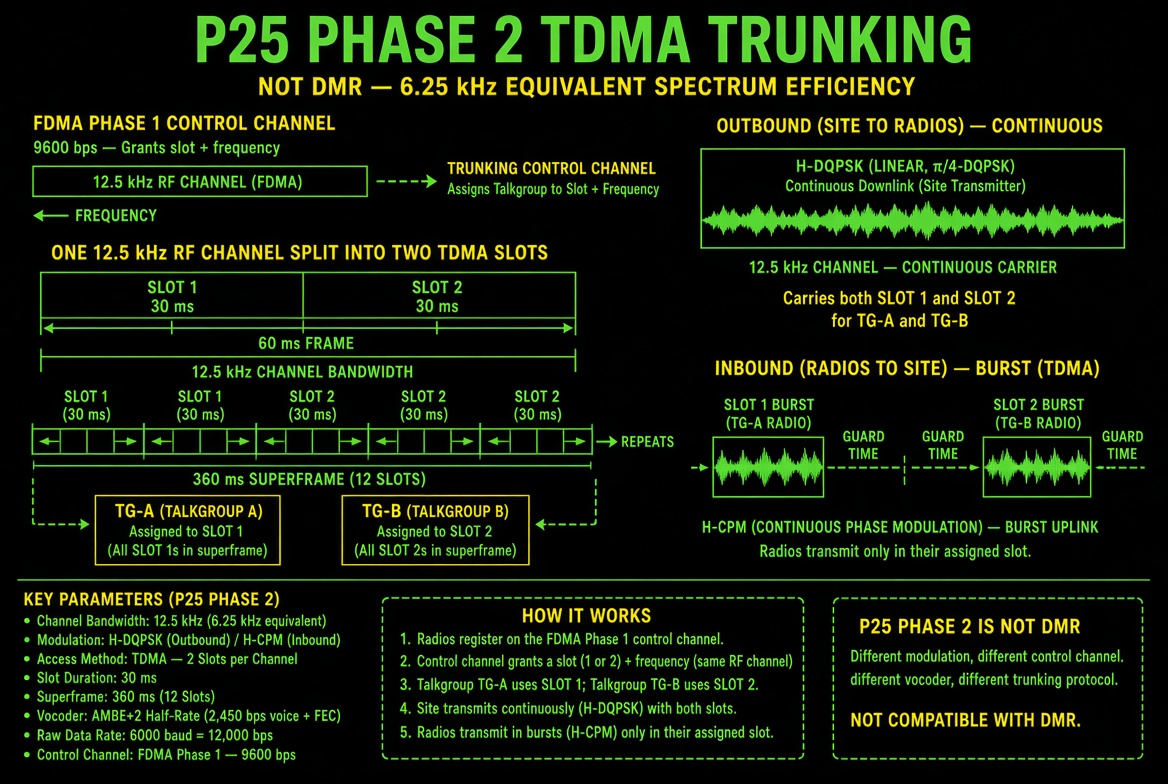
P25 TDMA trunking is Project 25 Phase 2: two independent voice paths inside one 12.5 kHz RF channel. That is the FCC 6.25 kHz-equivalent efficiency rule without splitting the licence into two 6.25 kHz FDMA pairs. The two paths are slots. A grant names frequency and slot.
TIA-102.BBAB (physical layer, 2009) and TIA-102.BBAC (MAC, approved 2010, published late 2010) are the core papers. Motorola began shipping ASTRO 25 Phase 2 in 2011. Conventional P25 remains Phase 1. Talk-around / simplex is Phase 1. Data traffic on mixed sites is usually still FDMA.
HOW A CALL IS SET UP
Idle radios still sit on a control channel — on almost every live system that channel is the Phase 1 FDMA 9600 bit/s C4FM/CQPSK control channel with TDMA extensions. A Phase 2 radio requests a call. The RFSS looks at who is affiliated:
— All parties Phase 2 capable → grant a TDMA traffic channel and a slot.
— A Phase 1 radio is in the talkgroup, or the talkgroup is provisioned FDMA / Dynamic Dual Mode → grant a full 12.5 kHz FDMA voice channel.
— Data call → FDMA traffic channel.
Radios jump to the assigned frequency, lock the slot, run half-rate voice, then return to the control channel. Phase 1 radios ignore TDMA-only TSBKs. A later standard adds a true TDMA control channel (two virtual CCs in 12.5 kHz). Most deployed nets have not cut that over.
THE AIR INTERFACE
Channel still 12.5 kHz. Symbol rate 6000 baud, two bits/symbol → raw 12 000 bit/s for the whole channel (~6000 bit/s per slot). Slot length 30 ms (360 bits on the air; ~320 information bits). Twelve slots = one 360 ms superframe — same wall-clock as a Phase 1 superframe. Four superframes = an ultraframe.
Outbound (site → radio) is continuous H-DQPSK. If only one slot is in a call, the unused slot carries a replacement burst so the downlink never goes quiet. Inbound (radio → site) is always bursty H-CPM: the handset ramps, sends its 30 ms slot, ramps down. That keeps the subscriber on a constant-envelope PA — same class of RF chain as Phase 1 C4FM, which is why portables did not need a linear amplifier.
Vocoder: AMBE+2 half-rate (~3600 bit/s). Phase 1 IMBE full-rate does not fit a slot. NIST comparison of full-rate vs half-rate AMBE+2 found no large MOS gap on the published tests.
Common emission designators: inbound H-CPM 8K10F1W / 8K10DXW; outbound H-DQPSK 9K80D7W / 9K80F1E / 9K80F1D. Do not confuse CQPSK 5K76G1E (Phase 1 simulcast) with Phase 2.
CONTROL CHANNEL AND MIXED SITES
The FDMA control channel was kept on purpose. One site can run Phase 1 voice, Phase 2 voice, and FDMA data from the same 9600 bit/s CC. TDMA extensions on that CC advertise slot capability, vocoder rate, and timing so a Phase 2 radio can leave the CC and land on an inbound H-CPM slot without a redesigned Phase 1 sync. The CC is not slot-locked to the traffic channels.
Dynamic Dual Mode (Motorola option): if a Phase-1-only radio affiliates to a TDMA talkgroup, the whole talkgroup drops to FDMA until that radio leaves. Least-common-denominator. Systems without DDM strap a talkgroup TDMA-only or FDMA-only.
NOT THESE
P25 FDMA trunking — one call per 12.5 kHz, IMBE, C4FM/CQPSK. Previous page.
DMR — also two slots in 12.5 kHz, different CAI, 4FSK both ways, 30 ms slots but not P25 grants.
TETRA — four slots in 25 kHz.
NXDN 6.25 — true 6.25 kHz FDMA, not two slots.
CAVEATS
“Phase 2 control channel” in a log is usually still Phase 1 C4FM with extra opcodes. A Harris-style TDMA CC exists in the suite and is rare on the air. 12 kbit/s is the RF channel rate, not the vocoder rate. CQPSK is Phase 1 simulcast, not H-DQPSK.
STATUS
In service on US public-safety trunked nets as the capacity layer. Mixed FDMA/TDMA sites are the normal field picture.
IN ONE SENTENCE
P25 TDMA trunking is Phase 2 two-slot operation — 30 ms slots, 6000 baud / 12 kbit/s in one 12.5 kHz channel, H-DQPSK down and H-CPM up, AMBE+2 half-rate — granted by a Phase 1 FDMA control channel that can still fall a talkgroup back to FDMA if a Phase 1 radio shows up.