WHAT IT IS
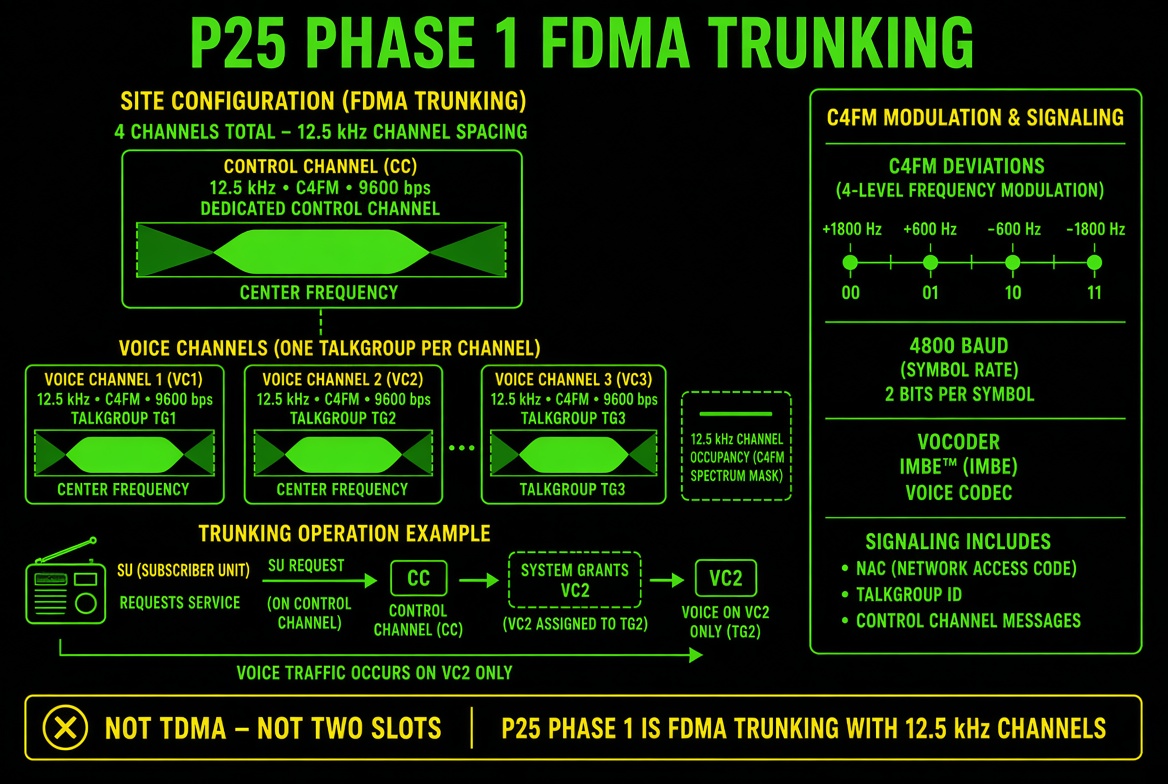
P25 FDMA trunking is Project 25 Phase 1 used as a pool of radio channels instead of a fixed repeater pair. FDMA means frequency division: one conversation occupies one 12.5 kHz channel for the whole call. A dedicated control channel hands out the voice channels. When the call ends, the channel returns to the pool.
This is the Common Air Interface baseline every P25 radio can do. Conventional P25 is the same air interface with no control channel — the talkgroup lives on one frequency. Phase 2 TDMA (two slots in one 12.5 kHz channel) is the next page. Until a TDMA control channel existed, even Phase 2 sites used this FDMA control channel.
HOW A CALL IS SET UP
1. Idle radios sit on the outbound control channel and read trunking signalling blocks (TSBKs) — system ID, neighbour sites, grants, status.
2. A subscriber unit (SU) keys a talkgroup. The request goes inbound on the control channel (radio to site).
3. The RF subsystem picks an idle voice channel and broadcasts a grant: talkgroup X, go to frequency Y.
4. Every radio affiliated to that talkgroup leaves the control channel, lands on Y, and the call runs IMBE voice until hang time expires.
5. Radios return to the control channel. The voice frequency is free for the next grant.
A site only radiates a talkgroup if at least one radio is affiliated. Wide-area systems (state VIPER-class nets) repeat that grant only at sites that have a member. Radio IDs are 24 bits (~16 million). Talkgroups are 16 bits (~65,000). A control channel carries on the order of 40 trunking commands per second.
THE AIR INTERFACE
Channel: 12.5 kHz. Symbol rate: 4800 baud (208 µs). Two bits per symbol → raw 9600 bit/s. Voice: IMBE full-rate (~7.2 kbit/s including FEC). Later full-rate AMBE also appears on FDMA voice. Error control by field: Golay, Hamming, Reed–Solomon, trellis.
Modulation, two compatible paths:
C4FM — constant-envelope 4-level FM. Deviations from channel centre: 01 = +1800 Hz, 00 = +600 Hz, 10 = −600 Hz, 11 = −1800 Hz. Mobile and most non-simulcast sites.
CQPSK (LSM, linear simulcast) — same symbol decisions at the sampling instant, shaped for simulcast delay spread. Needs a linear PA. Fixed sites only. An FM receiver still reads it.
Emission designators commonly logged: C4FM 8K10F1E / 8K10F1D; CQPSK 8K70D1W / 9K70F1D.
WHAT THE CONTROL CHANNEL CARRIES
Outbound: system identity, Network Access Code (NAC, 12-bit, the digital equivalent of CTCSS), WACN / system / RFSS IDs, neighbour lists, channel grants, call alerts, status, registration acks. Inbound: affiliation, call request, deregistration, emergency. A composite control channel can be stolen for voice; while it is a traffic channel it does not issue grants. Dedicated control is the normal trunked layout.
Encryption is on the voice payload (DES, AES-256 on later systems), not a second modulation. Clear and encrypted talkgroups share the same pool.
NOT THESE
P25 conventional — same C4FM / IMBE, no control channel, NAC instead of a grant.
P25 Phase 2 TDMA — two slots in one 12.5 kHz voice channel, H-DQPSK down / H-CPM up, AMBE+2 half-rate. Next article.
DMR — also two-slot TDMA in 12.5 kHz, different CAI.
TETRA — four slots in 25 kHz.
CAVEATS
“Phase 1” is the FDMA air interface. A Phase 2 site still uses a Phase 1 control channel unless it has been cut over to a TDMA control channel. CQPSK is not Phase 2. Dynamic Dual Mode can drop a talkgroup back to FDMA if a Phase-1-only radio affiliates.
STATUS
The control channel most P25 trunked systems still run. Voice may be FDMA, TDMA, or mixed on the same site.
IN ONE SENTENCE
P25 FDMA trunking is Phase 1 as a pool — a 12.5 kHz C4FM (or CQPSK) control channel at 4800 baud / 9600 bit/s grants one IMBE voice channel per call, and every radio that shares the talkgroup jumps to that frequency until hang time ends.