WHAT IT IS
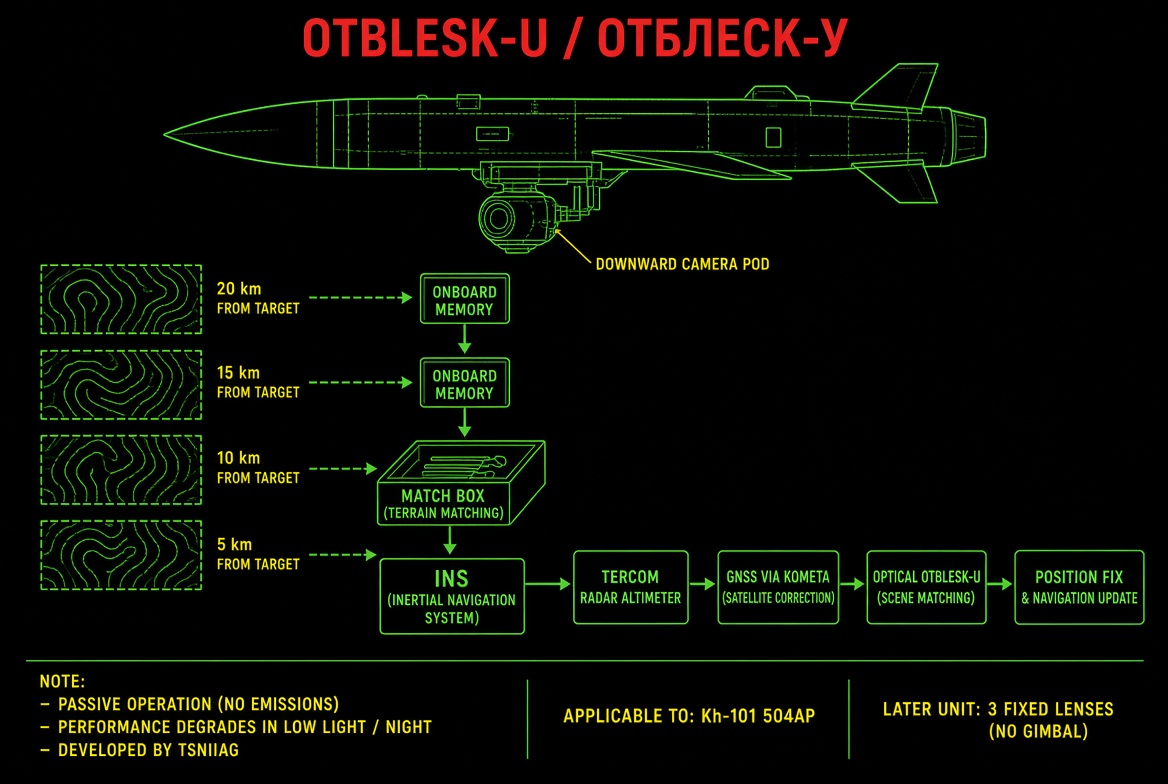
Otblesk-U (Russian: «Отблеск-У», “Gleam-U”) is the optoelectronic scene-matching corrector on the Kh-101 cruise missile, fitted as the fourth guidance layer on izdeliye 504AP. It compares a downward view of the ground with reference frames loaded before launch and writes a position fix into the inertial navigator. It does not radiate. Jamming the satellite receiver does not touch it.
GUR’s parts list (published 8 July 2025) names the unit “opto-electronic guidance system Otblesk-U,” manufacturer AO TsNIIAG, with NPO Geofizika-NV and EPO Signal on the chain. Raduga designs the missile. Smolensk builds it. About 111 of the 504AP modification were reported produced in 2021–2022. The same airframe carries the L-504 expendable-decoy dispenser. That dispenser is not part of the correlator.
WHERE IT SITS IN THE STACK
Kh-101 navigation is four layers, used together, not instead of each other.
INS — dead reckoning for the whole flight. Drifts.
GNSS — GPS / GLONASS, later with a Kometa-class CRPA. Dies under a good jammer.
TERCOM — radar altimeter versus a stored elevation profile. Works at night. Coarse.
Otblesk-U — optical DSMAC. Tightest fix. Needs a picture.
Ukrainian wreck briefs describe the optical unit as the terminal corrector, about the last 20 km, with reference “portraits” tied to patches near 20, 15, 10 and 5 km from the aimpoint — bridges, road junctions, rail yards. Midcourse stays on INS, satellite, and TERCOM so the map load stays small. A terminal seeker (optical or radar, depending on the card) is a further layer on some writeups and is not the same box.
HOW THE MATCH WORKS
Before launch, digital frames of the correction patches are written into memory. In the terminal leg a downward camera photographs the underlying surface. A correlator slides the live frame over the stored frame, finds the offset, and updates the INS. The method is the same class as Tomahawk DSMAC and as Susanin on the jet Geran. Susanin is the drone-scale cousin. This is the missile box.
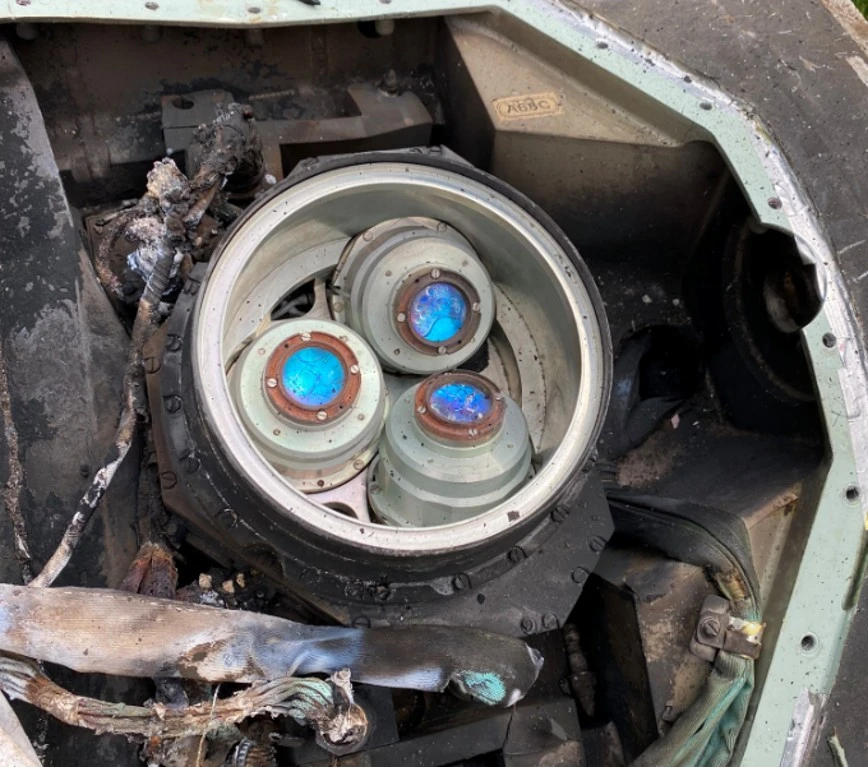
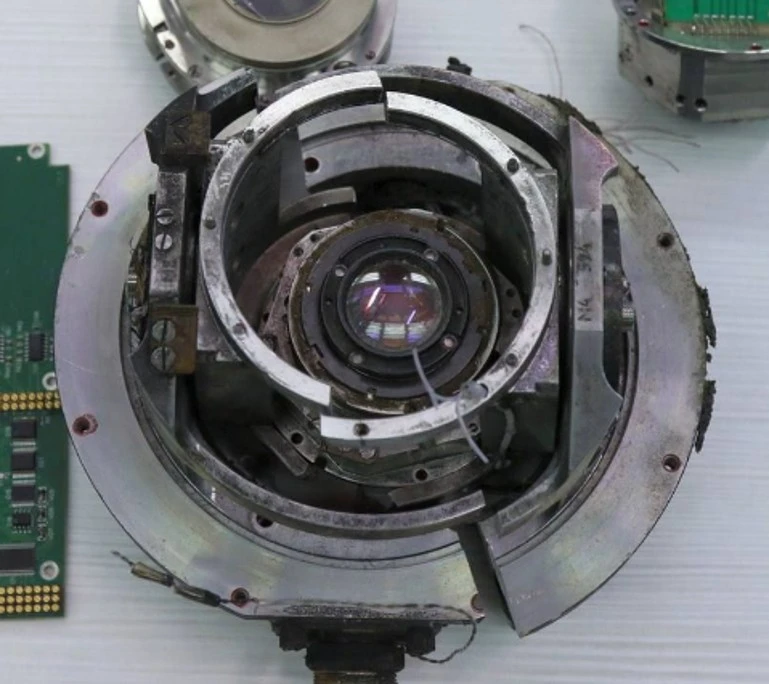
Early recovered units had one moving optic. Later 504AP wrecks, including a November 2022 round shown in early 2023, have three fixed lenses at different fields of view instead of one steerable lens. Ukrainian accounts treat that as the accuracy upgrade. A 2026 note also ties a smaller Kometa-class satellite antenna to the same modernization pass. The camera and the CRPA are different sensors.
LIMITS
The correlator needs light, a recognizable patch, and a reference that still looks like the ground. Night, snow, long shadows, and a changed junction cut the match. Defense Express and later technical writeups treat night DSMAC on Kh-101 as the layer that drops out, which is why night raids lean on INS, TERCOM, and whatever GNSS still comes through. Map loading is slow and wants a trained crew and a loader, which is another reason the optical patches are terminal-only.
Published circular-error figures for the missile (about 10–20 m on older cards, “a few metres” on the 504AP claim) are missile figures, not a bench test of this box alone.
PLANT AND AIRFRAME
TsNIIAG is the named designer of the guidance unit. Geofizika-NV is an optical house. EPO Signal is on the GUR chain. A 2026 private-intelligence note that called Otblesk a lidar from the Azov Optical-Mechanical Plant is a single source and is not the GUR stencil. The recovered hardware shown in Kyiv is a camera correlator, old single lens and new three-lens. Treat “lidar” as unconfirmed.
Carrier is the Kh-101 (and the nuclear Kh-102 airframe family). Launchers: Tu-95MS and Tu-160. The missile cruises near Mach 0.58, can go higher, and flies from tens of metres to about 10 km. Range cards run from about 2,500 km to higher claimed figures. None of that is a property of the correlator.
NOT THESE
Susanin — same job, Geran-4 / Geran-5, different box.
TERCOM — radar height versus a profile. Kh-555 and Kalibr have had this without a public DSMAC equivalent.
Kometa — CRPA in front of the GNSS receiver.
L-504 — flare / decoy dispenser on 504AP.
SN-99 / BAGET — other Kh-101 avionics names on wreck cards. Not the camera.
CAVEATS
“Otblesk-U” is the GUR and Russian-press name for the optical layer on 504AP. Older missiles had an optical corrector before that stencil. Three-lens versus one-lens is from wreck photos, not a brochure. Night loss of the optical layer is inferred from how DSMAC works and from Ukrainian technical press, not from a Russian acceptance trial.
STATUS
Fielded on Kh-101 504AP from the early 2020s. Still the optical layer being recovered from wrecks.
IN ONE SENTENCE
Otblesk-U is TsNIIAG’s optical DSMAC on Kh-101 izdeliye 504AP — three fixed lenses on the later unit, reference patches in the last 20 km, a passive fix into the INS when GNSS is gone — and it goes blind at night in a way TERCOM does not.