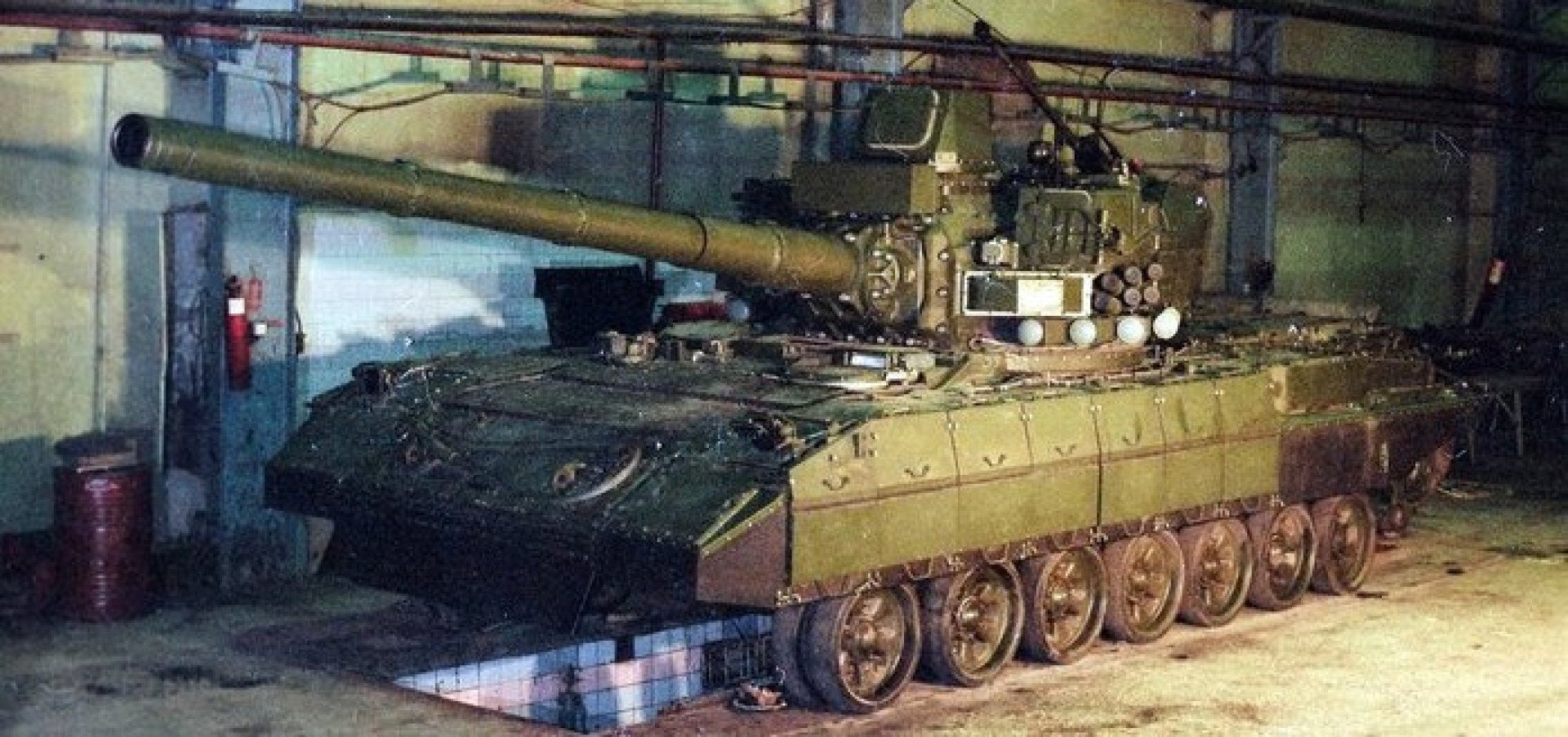
WHAT IT IS
Object 195 is the internal index of a Russian next-generation main battle tank developed at UKBTM / Uralvagonzavod in Nizhny Tagil. The open name is T-95. The design theme was «Усовершенствование-88» (Improvement-88). Work ran from the late 1980s to 2010. The Ministry of Defence stopped funding it in April–May 2010. A handful of prototypes were built. None entered service.
It is the direct ancestor, in ideas, of the T-14. Unmanned turret, crew in a hull capsule, new gun, new powerpack. Armata is the later, lighter-calibre, actually-paraded version of that layout. Object 195 is the one that was judged too heavy, too new, and too expensive for the industry of 2010 to build in series.
LAYOUT
The break with the T-72 is the same break T-14 later made. Crew out of the turret. Published reconstructions put two or three men in an isolated armored compartment in the forward hull — commander, driver, and a gunner, or a two-man crew with more of the gunnery automated. The turret is uncrewed and carries the gun and the autoloader. A hit on the turret is meant to disable the weapon, not kill the crew.
Secondary armament on the better-sourced reconstructions is a 30 mm automatic cannon (2A42 or 2A72 are both named) coaxial or paired with the main gun, for light armor and the close fight a 152 mm round is wasted on. Machine guns are assumed and not well documented.
THE GUN
Main armament is the 2A83 152 mm smoothbore. That calibre is the point of the project. A 152 mm tank gun fires a heavier rod and a heavier high-explosive round than 125 mm, and can in principle launch a larger gun-tube missile. Russian press claims from the period include penetration on the order of 700 mm of armor at 2,000 m and the ability to fire anti-tank and anti-aircraft missiles through the tube. None of those figures comes from a published trial report.
Ammunition stowage is given as about 40 rounds in later reconstructions. The autoloader had to handle a longer, heavier round than the T-72 carousel. That drove turret volume, which drove weight. Howitzer ammunition is not interchangeable with a tank 152 mm round. The tube is a tank gun.
AUTOMOTIVE AND PROTECTION
The powerpack associated with the project is the Chelyabinsk X-12 diesel that later appears as the 12N360 / A-85-3A on Armata, in the 1,500 hp class (some cards say 1,650). Weight cards run from under 55 t to 58–60 t. Road speed is listed around 75 km/h, range past 500 km. Suspension is described as hydropneumatic on some English cards and as a developed torsion set on others. Treat both as unverified.
Protection is composite hull armor plus explosive reactive armor. Kontakt-5, Relikt, and an Afganit- or Drozd-2-class active system have all been named in secondary sources. The hard public fact is that the tank was designed with a crew capsule and a heavy turret, not which ERA tiles were on the last prototype.
HISTORY
Improvement-88 started in 1988 under Vladimir Potkin at UVZ, as the clean-sheet successor once further T-72 growth was judged insufficient. Funding collapsed with the Soviet Union. Work was nearly still through the 1990s. Defence Minister Igor Sergeyev mentioned the prototype publicly in 2000. A small number of running hulls existed by the early 2000s. In 2008 the type was described as ready for state trials, and the government said a tank superior to the T-90 would reach units after 2010.
It did not. On 7 April 2010 deputy defence minister and armaments chief Vladimir Popovkin said funding for Object 195 had stopped and the project was closed. His stated reason: the design was morally obsolete, having been in work for almost two decades. Other stated reasons in the same season were cost, the 2008–10 budget squeeze, and the inability of the Russian industry of that year to series-produce the new gun, the new transmission, and the new electronics together. Popovkin said the Army would modernize the T-90 instead, and that UVZ could continue on its own money if it wanted. UVZ said it would. A closed showing was reported at the Nizhny Tagil “Defence and Protection 2010” exhibition in July. By 2011 UVZ director Oleg Sienko was still saying the plant would finish the work. Nothing fielded came of it.
The layout, the X-diesel, the unmanned turret, and the crew capsule reappeared, scaled to a 125 mm gun, as the T-14 Armata, first shown in 2015. Object 195 is the cancelled 152 mm draft of that tank.
WHAT IS ACTUALLY KNOWN
Firm: the index, the plant, the theme name, the 152 mm unmanned-turret concept, cancellation in spring 2010 by Popovkin, a few prototypes, no service. Everything else — exact crew count, exact weight, which 30 mm gun, which APS, hydropneumatic versus torsion, round count — comes from leaks, later 3D reconstructions of alleged blueprints, and press. A December 2025 wave of renders based on claimed factory drawings repeated 58 t, 2A83 with 40 rounds, 2A72, three-man capsule, 1,650 hp. Useful as a consistent picture. Not a UVZ data sheet.
NOT THESE
T-14 Armata — the later, 125 mm, paraded descendant. Object 148, not 195.
Object 640 / Black Eagle — Omsk’s rival next-tank proposal, different bureau, manned turret with a bustle autoloader.
2S35 Koalitsiya-SV — 152 mm howitzer on a related generation of chassis. Not a tank.
T-14 “152 mm variant” — a 2020s claim about Armata. Not a revived Object 195.
CAVEATS
No brochure, no parade, no verified combat, no confirmed production count beyond “several prototypes.” English-language specification tables disagree with each other and with the Russian wiki. Popovkin’s “obsolete” and the industry’s “we cannot build it in series” are both on the record. Which one decided the cancellation is not.
STATUS
Cancelled 2010. Concepts absorbed into Armata. The prototypes are not a fleet.
IN ONE SENTENCE
Object 195 (T-95) is UKBTM’s cancelled next tank — unmanned turret, crew capsule, 152 mm 2A83 — run from 1988 to 2010, killed by Popovkin as obsolete and unbuildable in series, and recycled in 125 mm form as the T-14.