WHAT IT IS
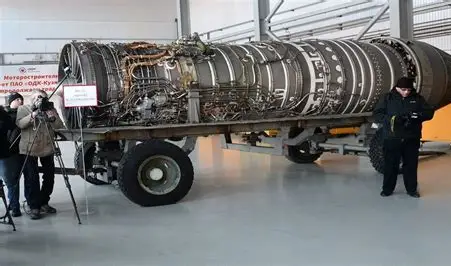
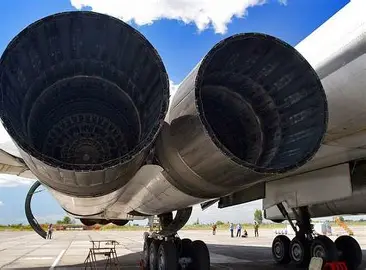
The Kuznetsov NK-32 is a Soviet then Russian three-spool, low-bypass, afterburning turbofan built to push a 270-tonne variable-geometry bomber to Mach 2. It is the engine of the Tupolev Tu-160 (NATO Blackjack). Four of them hang in paired nacelles under the wing gloves. Dry thrust is 14,000 kgf (about 137 kN). Full afterburner is 25,000 kgf (about 245 kN) each — roughly 100 tonnes of installed reheat for the aeroplane. That is still the highest thrust figure fitted to a combat aircraft; big civil fans make more pounds but at exhaust speeds that will not hold a supersonic cruise.
Factory names wander. Kuznetsov papers and Russian Wikipedia treat NK-32 as the service type and NK-32-1 / NK-321 as the Tu-144LL / test-airframe cousin. English lists often print NK-321 for the bomber engine as well. Series 01 is the 1980s production article. Series 02 (NK-32-02, sometimes “Tier 2”) is the restarted Samara build for Tu-160M / M2. This page uses NK-32 for the family and flags the shop name when it matters.
PLACE IN THE KUZNETSOV LINE
Nikolai Dmitrievich Kuznetsov’s Kuibyshev (now Samara) bureau already had NK-144 on early Tu-144, NK-22 / NK-23 on early Tu-22M, and NK-25 on Tu-22M3. NK-32 is the bigger three-spool answer for the Tu-160 requirement, designed from 1977, series from about 1983–84, first aircraft in service 1987. Production stopped in 1993 after on the order of 250 engines. Ground derivatives followed: NK-36ST / NK-37 class industrial gas turbines and the NK-361 gas-turbine locomotive project. The same core is the advertised starting point for a non-afterburning PAK DA engine (NK-65 in some English notes; “izdeliye RF” in Samara investment language) and for paper PD-30 / An-124 re-engine studies. Those are related programmes, not the bomber afterburner on the wing.
ARCHITECTURE
Three shafts. Fan / low-pressure compressor: three stages. Intermediate compressor: five stages. High-pressure compressor: seven stages. Annular multi-injector combustor. High-pressure turbine: one cooled stage, monocrystal blades, disk on the order of a metre. Intermediate turbine: one stage. Low-pressure turbine: two stages. Common afterburner and a variable supersonic nozzle. Bypass ratio about 1.4 (some tables 1.36–1.45). Overall pressure ratio about 26.8–28.4 depending on the sheet. Air mass flow about 278–290 kg/s. Turbine-inlet temperature in the 1,575–1,630 K band (about 1,300–1,357 °C). Control: electronic with hydromechanical backup.
Compressor blading is titanium, steel, then nickel alloy in the HP spool. First-stage treatment for lower radar return is mentioned in Russian technical writing — a modest RCS tweak, not a stealth engine. The three-spool split lets each rotor run nearer its own best speed, which is why a low-bypass military fan can still post a subsonic cruise SFC around 0.72–0.73 kg/kgf·h. Supersonic / reheat SFC is about 1.70 kg/kgf·h; some Russian rows print 2.1 kg/kgf·h in full afterburner. Those are different flight points. Do not average them.
NUMBERS THAT DO NOT AGREE
Length: English jet-engine tables often give 6,000 mm. Russian Wikipedia and russianplanes.net give 7,453 mm for the complete engine including nozzle. Diameter: 1,460 mm inlet vs 1,700–1,785 mm external. Dry mass: 3,400 kg in Western spec sheets vs 3,650 kg in Russian ones. Thrust-to-weight therefore prints as 7.35 or 6.85 depending on which mass you divide 25,000 kgf by. This article keeps both clusters. Inlet diameter ~1,455 mm is the figure that matches the nacelle.
Life: assigned calendar life in Russian notes about 12 years, extendable toward 21. Hot-section hours are not a public TBO plate.
AIRFRAMES
Tu-160 / Tu-160M / Tu-160M2 — four engines. This is the only series combat application. Tu-144LL — two NK-32-1 / NK-321 class engines replaced the outboard NK-144s for the 1996–99 NASA / Tupolev SST research campaign. Tu-142LL — used in engine development flying. Tu-22M4 — one prototype with NK-32-class engines; programme stopped 1991. Tu-22M3M — publicly described as taking NK-32-02 in place of NK-25. Whether that swap reached a fleet standard is not confirmed in open sources; treat it as a stated intent, not a counted re-engine programme. Yak-43 — paper VTOL, not built.
Four NK-32s at 245 kN give the Tu-160 about 980 kN installed in reheat and about 549 kN dry. That is the number behind the published 12,000 km-class unrefuelled figures and the Mach 2 dash. It is also why the aircraft drinks on the ground: low-bypass afterburning fans do not loaf efficiently at taxi.
NK-32-02 AND THE RESTART
Series production died in 1993 with the Soviet order book. Long-range aviation kept flying on overhauled 01 engines and a shrinking spare pile. Samara (UEC-Kuznetsov, Rostec) was told to bring the type back as series 02: new compressor and turbine materials, revised cooling, claimed ~10 percent lower specific fuel consumption, same 25-tonne-class thrust, all-Russian bill of materials. Plant language: lighter, longer range — about 1,000 km extra on a Tu-160M mission profile, which is a briefing figure, not an independent flight-test table.
First development batch to the customer August 2020 (six). More in October 2020. First Tu-160 flight on 02 engines 3 November 2020 from Kazan. Regular contract deliveries from late 2020. By August 2022 UEC said the fifth Tu-160M airframe had received 02 engines. A 2021 plant note spoke of more than ten delivered in the first year and another 22 in build or modernisation. A multi-tens-of-billions-of-rubles Samara investment programme added shops explicitly for NK-32-02 parts and for the PAK DA demonstrator core. Those are Rostec / UEC statements.
DERIVATIVES
NK-32-02 gas generator is also the advertised parent of the PAK DA powerplant (subsonic flying wing, no reheat in the public description). Thrust class in a 2016 UAC line was 23 tonnes; later text is vaguer. NK-65 is the English label that stuck to that non-afterburning study. PD-30 is a geared high-bypass civil / An-124 proposal off the same core, 30,000 kgf class — paper. Industrial NK-36ST / NK-37 spin the core as a 25 MW-class ground turbine. None of those are drop-in bomber engines.
WHAT IT IS NOT
It is not NK-25 (Tu-22M3), not NK-144 (early Tu-144), not NK-12 (Tu-95 contra-rotating turboprop), not Saturn AL-31 or izdeliye 30. It is not a stealth engine. “Most powerful combat-aircraft engine” is true as a thrust number and false as a comparison to high-bypass civil fans or to thrust-to-weight of a fighter motor.
CAVEATS ON THE NUMBERS
Mass, length, OPR, SFC, and T-to-W disagree between the English jet-engine.net sheet and the Russian handbook cluster. Series-02 range gain of 1,000 km is a manufacturer claim tied to a 10 percent SFC cut. Total 01 production “~250” is a secondary census. How many 02 engines exist in 2026 is not a published stock figure.
STATUS
Series 01: out of production since 1993, still the majority of engines on flying Tu-160s until each airframe is rebuilt. Series 02: in low-rate production at UEC-Kuznetsov, Samara, for Tu-160M / M2 and as the industrial seed for the next bomber core. The type remains the only engine that makes a Blackjack a Blackjack.
IN ONE SENTENCE
NK-32 is Kuznetsov’s three-spool, 14/25-tonne afterburning turbofan — four to a Tu-160 — killed as a production article in 1993 and brought back in Samara as series 02 so modernised Blackjacks, and on paper a PAK DA core, still have a 245 kN motor.