WHAT IT IS
A microwave / radio-frequency directed-energy weapon couples a high-power electromagnetic pulse or beam into the wiring, antennas, and semiconductor junctions of a target so that voltage and current in those circuits leave the design envelope. The Russian administrative phrase is «оружие на новых физических принципах» — weapons on new physical principles — of which СВЧ (super-high frequency / microwave) and сверхширокополосный импульс (ultra-wideband pulse) are the RF branch. Effect on electronics runs from bit-flip and reset, through latch-up and interference, to permanent junction damage. Effect on a platform is loss of seeker, flight computer, radio, fuze, or power converter while the airframe or hull remains intact.
Open literature splits the radiation into two families. Narrowband high-power microwave (HPM) is a directed beam at a chosen band — commonly X-band / centimeter-wave in Russian export sheets — with high antenna gain. Ultra-wideband (UWB) radiation is a short, spectrally fat pulse that illuminates many resonances at once. Both families need a pulsed-power source, a converter that turns electron-beam or explosive energy into RF, and an antenna or warhead geometry that puts field strength on the target.
HOW THE COUPLING WORKS
An antenna, cable shield discontinuity, aperture, or seam collects RF and delivers it as conducted current. At the chip, that current appears as overvoltage across oxide and junctions. Nanosecond pulses favor dielectric puncture and upset; longer dwell favors heating. Peak power in published Russian sources sits in the hundreds of megawatts to gigawatts for laboratory tubes; average power is kilowatts because the duty cycle is a train of 5–20 nanosecond shots. Front-door coupling uses the target’s own antenna. Back-door coupling uses cracks, cables, and power lines. Line of sight, multipath, polarization, and the target’s shielding set the field that actually arrives.
Employment concepts in Russian writing: point-defense of a battery or airfield against UAVs and precision munitions; remote neutralization of radio fuzes and electronic mines; air-burst munitions that flood a volume with UHF; airborne or space-borne emitters against electronics in other vehicles. Pulse shape and carrier can be set for temporary upset or for component destruction, per KRET statements on the Alabuga research cycle.
SOVIET ROOTS
Andrei Sakharov’s 1950s work on magnetic-field compression under explosive drive is the ancestor of compact non-nuclear EMP generators in Russian literature. High-current electron accelerators appeared in the USSR in the 1960s. Relativistic microwave electronics followed in the early 1970s once those accelerators existed. The first generator of coherent radiation from a high-current beam — a relativistic backward-wave oscillator — was a joint experiment of the Radiophysics Research Institute and the Lebedev Physical Institute under the initiative of A. V. Gaponov-Grekhov and M. S. Rabinovich (N. F. Kovalev, M. D. Raizer, M. I. Petelin, A. V. Smorgonskiy, L. E. Tsopp). Published result: single ~10 ns, ~400 MW pulses in X-band, the first true HPM source in the international timeline. A year later Cornell reported 500 MW on a similar BWO. Gennady Mesyats (later RAS vice president) dated Soviet nanosecond microwave pulses to the decade after those accelerators.
Through the 1970s–90s the Tomsk–Moscow–Nizhny Novgorod line scaled Cerenkov devices: surface-wave oscillators (SWO), radiation diffraction generators (RDG / orotron), multi-wave Cerenkov generators (MWCG), multi-wave diffraction generators (MWDG). The GAMMA pulsed-power machine at the Institute of High Current Electronics (Tomsk) drove overmoded structures. Highest published figure in that family: an X-band MWCG coupling 15 GW into its output waveguide. Parallel work on gyrotrons and gyro-klystrons at IAP Nizhny Novgorod produced the megawatt-class tubes later used for fusion heating and, in principle, for millimeter-wave directed energy.
RESEARCH LOCATIONS
Institute of High Current Electronics (IHCE / ИСЭ СО РАН), Akademichesky Ave. 4, Tomsk, 634055. Relativistic BWOs on the SINUS accelerator family; 650 MW class at ~30% efficiency in uniform BWOs, ~500 MW at ~40% in nonuniform BWOs (Korovin, Polevin, Rostov and co-authors). MWCG / MWDG gigawatt experiments with GAMMA.
A. V. Gaponov-Grekhov Institute of Applied Physics (IAP / ИПФ РАН), Nizhny Novgorod, 603950. Relativistic BWO origin with Lebedev; gyrotrons with GYCOM; free-electron masers; superradiance of extended bunches; pulse compression to multi-gigawatt peaks. The Krot plasma chamber used for UWB / ionosphere-path work applicable to space RF.
P. N. Lebedev Physical Institute (FIAN), Moscow. Partner on the first relativistic BWO.
Institute of Radio Engineering and Electronics (IRE RAS), Moscow. V. A. Cherepenin line on pulsed broadband microwave and magneto-explosive feed in the 2000s.
Institute of Electrophysics, UB RAS, Yekaterinburg. Subnanosecond / W-band superradiant oscillators with IAP (Yalandin and co-authors). Compact generators of hundreds-to-thousands of megawatts in nanoseconds reported jointly by Tomsk, Yekaterinburg, Nizhny Novgorod, and Moscow groups (Mesyats briefing to RAS Presidium, 2007).
VNIIEF, Sarov (All-Russian Research Institute of Experimental Physics). Explosive pulsed power and compact EMP sources in the classified weapons complex.
Moscow Radio Engineering Institute (MRTI). Cited as developer of a 2015-era “microwave gun” for aircraft, UAVs, and PGMs at a stated range around 10 km — the same parameter set as Ranets-E.
KRET (Concern Radio-Electronic Technologies, Rostec), Moscow. Industrial integrator and public voice for Alabuga and later microwave-complex statements (Vladimir Mikheev).
NIIIP / RKB Globus, Ryazan, designer of 15M107 Listva; Krasnodar Instrument Plant Kaskad, manufacturer. TUSUR, Tomsk, with ISS Reshetnev on satellite filters against ultra-short pulses.
SOURCE HARDWARE FAMILIES (LABORATORY)
Relativistic BWO: slow-wave structure, intense relativistic electron beam (IREB). Early X-band 10 ns / 400 MW (Lebedev–IAP). Later Tomsk SINUS machines: 500–650 MW, 20–40% efficiency. A published X-band rippled-wall BWO used ~500 kV, ~10 kA, ~1 GW, ~20%, ~30 ns with magnetic focusing.
MWCG / MWDG / SWO / RDG: overmoded Cerenkov and diffraction structures on GAMMA-class pulsed power. Gigawatt to 15 GW coupled into waveguide in the highest X-band MWCG report. Bands in that campaign: about 9–60 GHz.
Vircator (virtual cathode oscillator): simple vacuum diode, wide spectrum, gigawatt class possible, efficiency often under 10% in the general HPM literature. Used internationally as a compact single-shot source; appears in surveys of Russian defensive HPM concepts.
Gyrotron / gyroklystron: IAP–GYCOM. Fusion-class CW megawatts at millimeter waves; pulsed 0.67 THz / 200 kW on 30 T pulsed solenoids; other tubes in the 0.26–0.53 THz / kilowatt band. Dual-use with plasma heating.
Magneto-explosive / explosively pumped generators: Sakharov-line magnetic compression feeding broadband microwave radiators or direct EMP. Russian literature claims record induced field and current in this class.
Superradiant surface-wave oscillators: IAP + Institute of Electrophysics. Example 2026 paper: 90 GHz, 800 ps, 160 MW class pulses for compact accelerators — the same pulsed-power stack that scales toward directed-energy heads.
RANETS-E (РАНЕЦ-Э)
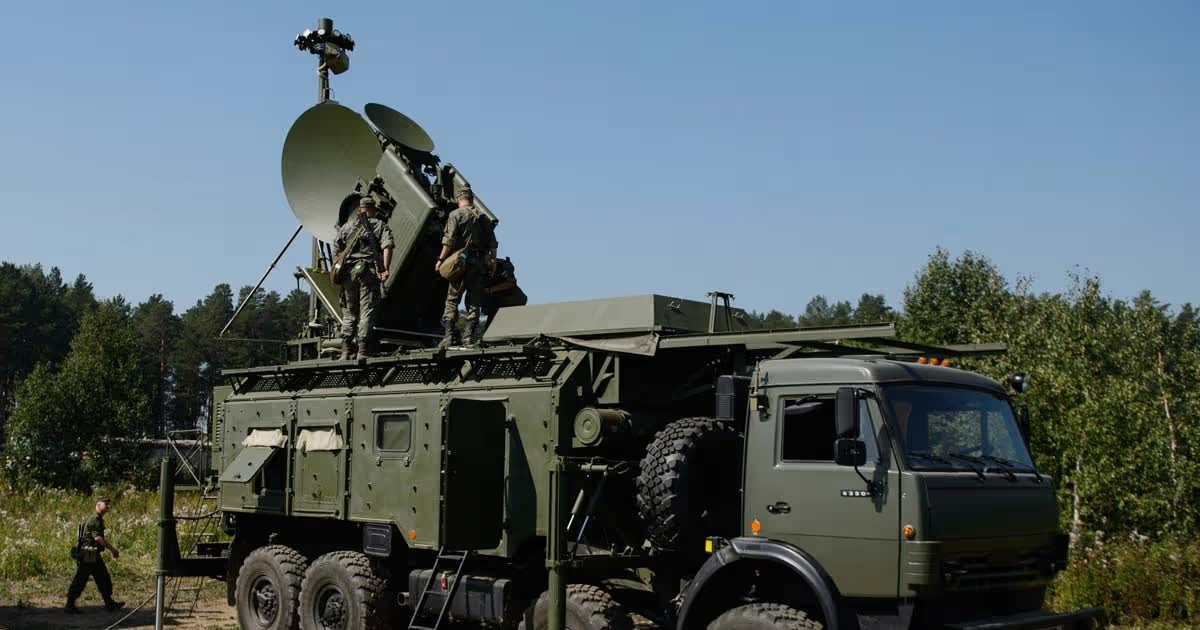
Mobile microwave radiation complex shown by Rosoboronexport at LIMA-2001, Langkawi. Late-1990s development. Mass of the installation about 5 tons. Chassis in Russian secondary sources: MAZ-543 / 7310 class. Elements listed by the exporter: antenna, high-capacity generator, control and measuring gear, energy-supply subsystem. Stationary or mobile mounting.
Published export / survey figures (Kopp compilation and Rosoboronexport-era sheets): X-band / centimeter wave, wavelength ~3 cm; peak power 500 MW; pulse width 10–20 ns; pulse repetition ~500 pps; average power 2.5–5 kW; antenna gain 45–50 dB; parabolic dish on the order of 3 m. Stated effects: electronics incapacitation inside about 10 km; burnout 8–14 km and circuit interference to ~40 km in GlobalSecurity’s recap of Russian commentary; all-round defense in a 60° vertical sector, 360° in azimuth in the 2001 pitch. Own radar for cueing; interface to air-defense nets. Recharge time of about 20 minutes appears in later Russian unofficial critiques. Status through 2015–2025 reporting: prototype / project, no series adoption announced.
ROSA-E (РОСА-Э)
Second RF system presented with Ranets-E at LIMA-2001. Non-flying. Same Rosoboronexport frame: research since the late 1990s on disabling pointing systems and electric circuits of precision weapons by set levels of electromagnetic radiation. Public specification sheet thinner than Ranets-E. Offered as a funded-development item.
FUROR (ФУРОР)
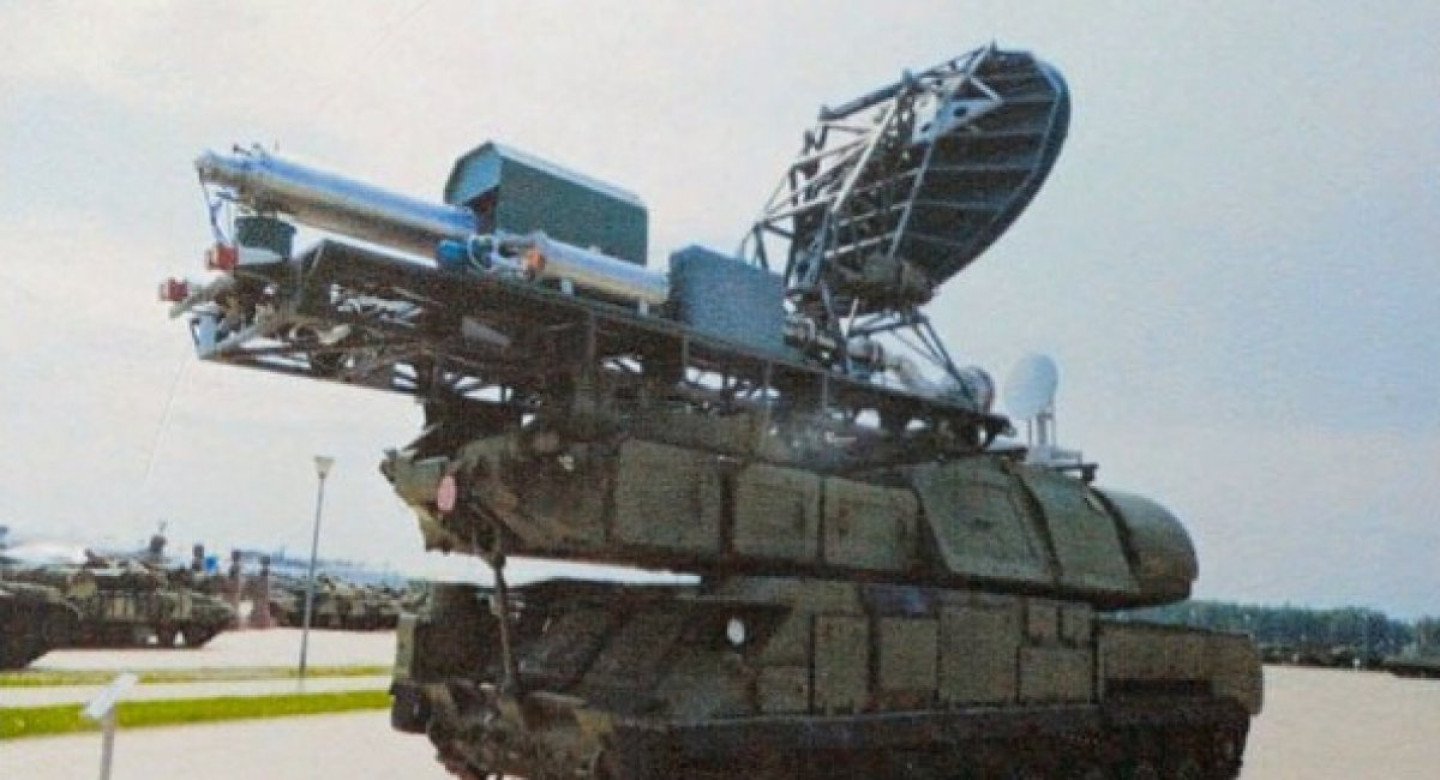
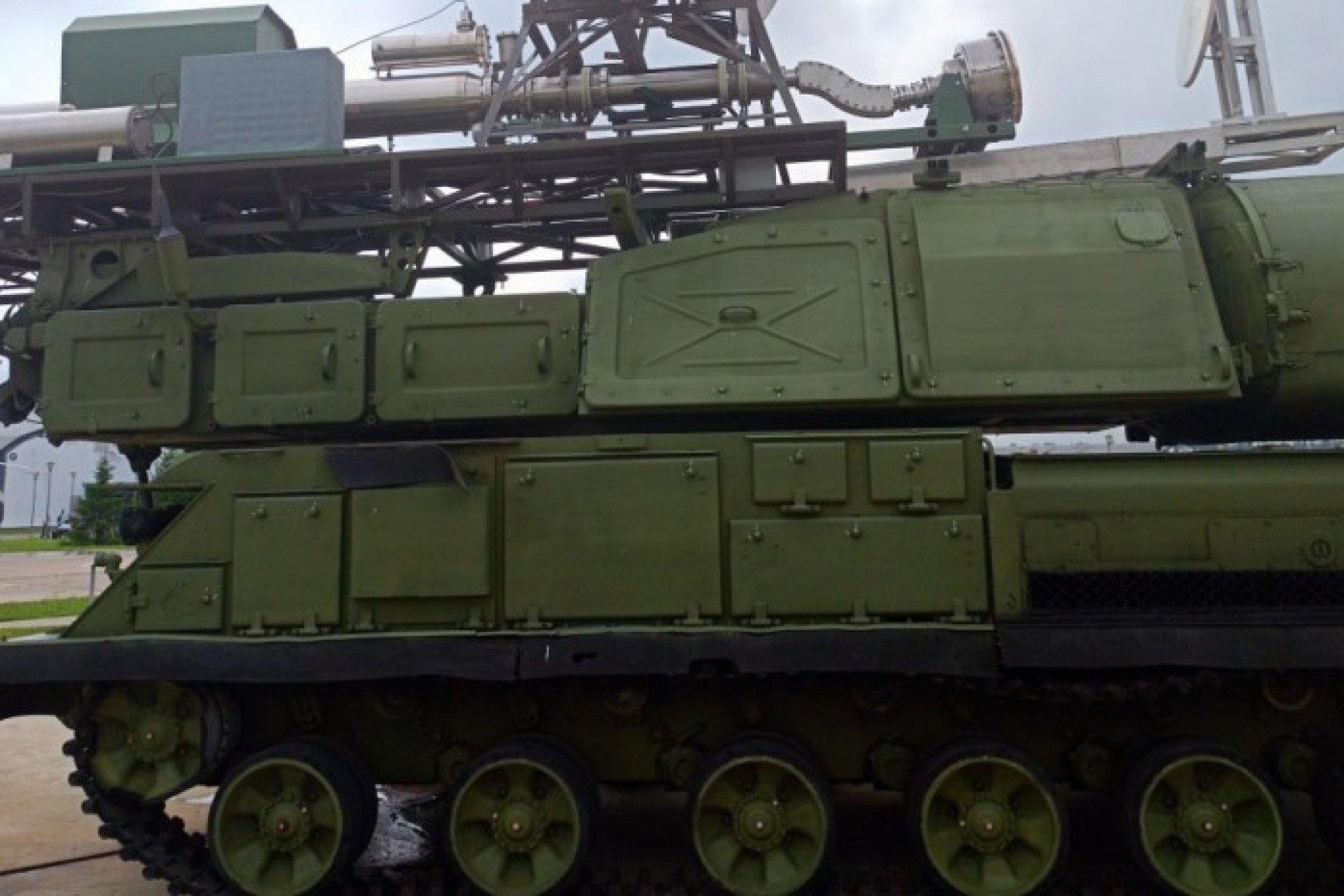
Mobile directed microwave radiation system first shown in the closed portion of Army-2015. Composition given to Russian outlets in 2015: high-power relativistic generator, reflected antenna, management and control system, transmission system, on the tracked chassis of the Buk air-defense family. Mission in the brochure: UAVs and precision-guided munitions; all-direction defense at a range exceeding 10 km. July 2025: prototype exhibited at the Kubinka armor museum as an item still under testing and refinement. Decade-class development interval from first closed show to museum floor.
ALABUGA (АЛАБУГА) — KRET PROGRAM
Code name for a 2011–2012 KRET scientific-research cycle on electronic-warfare prospects and electromagnetic weapons, after which results were classified as a critical technology. Mikheev’s later clarification: the name covered a research program and a nomenclature of effects, with laboratory models and test-range work, rather than a single serial missile on public display. Open reconstruction of the intended product: UHF / EMP generator packaged as a munition (missile, bomb, or shell); air burst on the order of 200–300 m; electronics kill radius quoted around 3.5 km in secondary sources; effects adjustable from interference to destruction of microcircuits. Carriers discussed in Russian military press: 3M14 Kalibr, Kh-555, Kh-101 class cruise missiles. Highest secrecy after 2012. Separate geographic name: the Alabuga special economic zone in Tatarstan is a drone-production site.
15M107 LISTVA (ЛИСТВА)
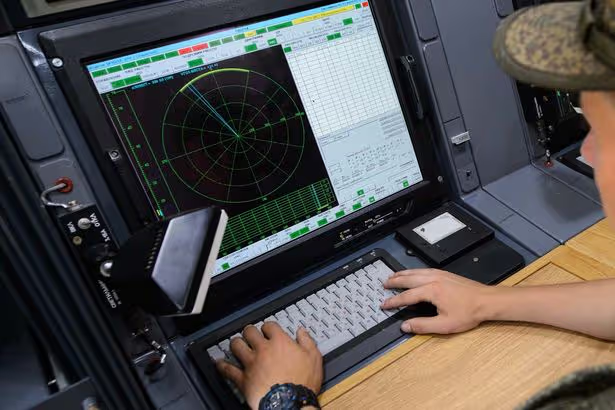
Remote mine-clearance vehicle (машина дистанционного разминирования) using high-power microwave plus induction search. Designer: NIIIP / RKB Globus, Ryazan. Builder: Kaskad, Krasnodar. Chassis: SBA-60-K2 Bulat armor body on KAMAZ-53501 / Mustang 6×6 components; KAMAZ-740 V8 diesel ~240 hp. Combat mass 18.4–20 t. Length ~8.9 m (to ~11.1 m with gear), width 2.5 m (to ~3.96 m), height 3.35 m (to ~4.74 m), wheelbase 4.66 m. Armor class Br6, mine resistance quoted as 2 kg TNT under a wheel / 1 kg under the floor in popular specs. Crew of five: driver, commander, operator, two sappers. Max road speed 60 km/h; clearance speed 15 km/h; ford 0.8 m; ground clearance ~385 mm. Power draw of the special suite ~12 kW. Temperature −50 to +45 °C.
Search: forward wide-span multi-zone module, 16 induction sensors; metal-containing mines detected on the move to 100 m. Microwave: roof parabolic antenna, pulsed S-band / microwave illumination across a 50 m clearance width, 90° sector; electronic mines and radio fuzes disabled by cooking semiconductor fuzing. Jamming radius against radio-controlled fuzes ~70 m. 2023 Ruselectronics upgrade: new microwave head with intended power flux density about 10 W/cm² at 50–80 m against semiconductor IEDs. Fielded with Strategic Rocket Forces route-clearance and engineer units; public photographs from Vitaly Kuzmin and MoD releases.
NUMIZMAT / KOSMOS-2558
Satellite launched 1 August 2022. Open Western assessment (The Space Review, 2025): probable on-orbit UWB / HPM payload for radio-frequency directed-energy experiments in a counterspace role. Russian public materials do not print a weapon designation for this object. Related ground research: IAP Krot chamber UWB-in-plasma work; TUSUR / ISS Reshetnev filters on satellite power buses against ultra-short pulses.
OTHER NAMED THREADS
2015 MRTI microwave gun: same 10 km / aircraft-UAV-PGM language as Ranets-E, presented as a revival of the 2001 export concept. Compact multi-hundred-MW to multi-GW nanosecond generators briefed to the RAS Presidium in 2007 by groups in Tomsk, Yekaterinburg, Nizhny Novgorod, and Moscow, with dual-use language covering high-resolution impulse radar and non-thermal effects on electronics and biological specimens. Nuclear-adjacent ultra-low-yield microwave generators appear as a category in Russian review papers on functional kill of radio-electronic systems. Peresvet is a laser complex of the Strategic Missile Forces (experimental combat duty 2018, five divisions announced 2019) and sits on the directed-energy list beside the RF line.
PUBLISHED SPEC SHEET (COMPILED)
Ranets-E: 500 MW peak, 10–20 ns, ~500 pps, 2.5–5 kW average, X-band, G ≈ 45–50 dB, ~3 m dish, 5 t class, 10 km-class stated kill, 8–14 / 40 km in secondary range pairs. Early relativistic BWO (Lebedev–IAP): ~400 MW, ~10 ns, X-band. Tomsk SINUS BWO: 500–650 MW, 20–40% efficiency. X-band MWCG (GAMMA / IHCE line): up to 15 GW into waveguide. Listva microwave head (2023 intent): ~10 W/cm² at 50–80 m; clearance strip 50 m; search 100 m; jam 70 m; 12 kW house power. Alabuga (open reconstruction): ~3.5 km electronics radius from air burst at 200–300 m.
Those figures come from export brochures, BSTJ-equivalent Russian journals, IEEE/SPIE papers, KRET interviews, and museum captions. Pulse-power physics supports the laboratory peaks. Operational range of a fielded beam weapon is set by antenna, atmosphere, and target hardness, which the public sheets treat as advertised maxima.
STATUS
Laboratory HPM in Tomsk, Nizhny Novgorod, Moscow, Yekaterinburg, and Sarov is a continuous Soviet-to-Russian line from the 1970s. Listva is a series engineer vehicle with a microwave effector at tens of meters. Ranets-E, Rosa-E, and Furor remain prototype / exhibit / export-project objects in the public record through 2025. Alabuga is a classified post-2012 technology basket. Numizmat is an assessed on-orbit experiment. KRET continues to describe microwave complexes for UAV defense and possible future aviation carriage.
IN ONE SENTENCE
Soviet and Russian microwave / RF directed weaponry is a 1970s-onward high-current-electronics enterprise — relativistic BWOs, MWCG gigawatt tubes, explosive-pumped generators, KRET’s Alabuga munition research, the Ranets-E / Furor mobile beam projects, and the fielded 15M107 Listva mine-clearance microwave truck — aimed at coupling nanosecond-to-microsecond RF into the electronics of munitions, vehicles, and satellites.