WHAT IT IS
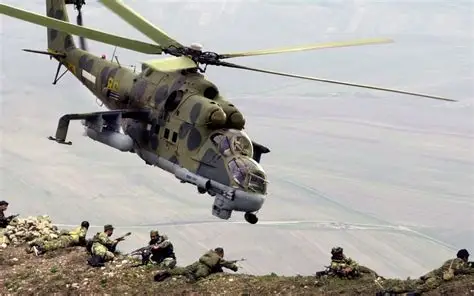
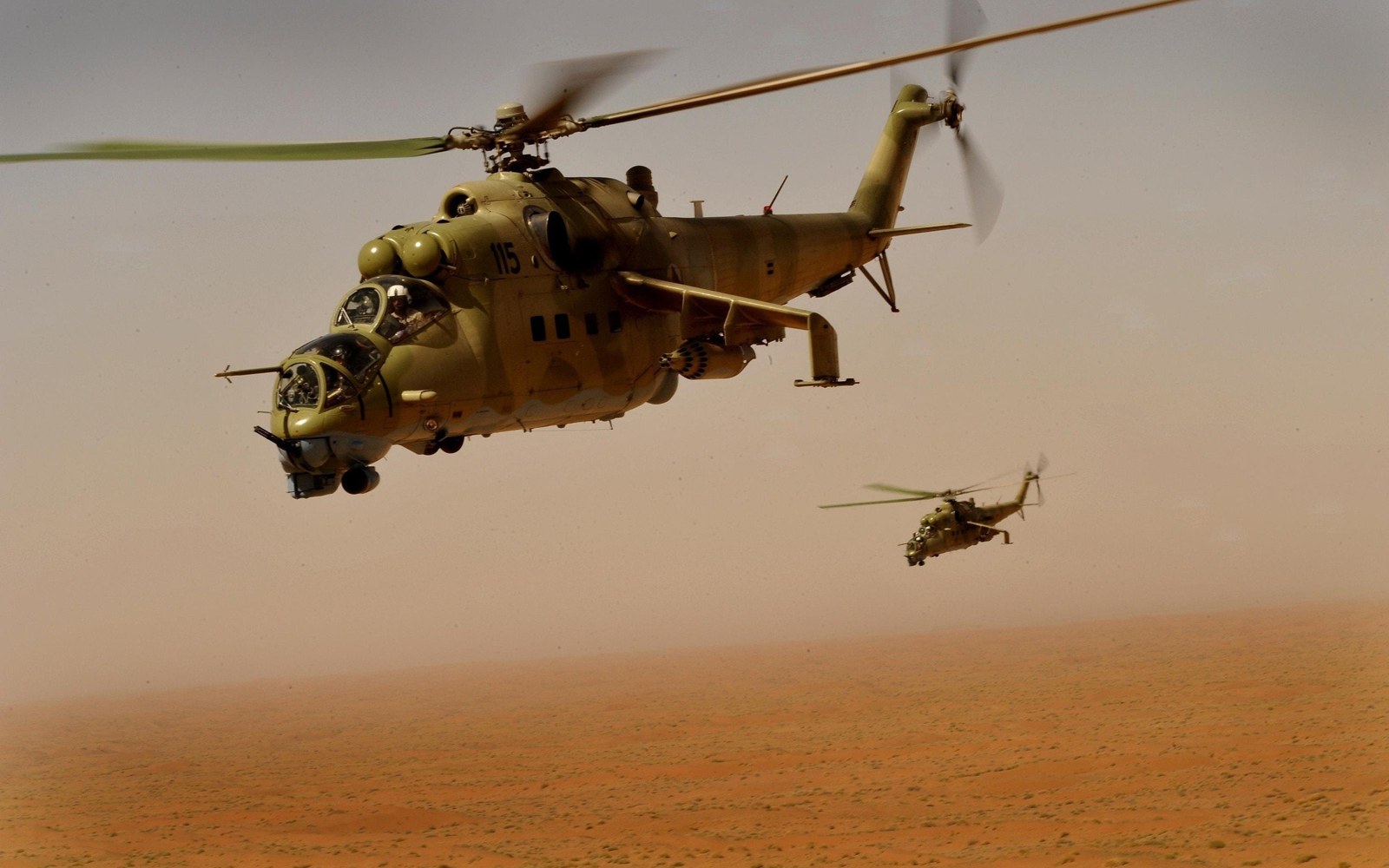
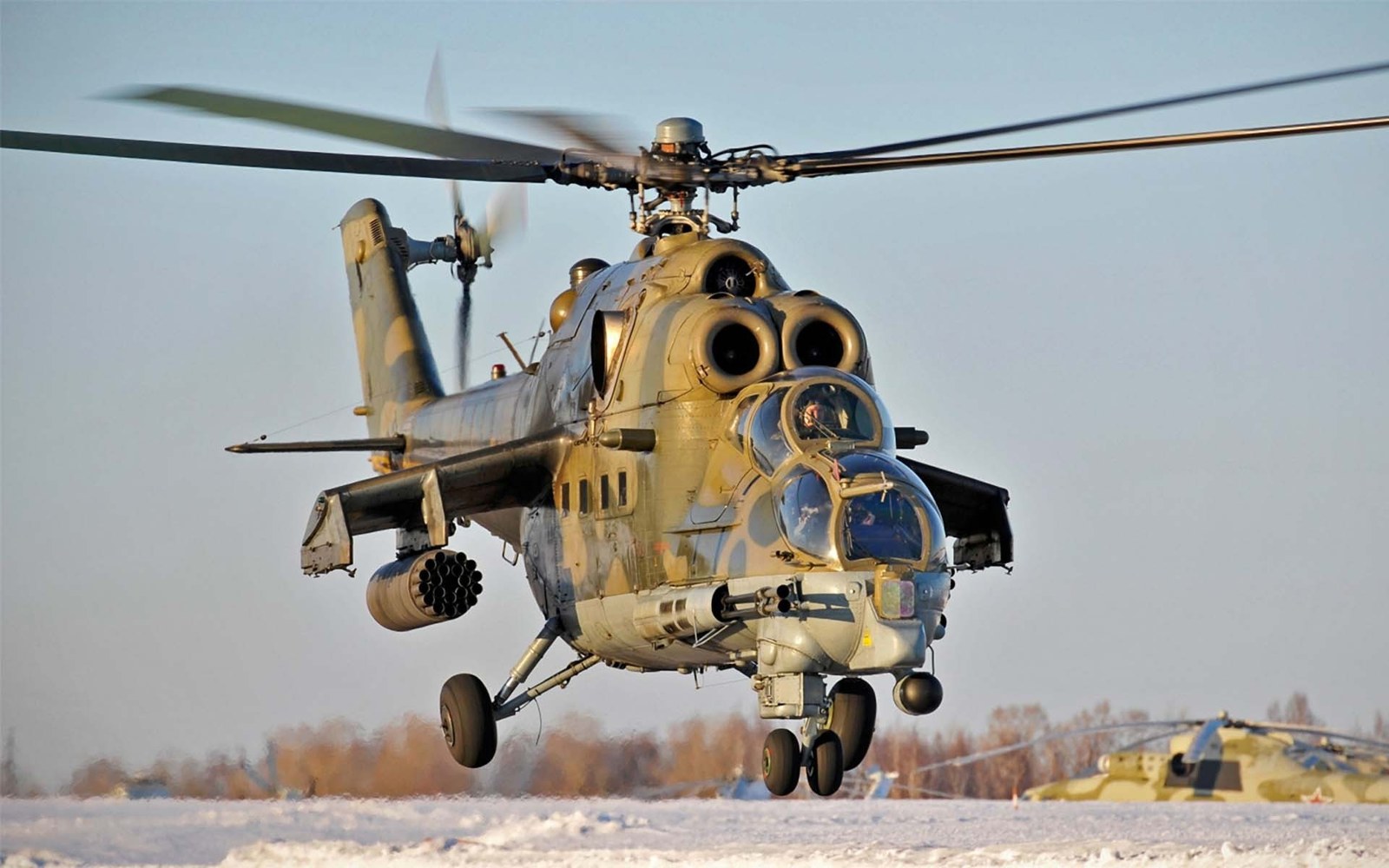
The Mil Mi-24 (Ми-24; NATO reporting name Hind; nicknamed «Крокодил», "Crocodile", in Russian service) is a Soviet and Russian twin-turboshaft assault helicopter designed by the Mil design bureau (ОКБ Миля, Moscow Helicopter Plant named after M. L. Mil). It is a rare hybrid: a heavily armed and armored gunship with a troop compartment behind the crew cabin, able to carry up to eight soldiers or stretcher patients. Its recognisable features are a five-blade main rotor, a three-blade tail rotor, stub wings that carry weapons and unload the rotor in cruise, retractable tricycle landing gear, a tandem cockpit with the weapons operator in front and the pilot behind and above him, and two engines mounted side by side above the cabin.
Russian Wikipedia calls the Mi-24 the first Soviet and, after the American AH-1 Cobra, the second dedicated combat helicopter in the world, and the first mass-produced dedicated combat helicopter with retractable landing gear. The first flight of the V-24 prototype is dated 19 September 1969 in most sources, and the type entered service in 1972. The Mi-24 flew its first combat missions in the 1970s, became the most recognisable Soviet symbol of the Soviet–Afghan War (1979–1989), and has since been used by dozens of air forces in more than 30 wars and armed conflicts (Russian Wikipedia).
Production figures differ by source. English Wikipedia gives 2,648 built (production 1969 to present), Russian Wikipedia gives about 3,500, and some other sources give higher or lower totals depending on whether export, Mi-35 and upgraded airframes are counted (see PRODUCTION). Russian Wikipedia states that serial production is still continuing in the form of the Mi-35M family at Rostvertol in Rostov-on-Don, and calls the Mi-24 the second most widespread attack helicopter in the world after the AH-64 Apache as of 2021 (citing the World Air Forces 2021 annual review).
This page covers the history, design, powerplant, weapons, variants, production, operators, combat use and the Russian Aerospace Forces (ВКС России) status of the type, with the sources of conflicting figures shown wherever they differ. A note on naming: the designation Mi-24 covers the whole family, while the export designations Mi-25 (export Mi-24D), Mi-35 (export Mi-24V), Mi-35P (export Mi-24P) and Mi-35M (the upgraded night-capable version) are used for foreign deliveries; NATO letter suffixes (Hind-A to Hind-G) are assigned to individual versions and are not always applied consistently across sources.
DEVELOPMENT
The concept of a helicopter that could both support infantry with fire and deliver them to the battlefield came out of the Mil bureau in the mid-1960s. English Wikipedia places an initial mock-up by Mikhail Leontyevich Mil (Михаил Леонтьевич Миль, 1909–1970) in 1966, derived from the Mi-8 transport helicopter, in which a troop cabin was combined with a weapons-carrying airframe. The proposal reportedly met resistance from military officers who doubted that one machine could be both a transport and a gunship, and the programme went ahead anyway. The details of that internal debate come from memoir-type literature and secondary sources and are not covered by official documents, so the exact sequence is treated here as reported rather than confirmed.
The formal start of development is usually dated to the decree of the Council of Ministers and the Central Committee of the Communist Party of the Soviet Union (постановление Совета Министров СССР и ЦК КПСС) of 6 May 1968 (Russian Wikipedia). The project received the bureau designation V-24 (also written «изделие 240»). Mikhail Mil died on 31 January 1970, only months after the first flight, and leadership of the bureau passed to Marat Nikolaevich Tishchenko (Марат Николаевич Тищенко), who is credited with directing the Mi-24 programme through its main production years and later with the Mi-28 and Mi-35 era. Tishchenko is the person most often named in Russian sources as the lead designer of the V-24 itself; the role of other engineers is less well documented in English sources.
The prototypes, called OP-1 and OP-2 in Russian Wikipedia, were ready within about a year, and a large share of components was shared with the Mi-8 and the naval Mi-14: engines in the early form, main rotor blades and parts of the transmission and systems. The first V-24 had a common double-seat forward cabin with dual controls in the style of the Mi-8, nicknamed the «веранда» ("veranda", a greenhouse-style canopy), a crew of pilot and operator with a flight engineer added later, and a central cabin that could hold up to eight soldiers with pivot mounts for personal weapons in the cabin windows. As the intended Shturm missile system was not ready, the first machines were fitted with the K-4V complex from the Mi-4 helicopter: the manually guided 9M17 Falanga-M missile, an NUV-1 machine-gun mount with an A-12.7 gun, and four bomb-rack beams for rockets or free-fall bombs (Russian Wikipedia; one line of that passage carries a missing-source flag).
First flight date: most sources, including English Wikipedia and the Russian Wikipedia infobox, give 19 September 1969. The Russian Wikipedia text also states that the factory test programme began on 15 September 1969 with test pilot G. V. Alferov (Г. В. Алфёров). The two dates are generally read as the first hover or ground-test activity and the first flight respectively, but the sources do not spell that out, so both are given here. Serial production at Arsenyev began in 1971, and the first Mi-24A machines were delivered to the army aviation of the Soviet Air Forces for trials; the type is usually listed as adopted in 1972.
The early flight testing exposed problems that shaped the later design. English Wikipedia lists lateral roll, weapon sighting difficulties and a limited field of view for the pilot as the main problems of the first Mi-24 series, and a redesign of the forward fuselage solved most of them. At the end of 1970 two machines were fitted with a wing with a negative dihedral of −12° to improve stability at speeds above 200 km/h (Russian Wikipedia), a feature that remained on all production models. The tail rotor was originally mounted on the right side on the first production machines and was moved to the left in later Mi-24A machines, remaining on the left on all subsequent variants (Russian Wikipedia).
The most important design change was the move to a tandem cockpit. The Mi-24D, with separated tandem cockpits for the operator-gunner in front and the pilot behind and above him, entered production in 1973 and was designed as a purer gunship than the earlier machines. Its shape, with a double-bubble canopy and a gun turret under the nose, is the one most people recognise as the Hind. Russian Wikipedia gives the 1973–1977 production run of the Mi-24D as about 600 machines. The Mi-24V followed in 1976 and was built in the largest numbers.
AIRFRAME AND PROTECTION
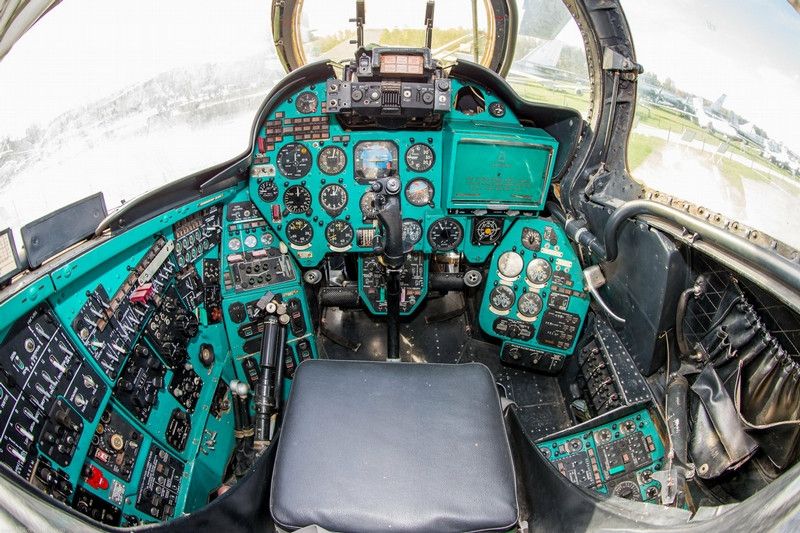
The Mi-24 is an all-metal riveted semi-monocoque helicopter. Russian Wikipedia describes the fuselage as made up of a nose section (the pressurized crew cabin), a centre section containing the troop cabin, the engine and transmission bay on top, a tail boom and a keel (fin) beam. The nose section is a separate sealed compartment pressurized with engine bleed air. The operator sits in front and the pilot behind, each in a separate canopy with its own armoured, electrically heated windscreen made of silicate glass. Side armour plates stand beside the crew seats, and the remainder of the canopy is oriented organic glass. The pilot enters through a door on the right and the operator through a glazed hatch on the upper left; both can be jettisoned by pyrotechnic cartridges in an emergency.
The troop cabin, between frames No. 1 and No. 8, is pressurized and is entered through two-leaf doors on both sides. The upper leaf and lower leaf of each door open independently, and the lower leaf folds down to serve as a step. Two four-seat folding benches hold eight troops sitting back to back and facing outward, or the cabin can carry two stretcher patients and two seated patients with an attendant, or up to 1,500 kg of cargo (Russian Wikipedia). Firing ports with pivot mounts allow soldiers to fire personal weapons from the cabin, and two PK 7.62 mm machine guns can be mounted on the lower door leaves. In practice, the troop-carrying role has been much less used than the gunship role. Soviet and later accounts report that in Afghanistan crews frequently removed the cabin armour and the exhaust screens, carried extra ammunition and heavy weapons for self-defence, and flew without troops (English Wikipedia, variants list).
Protection is a combination of armour and system redundancy. The crew compartment has armoured plates and armoured glass in front of both crew members; English-language sources often give the cockpit armour as capable of withstanding 12.7 mm rounds, and Russian sources say the rotor blades and tail rotor blades are designed to tolerate hits from small arms. These figures come from manufacturer or popular literature and vary from source to source, so they are not treated as exact here. The fuel tanks are protected self-sealing tanks made of rubber with a nylon layer; some tanks can be filled with polyurethane foam, and when the foam is absent a neutral-gas system feeds carbon dioxide into the tank vapour space. A centralized automatic fire extinguishing system uses Freon-114 and protects four compartments separated by titanium bulkheads: the two engine compartments, the main gearbox and service tanks, and the auxiliary power unit and tank No. 3 compartment (Russian Wikipedia, citing the Mi-24V technical description of 1982).
The wing is a free-standing cantilever with an area of 6.75 m², a negative dihedral of −12°, and an incidence of +19° (Russian Wikipedia), and it carries the weapon pylons. The wingtips have vertical end plates (pylons) that improve lateral stability and carry additional stores. The wing offloads the main rotor in forward flight; the share of lift supplied by the wing is quoted in popular sources as roughly a quarter at cruise speed, but this value is not given in the Russian technical description used here and is treated as an approximate figure. The horizontal stabilizer is all-moving and is mechanically linked to the collective pitch lever: as collective pitch increases, the stabilizer incidence increases, and at minimum collective it becomes negative. The tail fin is cambered and set at 6° to the aircraft axis to unload the tail rotor at high speed.
The undercarriage is a retractable tricycle, with a twin nosewheel and single main wheels, and a non-retractable tail skid that protects the tail rotor in a hard landing. Retraction reduces drag and the power needed at high speed. The Mi-35M and some other later machines have fixed (non-retractable) landing gear; the fixed gear is usually explained as a saving in weight and complexity, and Defense Express describes it as intended to limit fuselage damage in emergency landings (the explanation is from secondary descriptions and is not an official statement; Russian Wikipedia lists fixed gear for the Mi-24VM and Mi-35M).
Another unusual design feature is that the nose, cabin floor and tail are tilted relative to the main rotor shaft (about 2°20′ to the left for the forward fuselage, and the rotor shaft is canted forward by 4°30′ and to the right by about 2°30′ relative to the cabin floor, per Russian Wikipedia). These offsets are intended to make the helicopter fly level in the hover and at high speed with less of a sideways tendency. Each of these angles is taken from a single Russian technical-description summary and has not been cross-checked against another source.
ROTOR SYSTEM AND TRANSMISSION
The main rotor has five blades and a diameter of 17.3 m. The blades are based on the Mi-8 design: each blade is rectangular in plan, has a spar and 18 compartments, an NACA-230M section and a geometric twist from 0° at the tip to about 3°36′ at the root (Russian Wikipedia). The set of blades has a mass of about 577 kg and the hub about 590 kg. The hub is fully articulated with horizontal, vertical and axial hinges and hydraulic dampers to prevent ground resonance, and centrifugal droop stops. The blades have an electric de-icing system with heating elements in the leading edges, switched in sequence by a programme mechanism.
The tail rotor has three blades, a diameter of 3.91 m and a swivel (cardan) hub, with a pitch range of about −6°55′ to +26°. In the early production models it was on the right of the fin, pushing, and in the later and main production versions it is on the left and the tail rotor acts as a tractor (Russian Wikipedia), a change made after early flight experience. The upgraded Mi-24VM and Mi-35M use an X-shaped tail rotor from the Mi-28, which produces less noise and gives better control authority than the three-blade design. A mechanical limiter, the SPUU-52 system, restricts tail-rotor pitch as a function of air density to avoid overloading the transmission during aggressive manoeuvring.
The main gearbox is the VR-24 (ВР-24). It reduces the engine output speed of about 15,000 rpm to a main rotor speed of about 240 rpm and has a dry mass of about 830 kg. The transmission also includes an accessory drive box, an intermediate and tail gearbox, the tail rotor shaft, a fan drive shaft and a rotor brake. The two engines drive the single gearbox through free-wheel clutches, so either engine can be disconnected without stopping the rotor. The hydraulic system is built as three circuits (main, duplicate and auxiliary), with pumps on the main gearbox so that the controls keep working in autorotation even if both engines fail. The controls include a four-channel autopilot (SAU-V24-1), a dual set of controls, and a reserve set of controls for the operator, so that if the pilot is incapacitated the operator can fly and land the machine (Russian Wikipedia).
ENGINES
The production Mi-24 is powered by two Klimov TV3-117 turboshafts (ТВ3-117), designed by the bureau led by Sergey Izotov (Сергей Петрович Изотов) in Leningrad and later associated with the Klimov name. The same engine family powers the Mi-8MT and Mi-14. Russian Wikipedia says that the series used the zero to third series of the TV3-117 and the high-altitude TV3-117V, and that the series 3 engine was installed in the largest number of Mi-24s. For the series 3 the take-off rating is quoted as 2,225 hp (and 2,100 hp for the TV3-117V), the nominal rating is 1,700 hp, and the engine mass is about 269 kg. Some English-language sources use higher figures of about 2,200 hp per engine for the TV3-117V and 2,500 hp for the VK-2500 used in later upgrades, and the differences are due to different ratings (take-off, emergency) and engine versions.
The predecessor engine is the Isotov TV2-117, which powered the Mi-8 and, according to a number of English-language sources (for example works by Gordon and Komissarov), was used on the V-24 prototypes and the earliest Mi-24A production machines before the TV3-117 became available. This is not stated in the Russian Wikipedia source used here, and the exact point at which the TV3-117 entered the Mi-24 production line is therefore treated as unconfirmed. The more powerful TV3-117 allowed the heavier armoured Mi-24D, V and P models to retain adequate performance in hot-and-high conditions. Even so, Russian Wikipedia reports that in Afghanistan at high-altitude pads, at full load and with a full weapon load, pilots had to take off and land in an aeroplane-style run because power was not enough for vertical manoeuvring.
Each engine has a dust-protection device (ПЗУ, "pylezashchitnoe ustroystvo") on the air intake to allow operation from unprepared ground, which cleans an estimated 70–75% of the airflow. To reduce vulnerability to infrared-guided missiles, many machines are fitted with exhaust-gas cooling and screening devices (ЭВУ, "ekranno-vykhlopnoe ustroystvo"), which were introduced as a result of the Afghan experience. A separate AI-9V auxiliary power unit supplies compressed air for engine starting and ground power. The fuel is T-1, TS-1 or RT kerosene, and the total internal fuel capacity of the Mi-24V/D is about 2,240 litres (Russian Wikipedia; 2,165 litres with foam-filled tanks). Ferry versions carry additional external or internal fuel: four underwing tanks of 475 litres each on the Mi-24V, or one or two additional tanks of 850 litres each in the cabin of the Mi-24D.
Later upgrades changed the engines. Ukrainian programmes such as the Mi-24V-MSB and Mi-24PU1 used the TV3-117VMA-SBM1V engine manufactured by Motor Sich, with claims of greater service ceiling and payload (Russian Wikipedia: 1,500 m greater maximum altitude and 1,000 kg greater payload for the Mi-24V-MSB). Russian experimental work on high-speed helicopters involved the Mi-24LL flying laboratory with VK-2500-1 engines, which reached a speed of 405 km/h in 2016 (Russian Wikipedia). These performance figures are manufacturer or programme claims.
SYSTEMS, AVIONICS AND EQUIPMENT
The electrical system is primarily three-phase AC at 208 V and 400 Hz from two GT-40PCh6 generators, with a 27 V DC secondary network from rectifiers and two lead-acid batteries. Cockpit flight instruments include a PKP-72M command flight indicator, the Grebyen ("Гребень") heading system, UKT-2 attitude indicators and a radio-magnetic indicator. Navigation equipment includes the DISS-15D Doppler speed and drift meter, the ARK-15M and ARK-U2 radio compasses and the RV-5 radio altimeter. Communications include the SPU-8 intercom, an R-860-1 or R-863 command radio, a Karat-M24 or Yadro-1G long-range radio and the Evkalipt-M24 radio, all taken from Russian Wikipedia's description of the Mi-24V and D. The main sight for the operator is the KPS-53AV station, and the pilot has an ASP-17V gun sight. Gun camera equipment includes a S-13-300-100 camera on the left wing pylon and a PAU-457-2M on the operator's station.
Self-protection equipment on the Mi-24V/D includes the SPO-10 radar warning receiver, the ASO-2V dispenser of PPI-26 infrared decoy flares (two sets of two beams on the tail boom, 32 cartridges per cassette), and the L-166V1A or UMP-V1A "Lipa" infrared jammer lamp mounted on the top of the rear fuselage. The Mi-24 cabin is designed for operations over contaminated terrain: air is cleaned and dried by the air-conditioning system, which maintains a slight overpressure, and an RChB (radiological, chemical and biological) reconnaissance variant exists (see VARIANTS). The helicopter also has a de-icing system for the rotor blades, windscreens and engine inlets.
The night and all-weather capability of the original machines is limited. The first Hind variants had no integrated thermal imager or night targeting system, and the Mi-24VP and later machines added night-vision goggles for the pilot (ОНВ-58В per Russian Wikipedia). A real night-attack ability came with the Mi-24PN, which has a television and thermal sighting subsystem in a dome in the nose, and with the Mi-24VM and Mi-35M which have the OPS-24N (GOES-342) gyro-stabilised electro-optical system. These upgraded models also include satellite navigation (GLONASS/GPS) and multifunction displays.
ARMAMENT
Armament varies by variant. The standard load-out consists of a fixed or movable gun, guided anti-tank missiles, unguided rockets, bombs and mines, and the machine has six hardpoints on most versions (four on some, such as the Mi-35M, which has two per wing, per Defense Express).
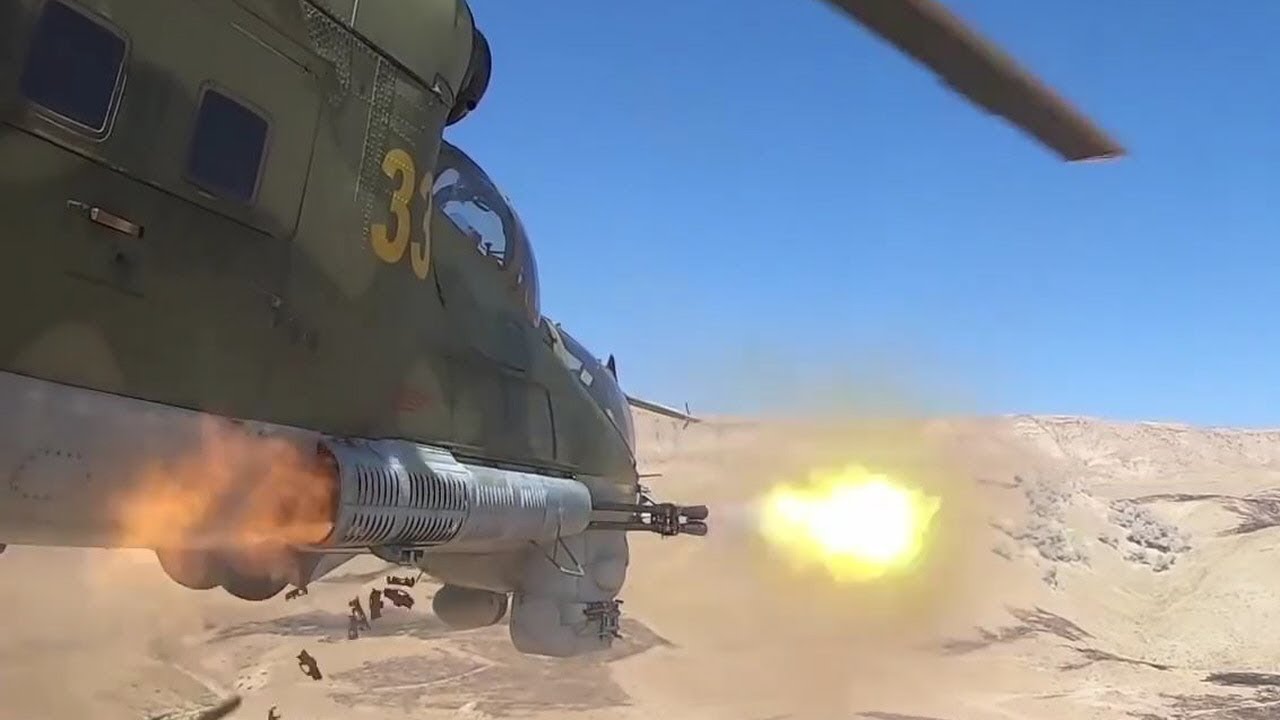
Guns. The Mi-24A to Mi-24V use a YakB-12.7 (ЯкБ-12,7) four-barrel 12.7 mm rotary machine gun in the USPU-24 turret under the nose, remotely aimed by the operator through the KPS-53AV sight. Russian Wikipedia gives a rate of fire of 4,500 rounds per minute in the Mi-24B text and an ammunition load of 1,470 rounds (750 in a transport configuration). The Mi-24P replaced the nose turret with a fixed 30 mm twin-barrel GSh-30-2K (9A-623K) cannon on the starboard side with 250 rounds; this version has extended barrels, flash suppressors and an evaporative barrel cooling system and can fire at a high rate of 2,000–2,600 rounds per minute or a low rate of 300–400 rounds per minute (Russian Wikipedia). The fixed gun is aimed by pointing the whole helicopter. The Mi-24VP and Mi-24PN and Mi-35M use a twin-barrel 23 mm GSh-23L in a movable NPPU-23 turret under the nose; Russian Wikipedia gives 460 rounds for the Mi-24VP.
Gun pods and containers. Two UPK-23-250 universal gun containers can be fitted, each with a GSh-23L and 250 rounds. The GUV-1 pod (AGS-17 Plamya grenade launcher) and GUV-8700 pod (one YakB-12.7 and two four-barrel GShG-7.62 machine guns) were developed in the late 1970s. Cabin firing ports allow personal weapons to be used.
Anti-tank guided missiles. The first machines carried four 9M17 Falanga (Фаланга; NATO AT-2 Swatter), a 1960s manually guided (MCLOS) missile. The Mi-24D introduced the semi-automatic Falanga-PV (9M17P) with radio-command guidance. The key missile for the main version is the 9K113 Shturm-V complex (Штурм-В; NATO AT-6 Spiral) with the 9M114 and the 9M114F (high-explosive) missile; all of these are 130 mm in diameter and about 1.83–1.84 m long, with a guided range of 5–5.5 km (Russian Wikipedia). It uses semi-automatic guidance in which the operator holds the crosshairs on the target and the missile receives radio-command signals from the helicopter. It was accepted into service on the Mi-24V on 29 March 1976 (Russian Wikipedia). The later 9M120 Ataka (Атака; NATO AT-9 Spiral-2) has a tandem high-explosive anti-tank warhead for greater armour penetration. Typically, four launch tubes are carried, and later versions can carry eight in two APU-4 pods; Russian Wikipedia says that a modernised variant introduced in 1986 carried 16 Shturm-V missiles, and that late Mi-24VP machines carried up to 12 Ataka missiles. These loads are maximum figures and in real operations the loads are often lower.
Rockets. The B8V20 (20 tubes) pod for 80 mm S-8 rockets and the UB-32A-24 (32 tubes) pod for 57 mm S-5 rockets are the most common loads; Russian Wikipedia gives up to 80 S-8 or up to 128 S-5 on four pods, and heavier S-13 (122 mm, in B13L1 pods) and S-24B (240 mm, on APU-68UM3 rails) rockets can also be carried. The rocket salvo interval is 0.05 s. The S-8 is effective against area targets and light armour, and is described in the Afghan literature as having a lethal radius of about 10–12 m for the 3.6 kg warhead of the S-8 (Russian Wikipedia).
Bombs and mines. The Mi-24 can carry free-fall bombs of between 50 kg and 500 kg, incendiary tanks (ZB-250ShM, ZB-500Sh), illumination bombs and BETAB-500ShP concrete-piercing bombs. Two KMGU-2 small cargo dispensers can lay mines, such as PFM-1, POM-1, POM-2 or PTM-1 and PTM-3; Russian Wikipedia states that two containers can hold 2,496 PFM-1 mines.
Air-to-air weapons. Some Mi-24Ps in the late 1980s were fitted with R-60 or R-60M infrared air-to-air missiles for self-defence against fighters and helicopters, and the Mi-24VP could use the 9M220O air-to-air variant of the Ataka missile and the Igla-V or Igla-S short-range missile on wingtip launchers (Russian Wikipedia). These are for self-defence and the Mi-24 is not an interceptor. Even so, there are documented cases of Mi-24s shooting down aircraft, including a Belarusian Mi-24V that shot down a Gordon Bennett Cup balloon on 12 September 1995, killing both American crew members (Russian Wikipedia), and the claim of helicopter-versus-helicopter victories in the Iran–Iraq War (see SERVICE HISTORY).
SPECIFICATIONS
The figures below are for the standard Mi-24V and Mi-24D, from the Russian Wikipedia technical-description summary (citing the 1982 manual for the Mi-24V/D) and its summary table, with other values given where sources disagree. Differences come from different versions, loads and definitions.
Crew: 2 (pilot and operator) or 3 with a flight engineer. Troops: up to 8, or 2 stretcher patients, 2 seated patients and an attendant.
Main rotor diameter: 17.3 m. Tail rotor diameter: 3.91 m. Length overall with rotors (rotor-swept contour): 21.35 m (manual) and fuselage length of 17.51 m (17.23 m on the Mi-24VM). Height: 4.73 m to the rotor head (manual) or about 5.47 m with rotors turning (summary table). Wing span: 6.66 m (manual) or 6.4 m (summary table); English sources commonly give about 6.5 m.
Empty weight: 8,650 kg to 8,680 kg (Russian Wikipedia gives both). Normal take-off weight: 11,200 kg. Maximum take-off weight: 11,500 kg, and 12,000 kg in the ferry configuration with external tanks. English-language references often give an empty weight of about 8,500 kg and a maximum weight of about 12,000 kg.
Engines: 2 × TV3-117V (2,100 hp take-off per Russian Wikipedia) or TV3-117 series 3 (2,225 hp). Some tables give 2 × 2,200 hp. Upgraded variants with VK-2500 engines are rated at 2 × 2,500 hp.
Maximum speed: 335 km/h at low level at a weight below 11,200 kg and 315 km/h above that (manual); the summary table gives 345 km/h, and a few sources give higher unofficial figures. Cruise speed: about 250 km/h. Maximum speed with an external load: 250 km/h.
Range: not less than 450 km at 500 m altitude with normal weight and a 5% fuel reserve (manual); ferry range of about 915–1,000 km with external tanks. Practical range in the summary table is 450 km and ferry range 1,000 km.
Service ceiling and hover: dynamic ceiling of about 5,200 m (manual, at 10,000 kg flying weight) or 4,950 m (summary table); static ceiling of 1,750 m with the dust-protection device off (manual) or 1,400 m (summary table). These differences are typical of Russian sources and relate to the conditions of measurement.
Load limits: load factor of −1.3 to +3 (summary table); bank angle limit 50°; internal cargo up to 1,500 kg; external sling load up to 2,400 kg (the manual also states an external suspension capacity of 800 kg for the standard sling, so the two figures describe different mounting systems). Fuel consumption: about 780 litres per hour on average (summary table).
Speed record: the A-10 record helicopter (a lightened, wingless Mi-24A derivative) set an absolute helicopter speed record of 368.4 km/h. English Wikipedia places the A-10 record activity in 1975 and Russian Wikipedia attributes the record to G. Karapetyan (Г. Карапетян) in 1978; the dates and pilot names are therefore treated as conflicting. Russian Wikipedia also lists 1975 climb records (3,000 m in 2 min 34 s and 6,000 m in 8 min 31 s) with a missing-source flag. In 1992 an all-female crew flew a Mi-24 from Moscow to Miami, about 20,000 km, according to Russian Wikipedia.
VARIANTS
The Mi-24 family has a large number of versions. The list below is based on Russian and English Wikipedia and Gordon and Komissarov (2001) as cited there. NATO reporting suffixes are given only where they are widely used; they are not always consistent between sources.
V-24 and early Mi-24 (Hind-A). Prototypes with the "veranda" cockpit, A-12.7 gun, UB-32A rocket pods and four Falanga-M (9M17) MCLOS missiles. Russian Wikipedia says the right-side tail rotor was used on the first aircraft.
Mi-24A (изделие 245; Hind-A / Hind-B in various sources). The first production version, built at Arsenyev in 1971–1973, with a longer cockpit and missiles on wing pylons. Russian Wikipedia says almost 250 were built; they went into the newly formed army aviation units. The Mi-24U (Hind-C; изделие 244) is a trainer with dual controls instead of the nose gun. English Wikipedia describes the Mi-24A as lacking the YakB-12.7 gun; this is a point where the sources and designations are not consistent.
Mi-24B (изделие 241). An experimental version with the USPU-24 turret and the YakB-12.7 gun; Russian Wikipedia says it was not built in series and was used to test weapons. Mi-24BMT (изделие 248) was a minesweeping prototype built in one example in 1974, according to Russian Wikipedia.
Mi-24D (изделие 246; Hind-D). The version with a tandem cockpit, built in 1973–1977 (Russian Wikipedia: about 600 machines). The export version is the Mi-25. The Mi-24DU (изделие 249) is the trainer.
Mi-24V (изделие 242; Hind-E). The most numerous variant, with the Shturm-V missile system, built from 1976 to 1986, accepted into service 29 March 1976 (Russian Wikipedia). It has the TV3-117V engine, ASP-17V sight and added the B8V20-A, B13L1 and APU-68UM3 rocket carriers. Russian Wikipedia says about 1,000 were built, while English Wikipedia says more than 1,500 were made; this is one of the biggest differences between the two. The export version is the Mi-35. Mi-24VU is the Indian training version.
Mi-24VP (изделие 258). A Mi-24V with a movable NPPU-23 turret and GSh-23L cannon, new avionics, Ataka missiles and air-to-air missiles, produced from 1989. Russian Wikipedia says no more than 25–30 were built and states that a figure of 179 given in some sources is incorrect; English Wikipedia also says only 25 were made.
Mi-24P (изделие 243; Hind-F). The version with a fixed side-mounted GSh-30-2K 30 mm cannon with 250 rounds, in production from 1981 to 1989 (Russian Wikipedia). Export: Mi-35P. Mi-24PN is a night variant with a thermal imager and TV sight in a nose dome, delivered to the Russian forces from 2003 (14 helicopters in 2004). Mi-24PS is a police or border patrol version.
Mi-24K (изделие 201; Hind-G2) is a reconnaissance and artillery-spotting version with an Iris system, Ruta digital reconnaissance complex and an AFA-100 camera. Mi-24R / Mi-24RKhR (Hind-G1; изделие 2462) is an RChB reconnaissance helicopter with soil sampling devices, which took part in the radiation reconnaissance after the Chernobyl accident in 1986. Russian Wikipedia says 160 Mi-24R were built; the precise count is not confirmed independently. The Mi-24RA and Mi-24KhR are related versions.
Mi-24VM / Mi-24PM / Mi-35M. The Mi-24VM is an upgraded Mi-24V with fixed landing gear, rotors from the Mi-28 (including the X-shaped tail rotor), all-weather avionics, an active infrared jammer and the Ataka missile; the export version is the Mi-35M. The Mi-35M, also known as the Mi-35M1 in some sources, is the night-capable version supplied to the Russian forces from about 2010 and exported to several countries, with a Vitebsk (L370) defence system fitted to all Russian machines by September 2018 (English Wikipedia). The Mi-35M2 is a version for Venezuela, the Mi-35M3 an export version of the Mi-24VM, and the Mi-35M4 (AH-2 Sabre) an upgrade with Israeli avionics for Brazil.
Mi-35P "Phoenix" and Mi-24P-1M / P-2M. A Russian programme named "Phoenix" (Феникс) produced a modernised Mi-24P, shown at the Army 2018 forum and at the MAKS 2019 air show, with the OPS-24N-1L sighting system, the KNEI-24E-1 flight navigation system with multifunction displays, a modular infrared countermeasure system and the 9M127-1 Ataka-VM missile. English Wikipedia states that serial production started in August 2020 for an export customer (Rostec press release as cited). Russian Wikipedia lists the Mi-24P-1M with an optional AESA radar, but flags that part of the passage as coming from a non-authoritative source, so the details of the radar option should be treated as unconfirmed.
Mi-24VP-M and Mi-24VP-I. Planned modernisations for the Russian forces with deliveries from 2006; Russian Wikipedia states these upgrade projects were not carried out.
Experimental versions. The Mi-24LL (Mi-PSV) is a high-speed research helicopter, a flying laboratory based on the Mi-24K with VK-2500-1 engines, new rotor blades and retractable gear but no wing; it reached 405 km/h in 2016 (Russian Wikipedia; English sources say "greater than 405 km/h"). The Mi-PSV with low-mounted wings was shown at MAKS 2015 as a mock-up and flew in 2017 (English Wikipedia).
Foreign upgrades. Ukraine developed the Mi-24V-MSB with Motor Sich engines and the Mi-24PU1 (adopted 2012, three prototypes delivered to troops in October 2016, per Russian Wikipedia). The South African firm ATE produced the Super Hind Mk II, III and IV. Russian Wikipedia says 33 ex-Ukrainian Hinds were modified for Algeria in 1999–2004 (Mk III), and 12 for Azerbaijan in 2010–2011 (Mk IV, designated Mi-24G in Azerbaijani service). The Czech Republic had Mi-35 helicopters modernised in 2003–2005 and again around 2017 with a FLIR and multifunction displays, and these were donated to Ukraine in summer 2023 (English Wikipedia).
PRODUCTION
The Mi-24 was built at two main plants: the Arsenyev aviation plant «Progress» (Арсеньевская авиационная компания «Прогресс», plant No. 116 of the Ministry of Aviation Industry) in Primorsky Krai in the Soviet Far East, and Rostvertol (Роствертол, plant No. 168) in Rostov-on-Don. Russian Wikipedia states that the Mi-24A was built at Arsenyev. Western literature (Gordon and Komissarov) generally describes Rostvertol as the main manufacturer of the Mi-24D, V and later models, with Arsenyev also building the Mi-24P; because the Russian Wikipedia text does not state the distribution of the later models in detail, the plant-by-plant breakdown after the Mi-24A is treated here as approximate. Rostvertol today builds the Mi-35M, Mi-28NE and other models.
Totals differ: Russian Wikipedia gives about 3,500 produced (citing a Mil jubilee book of 1998 and a Russian business newspaper of 2007); English Wikipedia gives 2,648 in its infobox. Neither source gives a clear year-by-year breakdown. For the main variants Russian Wikipedia gives about 250 Mi-24A (1971–73), about 600 Mi-24D (1973–77), about 1,000 Mi-24V (1976–86) and then the Mi-24P from 1981, while English Wikipedia says more than 1,500 Mi-24V were made. The Mi-24V and Mi-24P are probably the most numerous, but no source reviewed here gives a reliable total per version, and the total of the Mi-24 family depends on whether the Mi-35 is counted separately.
Russian Wikipedia says that serial production began in 1971 and "continues to this day" in the Mi-35M version. The Ukrainian outlet Militarnyi reports that the Russian Ministry of Defence signed a contract in 2010 for 22 Mi-35M and at least one later contract for 27 more, and notes that the total number delivered is not officially disclosed. The Mi-35M has therefore been built in low numbers compared with the Soviet-era Hinds, and the number of new-build helicopters should be treated as an estimate.
OPERATORS
The Mi-24 has been used by the air forces or armies of dozens of countries; English Wikipedia lists 58 other users in addition to Russia. Counts in the lists change quickly, and some of the quoted numbers are from IISS The Military Balance editions in 2022–2024 (as compiled by Russian Wikipedia), so the figures below are approximate and not current. Operators that were reported as still using the type in the Russian Wikipedia list include the following (with counts given there, and the year of the source):
Russia: about 96 Mi-24D/V/P (as of 2024; English Wikipedia lists 96 Mi-24D/V/P and 56 Mi-35P for the Aerospace Forces) and 8 Mi-24P in naval aviation. The Border Service is also listed in English Wikipedia as a user. See the dedicated section below for Russian fleet estimates.
Europe and the Caucasus: Azerbaijan (about 20 Mi-24 and 24 Mi-35M, 2023); Armenia (7 Mi-24P, 2 Mi-24K and 2 Mi-24R, 2023); Belarus (12 Mi-24, 2023); Bulgaria (6 Mi-24V in service with more in storage, 2024); Hungary (6 Mi-24V and 2 Mi-24P, 2024); Georgia (6 Mi-24V, 2023); Serbia (2 Mi-24V of doubtful readiness and 4 Mi-35M, 2024); Ukraine (45 in 2024 according to Russian Wikipedia; English Wikipedia lists 39 Mi-24 as of 2025; the two figures are from different editions and different counting).
Middle East and Asia: India (17 Mi-25/Mi-35, 2023, named Mi-35 Akbar in Indian service); Iraq (20 Mi-35M, 2023); Syria (20 Mi-24D and 4 Mi-24P, 2023, a figure that predates the events of December 2024 and should not be taken as the present fleet); Kazakhstan (12 Mi-35M and a number of Mi-24V in storage or used for spare parts, 2023); Uzbekistan (29 Mi-24 and 12 Mi-35M, 2023); Turkmenistan (10 Mi-24P, 2023); Tajikistan (4 Mi-24, 2023); Kyrgyzstan (2, 2023); Afghanistan (4 Mi-35, 2023, a figure from before and unrelated to the present state of the Afghan forces); Indonesia (6 Mi-35P); Myanmar (12 Mi-35P); Pakistan (4 Mi-35M); Sri Lanka (about 11 Mi-24/Mi-35 of several versions).
Africa and Latin America: Algeria (about 30 upgraded Super Hind, 2023); Angola (34 Mi-24 and 22 Mi-35); Ethiopia (15 Mi-24 and 3 Mi-35P); Nigeria (about 16 of several variants); Sudan (about 34); Uganda (7); Zimbabwe (6); Mali (about 9); Venezuela (9 Mi-35M2); Peru (16 Mi-25 of questionable readiness and 2 Mi-35P).
Former operators include the Soviet Union, East Germany, Czechoslovakia (the first Mi-24D arrived in August 1978), Poland (which retired the type and transferred helicopters to Ukraine as military aid, per Russian Wikipedia), Croatia, North Korea, Vietnam, Cuba, Brazil (12 Mi-35M, withdrawn in 2022 reportedly because of the lack of support from the supplier), Nicaragua (18 delivered, with at least two lost, per Russian Wikipedia), Slovakia, North Macedonia, Cyprus (4 Mi-35P, listed for sale in 2024) and Eritrea. A few ex-German Hinds were reported as used by the US military for training air defence crews and for opposing-force roles (Russian Wikipedia, which gives 3 to 6 helicopters).
All of these counts are from public secondary sources, many are single-year snapshots, and some of the aircraft are in storage or not airworthy. Transfers during the Russian invasion of Ukraine (for instance from Poland and the Czech Republic) and war damage to the Ukrainian and Russian fleets mean that the numbers for those states change.
SERVICE HISTORY AND ROLES
Soviet service. The Mi-24 entered the army aviation of the Soviet Air Forces in the early 1970s in separate helicopter regiments assigned to combined-arms armies and air-assault brigades. Soviet-era Russian sources state that Mi-24s were also used to intercept intruders on the border, with at least five aircraft forced to land, and one account of a 1983 Mi-24 that crashed during a chase of an American AH-1 on the East–West German border; both stories are from Russian Wikipedia and are single-source and not independently verified here. A Mi-24R was used for radiation reconnaissance after the Chernobyl disaster in 1986.
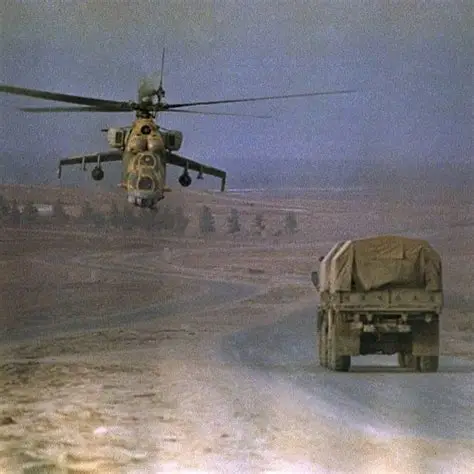
Afghanistan, 1979–1989. The Soviet-Afghan War was the first large-scale test of the type. Russian Wikipedia says that the Mi-24 was used for reconnaissance, covering air-assault landings and strikes, and that the helicopter group of the 40th Army reached 251 machines by the end of 1980 (this refers to all helicopter types, not only Mi-24). Typical missions were pre-planned strikes and on-call fire support, with combined use of rockets, machine gun and bombs. With a mixed rocket-and-bomb load, a pilot fired unguided rockets from 1,200–1,500 m and the operator then dropped bombs while the machine gun suppressed the target; at 800–1,000 m the YakB-12.7 was used, and the same Russian text says it was able to penetrate a half-metre adobe wall. The Mi-24 was also used with large bombs against stone and mud fortresses, which were unaffected by S-5 rockets. Mujahideen reportedly called the helicopter «шайтан-арба» ("Satan's chariot"), a nickname repeated in many popular accounts and not covered by official documents.
The Afghan war also showed the type's weaknesses. High altitude and heat reduced engine power, and the Russian text says that pilots had to take off with a rolling run at high-altitude pads. In response, dust filters were installed, flare dispensers, an infrared jammer lamp and exhaust screens were added, and crews adapted tactics. The most effective weapons against the Mi-24 for a long time were heavy machine guns, the DShK and the ZGU, which Russian Wikipedia says accounted for 42% and 25% respectively of Mi-24s lost in 1985 (flagged as needing a source). From 1983 mujahideen received man-portable air-defence systems, first Soviet Strela-2 from Egyptian stocks and American Redeye, then the FIM-92 Stinger; the first reported use of the Stinger was on 26 September 1986 near Jalalabad, when three Mi-24s were reported shot down within seconds (Russian Wikipedia footnote). The CIA estimate of 7 hits in 10 launches and the statement that 31 Stingers were needed per Mi-24 are both quoted by Russian Wikipedia with weak sourcing (one flagged as non-authoritative), and the two are inconsistent with one another, so neither figure should be used as a precise hit rate.
Losses in Afghanistan: Russian Wikipedia gives 127–129 Soviet Mi-24s lost in Afghanistan on incomplete data (excluding border troop and Central Asian military district machines), and with 72 lost Afghan Mi-24s the total is stated to exceed 200. Three Afghan Mi-24s were reportedly flown to Pakistan. These are summary figures from a single compilation.
Iran–Iraq War, 1980–1988. Iraqi Mi-24s were used as gunships against ground targets and, in a less expected role, against Iranian helicopters, notably AH-1 Cobras. Russian Wikipedia says Iraq claimed 53 air victories over Iranian helicopters (other sources say no more than 20) and lost 6–7 Hinds in combat with Cobras, while 15 Iraqi Mi-24s were reported to have been shot down by fighters, mainly F-5s. An episode in which a Mi-24V destroyed an F-4 Phantom is described, and independent researchers doubt it. Because these accounts come from the combatants, they are treated as claims.
Other conflicts. Russian Wikipedia lists use in the Cambodian–Vietnamese conflict, the Ogaden war, the Chadian–Libyan conflict, the Sri Lankan Civil War (nine lost), the Sudanese civil wars, Nagorno-Karabakh from 1988–1994 (both sides, with six Azerbaijani and four Armenian Mi-24 reported lost), Tajikistan, Transnistria, Abkhazia (where a Russian Mi-24 reportedly shot down a Georgian Mi-24 with cannon fire on 5 October 1992), Sierra Leone, Croatia, the Ethiopian–Eritrean war, the 2001 Macedonia conflict, the Polish deployment in Afghanistan and Iraq, Ivory Coast (three Mi-24s destroyed on the ground by French forces), the 2008 war in Georgia, the Syrian civil war, Iraqi operations against the Islamic State (with at least four Iraqi Mi-24/35 reportedly shot down in 2014), the 2016 Nagorno-Karabakh clashes and the Donbas war.
Chechnya. In the First Chechen War (1994–1996) and the Second Chechen War (from 1999) Russian Mi-24s were used for strikes and fire support. Russian Wikipedia says that seven were lost in the first war by July 1995, and that 11 Mi-24s were lost in the first year of the second war, with the figure rising to 23 by 2005. Reports of individual strikes in that source, such as an attack on a tank regiment at Shali in November 1994, come from Russian military accounts.
Syria. Syrian government forces used Mi-24s; Russia deployed 12 Mi-24Ps to Khmeimim in September 2015 (Russian Wikipedia), and used Mi-35M and later Mi-28N and Ka-52 for fire support. In November 2020, Russian Wikipedia reports that an Azerbaijani air-defence system shot down a Russian Mi-24P over Armenia, killing two crew members. Azerbaijan later said that it was a mistake. This is treated as a documented incident by the Russian and Azerbaijani authorities, although the details of the investigation are not covered here.
The war in Ukraine. The Mi-24 has been used by both sides in the Russian invasion of Ukraine since February 2022. Ukrainian Mi-24s, including Ukrainian machines upgraded to the Mi-24PU1 standard and helicopters donated by Poland and the Czech Republic, were used for strikes and low-level attacks; one Ukrainian Mi-24 from the 16th Army Aviation Brigade was lost near Brovary on 8 March 2022 with two crew members killed (English Wikipedia). On 1 April 2022, two Ukrainian Mi-24s were reported to have attacked an oil depot in Belgorod, Russia (English Wikipedia says "reportedly"; Russian authorities blamed Ukraine, while Ukraine did not officially confirm responsibility at the time). On the Russian side, Mi-24P and Mi-35M helicopters were used from the first days of the war, including in the Hostomel (Antonov airport) fighting; Russian Wikipedia says at least one Mi-24 was brought down by a Javelin anti-tank missile in direct-attack mode near Hostomel, and at least eight Russian Mi-24s were destroyed by Ukrainian forces by November 2022, including by Stinger MANPADS.
Photo-verified loss lists from the open-source blog Oryx, as quoted in English Wikipedia on 27 May 2025, record 4 Mi-24P, 4 Mi-24V/P/35M and 10 Mi-35M lost for Russia and 2 Mi-24P and 7 Mi-24 of unknown variant for Ukraine. Defense Express notes that the Oryx method counts only losses with photographic proof and tends to undercount losses in occupied territory. Militarnyi, a Ukrainian outlet, reports at least nine Mi-35Ms destroyed and one damaged on the ground. Official claims by the Ukrainian General Staff and the Russian Ministry of Defence are not independently verified and are treated here as claims. Janes reported, via Defense Express, that an Italian Army officer speaking at the International Military Helicopter 2025 conference said that Russia was using about 95 Mi-24/35, 75 Ka-52 and 55 Mi-28 against Ukraine, and that at least 30% of the Russian helicopter fleet could not be used because of technical problems; this is a conference statement, not an official inventory.
Use in Ukraine has made clear that the Mi-24 and its successors are vulnerable to MANPADS and to ground fire in a contested battlefield with dense short-range air defence, and that survival has relied on low-level flight, decoy flares and standoff firing from distance, using rockets in a pitch-up "lofting" technique (a tactic widely discussed in open-source reporting but not documented in an official source cited here).
RUSSIAN AEROSPACE FORCES STATUS AND MODERNIZATION
Fleet size. There is no official public inventory. IISS The Military Balance 2022 (as cited by Defense Express) estimated about 100 Mi-24 of all versions and about 60 Mi-35M in Russian service before the invasion of Ukraine; The Military Balance 2024 (as cited by Defense Express) gave 108 Mi-24 and 56 Mi-35 at the start of 2024. A different IISS-based extract on English Wikipedia lists 96 Mi-24D/V/P and 56 Mi-35P for the Aerospace Forces plus 8 Mi-24P for naval aviation. Another secondary source (battlepolicy.com) says about 329 Mi-24/35 airframes. These figures do not agree, are not directly comparable (they count the Mi-35M differently and relate to different dates), and none is an official count. The best one can say is that the Russian fleet is probably in the low hundreds, of which a large share is not airworthy at any time.
Role in the fleet. The Mi-24 was designated for replacement by the Mi-28N «Night Hunter» (Ми-28Н «Ночной охотник») and the Kamov Ka-52 «Alligator» (Ка-52 «Аллигатор») from the 2000s, but the Mi-24 has remained widely used because of its troop-carrying capacity and the large number of available airframes. Defense Express commented that, according to the Janes report, the Mi-24/35 was the most used attack helicopter in the war on the Russian side, more than the Ka-52 and Mi-28, because older but available machines are used when the better types are exhausted or restricted.
Modernisation. The upgrades of the Russian Mi-24 followed several paths. The Mi-24PN night version was delivered from 2003 (14 helicopters in 2004). The Mi-24VM / Mi-35M upgrade, with fixed landing gear, Mi-28-style rotors, an X-shaped tail rotor, the GOES-342 sighting system and the Ataka missile, has been supplied to the forces since about 2010-2011 (Russian Wikipedia says deliveries began in 2011; Militarnyi reports 2010 contracts), and by September 2018 all Russian Mi-35Ms had the Vitebsk defence system (English Wikipedia). Russian Wikipedia also states that the planned Mi-24VP-M and Mi-24VP-I upgrades for the Russian forces were not carried out. A further "Phoenix" upgrade, designated Mi-24P-1M / Mi-24P-2M (export Mi-35P-1M / P-2M) was shown from 2017 to 2019; Russian Wikipedia says that serial machines were shown at MAKS 2019 and production began at the start of 2019, but that passage is flagged as coming from a non-authoritative source, and English Wikipedia places the start of serial production for an export customer in August 2020, so the dates are treated as unconfirmed. Whether the Russian Aerospace Forces are receiving the Phoenix standard in significant numbers is not documented in the sources used.
Retirement. No official retirement date for the Mi-24 in Russian service was found. Modernisation and the continued production of the Mi-35M indicate that the type is expected to remain in service for years, but the long-term policy of replacing it with the Mi-28NM and Ka-52M, and the effect of wartime losses, sanctions and engine-supply problems, is subject to a number of unofficial reports (for example, Militarnyi's report that Russia asked several countries to return more than a hundred previously sold engines). These are not verified and are listed only as reported.
LOSSES AND ACCIDENTS
The Mi-24 has one of the longest loss lists of any military helicopter, because of its wide use. Russian Wikipedia gives an accident and crash list that is a secondary compilation and not complete; examples include the loss of the Mi-24P of the Syzran military flight school near Pugachev in 2009 (crew killed; Russian Wikipedia attributes the accident to the failure of a blade pitch lever on a machine built in 1987 and overhauled in 2007), the loss of a Belarusian Mi-24 at Pruzhany in November 2011 (three crew killed), the crash of three Ugandan Mi-24 in Kenya in August 2012, and a Mi-24 hard landing in Belarus in June 2023. Combat losses are listed in the SERVICE HISTORY section.
The loss rate of the Hind in war is generally attributed to the combat environment: Afghanistan with heavy machine guns and MANPADS, Chechnya with ground fire and small-arms, and Ukraine with MANPADS. A raw count of losses cannot be compared across wars because the numbers of aircraft in service and the exposure time are different.
COMPARISON AND CAVEATS
Against the AH-1 Cobra. The Bell AH-1 Cobra first flew on 7 September 1965 and was the first dedicated gunship helicopter. It is a much smaller machine, with a two-man crew in tandem and a typical maximum weight of about 4,500 kg for the AH-1G (approximate), compared with 11,500 kg for the Mi-24. The Mi-24 is much heavier and more powerful, can carry troops, and has a higher speed and more armour; the Cobra is smaller, with a narrower profile that is harder to hit. The basic design logic of the two is therefore different: the Cobra is purely a gunship, while the Hind is a gunship and transport at the same time.
Against the AH-64 Apache. The Hughes (later McDonnell Douglas, now Boeing) AH-64 Apache first flew in 1975 and entered service in the 1980s. The AH-64A has a maximum weight of about 9,500 kg (approximate) and a crew of two, with a 30 mm M230 chain gun and AGM-114 Hellfire missiles. The Apache was designed specifically for anti-tank operations with good night capability and survivability, and it does not carry troops. In comparison, the Hind carries more weight, has a similar or higher top speed in the base version (the Mi-24 is recorded at 335 km/h in the Russian manual; the AH-64A is usually listed at about 290–300 km/h in English sources, an approximate value that is not taken from the sources used above), and has a larger and heavier airframe, but older avionics before the upgrades. Modern comparisons are difficult because each country's versions differ and the fighting experience is different. It is also questionable to compare the two types by looks or claims, since combat losses depend mostly on tactics and the threat environment.
The troop compartment is the Hind's defining feature and also a design compromise: the volume used for the troop cabin increases weight and the size of the target, and the cabin armour and troop-carrying were often removed in Afghanistan. After the 1980s Soviet and Russian helicopter design moved toward separate roles (the Mi-28 as a dedicated attack helicopter, the Mi-8 for transport), although the Ka-52 has some similar roles. The Mi-35M and the Phoenix upgrades should be treated as modernised versions of a 1960s design.
Caveats. Most of the information on this page comes from Wikipedia articles (English and Russian), which in turn rely on Russian technical literature, Gordon and Komissarov, IISS The Military Balance, and press reports. Soviet and Russian sources, combat claims from either side of any war, and open-source loss counts (Oryx, Ukrainian General Staff, Russian Ministry of Defence statements) should be treated as claims or partial counts. Technical values for weight, speed, range, engine power and ceiling vary by version and by definition, and the values listed here are examples. Operator numbers are year-specific snapshots and are not current. Details related to Russian modernisation programmes, such as the Mi-24P-1M AESA radar, the dates of serial production of the Phoenix upgrade and the size of the active fleet, are partly based on non-authoritative or secondary sources and may not be correct.
STATUS
The Mil Mi-24 is in service with the Russian Aerospace Forces and with more than 50 other operators, some of whom use only a few machines or machines in storage. The original Soviet-era Mi-24A, D and V models are mostly retired or kept in reserve in Russia, while the Mi-24P, the night-capable Mi-24PN and the upgraded Mi-35M are in service, and the Mi-35M is still produced in small numbers at Rostvertol (Russian Wikipedia; production numbers not officially disclosed). Ukraine and Russia both use the type in the war that began in 2022 and both have lost aircraft, with exact counts unconfirmed. Museum and monument examples are found at Monino (Central Air Force Museum), Kyiv (State Aviation Museum), Arsenyev, Rostov-on-Don and other places listed in Russian Wikipedia. The Mi-24 should be regarded as an ageing but still widely used type whose long-term future depends on the success of modernisation and on the operators' ability to maintain the airframes and engines.
IN ONE SENTENCE
The Mil Mi-24 Hind (Ми-24 «Крокодил») is a Soviet twin-turboshaft armoured gunship with an eight-seat troop cabin, first flown on 19 September 1969 and in service from 1972, built in roughly 2,600 to 3,500 aircraft (sources differ) at Arsenyev and Rostov, armed with a YakB-12.7, GSh-23 or GSh-30-2 gun, Falanga, Shturm and Ataka guided missiles and unguided rockets, used in Afghanistan and in more than 30 other conflicts including the war in Ukraine, and still serving with Russia and many other air forces today in the upgraded Mi-24P, Mi-24PN and Mi-35M forms.