WHAT IT IS
LTO (Linear Tape-Open) is an open magnetic-tape cartridge format for backup and archive. The consumer-visible name on the box is Ultrium. The consortium that owns the spec is the LTO Program: Hewlett Packard Enterprise, IBM, and Quantum (the Technology Provider Companies). IBM designs and builds the actual drive mechanism that everyone else badges. Media comes from Fujifilm, Sony, and licensees. First generation shipped in 2000. Generation 10 is shipping in 2025–26.
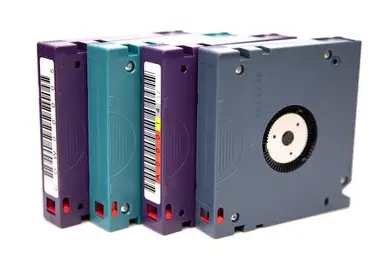
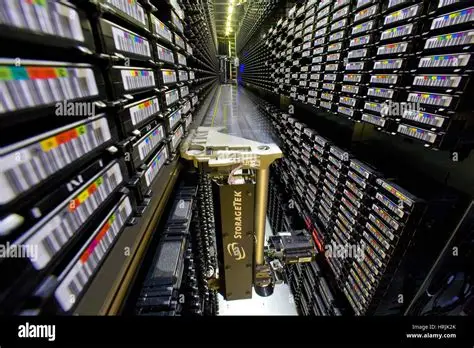
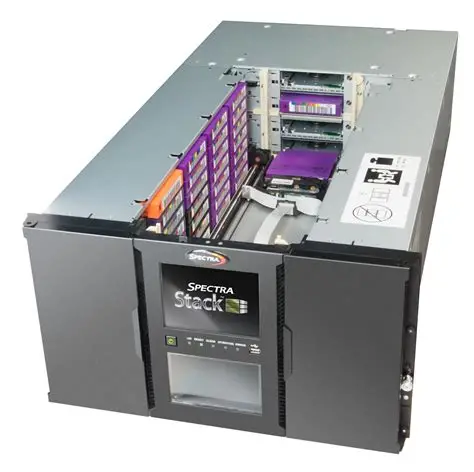
It is not DLT, not 3480/3592 enterprise square tape, not DAT, not 8 mm Exabyte. It is a single-reel cartridge, 102 × 105.4 × 21.5 mm, half-inch class tape (12.65 mm wide) that unspools onto a take-up reel inside the drive. A full-height or half-height drive sits in a server, a SAS/FC library robot, or a standalone dock. Libraries from IBM, Spectra, Quantum, HPE, and others hold tens to thousands of slots.
The plastic brick on a shelf is offline storage. That is the point: ransomware cannot encrypt a cartridge that is not mounted, and a dark aisle draws watts in the low single digits per petabyte.
WHAT IT IS USED FOR
Enterprise backup rotation. Long-term archive (media brochure life 30 years in spec climate). Air-gapped / “cyber-resilient” copies. Media and broadcast masters. Scientific and intelligence holdings that outgrow disk. LTFS (Linear Tape File System) lets a cartridge look like a filesystem to a host so an editor or an analyst can drag files without a backup app. WORM cartridges exist for compliance. AES-256 encryption lives in the drive.
It is sequential. It is not a random-access disk. Time-to-first-byte is seconds to a minute while the robot mounts and the drive threads and seeks a wrap. Streaming a full LTO-9 or LTO-10 cartridge at native rate is still many hours.
HOW THE TAPE IS LAID OUT
Four data bands run the length of the ribbon, sandwiched by five factory-written servo bands. Guard bands sit at the edges. The head straddles one data band plus the two servo bands that fence it.
Servo is timing-based servo (TBS): chevron / “V” magnetic stripes pre-recorded at the factory. Pulse timing tells the drive lateral position, velocity, skew, tape width, band ID, and longitudinal position (LPOS — a few of the stripes in each frame are position-modulated). The head does not guess. It servo-locks to those chevrons while the tape runs at up to ~10 m/s.
Writing is linear serpentine. A wrap is one end-to-end pass of N parallel tracks (8, then 16, now 32 data elements on current heads). At EOT the head steps sideways a fraction of a track-pitch and runs back toward BOT. Wraps fill a data band from the edges inward. Then the actuator steps to the next band. Band order on later gens is a specified sequence (often cited 3-1-0-2) so wear and tension stay even.
LTO-9 example: 8,960 data tracks, 2,240 per band, 32-wide wraps. LTO-10 tables go to 15,104 tracks on the HPE media sheet. Track density, not tape speed, is how LTO-10 bought capacity; native streaming stayed 400 MB/s because 6 µm-class film tears if you crank the capstan.
HOW THE DRIVE WORKS
Cartridge drops in. Drive grabs the leader pin, threads tape onto the internal take-up reel, tensions it across a roller path and an air-bearing head. Two or three head modules: write elements, read-verify elements downstream (write-plus-read on the same pass — a hard error is rewritten), servo readers on the chevrons.
A coarse stepper puts the head on the right band. A fine voice-coil / piezoelectric actuator follows lateral tape motion at servo bandwidth. If the tape dances faster than the actuator, you get a servo error and a reposition. That is why LTO-9 first-init “media optimization” was infamous: the drive maps that cartridge’s dimensional personality before it will trust full-speed writes. LTO-10 dropped the mandatory first-use calibration ritual on the new media.
Data path: host (SAS or 8/16/32 Gb Fibre Channel) → drive buffer → hardware compression (LTO-DC; planning factor 2:1 through LTO-5, 2.5:1 from LTO-6 — fiction for already-compressed video) → optional AES-256 → write equalizer → heads. Read is the reverse, with C1/C2 Reed-Solomon-class ECC and read-while-write verify. A cartridge memory chip (LTO-CM / MIC) in the case holds a cartridge table the library can read by RF without threading.
IBM’s drive team has said the LTO-10 ASIC can already talk to a future 64-element head at ~1 GB/s; that head is the next mechanical leap, not LTO-10.
THE CARTRIDGE
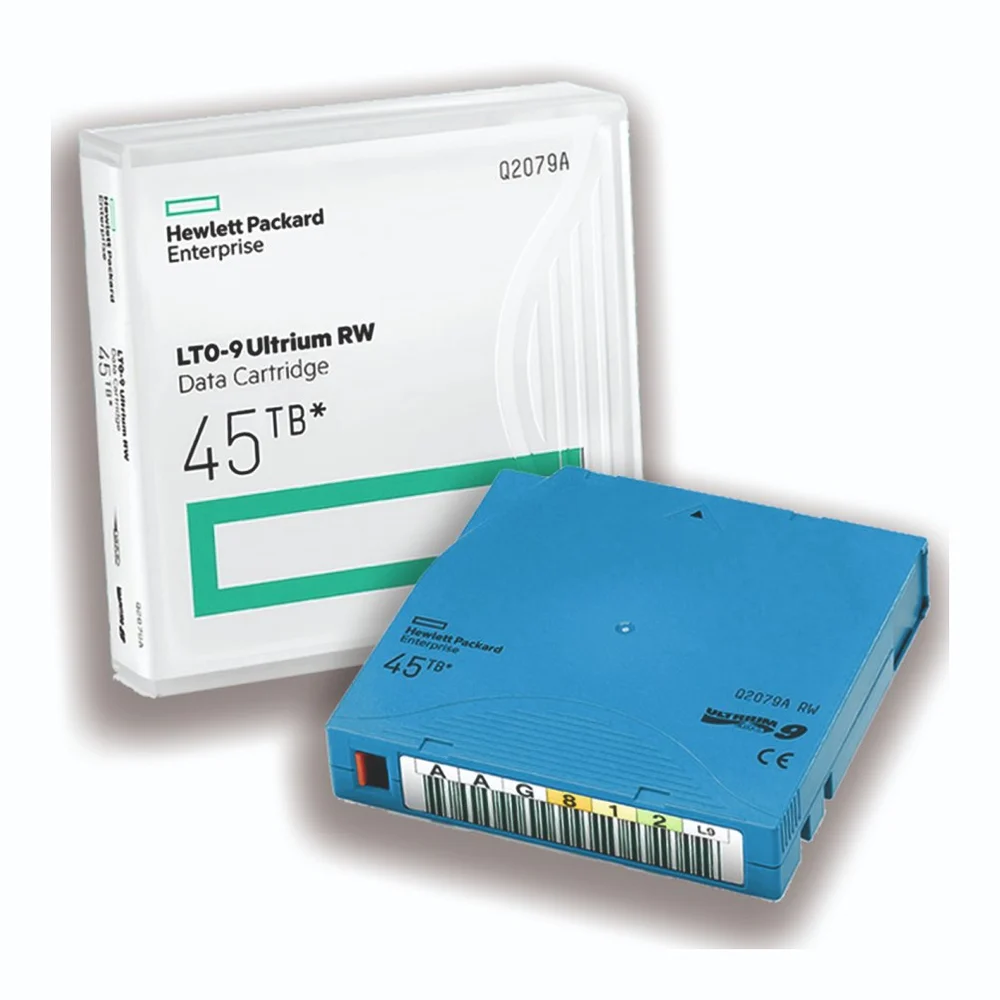
Single reel, spring door, leader pin. Tape: polyethylene naphthalate (PEN) base through LTO-9; LTO-10 40 TB part uses an Aramid base film that is thinner and smoother so more metres fit the same shell. Magnetic coat: metal-particle early gens, barium ferrite (BaFe) from LTO-6, LTO-10 described as strontium-ferrite-doped BaFe on the HPE sheet. Width 12.65 mm. Thickness fell from ~8–9 µm class at the start to 5.2 µm on LTO-9/10. Length ~846 m (LTO-6) → 960 m (LTO-7/8) → 1,035 m (LTO-9 and the 30 TB LTO-10). The 40 TB LTO-10 cartridge is more tape on Aramid in the same form factor.
WORM shells will not let the drive overwrite. Cleaning cartridges exist; they are not data tape. Color of the shell is brand paint; generation is the label and the CM chip.
GENERATIONS (NATIVE / COMPRESSED PLANNING / NATIVE STREAM)
LTO-1 (2000) — 100 GB / 200 GB / 20 MB/s
LTO-2 (2003) — 200 / 400 / 40
LTO-3 (2005) — 400 / 800 / 80 — first WORM
LTO-4 (2007) — 800 GB / 1.6 TB / 120 — hardware encryption
LTO-5 (2010) — 1.5 / 3 / 140 — partitioning + LTFS
LTO-6 (2012) — 2.5 / 6.25 / 160 — BaFe, 2.5:1 compression factor
LTO-7 (2015) — 6 / 15 / 300 — Type M 9 TB cartridge written in LTO-8 drives
LTO-8 (2017) — 12 / 30 / 360
LTO-9 (2021) — 18 / 45 / 400
LTO-10 (2025–26) — 30 TB / 75 TB and 40 TB / 100 TB cartridges, same drive, 400 MB/s native / up to 1,200 MB/s if the compressor is fed compressible data on 32 Gb FC
Roadmap after the November 2025 refresh runs through LTO-14 at 913 TB compressed planning (365 TB native in one vendor FAQ; treat roadmap numbers as consortium slides, not purchase orders).
COMPATIBILITY
Classic rule, LTO-1 through LTO-7: a drive writes its own generation and one back; reads two back. LTO-8 and LTO-9 tightened to one generation read and write. LTO-10 reads and writes LTO-10 only. That break is the planning fact. An LTO-9 archive does not mount in an LTO-10 drive. Keep a 9-generation reader or migrate.
WHO BUILDS WHAT
Drives: IBM mechanism inside IBM TS, HPE StoreEver, Quantum, and other bezels. Libraries: IBM TS4300/4500 and Diamondback, Spectra TFinity / Stack, Quantum Scalar, HPE tape libraries, smaller Autoloaders. Media: Fujifilm and Sony as the film science; branded by HPE, IBM, Quantum, Fuji, Sony. Interfaces: SAS for small boxes, Fibre Channel for libraries, some Thunderbolt/SAS docks for post houses.
NOT THIS
IBM 3592 / TS11xx Jaguar — enterprise format, different cartridge, higher duty, used in the same rooms. DLT/SDLT — dead competitor. The flooded glass jars in the 33 Thomas Street / TITANPOINTE plant photographs are lead-acid battery cells, not LTO.
CAVEATS
Compressed terabytes assume 2.5:1. Encrypted or already-compressed payloads write near native. LTO-10 30 vs 40 TB is two media SKUs, one drive. Track counts and coating names come from vendor quickspecs and shift by revision. “30-year archive” is climate + handling, not a tape left in a truck.
STATUS
Alive and scaling. Disk and object stores took the working set. Tape kept the cold set and the air gap. LTO-10 is the current buy; LTO-9 is the installed mountain that LTO-10 will not read.
IN ONE SENTENCE
LTO Ultrium is the open half-inch single-reel tape that IBM-built drives write in 32-track serpentine wraps between factory servo chevrons — 100 GB in 2000, 18 TB on LTO-9, 30 or 40 TB on LTO-10 at 400 MB/s — used as offline archive because a cartridge on a shelf has no attack surface and almost no watt.