
WHAT IT IS
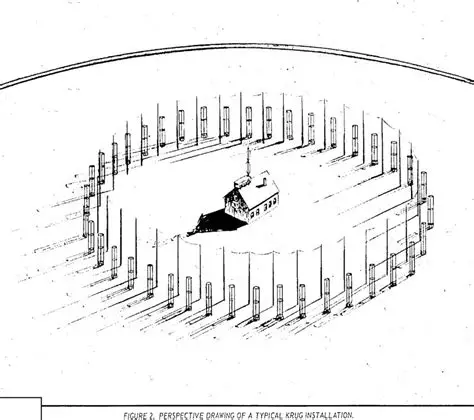
Krug (Russian: Круг, “circle” or “ring”; sometimes written Krugg in English) is the Western name for the Soviet Union’s large Circularly Disposed Antenna Arrays used for high-frequency intercept and direction finding. The arrays are Wullenweber-class CDAAs: a ring of broadband vertical monopoles around a reflecting screen, with a processing building at the centre.
This is not the 2K11 Krug (NATO SA-4 Ganef) surface-to-air missile system. It is not Okno, not a space-surveillance radar, and not Moment/Sledopyt satellite ELINT — those hear spacecraft. Krug hears high-frequency radio on the ground and in the air, at ocean distances.
WHAT IT DOES
High frequency (roughly 3–30 MHz) does not stop at the horizon. The ionosphere reflects it, so a transmitter in the Atlantic or over Europe can be heard in the Soviet interior. The problem is that a single whip antenna tells an operator only that a signal exists. It does not say from which direction, or where on the map the ship, aircraft, or shore station sits.
A Krug array answers the direction question. Forty wideband monopoles around a circular screen sample the incoming wave at many points on a circle. Combining those samples with controlled phase — the same family of idea as a PESA, applied to receive-only HF — forms a narrow beam that can be swept in azimuth, or several beams at once. The operator, or later the computer, finds the azimuth at which the signal is strongest. That azimuth is a line of bearing from the site to the transmitter.
One line of bearing is not a location. It is a ray that may be thousands of kilometres long. A second Krug, hundreds or thousands of kilometres away, takes its own bearing on the same emission. Where the two rays cross is a fix. A third site shrinks the error ellipse. Western handbook cards printed about 1° bearing accuracy and a 5,000-nautical-mile class range. One degree at that distance is still a wide swath of ocean; the network’s value was many stations hearing the same call, not a single precise pin.
At the same time the array is a large intercept antenna. The same elements that take a bearing also deliver a strong copy of the waveform to receivers: callsigns, schedules, traffic volume, modulation type, and, when the link is readable, content. Direction finding and listening are one facility.
The system is passive. It does not illuminate. It does not jam from the ring itself. It sits and hears.
WHAT IT WAS USED FOR
Naval HF. Cold War fleets talked on HF when they were beyond line-of-sight of their own shores. A Krug net could place a task-group’s HF voice or broadcast transmitter on a plot, watch it move from watch to watch, and cue other collectors or reconnaissance. Submarine broadcast and some shore-to-submarine paths also live in HF; open assessments list monitoring of those paths among the missions of the large Soviet CDAAs, without claiming the ring itself was a two-way submarine radio.
Air HF. Long-range aircraft — transports, bombers on training tracks, tankers, some maritime patrol — used HF for position reports and command. Bearings on those nets produced tracks that radar beyond the horizon could not.
Shore and staff nets. Embassies, HF backup for microwave and cable, and NATO/US command circuits that still used high frequency were a standing intercept target. Western writing describes mapping of NATO HF command-and-control infrastructure as a principal product of the Krug network: not the content of every message, but where the transmitters sat and when they keyed.
Cueing. A bearing from Krug is a searchlight for other systems — airborne collectors, smaller tactical DF, or a satellite when one is in view. The ring finds the azimuth; something else may take over the target.
What it was not used for. It does not track silent satellites. It does not guide a missile. It does not see microwave LOS links or modern SATCOM as its native band. It does not replace Okno’s optical catalogue or Don-2N’s ABM picture. When HF declined as the world’s long-haul bearer — after satellites and fibre — the operational weight of a 300-metre ring declined with it.
THE ARRAY
A classic NATO-identified Krug is a pad 200–300 m across with a reflecting screen about 105 m in diameter and about 40 large caged monopoles on a circle of roughly 120 m. The centre house holds beam-formers and DF receivers. Coverage is 360°.
Thick Eight reused the same caged monopole on only eight masts. Fix-24 was a smaller dual-band concentric-ring family (pads about 150–200 m). In Western usage “Krug” means the large 40-element class. Thirty-one such sites were listed in declassified U.S. inventories, plus overseas intercept centres in older Russian descriptions of a perimeter network (Lourdes, Cam Ranh, and others). Imagery in the 2000s showed most pads abandoned; a remainder, including Gatchina / Verolantsy near St. Petersburg, still looked intact. “About ten active” was a cautious open estimate, not a Ministry count.
LINEAGE AND NAME COLLISIONS
The geometry is German Wullenweber work from the Second World War. Soviet large CDAAs of the late 1940s–1950s are described in Western literature as built with that inheritance.
A different Soviet object also nicknamed Krug appears in Yantar / Duga (5N77 Steel Yard) accounts: a ring about one kilometre across, tasked with sounding the ionosphere to correct an over-the-horizon radar. That is a different diameter and a different programme. 2K11 Krug / SA-4 is the tracked army SAM. New concentric earthworks reported in Kaliningrad in the mid-2020s have been compared in the press to a CDAA; that is an imagery guess, not a name plate.
STATUS
Most Cold War Krug pads are archaeology. HF-DF as a mission did not vanish; it moved to smaller arrays and lost primacy to satellite and microwave collection. A handful of large rings may still take bearings. In 2026 open writing the word Krug is as often a dead circle in a field as it is a living 40-mast fence.
IN ONE SENTENCE
Krug is a Soviet 40-mast HF direction-finding circle that listens to sky-wave radio, draws a bearing to the transmitter, and — when two or more sites hear the same call — puts a ship, aircraft, or shore station on the map, which is why it existed and why it is not a radar, a SAM, or a space telescope.