WHAT IT IS
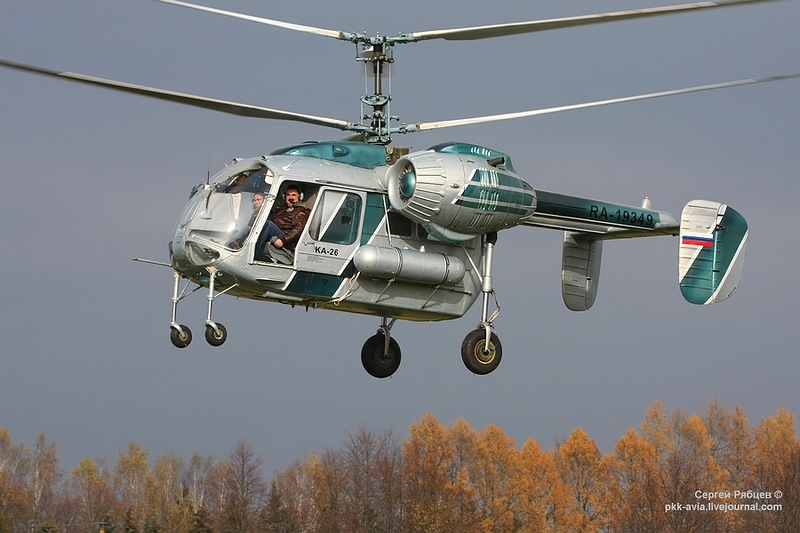
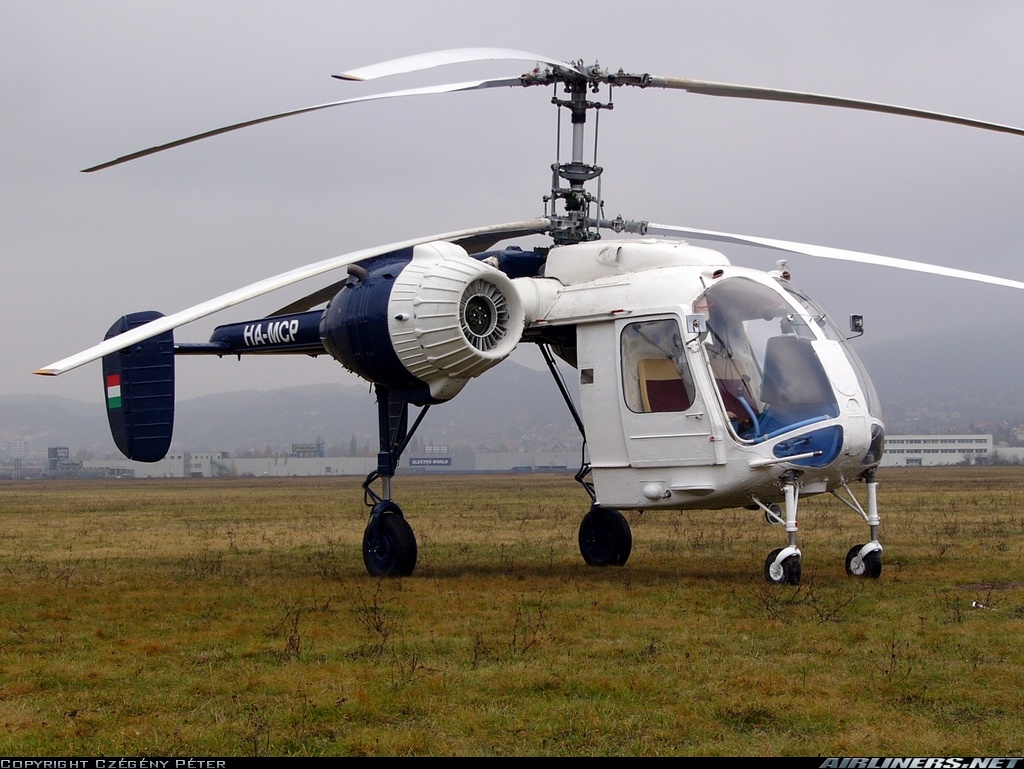
The Kamov Ka-26 (Ка-26; NATO reporting name Hoodlum, in Russian «Хулиган») is a small Soviet twin-piston-engine utility helicopter with two coaxial, contra-rotating three-blade rotors, designed by the Kamov design bureau (ОКБ Камова, OKB-2, led by general designer Николай Ильич Камов) in the first half of the 1960s. Its central idea is a "flying chassis" («летающее шасси»): a short cockpit pod at the front, a rectangular central platform that carries the gearbox, rotors and two side-mounted engine nacelles, and two tail booms behind. Behind the cockpit the operator can fit whatever the job needs: a six- or seven-seat passenger and cargo cabin, an open cargo platform, chemical tanks and spray booms, a dust hopper, a winch, an external-load beam, a medical module or survey equipment.
The Ka-26 was designed first of all as an agricultural helicopter for crop spraying and dusting, and that is the role in which it became best known, but it was built as a universal machine and served as a light transport, air ambulance, forest patrol and fire-watch aircraft, geological survey platform, traffic police (ГАИ) patrol helicopter, ship-based rescue helicopter and flying crane. Russian Wikipedia credits it as the first Soviet helicopter certified to the American FAR-29 airworthiness standard (1967).
The prototype made its first hover on 24 May 1965 (test pilot В. И. Громов, per Russian Wikipedia) and its first circuit flight on 18 August 1965, the date normally quoted as the first flight. Series production began in 1969 at the Kumertau aviation plant (Кумертауское авиационное производственное предприятие, КумАПП) in Bashkiria. About 816 were built (an often-quoted total; one English-language source gives 850, see PRODUCTION) and about 257 of them went to 14 foreign countries. Production ended in 1985. Descendants are the single-turboshaft Ka-126 (Romanian-built, small numbers) and the twin-turboshaft Ka-226, which is still in production at Kumertau in 2026 for Russian state users.
DEVELOPMENT
In the early 1960s the Kamov bureau was tasked with building an agricultural helicopter able to accept several kinds of interchangeable equipment. Russian Wikipedia names the deputy chief designer М. А. Купфер as the leader of design and construction. Kamov had already built several coaxial machines (the Ka-8 and Ka-15 in the late 1940s and 1950s, the Ka-18 and the Ka-25 naval helicopter), and the coaxial layout was chosen again for the new helicopter. The bureau's approach is generally explained by three advantages of the coaxial layout: no tail rotor to absorb power, no tail-rotor related directional problems and accidents, and a compact footprint for a given lift because the whole rotor disc area is used for lift.
The first prototype was built in 1965. Per Russian Wikipedia the first hover was on 24 May 1965 and the first circuit flight on 18 August 1965. State tests began in 1966. The helicopter was shown at an international agricultural machinery exhibition, where it is reported to have been awarded a gold medal, and in 1967 it was shown at the Paris Air Show at Le Bourget, where it was reported to have been certified to FAR-29 standards, the first Soviet helicopter to be so (claims from Russian Wikipedia; the original certificate was not checked for this article).
Series production was organised in 1969 and deliveries to Aeroflot's agricultural and general-purpose units, to the Soviet Ministry of Internal Affairs (Militsiya and GAI traffic police) and to export customers followed. English Wikipedia and many references give the manufacturing period as 1968–1985 while Russian Wikipedia gives 1969–1985; the first aircraft were probably built in 1968 for the pre-series, with serial production from 1969.
The Kamov bureau used the Ka-26 as a base for several experiments and derivatives. The Ka-26SS (Ка-26СС) was an experimental aircraft built to study a jet-flow directional control system compensating for rotor torque, a NOTAR-type system (jet beams on the tail), and is described by English Wikipedia as a technology testbed for the later Ka-118 project. The Ka-126 replaced the two piston engines with one turboshaft, and the Ka-226 with two turboshafts. These are described in the VARIANTS section.
COAXIAL ROTOR SYSTEM AND KAMOV DESIGN PHILOSOPHY
A coaxial helicopter has two main rotors on the same axis, turning in opposite directions. The torque of one rotor cancels the torque of the other, so no anti-torque tail rotor is needed, and all engine power goes to lift and propulsion. Directional (yaw) control is done by changing the relative torque of the two rotors, in practice by differential collective pitch, so the pilot's pedals change the pitch of the upper and lower rotors in opposite senses. The Ka-26 uses this layout, with a two-rotor hub, a single main gearbox and swashplates for the two rotors.
Properties normally attributed to the layout, including by the manufacturer and the Russian-language literature: a short overall length (7.75 m fuselage with a rotor diameter of 13 m), full aerodynamic symmetry in the left and right directions, high hover efficiency, no sensitivity to crosswind from tail rotor loss of effectiveness, the ability to make flat turns on the spot without altering altitude, and safer work close to obstacles because there is no exposed tail rotor. Downsides that are generally acknowledged: a more complicated rotor hub and control linkage, the risk of the upper and lower blades striking each other if one rotor flaps or loses its pitch link excessively (blade-to-blade contact is a known hazard of coaxial designs), and higher aerodynamic drag of the hub, which limits top speed.
Ka-26 rotor details (Russian Wikipedia): two three-blade rotors with articulated blade attachment, spaced 1.17 m apart vertically. The blades were reported as made from glass-fibre composite with an epoxy-phenolic binder, claimed to be the first use of such blades in world helicopter practice, with a hollow spar of variable section, bonded light tail sections, a steel root fitting bolted on, a rubber erosion-protective leading edge and a counterweight in the nose. Anti-icing tubes carried liquid from a tank behind the central fuselage to the blade leading edges. The blades were stated to have virtually unlimited resource. These are Russian-language descriptions of design intent and have not been independently confirmed here.
In agricultural work the coaxial rotor is credited with a symmetrical vortex pattern. English Wikipedia reports that Hungarian operators claim that the airflow of the Ka-26 lets well-atomised pesticide linger and settle also on the underside of leaves, giving a more even distribution without the side currents of a tail rotor, and that it is used to spray vineyards where a conventional helicopter's downwash would damage vines. The same source marks parts of this claim as lacking citation. It is best read as operator opinion, not as a measured result.
AIRFRAME
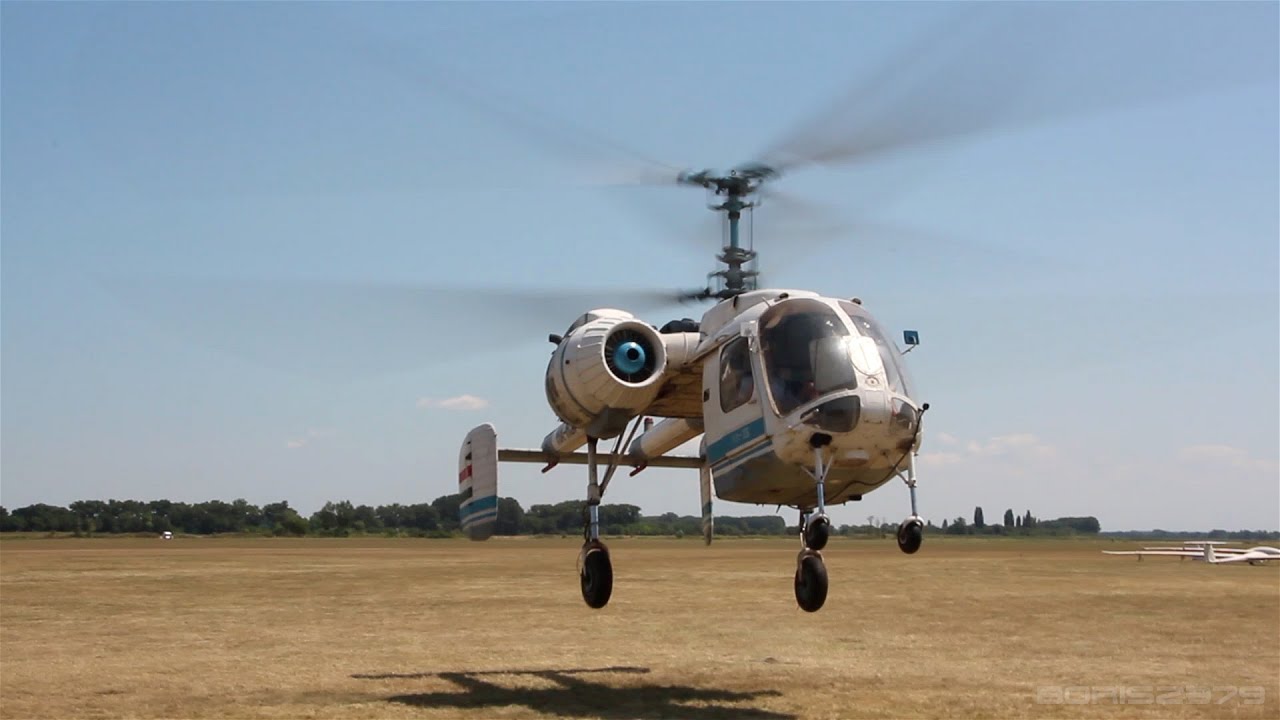
The fuselage follows the "flying chassis" scheme. A rectangular central compartment ("platform") carries on its top the main gearbox with the rotor system, and on its sides two engine nacelles. At the front is the two-seat crew cabin, at the rear two tail booms that carry a horizontal stabiliser (with end fins). Landing gear is a four-leg wheeled undercarriage; the Ka-26 does not use skids. Ships' variants carried inflatable flotation bags on the rear wheels and nose, with compressed-air cylinders fired by pyrotechnic cartridges (type ПП-3) for emergency landings on water.
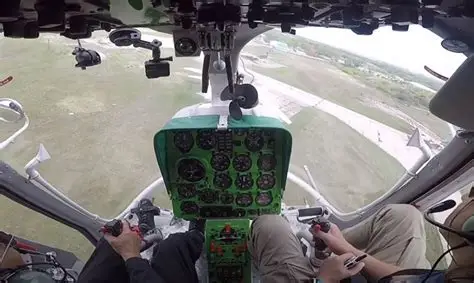
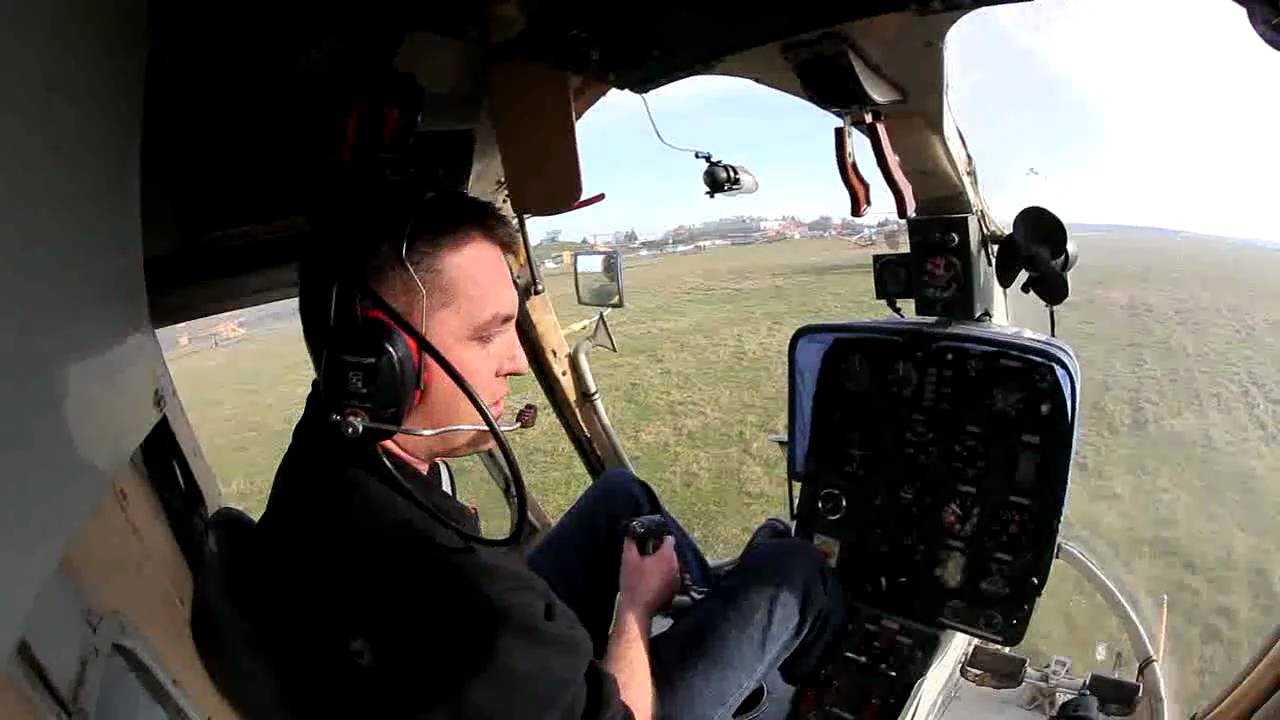
The cockpit seats two with good all-round visibility through a large glazed area and sliding doors. Standard crew is one pilot (a second set of controls can be fitted, and many aircraft flew with a single pilot and, in passenger work, an operator). Front windscreens have wipers and anti-icing. In the agricultural version the cockpit gets an air-purification system with a centrifugal separator-blower creating overpressure and a filter-absorber to protect the pilot from chemicals. Radio and instrument bays behind the crew seats have large service hatches.
The principal engineering feature is the quickly changeable payload section. Russian Wikipedia states that a crew of three could convert the helicopter from one role to another in 1.5–2 hours, and that all variants except the ship and geological survey ones could be re-equipped by two or three technicians in less than a working day. Mounting points and wiring for all alternative equipment are built into the airframe from the start. English Wikipedia notes that the aircraft can fly with or without the cargo or passenger box attached.
Fuel: three tanks (two front, one rear) with a total of 620 litres; two additional 160-litre tanks can be fitted on the sides of the cargo cabin (Russian Wikipedia). The fuel is given as «СБ-78», a mixture of aviation gasolines Б-70 (75%) and Б-91/115 (25%). The helicopter therefore burns leaded aviation gasoline, not kerosene, which has been an increasing logistics burden as avgas has become less common.
ENGINES
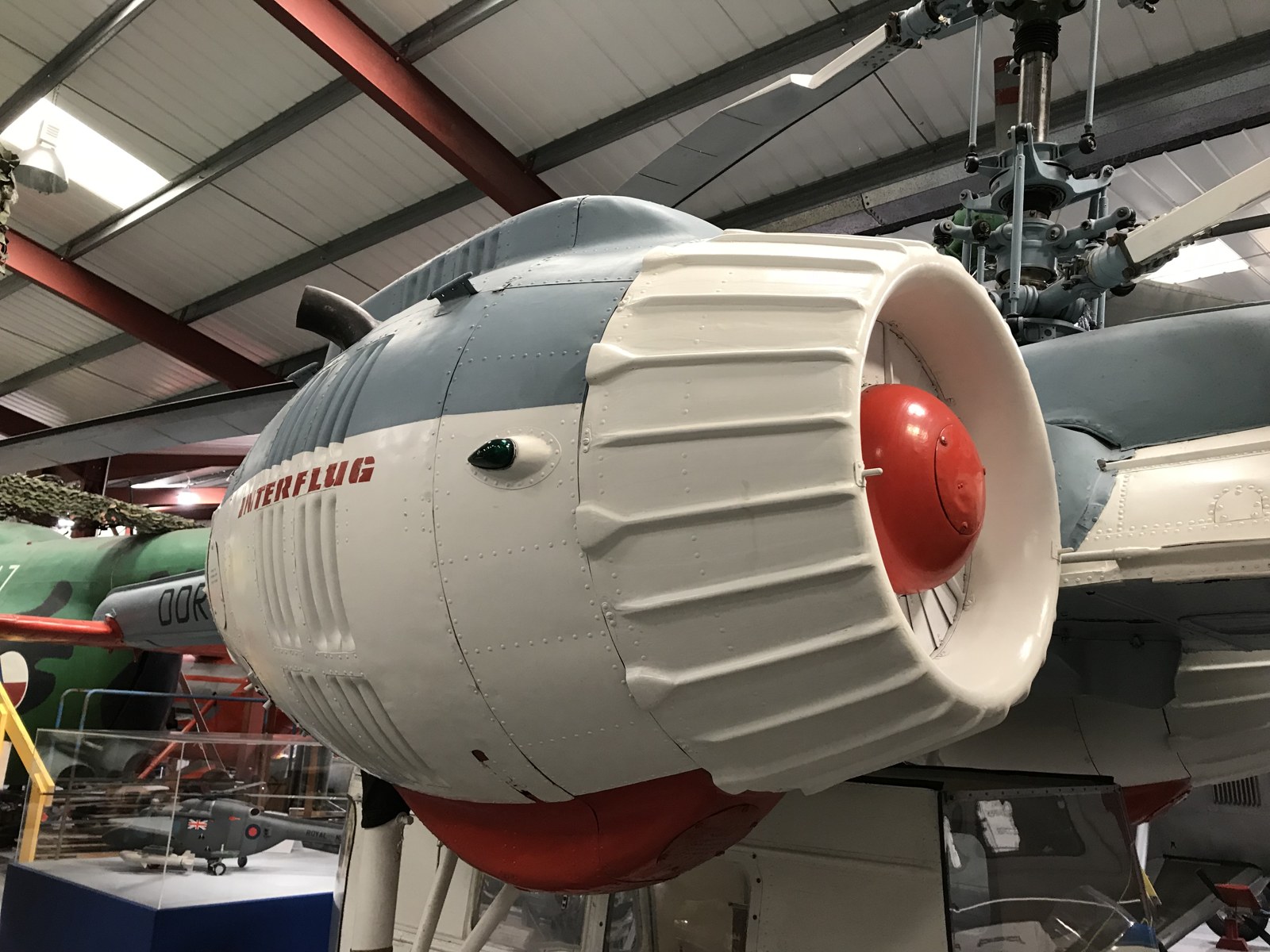
Power comes from two Vedeneyev M-14V-26 (М-14В-26) nine-cylinder, air-cooled radial piston engines, each rated 325 hp (239 kW; 242.5 kW in one data set), mounted in nacelles on each side of the fuselage. The M-14 family was developed by Vedeneyev's bureau (ОКБ Моторостроения, at the Voronezh Mechanical Plant), and is the same engine family used on the Yak-18T, Yak-52 (M-14P) and Su-26/29/31 aerobatic aircraft in different forms. The helicopter's engines drive the main gearbox through a transmission with a distribution gearbox and a gearbox type Р-26 (the Russian accident record refers to a Р-26 main gearbox failure).
Startup is an electro-pneumatic starting system. Carburettor air-inlet heating, anti-icing and cabin heating (a petrol heater type 2140А) are provided. The Russian source gives the electrical system as 28.5 V DC with one or two 3 kW GSR-3000M generators, a 12SAM-28 or 20NKBN-25 battery, 36 V 400 Hz AC for instruments from a PT-200Ts converter (with a standby PAG-1FP), and a ground-power receptacle ШРАП-500. In the agricultural version two MT-3000M electric motors drive spray pumps (ЭЦН-17 centrifugal pumps) or dusting fans.
One engine out: English Wikipedia (Jane's 1982–83) lists a service ceiling with one engine inoperative of 500 m, which shows that the Ka-26 can continue level flight on a single engine only at low weight and low altitude. This is one of the arguments for later turbine versions, since a twin-piston helicopter is not as safe on one engine as its twin layout suggests.
SYSTEMS, AVIONICS AND EQUIPMENT
The Ka-26 was designed for day and night flying and for flight in difficult weather, but the avionics are of the 1960s. According to the Russian technical description (Транспорт, 1976, as cited by Russian Wikipedia): instrument panel with about 20 gauges, magnetic compass КИ-13, heading system ГМК-1АЭ with a ГА-6 gyro unit, radio compass АРК-9, radio altimeter РВ-3, pitot-static receiver ПВД-6М with 100 W heating, VHF radio «Ландыш-5», HF radio «Карат», intercom СПУ-7 (СПУ-8 in the GAI version), a voice recorder МС-61, and a barograph АД-2. For GAI patrol versions, four field loudspeaker sets ПЗС-68 allowed an operator to address drivers on the road. When the helicopter is converted to the agricultural role the radio altimeter, radio compass, heading system and one converter are removed to save weight.
Lights include a taxi/landing light МПРФ-1А and a landing/search light ФПП-7. A winch, electric type ЛПГ-150М, can lift or lower loads up to 150 kg from hover heights of up to 40 m, using two reversible D-500TV motors and a hand-held pendant ПУЛ-1А. The external load beam under the centre section uses an electric hook lock ДГ-64, with manual and remote release. The ship rescue version carries a winch ЛПГ-150-М3, a rescue boat ЛАС-5М3 with a «Коралл» radio, and a television camera.
SPECIFICATIONS
The figures below are for the standard Ka-26 and are taken from English Wikipedia (Jane's All The World's Aircraft 1982–83) with Russian Wikipedia values given alongside where they differ. Differences come from different loads, definitions and sources.
Crew: 1 (optionally 2). Passengers: 6 (Russian data) or 6–7 (Jane's) in the passenger module; or 2 stretcher patients, 2 seated patients and a medical attendant.
Payload: 700 kg (Russian Wikipedia infobox); 900 kg of passengers or liquid chemicals (Jane's; also stated for cargo in the Russian variants list); 1,065 kg dusting or platform load; 1,100 kg slung load (Jane's). The 700 kg figure probably reflects a practical payload with fuel.
Fuselage length: 7.75 m. Width over engine pods: 3.64 m. Height: 4.05 m.
Rotor diameter: 2 × 13.0 m. Rotor spacing: 1.17 m.
Empty weight: 1,950 kg without passenger pod, platform or agricultural equipment. Gross weight 3,076 kg with passenger pod; 2,980 kg other versions. Maximum take-off weight: 3,250 kg.
Fuel: 620 litres in main tanks plus two optional 160-litre tanks.
Powerplant: 2 × Vedeneyev M-14V-26, 325 hp (239 kW) each.
Maximum speed: 170 km/h. Cruise speed: 150 km/h maximum (Jane's) or 135 km/h (Russian Wikipedia); economical cruise 90–110 km/h. Agricultural working speed 30–115 km/h (Jane's) or 30–130 km/h (Russian Wikipedia), swath width 20–60 m.
Range: 400 km with 7 passengers and 30 minutes reserve (Jane's); 520 km "practical" range (Russian Wikipedia). Ferry range 1,200 km with auxiliary tanks (Jane's). Endurance 3 h 42 min at 90–110 km/h (Jane's).
Service ceiling: 3,000 m. With one engine inoperative: 500 m (Jane's). Hover ceiling in ground effect 1,300 m and out of ground effect 800 m at 3,000 kg (Jane's).
Records: Russian Wikipedia credits the type with five world records, among them an altitude record of 5,330 m for helicopters in the 1,750–3,000 kg take-off weight class, and a climb to 3,000 m in 8 min 51.2 s. Exact FAI record numbers and dates were not verified for this article.
VARIANTS
The Ka-26 was sold as one basic helicopter with different equipment kits. Russian Wikipedia lists these as production configurations:
Agricultural («сельскохозяйственный»): no cargo cabin, with tanks or hoppers for spraying and dusting, swath 20–60 m at 30–130 km/h. Chemical load is given as about 900 kg, and an 800-litre tank is quoted for a Ukrainian museum exhibit.
Transport: with a cargo/passenger cabin for 6 passengers or 900 kg of cargo, or with a flat cargo platform instead of a cabin.
Ambulance («санитарный»): for two stretcher patients and two seated, with a medical attendant and equipment.
Forest patrol («лесопатрульный»): for patrolling forests and rescue work in fires, with a ЛПГ-150 winch, 40 m cable and hook.
Flying crane («летающий кран»): for assembly work and transporting loads up to 900 kg on external sling.
Ship rescue («корабельный спасательный»): with winch, lifting gear for victims, rescue boat ЛАС-5М3, television camera and emergency flotation bags. Ka-26 helicopters are recorded as having flown from Soviet whaling ships; the Russian accident list includes a 14 May 1975 loss of a Ka-26 that crashed into the South Pacific right after take-off from the whaling base «Советская Украина», reportedly because of a rotor blade detaching.
Patrol («патрульный», for the State Automobile Inspectorate, ГАИ): loudspeakers, winches, cargo hook, optional TV camera for aerial filming.
Geological survey («геологоразведочный»): with magnetic survey equipment in the cabin and a ring antenna mounted around the fuselage. The ship and geological versions could not easily be converted to other roles.
Ka-26SS (Ка-26СС): an experimental NOTAR-like aircraft with a jet-flow directional control system (testbed).
English Wikipedia names the base type "Ka-26 Hoodlum-A", with 850 built (see conflict note under PRODUCTION).
Related designs:
Ka-126 (Ка-126, NATO Hoodlum-B): developed in cooperation with Romania under a Romanian-Soviet agreement of 1984 and a protocol of October 1985. It dropped the two piston engines and the engine nacelles and used one Glushenkov (OMKB «Mars») TVD-100/TVO-100 turboshaft of 720 shp (537 kW) mounted on top of the fuselage above the cabin, with modified rotor blades and a new fuel system. English Wikipedia lists 2 prototypes and 15 series aircraft built by Industria Aeronautică Română (IAR) in Romania, 17 in total, with production stopping and the programme cancelled after 1991. Sources conflict on the date of the first flight: 22 December 1988 for the IAR-built aircraft with TV-100 engine (Ka-126 article), and "first flown in 1986" (variants lists). The Ka-126 is listed as having a maximum speed of 180 km/h, range 713 km and service ceiling 3,850 m (Jane's 1993–94). Some Ka-126 aircraft later flew with Romanian civil operators.
Ka-128: one prototype with a 722 shp (538 kW) Turbomeca Arriel 1D1 engine.
V-60: a project of 1980s for a light armed escort helicopter, about 3,500 kg, derived from the Ka-126. Only a model exists, and it is sometimes confused with early concepts of the Ka-60 (whose prototypes were designated V-62).
Ka-226: the twin-turboshaft descendant (see RUSSIAN STATUS AND THE KA-226 LINEAGE).
PRODUCTION
Production of the Ka-26 was at the Kumertau aviation plant (КумАПП) in Bashkortostan, which has built Kamov helicopters since the 1960s and now specialises in coaxial machines (Ka-27/28/31/32 and Ka-226/226T). Quoted totals:
816 built (Russian Wikipedia, English Wikipedia infobox), of which 257 were supplied to 14 foreign countries (Russian Wikipedia).
850 built (English Wikipedia variants list). This is a different number from the infobox of the same article, and the larger value is probably a rounded or inclusive figure, so 816 is used as the primary total in this article.
Production years: 1969–1985 (Russian Wikipedia) or 1968–1985 (English Wikipedia).
Unlicensed copies: on 30 June 2020 Moldovan police and prosecutors reported closing a clandestine factory in the Transnistrian region on the Dniester, about 50 km from Chișinău, that was assembling helicopters similar to the Ka-26 for illegal sale to customers in CIS countries. English Wikipedia (citing Balkan Insight and Air International, August 2020) states that the production line had ten airframes in various stages of completion. Details of the number of aircraft actually delivered are not known from the sources available.
OPERATORS
The Ka-26 was used in the USSR by Aeroflot's agricultural aviation (the bulk of the fleet, with a large share in Ukraine, Moldova, Russia, Belarus, Kazakhstan and the Caucasus), by the Ministry of Internal Affairs (Militsiya and GAI), and by research, geological, whaling and forestry organisations. Russian Wikipedia names these operator countries: Russia, Belarus, Bulgaria, Hungary, Sweden, Mongolia, East Germany (GDR), Sri Lanka, Romania and Japan, plus the United States (marked as without a source, and described as sold through a front firm) and "others". English Wikipedia lists the following:
Soviet Union: Militsiya (former); civil aviation (Aeroflot) as the main user.
Russia: Gazpromavia is listed as an operator in English Wikipedia (source dated 2013) and Russian Wikipedia's infobox. This listing is dated and the current Gazpromavia fleet should be checked against the company's own site;
Romania: West Copter (listed in English Wikipedia from a website, 2013 or earlier).
Hungary: civil agricultural operators (see below); the Hungarian Air Force is listed as a former military operator.
Bulgaria: Bulgarian Air Force (former). The Bulgarian agricultural fleet has also flown Ka-26 civil machines, and Bulgarian civil registrations appear in accident lists (for instance LZ-6042 near Nesebar in 2016, per Russian Wikipedia).
East Germany: People's Police (Volkspolizei, former). Russian Wikipedia also mentions use by the police of West Germany. The extent of Interflug use (the East German state airline) was not confirmed in the sources used here; at least one museum Ka-26 is preserved in Interflug markings.
Mongolia: Mongolian Air Force (former, listed from a World Air Forces historical listing).
Lithuania: Lithuanian State Border Guard Service (former).
Sri Lanka: Sri Lanka Air Force (former).
Hungary: the Hungarian register database avia-info.hu shows Ka-26 airframes with military operation from 1971 until 1984 or 1990 (in the entries seen, ex-Hungarian Air Force aircraft with serial numbers 7001406, 7001408, 7001501, 7001506 and so on), and some of these were later re-registered with HA-M.. civil registrations, sold abroad or preserved as monuments (one of the entries lists a location in Budapest, Csepel, one in Börgönd). The Hungarian type was also used extensively for vine and orchard spraying, and an HA-MCH accident on 12 April 2018 (aircraft with a fertiliser load fell on take-off during agricultural work, no injuries) shows civilian agricultural use was still taking place in 2018 (Russian Wikipedia, citing Aviation Safety Network). Whether any Hungarian Ka-26 still flies commercially in 2026 is not established here.
Ukraine: according to the Antonov State Aviation Museum in Kyiv, the Ka-26 was operated until 1991 by the Zaporizhzhia, Kyiv and Kherson combined aviation squadrons, and in independent Ukraine by several airlines until 2006, including ARP-410. The museum holds two Ka-26 helicopters, one with a passenger module (built 1969, operated by the Kherson squadron) and one with a spraying kit and 800-litre tank (built 1977).
Military use: the Ka-26 was not a combat helicopter and carried no weapons in standard form. English Wikipedia says that some Warsaw Pact armies used it only in light paratroop or airborne liaison roles (marked "citation needed") and that its cruise speed of about 150 km/h compared with the Mil Mi-2's 220 km/h limits general military usefulness, while its shorter length (7.75 m against 11.9 m) and smaller rotor diameter (13 m against 14.6 m) are advantageous in urban areas. Both comparisons use catalogue values.
SERVICE HISTORY AND ROLES
Agriculture: this was the main task of the Ka-26 in the USSR, where it flew chemical treatment («авиахимические работы», АХР) of grain, cotton, orchards, vineyards and forests. Low-level work in the 5–15 m band among power lines and poles is the principal hazard. Of the Russian Wikipedia accident table (a compilation largely drawn from AirDisaster.ru), a large share of fatal accidents are listed as collisions with power lines, most in agricultural flights and many at heights below the safe flight height, and the rest include flight into weather and loss of orientation, pilot error, and several technical failures.
Fire and forestry: the forest patrol version carried an electric winch and was used for fire reconnaissance and rescue work.
Police and traffic control: the GAI version, with loudspeakers and television camera, was used for traffic surveillance and convoy escort, which made it familiar to the Soviet public. It appears in many Soviet and East European films, among them «Старики-разбойники» (Old Rogues), «Шла собака по роялю» (where an agricultural Ka-26 and its young pilot are central), «Сыщик», «Письма мёртвого человека», «Золотая мина» and the Hungarian film «Pogány Madonna» (1980), and as a smuggler's helicopter in the fourth season of the television series «Stranger Things» (as stated in Russian Wikipedia).
Geological survey: with a ring antenna around the fuselage for magnetic survey.
Ship-based rescue: with whaling and other vessels.
Military: besides the liaison and light-transport use in Bulgaria, Hungary and Mongolia, the Ka-26 was not developed into a weapons platform. For completeness a Kyiv Post article (publication date not verified here) quoted a Ukrainian naval official as saying that sea drones armed with R-73 missiles had destroyed two Russian Mi-8 helicopters over the Black Sea and damaged a Ka-26 "military helicopter" in the preceding December. That is an uncorroborated single-source statement of unclear exact type identification, and is not treated here as established; no confirmed combat use of the Ka-26 in the war between Russia and Ukraine is known from sources reviewed, and there is no verified case of the Ka-26 being used as a drone carrier.
Accidents and limits: the Russian Wikipedia list, from 1969 on, runs to several dozen losses, many fatal. Causes recorded include: wire strikes in agricultural flights; low flight over snow with loss of the horizon (1975); alcohol impairment of pilots (1974 and 1975 entries); engine failure when fuel was exhausted (Krasnovodsk, 19 September 1969, 5 of 6 killed); lightning strike (1974); blade or hub failures (for instance a rotor-blade separation on 2 November 1979 attributed to a failed pin of the upper hub, and a lower-to-upper rotor contact after a pitch-link failure at Leningrad (Rzhevka), 16 April 1979); main gearbox failures (1976, 1981, 1984); a stone thrown at the rotor blade (1977); and overloaded or rearward-wind flight in the tail-first attitude (1984). A 2002 crash at Noginsk (Moscow region) killed five when a crew trying to avoid a flock of birds struck a cable between two buildings. The 7 November 2025 Dagestan accident quoted in the same family of lists concerns a Ka-226, not a Ka-26. The table is a secondary compilation, not an official accident register, and the causes given are from the cited investigations as summarised there.
Operating limits visible in the data: relatively low maximum take-off weight of 3,250 kg, 150 km/h class cruise, a service ceiling of 3,000 m, limited single-engine performance (500 m service ceiling one engine inoperative per Jane's), reliance on avgas, and the engine's finite resource. The wear-out of the Mi-2 and Ka-26 fleets by about 2002 is given as one reason for the Ka-226 programme.
RUSSIAN STATUS AND THE KA-226 LINEAGE
Russian Federation: no precise count of Ka-26 helicopters still flying in Russia is available from the sources used. Russian Wikipedia says that many of them were still in operation as of 2009, and the Ka-226 article explains that the Ka-26 and Mi-2 were being withdrawn because their service resource ran out by about 2002, with an emphasis on about 500–600 potential demand for a light twin. A small number of Ka-26 may still fly as agricultural, private or museum aircraft in Russia, Ukraine and Eastern Europe, but a reliable current figure was not found. The helicopter is out of production and not part of any modernisation programme.
Ka-226 (Ка-226): the Kamov bureau began work on a deep modernisation of the Ka-26 and Ka-126 in 1990. The Ka-226 retained most design solutions of the Ka-26 (coaxial rotors, flying-chassis layout with replaceable cargo module) but has two turboshaft engines mounted above the central compartment: Allison (Rolls-Royce) 250-C20R/2 of 2 × 338 kW (460 hp), a VR-126 gearbox, torsion-mounted semi-rigid blades, a composite and aluminium airframe and new avionics. The first flight was on 4 September 1997, with entry into service in 2002. Russian Wikipedia credits it with a designated resource of 18,000 flight hours and 25 years of service, and says that 269 had been produced (the date of that count is not given). Kumertau builds it for state users and the Kamov-designed machine is offered to external customers.
Ka-226T (Ка-226Т): a version with Safran (Turbomeca) Arrius 2G1 engines and a new gearbox and avionics. A type-certificate supplement of the Interstate Aviation Committee Aviation Register (АР МАК) for the Ka-226T was announced by Russian Helicopters (Rostec press release), which stated that Ka-226 helicopters in special configurations for Russian security services are still built at Kumertau and that Ka-226T production would also be organised there. India signed a contract in December 2015 for 200 Ka-226T helicopters (40 supplied, 160 to be assembled in India under a joint venture with HAL), and Russian Wikipedia reports that India froze the talks in mid-February 2023, reportedly because of the proposed localisation level. No Indian deliveries are known to the sources used here.
Import substitution: the Ka-226T is to be re-engined with the Russian Klimov VK-650V turboshaft (650 hp take-off; 750 hp emergency rating). Work on replacing the French engines began in 2020 (Russian Wikipedia). The Russian Ministry of Transport announced on a date in 2025 (February 2025, per search summaries) that the VK-650V engine had received a certificate, to be used on the Ansat and the Ka-226T. According to the same reports the Ka-226T with VK-650V had not yet completed its own type certification in 2025. The status in 2026 is not confirmed here.
Operators of the Ka-226 family (Russian Wikipedia, mostly from the IISS Military Balance 2023/2024): Russian Aerospace Forces about 19 Ka-226U as of 2024; Naval Aviation 6 Ka-226T as of 2024; FSB aviation about 4; Rosgvardia 1 Ka-226T as of 2023; civil users include Gazpromavia, the Orenburg regional clinical hospital, Moscow police and city traffic centre aircraft, and EMERCOM (МЧС) with 8 Ka-226T. The Ukrainian Navy was listed with 1 Ka-226 as of 2023, with the current status unknown. The Ka-226 therefore carries on the Ka-26 concept (a coaxial helicopter with a changeable payload module) in current production, even though no Ka-26 airframe is in series production.
Related Kumertau-built types are the Ka-27/28/29 naval helicopters, the Ka-31 radar picket and the Ka-32A11BC civil helicopter, all of which share the coaxial layout but are not derivatives of the Ka-26.
COMPARISON AND CAVEATS
Comparison types: the Mil Mi-2 (Polish-built light twin-turbine helicopter with a tail rotor) was the Ka-26's main contemporary in the same class in the Eastern bloc: it is faster (about 220 km/h cruise by the English Wikipedia comparison, or 190 km/h in the Russian Ka-226 comparison table), with room for 8–10 passengers, but longer (11.9 m) and with a tail rotor. The Western Kaman K-MAX is the type listed as comparable in role and layout by Wikipedia, though it is an intermeshing-rotor aircraft, not a coaxial one.
Caveats when reading data about the Ka-26: (1) production totals differ (816 or 850); (2) payloads, ranges and cruise speeds differ between Jane's and Russian sources because they use different loads and reserve rules; (3) the Ka-26 "Hoodlum" code is used by NATO for the whole Ka-26/126/128/226 family, so the name alone does not identify the version; (4) many operator lists are dated and describe past service; (5) statements on the aerodynamic benefits for crop spraying are operator claims; (6) military use outside Bulgaria, Hungary, Mongolia, Sri Lanka and the GDR police is not documented here.
STATUS
Out of production since 1985. A declining number of airframes remain in civil use as agricultural, private and museum aircraft in Russia, Ukraine, Hungary, Bulgaria and other countries, and preserved examples are displayed in aviation museums, among them Peenemünde (Germany), Riga (Latvia), Kyiv (Antonov State Aviation Museum and Kyiv Aviation Institute) and Budapest. Military service has ended in Bulgaria, Hungary, Mongolia, Lithuania, Sri Lanka and the GDR (which no longer exists), according to English Wikipedia. The type has no modernisation programme; the Ka-126 (17 built in Romania) was cancelled after 1991 and the Ka-226 family continues at Kumertau for Russian security services, the military and EMERCOM, with the Ka-226T engine replacement (VK-650V) being developed. Gasoline engines, aging airframes and the wear of the original fleet have made the type obsolete for regular commercial work, though it remains well remembered for its role in Soviet agriculture.
IN ONE SENTENCE
The Kamov Ka-26 Hoodlum (Ка-26) is a 3,250 kg Soviet coaxial "flying chassis" helicopter with twin Vedeneyev M-14V-26 piston radials and a swappable cargo, passenger or agricultural module, first flown in 1965 and built at Kumertau from 1969 to 1985 (about 816 aircraft, 257 exported), best known for crop spraying, whose line continues through the Ka-126 (17 built in Romania) into the twin-turboshaft Ka-226, still produced at Kumertau for Russian state users.