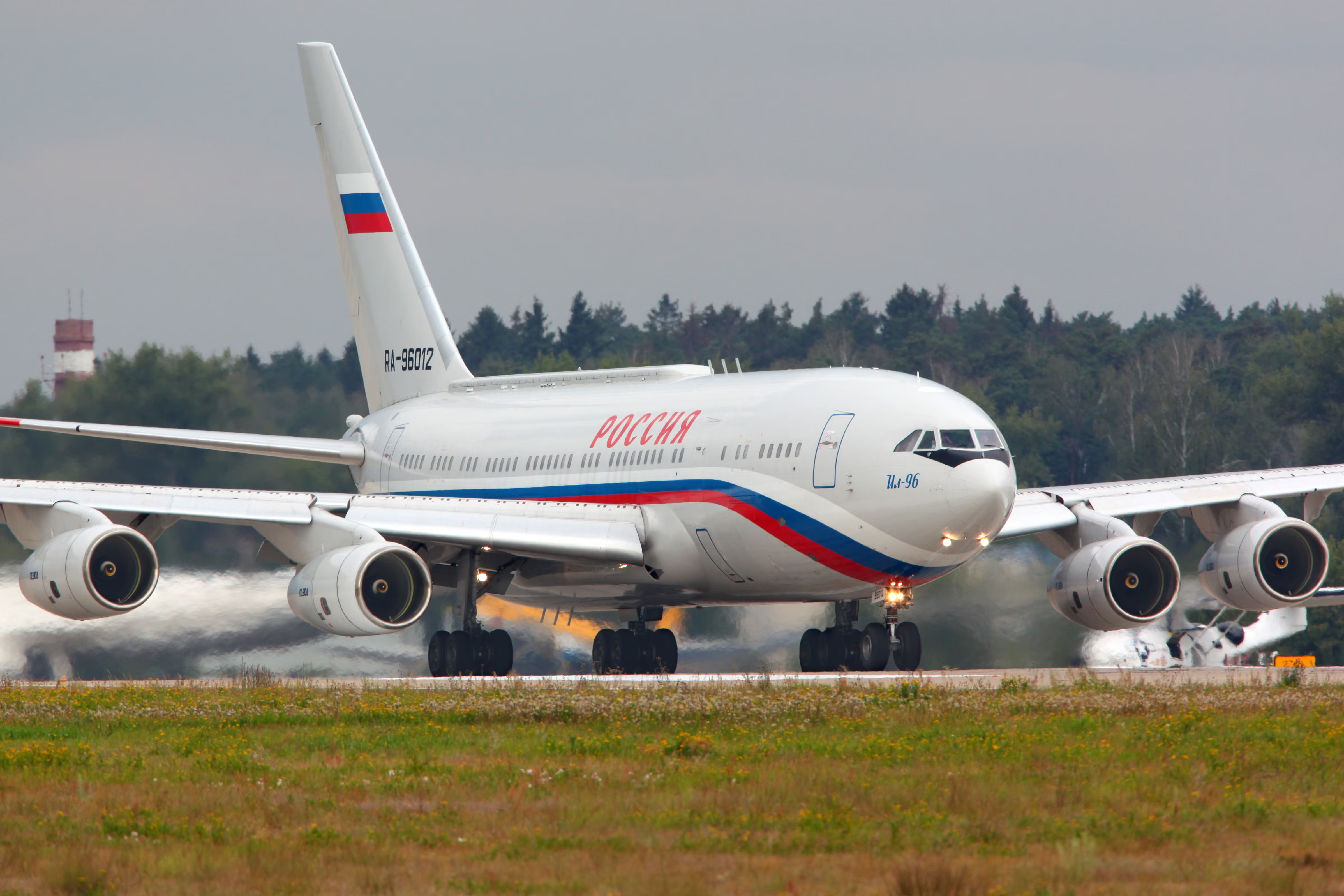
WHAT IT IS
The Il-96 is Russia’s only homegrown long-haul widebody: a four-engine, two-aisle jet with the same 6.08 m fuselage diameter as the Il-86, a new supercritical wing with winglets, and Aviadvigatel PS-90A fans. First flight 28 September 1988. Aeroflot service 14 July 1993. Built at VASO in Voronezh in ones and twos. About 37 airframes of all marks by late 2024 in the Russian Wikipedia count: 33 Il-96-300, three Il-96-400T freighters, one Il-96-400M prototype.
It was supposed to be the Soviet 767. It became the presidential and special-detachment airplane — Rossiya SLO, Cubana leftovers, a few cargo hulls — because four PS-90s burn money next to two Western fans and VASO never tooled for a real line. After 2022 it is also the stopgap long-haul while there is no CR929 and no PD-35 twin in service.
FROM THE IL-86
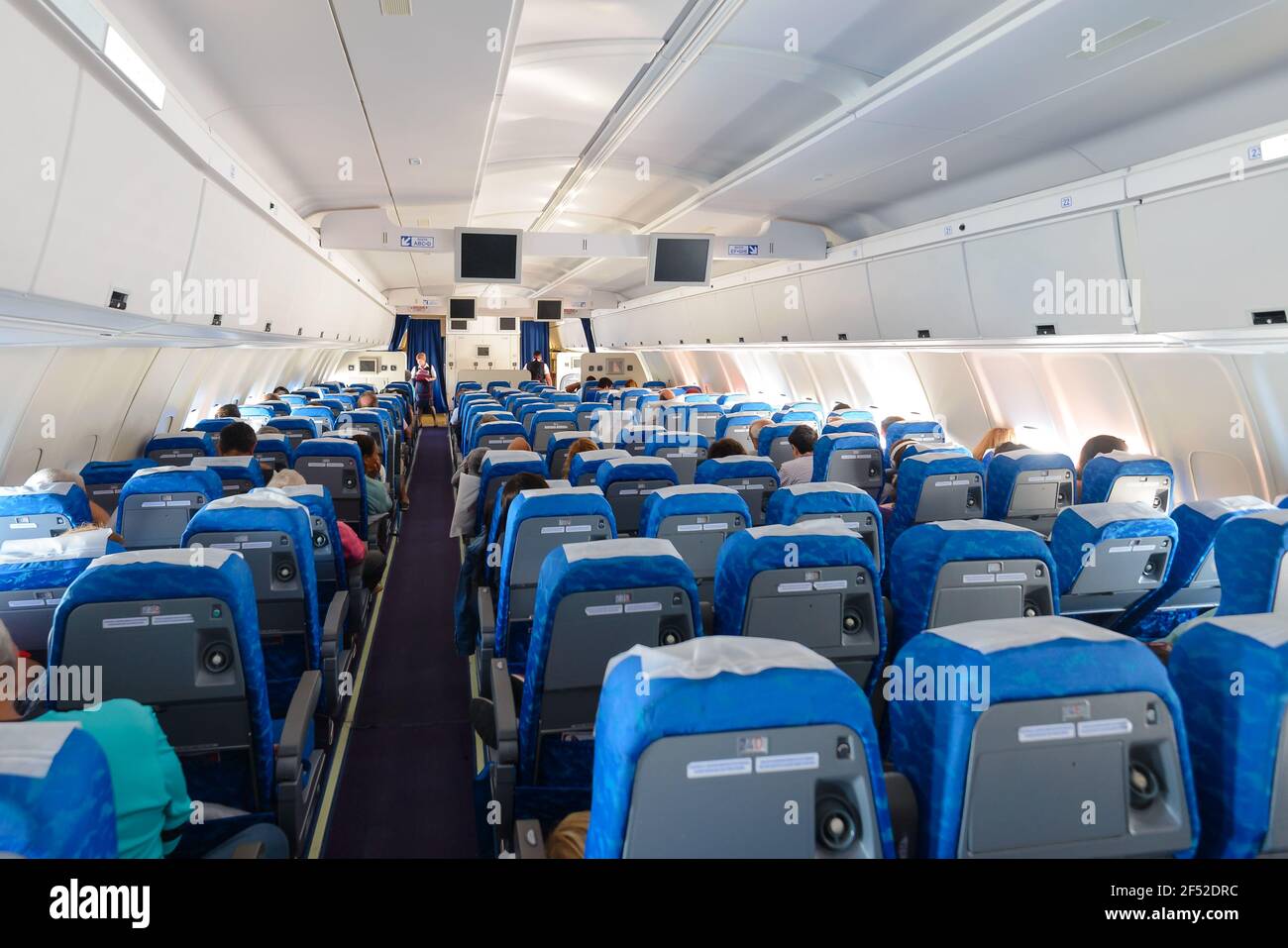
Il-86 was the first Soviet widebody: four Kuznetsov NK-86s, no range for oceans, lower-deck stairs for airports without jetways. Il-96 keeps the 6.08 m tube and 5.70 m cabin, shortens the -300 fuselage by about 5.2 m versus the 86, redesigns the shell for damage tolerance and a longer life, and hangs high-bypass PS-90As on a new 30°-sweep wing. Fly-by-wire and a glass-era cockpit (three-crew on the 300, two-crew advertised on M/400). Cat IIIA autoland on the international card. Winglets are part of the silhouette.
Chief designer line is Ilyushin; production is the Voronezh plant, now a branch of PJSC Il inside UAC.
ENGINES
PS-90A — four on the -300. 16,000 kgf / ~157 kN each. Bypass ~4.5. Same family as the Tu-204’s twins, just twice as many. FADEC on later standards; A2 upgrade path exists on paper.
PS-90A1 — four on 400 / 400T / 400M. ~17,400 kgf / ~171 kN.
PW2037 / PW2337 — Il-96M / some T cards. Western cockpit (Rockwell Collins in the 1990s pitch). One M flew 6 April 1993. The market did not buy it.
PS-90A3 then two PD-35s — the drawn future for a twin 96. PD-35 is still a development engine. Until it exists the airplane is a four-holer, and four-holers lost the airline war in the 1990s.
IL-96-300
The production airplane. Length 55.35 m. Span 57.66–60.12 m depending on which table you trust (winglets confuse the print). Height 17.55 m. Wing area 350 m² on some 300 cards, 391.6 m² on the common family table — the larger number is the 400-series wing used in most comparison charts. Empty ~120 t. MTOW 240–250 t. Payload 40 t. Seats 237 / 263 / 300 in 3/2/1 class. Cruise 850–870 km/h, M 0.78–0.84. Ceiling 12,000–13,100 m. Range with a heavy load ~9,000 km; long-range passenger figures run 10,000–11,500 km in marketing. TO run ~2,340 m. Landing roll on the optimistic card ~860 m.
Type certificate December 1992. Serial from 1993. VASO had built on the order of 23 serial -300s by 2020. Cubana took a couple. Aeroflot parked the type. Rossiya Special Flight Detachment is the public customer that still matters. -300PU is the VIP / presidential hull (Putin’s flying office in the popular telling). -300V with built-in airstairs was a paper mid-haul idea.
STRETCHES AND CARGO
Il-96M — 64.7 m class fuselage, PW2337, two-crew, 307/340/420 seats. First flight 1993. No airline fleet.
Il-96T — cargo M/400 body. Main-deck door. Payload on the high card 92 t. Three 400T-class freighters in the 2024 census.
Il-96-400 / 400T — PS-90A1, 63.94 m, MTOW ~265–270 t, payload 58 t passenger / more as freighter, 315/386/436 seats. First 400-shape flight 16 May 1997. Service from 2009 on the cargo side. One air-force command-post path off the Il-86 VKP role.
Il-96-400M — the current “new” airplane: 400 fuselage, modernized two-crew cockpit, Russian systems, PS-90A1 (A3 drawn). First flight 1 November 2023, low and slow (to 2,000 m / 390 km/h on the debut). Price in one Russian note 8.5 billion rubles. Tests continued into 2026 with gaps. This is the hull UAC talks about when it says widebody production is back. It is still four engines and a 1988 wing.
Paper only or dead: -300D with P&W, -550 double-deck with NK-92, twin PD-35 conversion after “2025” in old slides.
FAMILY CARD (ROUNDED)
300 — 55.3 m, 3 crew, 300 max seats, 40 t payload, 250 t MTOW, 4×PS-90A, ~9,000 km with load.
M — 64.7 m, 2 crew, 420 max, 58 t, 270 t, 4×PW2337.
T — cargo M body, 92 t payload card, 270 t.
400 / 400M — 63.9 m, 435 max seats, 58 t, 265–270 t, 4×PS-90A1.
Fuel on the 300 is about 152,600 L. Cruise Mach same band on all of them. Four fans are why Aeroflot’s own economics pieces in the 2000s preferred a 767-300 on the same city pair.
WHO FLIES IT
Rossiya SLO / presidential and government lift is the core remaining passenger use. Cubana operated -300s when Soviet credit still meant something. Cargo 400Ts had brief commercial lives. Aeroflot’s scheduled -300s are gone (one stored hull burned at Sheremetyevo in 2014). VKS / special-mission conversions exist in small numbers. There has never been a 50-ship airline fleet.
PRODUCTION REALITY
VASO output by decade is a handful: 4 in the 1980s, 11 in the 1990s, 10 in the 2000s, 7 in the 2010s, then 1–0–1–0–0 through 2025 in one Wikipedia year table (the 2023 one is the 400M). Comprehensive program language still lists ~14 new -300s to 2030 and higher 400M talk; 2026 Rosaviatsiya briefing noise included ~23 -300s out to 2035. UAC “triple output by 2030” is a press target against a baseline of almost nothing.
Voronezh is also on the MC-21, Superjet, Il-114-300, and Il-76MD-90A cooperation chain. That is why a 10.5 billion ruble pylon/nacelle park for PD-8/PD-14 got cut in half and pulled back onto the main site in January 2026. The 96 is not the plant’s only child and is not the profitable one.
September 2026: the -300 was entered in the Russian industrial-product register — a paperwork stamp that the 1990s jet is “domestic,” useful for state buying, not a new design.
VERSUS THE WORLD
A330 / 787 / 777 did to the Il-96 what the 737 did to the Tu-154: two engines, global support, hours. The 96’s argument is sovereignty and four-engine overwater rules that airlines no longer care about. As a flying machine it is a competent 1988 widebody. As a product it lost in 1995 and has been a state airplane ever since.
STATUS
In production the way a presidential shop is in production. -300 still the government standard. -400M in flight test / early industrial restart, aimed at SLO and cargo more than Aeroflot schedules. Twin PD-35 remains the slide that would make the type modern; it is not on the ramp. Until that engine exists, Russia’s long-haul indigenous option is four PS-90s and a Voronezh rate measured in aircraft per presidential term.
IN ONE SENTENCE
The Il-96 is Ilyushin’s four-PS-90 widebody off the Il-86 tube — first flown 1988, built by the dozen at Voronezh, flown by the state — with a stretched 400M still trying in 2026 to be a serial airliner in a world that already chose twins.