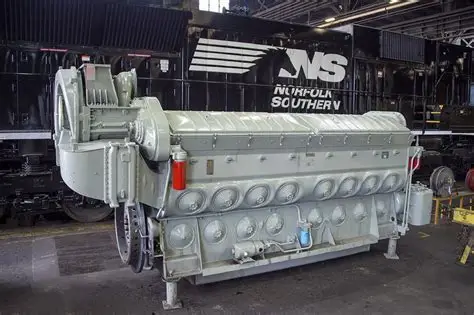
WHAT IT IS
The EMD 645 is General Motors Electro-Motive Division’s second-generation two-stroke locomotive and marine diesel, named for displacement per cylinder: 645 cubic inches (10.57 L). Bore 9-1/16 in (230 mm), stroke 10 in (254 mm). 45° V block, uniflow scavenged, unit injectors, one cast-iron head per cylinder. Production for new locomotives runs about 1965–1984, with marine and parts engines later. It replaced the 567 (8-1/2 × 10 in, 567 in³) and was itself replaced in new high-output rail use by the 710 (same bore, 11 in stroke, 710 in³).
There is no separate mass-production engine family officially called “EMD 745.” What shows up next to 645 in marine catalogs is a 745 kW continuous genset rating — the bottom of EMD’s 60 Hz / 900 rpm generator range (745–3,580 kW). People also blur 645 with 710 when they say “the EMD two-stroke.” This page treats 645 as the prime mover and notes 710 and that 745 kW rating so the label on the folder still matches the engine in the room.
WHY A TWO-STROKE
Every power stroke is a working stroke. Air is forced in through ports in the liner near bottom dead center; four (567) or six (645) exhaust valves in the head dump the burned charge. A Roots blower or a gear-driven turbo with an overrunning clutch provides the scavenge air — a two-stroke this size will not run on piston suction alone. At low rpm the 645/710 turbo is clutched and driven as a compressor; when exhaust energy is enough the clutch overruns and it is a true turbo.
Lineage is Winton / Kettering: Charles “Boss” Kettering’s GM lab and son Eugene Kettering after GM bought Winton. 201A to 567 (1938) to 567C stronger case (1953) to 645 larger bore and still stronger weldment case (1965–66). A few late military 567s were built in 645 cases so the paperwork could say “proven model.”
HARD NUMBERS — 645
Configuration: V8 / V12 / V16 / V20 (V6 exists in the family tree; rail and marine volume is 8–20). Compression: 14.5:1 on 645E and 645E3; 16:1 on 645E3A. Governed speed: idle ~200–350 rpm depending on sheet; full 900 rpm typical, 950 rpm on E3A / 50-series. Marine variable to 900. Stationary 900 rpm = 60 Hz, 750 rpm = 50 Hz. Power: roughly 750–4,200 hp (560–3,130 kW) across the catalog. Per-cylinder marine talk is ~160 hp class on early 645s.
Common locomotive ratings at 900–950 rpm:
8-645E Roots — 1,000 hp (SW1000/1001) 8-645E3 turbo — 1,500 hp (GP15T, MP15T) 12-645E Roots — 1,500 hp (SW1500, MP15, GP15) 12-645E3 turbo — 2,300 hp (GP39, SD39) 16-645E Roots — 2,000 hp (GP38 / GP38-2, SD38) 16-645E3 turbo — 3,000 hp (GP40, SD40, SD40-2) — the North American freight default 16-645E3A — 3,300 hp (half of a DDA40X) 16-645F3B — 3,500 hp (GP50, SD50) — the stressed 950 rpm mark 20-645E3 — 3,600 hp (SD45 family) 20-645E3A — 4,200 hp (SD45X)
Torque on a 20-645 at 3,600 hp / 900 rpm is in the 21,000 lb-ft neighbourhood. That is why the crankcase is a welded fabrication of plate and forgings, not a passenger-car block.
LETTER CODES
645E — Roots-blown “normally aspirated” in EMD speech. Reliable, cheaper, 2,000 hp from a 16. 645E3 — turbo, 14.5:1, 900 rpm, 3,000 hp 16-cylinder. SD40-2 engine. 645E3A — 16:1, 950 rpm, more power from the same iron. 645E3B / E3C — later service variants; E3C shows up in export 16s. 645F / F3B — high-output 50-series. The F at 950 rpm is what pushed EMD to the longer-stroke 710 after reliability complaints. Marine 645E6 Roots and 645F7B turbo — ABS-rated sheets; 8/12/16 Roots 1,050–2,100 hp at 900 rpm; turbo eight starts ~1,700 hp.
Left- or right-hand rotation for marine pairing. Deep oil pan so the pump does not suck air when the hull rolls. Power assemblies (liner, piston, head, “fork and blade” rods on a throw) are the unit of overhaul.
WHERE IT WORKED
Rail: almost every second-generation EMD road switcher — GP38-2, GP40-2, SD40-2 (the high-water mark), SD45, then GP50/SD50 on the F engine. Switchers SW1000 through MP15. One 16-645 even went into the Terex 33-19 Titan prototype haul truck.
Marine: tugs, workboats, some naval auxiliaries. Two 20-645s into one combining gearbox is a period engine-room picture. EMD had been a railroad shop; WWII fleet-tug installs and the later death of Cleveland Diesel left La Grange in the boat business.
Stationary: 60/50 Hz generator sets. That catalog line is where 745 kW appears as the small end of the 900 rpm / 60 Hz band.
THE 710 — WHAT 645 BECAME
1984–85: same 9-1/16 in bore, stroke stretched to 11 in, turbo only, 8/12/16/20 cylinders. Mechanical then electronic injection. Built beside the 645 into the late 1990s. GP60 / SD60 / SD70 family. Marine 710G7B ratings on one old sheet: 2,000 / 3,000 / 4,000 / 5,000 hp for 8/12/16/20. The 645 remains supported; power packs are still made because GP38-2s and SD40-2s have not finished working.
WHAT BREAKS AND WHAT LASTS
The architecture is conservative: wet liners with their own jackets, fork-and-blade rods, Woodward governor on mechanical engines, forced lube, water jackets everywhere. Failures that made the papers were the 50-series F engines at 950 rpm and high BMEP — crank and power-assembly trouble — which is why the 710 exists. Roots 16-645E units from 1972 are still on the road if the railroad changes oil and does not cook the water. Dual-fuel (gas + pilot diesel) conversion kits were sold for 645 and 710 stationary and coal-hauler duty; that is a aftermarket story, not a factory letter.
STATUS
645 new-build locomotives stopped in the mid-1980s; marine and remanufacture lingered. Progress Rail / EMD still feeds parts. 710 and later four-stroke 1010 take new EPA-sensitive work. The 645 is the sound of a second-generation American road freight diesel and of a lot of tugs that have no intention of becoming four-strokes.
IN ONE SENTENCE
The EMD 645 is a 45° two-stroke V diesel with 645 cubic inches in each pot, Roots- or turbo-scavenged, that pulled SD40-2s and tugs for half a century; “745” in the same breath is the small 60 Hz genset kilowatt rating (or a mix-up with the 710), not a third bore.