WHAT A BARREL IS
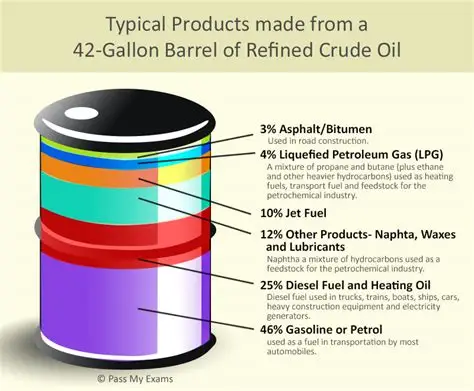
A petroleum barrel is 42 U.S. gallons (158.987 litres). Crude is a mixture of hydrocarbons from C1 gas through asphaltenes, plus sulfur, nitrogen, metals (nickel, vanadium), salts, and water. Nothing in the ground is “gasoline.” A refinery sorts the mixture by boiling point, then breaks, reshapes, and cleans molecules until they meet a fuel specification. Because many finished products are less dense than the crude they came from, a modern U.S. plant typically ships about 45 gallons of products from 42 gallons of crude — EIA processing gain around 6.3% in 2023 (about 44.65 gallons accounted, 2.65 gallons of gain).
TWO AXES THAT CLASSIFY CRUDE
Density — API gravity. Degrees API = (141.5 / specific gravity at 60 °F) − 131.5. Water is 10 °API. Higher API is lighter. Common bins: light ≳ 31–35 °API; medium in between; heavy ≲ 22–25 °API; extra-heavy / bitumen ≲ 10 °API and semi-solid at ambient temperature. Light oil is rich in short chains that distill into naphtha, kerosene, and diesel. Heavy oil is rich in vacuum gas oil and resid — asphalt, coke, fuel oil unless the plant cracks it.
Sulfur — sweet vs sour. NYMEX / common trade line: sweet ≤ 0.5 wt% S, sour above that. EIA sometimes draws sour above 1 wt%. Sweet crude needs less hydrotreating and is kinder to steel. Sour crude needs hydrogen, high-pressure reactors, and Claus sulfur plants or the fuels fail sulfur specs and the pipes corrode.
Four trade corners follow: light-sweet (easy gasoline/jet slate), light-sour (light molecules, expensive cleanup), heavy-sweet (uncommon), heavy-sour (cheap barrel, complex refinery or a pile of resid). TAN (total acid number) is a third axis on some grades — naphthenic acids eat distillation metallurgy.
BENCHMARKS AND WHERE THE OIL SITS
Light sweet. WTI / Cushing, Oklahoma — typically ~39.6 °API, ~0.24% S (some WTI Light assays ~47.5 °API, 0.05% S). Bakken, U.S. ~43.8 °API, 0.09% S. Brent Blend, North Sea (Brent/Ninian, Sullom Voe) ~38.3 °API, ~0.37% S — the waterborne Atlantic marker. Forties (UK) can run even lighter. Tapis (Malaysia) ~45.8 °API, 0.03% S. Saharan Blend / Algerian light ~44 °API, ~0.1% S; some Algerian streams are quoted extremely light. Azeri BTC ~39 °API, 0.16% S. Murban (UAE) ~40 °API, ~0.78% S — light, on the sour side of “sweet.” Bonny Light (Nigeria) ~35 °API, ~0.1% S.
Medium / sour workhorses. Arab Light (Saudi) ~33–34 °API, ~1.7–1.9% S. Arab Extra Light ~39–40 °API, ~1.0–1.2% S. Arab Medium ~30–31 °API, ~2.4–2.7% S. Dubai / Oman — medium sour markers for Asia. Urals (Russia) ~31–33 °API, sulfur often ~1.3% and a wide 0.8–1.8% band depending on the blend to port. U.S. Gulf sour grades sit on ASCI.
Heavy sour. Arab Heavy ~27–28 °API, ~2.8–3.0% S. Mexican Maya ~21–22 °API, ~3.3–3.4% S. Basrah Heavy (Iraq). Western Canadian Select — diluted oil-sands bitumen. Merey 16 / Boscan (Venezuela) — extra-heavy, Boscan near ~10 °API and several percent sulfur. California heavy sour. These barrels need vacuum units plus FCC, hydrocrack, and/or coking or they leave the plant as fuel oil and asphalt.
One country ships the whole ladder: Saudi Super Light ~50 °API / 0.09% S through Arab Heavy. OPEC “basket” is a mix, not a single assay.
WHAT THE CRUDE CONTAINS BEFORE ANY CRACKING
Straight-run yields are the boiling-range cuts off the towers. Engineering Toolbox-style volume % vs whole-crude density (North American cut points, approx.):
At SG 0.800 (very light): light+heavy naphtha ~37%, kerosene ~17%, diesel ~16%, VGO ~18%, vacuum resid ~5%. At SG 0.840: naphthas ~25%, kero ~17%, diesel ~17%, VGO ~27%, vacuum resid ~11%. At SG 0.880: naphthas ~16%, kero ~14%, diesel ~17%, VGO ~33%, vacuum resid ~18%. At SG 0.920 (heavy): naphthas ~10%, kero ~9%, diesel ~18%, VGO ~35%, vacuum resid ~27%.
A generic light-sweet assay (Rapier): gas 4.4%, light naphtha 6.5%, naphtha 18.6%, kero 13.8%, distillate 32.4%, gas oil 19.6%, 1050 °F+ resid 4.7%, S 0.3%, API 34.8. Generic heavy-sour: gas 3.4%, light naphtha 4.1%, naphtha 9.1%, kero 9.2%, distillate 19.3%, gas oil 26.5%, resid 28.4%, S 4.9%, API 22. The resid pile is why heavy crude is cheap and why cokers exist.
THE REFINERY AS A MACHINE
Complexity ladder: topping (distill only) → hydroskimming (distill + naphtha reformer + hydrotreat) → cracking (add FCC and/or hydrocracker) → coking / deep conversion (delayed or fluid coker, resid hydrocrack). Nelson complexity index scores that kit. A topping plant on Maya makes mostly fuel oil. The same Maya in a Gulf Coast coking refinery becomes gasoline, diesel, jet, and petcoke.
Tank farm first: segregated crude slates, slop, intermediates, finished mogas/diesel/jet, fuel gas, LPG, sulfur. Crude is pumped through charge heaters and electrostatic desalters — mix with wash water, high-voltage field coalesces brine droplets, salts leave as wastewater so they do not foul heaters or poison catalysts.
ATMOSPHERIC DISTILLATION (CDU / PIPESTILL)
First real process unit in almost every refinery. Desalted crude is preheated against hot products in a train of shell-and-tube exchangers, then fired in a pipe-still heater to roughly 340–370 °C (about 650–700 °F) and flashed into a tall fractionator at just above atmospheric pressure. Trays or packing; pumparounds take heat out to run the preheat train; side strippers steam-strip light ends from the liquid draws.
Typical draws, light to heavy: fuel gas and LPG overhead; light naphtha; heavy naphtha; kerosene / jet cut; light gas oil (diesel-range); heavy atmospheric gas oil; atmospheric residue (AR) out the bottom — everything that would crack if you pushed the heater hotter at 1 atm. Those cuts are still “straight-run.” They are not finished gasoline.
VACUUM DISTILLATION (VDU)
AR is heated again (~400 °C) and flashed into a vacuum column at about 25–40 mmHg in the flash zone (sometimes steam to cut hydrocarbon partial pressure further; modern “dry vac” uses low-ΔP grid internals). Vacuum from steam ejectors and/or pumps. Purpose: boil VGO off without thermally cracking the resid in the heater. Products: light and heavy vacuum gas oil (FCC / hydrocracker feed, or lube cuts), vacuum residue (VR) to coker, visbreaker, asphalt, or resid hydrocracker.
TREATING — HYDROTREATERS
Fixed-bed reactors, Co-Mo or Ni-Mo on alumina, hydrogen at tens to more than a hundred bar depending on the cut. HDS strips sulfur as H2S; HDN strips nitrogen; olefins saturate. Naphtha hydrotreater protects the reformer catalyst. Diesel and kero hydrotreaters make ULSD and jet sulfur specs. FCC naphtha needs its own post-treat to meet gasoline sulfur. H2S goes to an amine plant then a Claus unit (and usually SCOT tail-gas) that makes elemental sulfur.
REFORMING AND OCTANE
Catalytic reformer takes hydrotreated heavy naphtha, 3–4 radial reactors with interheaters (the reactions are endothermic), platinum/rhenium or similar catalyst. Dehydrogenation and cyclization raise octane and make hydrogen — the refinery’s H2 plant starts here and is topped up by steam-methane reformers. Semi-regen units shut down to burn coke off the catalyst; CCR units circulate beads through a regenerator continuously. Reformate is a gasoline blendstock. Light naphtha may go to an isomerization unit (C5–C6, higher RON). C3–C4 olefins from the FCC plus isobutane go to alkylation (HF or sulfuric acid) for alkylate — another high-octane, clean gasoline stock.
CONVERSION — MAKING LIGHT FUEL FROM HEAVY CUTS
FCC. Fluid catalytic cracker: VGO plus sometimes resid meets hot microspheroidal zeolite catalyst in a riser. Oil vaporizes, cracks in seconds, catalyst and vapor separate in cyclones. Coked catalyst burns in the regenerator; that heat runs the reaction. Main fractionator cuts cracked naphtha (gasoline), LPG (alkyl feed), light cycle oil (diesel blend or further treat), slurry. More than half of world gasoline historically traces to FCC naphtha plus reformate and alkylate.
Hydrocracker. High-pressure H2, dual-function catalyst (metal + acid). VGO / DAO becomes naphtha, jet, and diesel with very low sulfur. U.S. units often biased to gasoline/jet; others to middle distillate. Pretreat bed knocks out S and N first.
Delayed coker. VR heated in a furnace, dumped into alternating drums where it cracks; gas, coker naphtha, and distillates leave overhead; solid petroleum coke stays. Drum switch, cool, cut coke with high-pressure water. Fluid coking is the continuous cousin. Visbreaker is a milder thermal soak that only drops resid viscosity for fuel-oil blend.
BLENDING AND WHAT LEAVES THE GATE
Finished motor gasoline is a recipe: reformate, FCC naphtha (treated), alkylate, isomerate, butane for RVP, ethanol or other oxygenate where required. Diesel / ULSD is hydrotreated straight-run LGO plus cracked distillates cut to cetane, cloud, and sulfur. Jet A / Jet A-1 is a kerosene cut with freeze, smoke, and flash specs — often hydrotreated straight-run plus hydrocrack jet. LPG (propane/butane), still gas to the refinery fuel system, petroleum coke, asphalt/road oil, lubes and waxes from selected VGO/resid trains, petrochemical naphtha, residual fuel oil where a market still exists.
EIA 2023 U.S. average gallons per 42-gal barrel of crude input: finished motor gasoline 19.57; distillate 12.47; kerosene-type jet 4.41; petcoke 2.06; still gas 1.68; HGLs 1.55; asphalt 0.84; residual fuel oil 0.71; lubes 0.38; plus small naphtha/feedstock/misc lines — total ~44.65. That slate is a complex U.S. fleet on a mixed crude diet, gasoline-biased. A hydroskimming plant in another region prints a different ticket.
HOW THE BARREL CHANGES WITH CRUDE AND KIT
Chevron training yields, topping/reforming only, liquid-volume % of crude (U.S. mogas/jet/diesel mode):
Maya (21.3 °API, 3.4% S): C4− 4%, gasoline 14%, jet 1%, diesel 0%, fuel oil 81%. Arabian Light (33.3 °API, 1.8% S): C4− 7%, gasoline 19%, jet 12%, diesel 18%, fuel oil 44%. Bonny Light (35.2 °API, 0.1% S): C4− 4%, gasoline 22%, jet 20%, diesel 22%, fuel oil 32%. WTI (39.1 °API, 0.3% S): C4− 4%, gasoline 28%, jet 17%, diesel 16%, fuel oil 35%.
Same Arabian Light, different hardware (Chevron): topping — gasoline 19 / jet 12 / diesel 18 / fuel oil 44. Add FCC-type cracking — gasoline 52 / jet 12 / diesel 4 / fuel oil 27. Hydrocracking bias — gasoline 38 / jet 26 / diesel 4 / fuel oil 27. Deep conversion with coking on a similar slate can push gasoline toward ~60% and fuel oil toward 1% with ~5% petcoke, gross liquid yield a few percent over 100 because of density change and hydrogen addition.
Rule of thumb used in planning texts: light crude (>30 °API) can show ~45–50% gasoline after modest conversion; heavy crude (<22 °API) may show ~30% gasoline until the bottoms units run. Distillate (diesel + jet) is less sensitive to whole-crude gravity than naphtha and resid are. A refinery buys a crude diet that matches its conversion kit and the local crack spread (gasoline vs diesel vs jet vs resid).
OFFSITES THAT MAKE THE UNITS RUN
Hydrogen plant and compressors. Amine / Claus / tail-gas sulfur. Sour-water strippers. Wastewater and API separators. Cooling towers. Fired-heater fuel-gas system (still gas + purchased methane). Flare and relief. Power and steam (cogeneration common). Blending headers and custody meters. Without desalting, sulfur recovery, and hydrogen, the conversion block cannot meet modern fuel law.
CAVEATS
Assays drift by well and by blend. Sweet/sour cutoffs are not identical across NYMEX and EIA. EIA gallons-per-barrel are fleet averages, not a promise from one CDU. Chevron tables are teaching cases. Bitumen usually arrives diluted (dilbit) or upgraded; the pipeline barrel is not the reservoir barrel.
STATUS
The process path — desalt, atmospheric and vacuum distillation, hydrotreat, reform, crack or coke, blend — is the world standard. What changes by region is crude diet, conversion depth, and whether the ticket is gasoline-heavy (U.S.), middle-distillate-heavy, or petrochemical-integrated.
IN ONE SENTENCE
Crude is graded by API gravity and sulfur, from WTI/Brent light-sweet to Maya/WCS/Venezuelan heavy-sour; a 42-gallon barrel is desalted and split in atmospheric and vacuum towers, then hydrotreated, reformed, and cracked or coked so a complex plant can turn that barrel into roughly 19–20 gal gasoline, 12 gal diesel, 4 gal jet and a slate of LPG, coke, and asphalt — with light crude giving those fuels almost off the still and heavy crude giving them only after the conversion block eats the resid.