WHAT IT IS
CROWD-36 is the Western monitor name for a Russian 36-tone MFSK telegraph system copied from British Piccolo Mk 1. Other catalogue names: CIS-36, CIS 10-11-11 MFSK, URS multitone, Russian Piccolo. The system name used in the monitoring and diplomatic-watch literature is Serdolik (Сердолик, “carnelian”) — reported as the long-range radio system that carries this waveform, not a GRAU index on a faceplate.
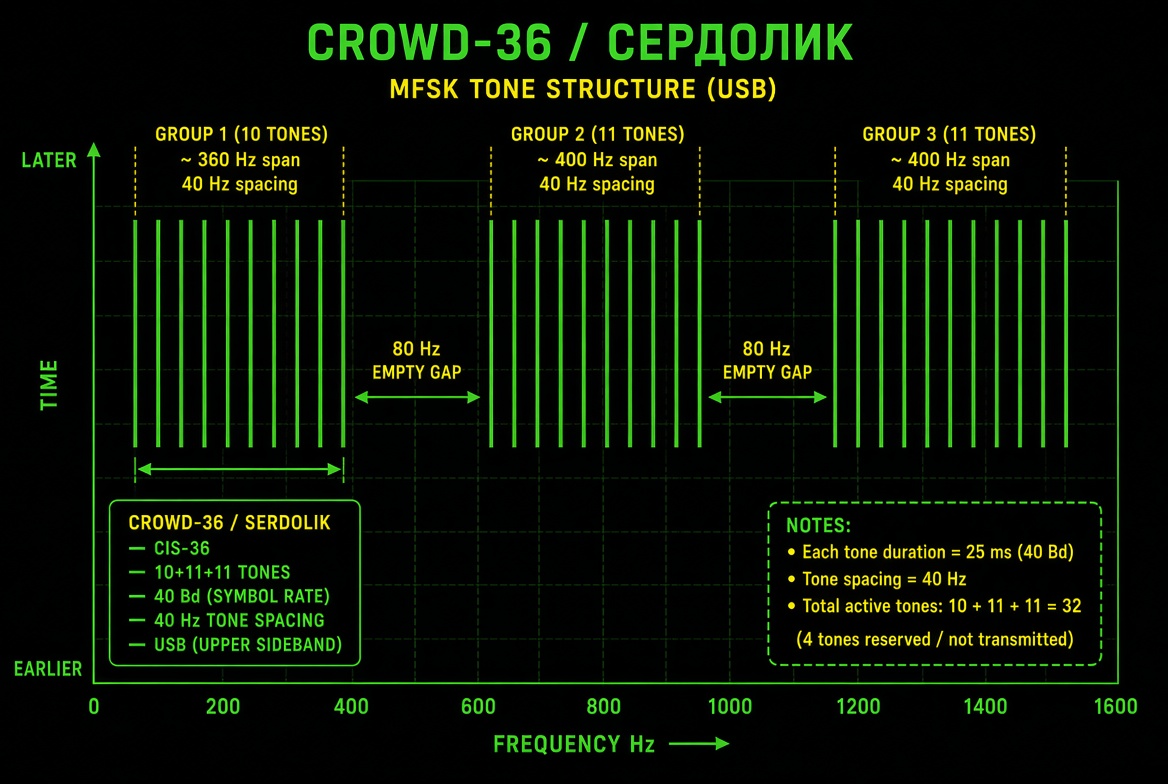
It is one tone at a time, not twelve PSK teeth at once. Thirty-two of the tones map to one ITA-2 / MTK-2 character each. Tones 1, 12, 24 and 36 are control / rarely used, which is why the waterfall shows three groups with 80 Hz holes between them.
Main published user: CIS / Russian diplomatic HF. Intel and military use is listed as suspected in the same handbooks. Later practice: CROWD-36 often does link establishment; the bulk traffic then moves to an OFDM mode on another channel. That is Serdolik-as-system, not a second PHY on this page.
WHAT THE WATERFALL LOOKS LIKE
On USB:
— Three clusters: 10 + 11 + 11 tones.
— Spacing 40 Hz inside a group.
— 80 Hz gaps between groups (missing tones 1 / 12 / 24 / 36 in traffic).
— Occupied width about 1.28–1.40 kHz (Wavecom theoretical 1400 Hz; some cards 1280 / 1320 Hz cursor span).
— Traffic at 40 Bd: one tone hops every 25 ms — a walking dot, not a filled fence.
— Idle / selcall: a short repeating five-tone pattern.
— Manual chat at 10 Bd: same geometry, each tone lasts 100 ms.
Sound: Olivia-like MFSK warble, narrower than CIS-12, no 3300 Hz Almaz pilot.
HOW THE AIR INTERFACE WORKS
MFSK-36 family, one active tone. Alphabet: 32 data tones = ITA-2 / Russian third-shift MTK-2. Wavecom traffic mode: horizontal line + vertical block parity, ten data frames plus a parity frame, five data characters plus one parity character per frame; NAK asks a repeat from the last good frame. Duplex on two frequencies is the book mode; simplex exists.
ITU / handbook variants:
1 — 25 ms / 40 Hz / 34 tones — 40 Bd (common traffic)
2 — 25 ms / 10 Hz / 34 tones
3 — 100 ms / 40 Hz / 34 tones — 10 Bd (manual / operator chat, often clear)
4 — 100 ms / 10 Hz / 34 tones
Wavecom also lists 20 Bd (50 ms). Auto speed change is kicked by control sequences. Opens often with a four-tone sync (T1=T3, T2 related); Rivet calibrates on a user-set high sync tone (commonly 24 or 31).
WHAT TRAVELS ON IT
Encrypted online traffic (5-figure or 5-letter groups in older logs). 10 Bd operator chat is frequently unencrypted. Modern logs: a one-second CROWD burst, then the real message on another mode/frequency — Serdolik used like poor-man’s ALE. Rivet / Wavecom / Hoka can print characters. They do not unwrap a working cipher book.
BANDS AND WHERE IT IS HEARD
HF USB, 3–30 MHz. Old published spots include the 5–20 MHz diplomatic cluster (examples from period lists: 5603, 6721, 8010, 10231, 16287, 18006 kHz class — schedules move). Not an Almaz army modem channel; different service, different width.
HARDWARE
No public AT-3004-style part number. Serdolik is the system name in open literature. The radio is whatever HF set feeds a 1.4 kHz MFSK modem. Decoders: Rivet (hobby, needs sync-tone set), Wavecom, go2decode, Hoka 300-32. No mass-market one-click box.
NOT THESE
CIS-12 / 16 / 20 — parallel PSK combs, ~3 kHz, 3300 Hz pilot on 12/20.
CIS-36-50 / BEE — navy FSK, two frequencies, not 36 MFSK tones. Different page.
X06 Mazielka — 6-tone selcal, often ahead of other CIS modes.
Piccolo Mk 6 — British 6-tone descendant; CROWD is the Mk 1 geometry with a Slavic alphabet.
CAVEATS
36 vs 34 tones: 36 possible, 32 data + 4 rare control; traffic looks like 34. Serdolik-as-system vs CROWD-as-waveform is a naming split, not two PHY. Frequency lists are historical spots.
STATUS
Still heard. Role has slid toward handshake / chat; OFDM takes the long file. The 10+11+11 picture has not changed.
IN ONE SENTENCE
CROWD-36 is the Serdolik system’s Piccolo-derived MFSK — 36 possible tones in 10+11+11 groups at 40 Hz, 40 Bd traffic or 10 Bd chat, ITA-2/MTK-2 on 32 tones — a ~1.4 kHz diplomatic/intel pipe, not an Almaz 12-tone modem.