WHAT IT IS
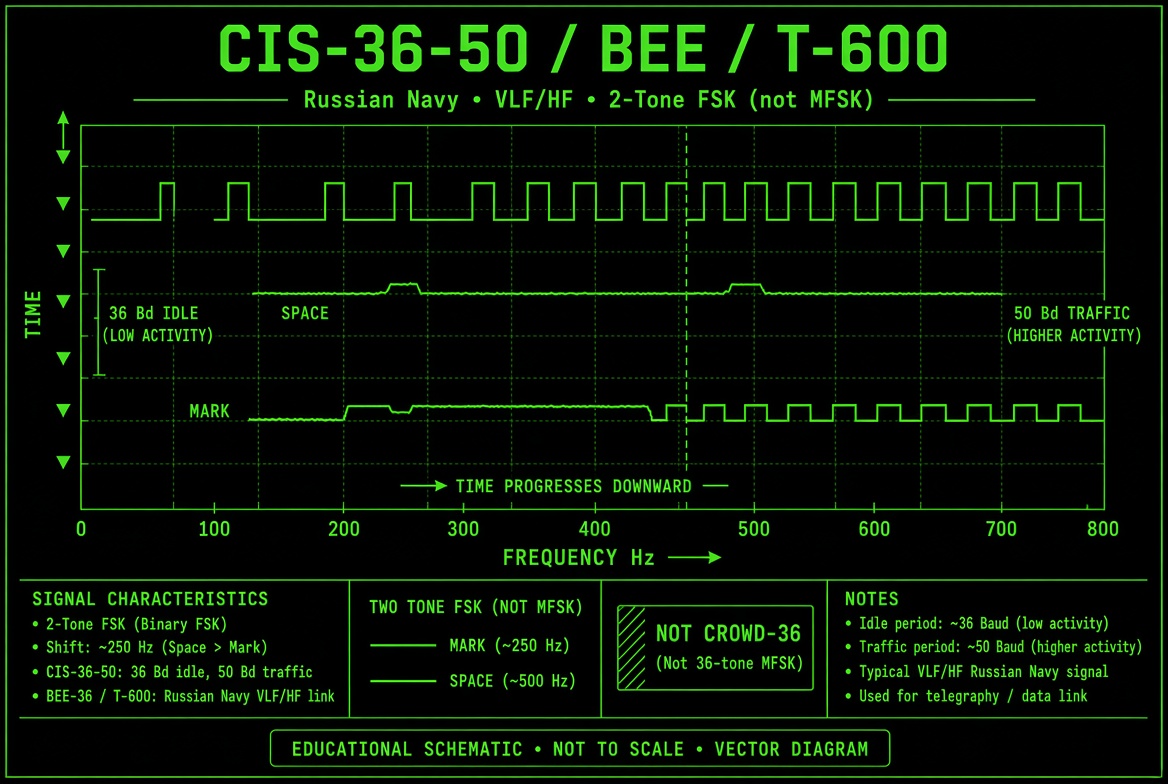
CIS-36-50 is a two-tone FSK fleet-broadcast waveform. Monitor aliases: BEE, BEE-36, T-600, CIS-Navy. The “36-50” is not 36 tones. It is 36 baud idle then 50 baud traffic.
Published user: Russian Navy Heard on HF and on VLF (18.1 kHz class logs for the 50 Bd / narrow-shift cousin used toward submarines). Regular clocked bursts on fixed frequencies — example handbook: minutes 08 / 28 / 48 past the hour on 10535 kHz, five minutes on, toggling 36/50 Bd.
Do not file this under CROWD-36. CROWD is 36 MFSK tones in 10+11+11 groups. This page is mark-and-space FSK.
WHAT THE WATERFALL LOOKS LIKE
Two parallel rails. Shift commonly 85, 125, 250 or 500 Hz (200 Hz is a Rivet default; 75 Hz shows up in VLF notes). Occupied width on Sigidwiki cards 300–550 Hz; handbook ~360 Hz for a mid shift. Idle is a clean reversal chatter at 36 Bd; traffic thickens at 50 Bd. No 3300 Hz pilot, no twelve PSK teeth, no three MFSK clusters.
Sound: a classic FSK tweet / bee — the BEE nickname is the ear ID.
HOW THE AIR INTERFACE WORKS
Synchronous FSK, simplex / broadcast. Wavecom rates: 36, 50, 75, 100, 150 Bd. Stock story: 36 Bd reversals open and close; payload runs 50 Bd. Later messages in a string skip the 36 Bd opener. Extra rates and odd shifts (including 50 Bd / 1000 Hz ahead of an Akula burst in 2025 logs) are variants, not a new mode name.
Frame: idle reversals → start sequence (~42–44 bits, polarity not 3:4 so it stands out) → payload → EOM (at least four end characters; “000100” class 7-bit words in one published dump). Payload is 5-bit characters stuffed into 7-bit words with a fixed 3:4 (or 4:3) ones/zeros ratio — an ITA-3 cousin. Blocks can repeat so the far end can check. Occasional FSK-CW callsigns sit on the same family.
All message traffic is treated as encrypted in the decoder manuals.
BANDS AND WHERE IT IS HEARD
HF USB across 3–30 MHz — fleet broadcast, clocked. VLF — 18.1 kHz 50 Bd / ~75 Hz shift logs as the submarine-path cousin. Same coding idea, different radio.
HARDWARE
T-600 is the monitor / Wavecom equipment name, not a photographed Almaz faceplate on this desk. The radio is whatever navy HF or VLF transmitter is keyed by that modem. Rivet decodes the frame if the shift is set; Wavecom lists CIS-36-50 as a stock card. No public plaintext.
NOT THESE
CROWD-36 / Serdolik / CIS-36 — 36-tone MFSK Piccolo. Different page.
CIS-50-50 — similar FSK idea, different baud/shift set.
CIS-40.5 / T-206 — another military FSK telegraph, ~600 Hz class.
CIS-8181 — navy FSK, 600 Hz class, different card.
Akula — navy burst that has been seen after a 50 Bd FSK opener; not this idle/traffic pair.
CAVEATS
Shift lists wander (85–500 Hz book, 200 Hz Rivet, 75 Hz VLF, 1000 Hz oddball). “T-600” is a decoder name. 18.1 kHz and 10535 kHz are example circuits, not an allocation table.
STATUS
Still on HF and still the thing you hear as a narrow FSK bee on navy schedules. The 36/50 name remains the ID even when the baud pair is not exactly 36 then 50.
IN ONE SENTENCE
CIS-36-50 is the Russian Navy BEE / T-600 FSK broadcast — 36 Bd reversals then 50 Bd encrypted 7-bit 3:4 traffic on two tones — a mark-and-space pipe on HF and VLF, not the 36-tone CROWD-36 MFSK that shares the number.