WHAT IT IS
CIS-20 is the monitoring name for the twenty-tone mode of the Almaz AT-3104 HF modem — the same Rostov box that still emits CIS-12. Factory language is “20-channel mode.” Listener language is CIS-20. Nothing on the front panel says CIS.
It is the CIS-12 idea packed tighter: more tones, slower symbols, same 3 kHz USB telephone channel, same unmodulated 3300 Hz pilot. Radioscanner and the I5-56578 notes treat it as the successor waveform on the newer modem, not a different radio service. Inputs are still TTY, vocoder, and speech-cipher baseband. The air picture changes. The job does not.
Almaz’s own AT-3104 sheet is why this page exists as a sibling to CIS-12: the upgrade list is “20-channel mode, faster processors / FPGA, smaller box.”
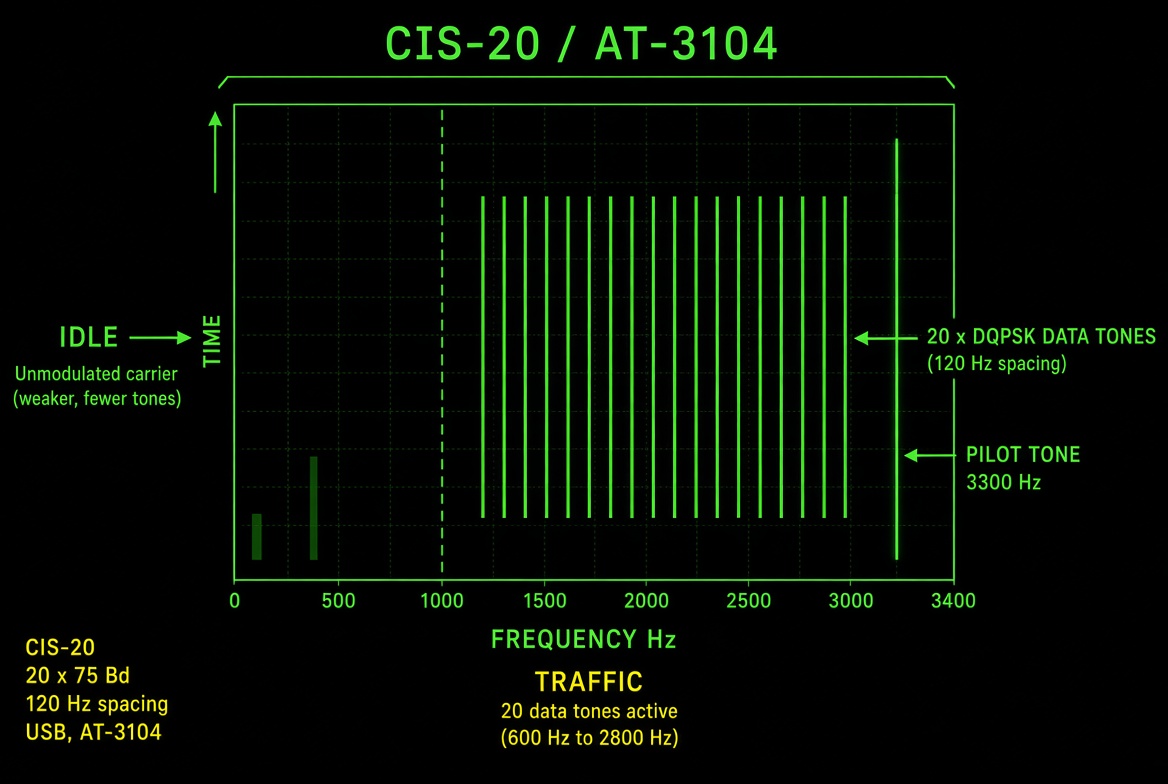
WHAT THE WATERFALL LOOKS LIKE
On USB with the suppressed carrier at 0 Hz audio:
— A denser comb than CIS-12: twenty parallel tracks, about 120 Hz apart, filling roughly 600–2800 Hz.
— The same thin continuous line at +3300 Hz. If that whistle is not at 3300, retune. The pilot is the family ID for both 12-tone and 20-tone Almaz modes.
— Occupied width of the pack plus pilot about 2.75–2.8 kHz.
— Traffic: twenty bars filled, π/4-DQPSK shimmer at 75 Bd — finer grain than CIS-12’s 120 Bd bars.
— Idle: modulation can drop to BPSK on the same 75 Bd / 120 Hz grid. Autocorrelation near 200 ms has been measured on idle. At least one recording leaves carrier 13 unmodulated, so the comb shows a gap.
Sound: still a nasal fence, but the teeth are closer together and the buzz is slower than CIS-12. Count bars first, then look for the pilot. Twenty teeth + 3300 Hz = this page. Twelve teeth + 3300 Hz = CIS-12.
HOW THE AIR INTERFACE WORKS
Radioscanner card used by the monitoring community:
— 20 data channels + 1 pilot
— Channel modulation π/4-DQPSK in traffic
— 75 Bd per tone
— 120 Hz channel step
— Coding rate cited as k = 3/5
75 Bd × 2 bits/symbol × 20 tones = 3000 bit/s gross on the air before the 3/5 coder. That is a monitor arithmetic line, not an Almaz sales figure. The published AT-3104 user rates remain 1200 and 2400 bit/s — the 20-tone mode is how the box spends that channel, not a third brochure speed printed on the case.
120 Hz spacing at 75 Bd is closer to an OFDM-friendly grid than CIS-12’s 200 Hz / 120 Bd mismatch. Wiki pages therefore stamp “OFDM.” The honest wording is: twenty separately generated PSK tones on a 120 Hz raster, plus pilot. Do not assume a single IFFT brick until a factory PHY paper says so.
Half-rate variant (logged 2015): same π/4-DQPSK picture at 37.5 Bd and 60 Hz step. Bandwidth stays ~2800 Hz. It looks like CIS-20 stretched in time, not a new modem.
WHAT TRAVELS ON IT
Same plug-in philosophy as CIS-12. Teleprinters, vocoders, speech-cipher sets, formalised command streams. Payload is encrypted off the air. A decoder that IDs the mode dumps symbols, not orders.
Idle is still a reserved pipe. The BPSK idle and the missing tone-13 sample are identification clues, not a second user service.
BANDS AND WHERE IT IS HEARD
HF USB, 3–30 MHz in the catalogue; daily logs sit in the same 6–15 MHz neighbourhood as CIS-12 because it is the same class of circuit and often the same radio. Baseband is still 300–3400 Hz audio, so the comb can also ride a multiplex / radio-relay telephone channel. RF frequency is the attached transceiver’s problem.
Heard less often than classic 12-tone AT-3004D in older logbooks. That is generation mix, not proof the 20-tone mode is rare on current AT-3104 fits.
HARDWARE
AT-3104 — FGUP Almaz, Rostov-on-Don. Seven delivery variants around apparatus SA286 and block VA119. End gear S1-FL-BI (GOST 27232-87). Radio S1-TChR (GOST 23578-79). 220 V 50/60 Hz, 115 V 400 Hz, or 21–33 V DC. ≤20 W DC / ≤25 VA AC. −40 to +50 °C, continuous. Simplex, half-duplex, duplex.
The same chassis still does CIS-12. Mode is a firmware / configuration choice, not a second rack. Older AT-3004D is the 12-tone parent; some notes allow that a late 3004 can be talked into 20-tone, but the factory upgrade story is AT-3104.
You identify the waveform on the waterfall. You identify the box only if you are standing in front of it.
NOT THESE
CIS-12 — twelve tones, 120 Bd, 200 Hz step, same 3300 Hz pilot. Sibling page.
CIS-16 — sixteen BPSK tones at 75 Bd (~2.7 kHz). Same modem family suspected. Different tooth count.
CIS-45 / 60 / 93 — OFDM HDR stack, different modem line, still often a 3300 Hz carrier. Do not merge.
T-230-1A Mahovik — one fat PSK carrier, not a 20-bar fence.
CAVEATS
Tone maps, k = 3/5, idle ACF 200 ms, and “carrier 13 quiet” come from Radioscanner / I5-56578 analysis of recordings, not an Almaz PHY manual on this desk. Gross 3000 bit/s is symbol math. Factory user rates stay 1200 / 2400. “OFDM” on wiki cards is a convenience label.
STATUS
Active as an AT-3104 mode. CIS-12 remains the more common name in casual logs because the 12-tone comb is older and louder in memory. The 20-tone comb is the one to mark when the teeth get tight and the baud drops to 75.
IN ONE SENTENCE
CIS-20 is the AT-3104 twenty-tone HF mode — 20 × 75 Bd π/4-DQPSK at 120 Hz spacing plus the family 3300 Hz pilot in a ~2.8 kHz USB channel — the tighter successor comb to CIS-12 on the same Almaz modem.