WHAT IT IS
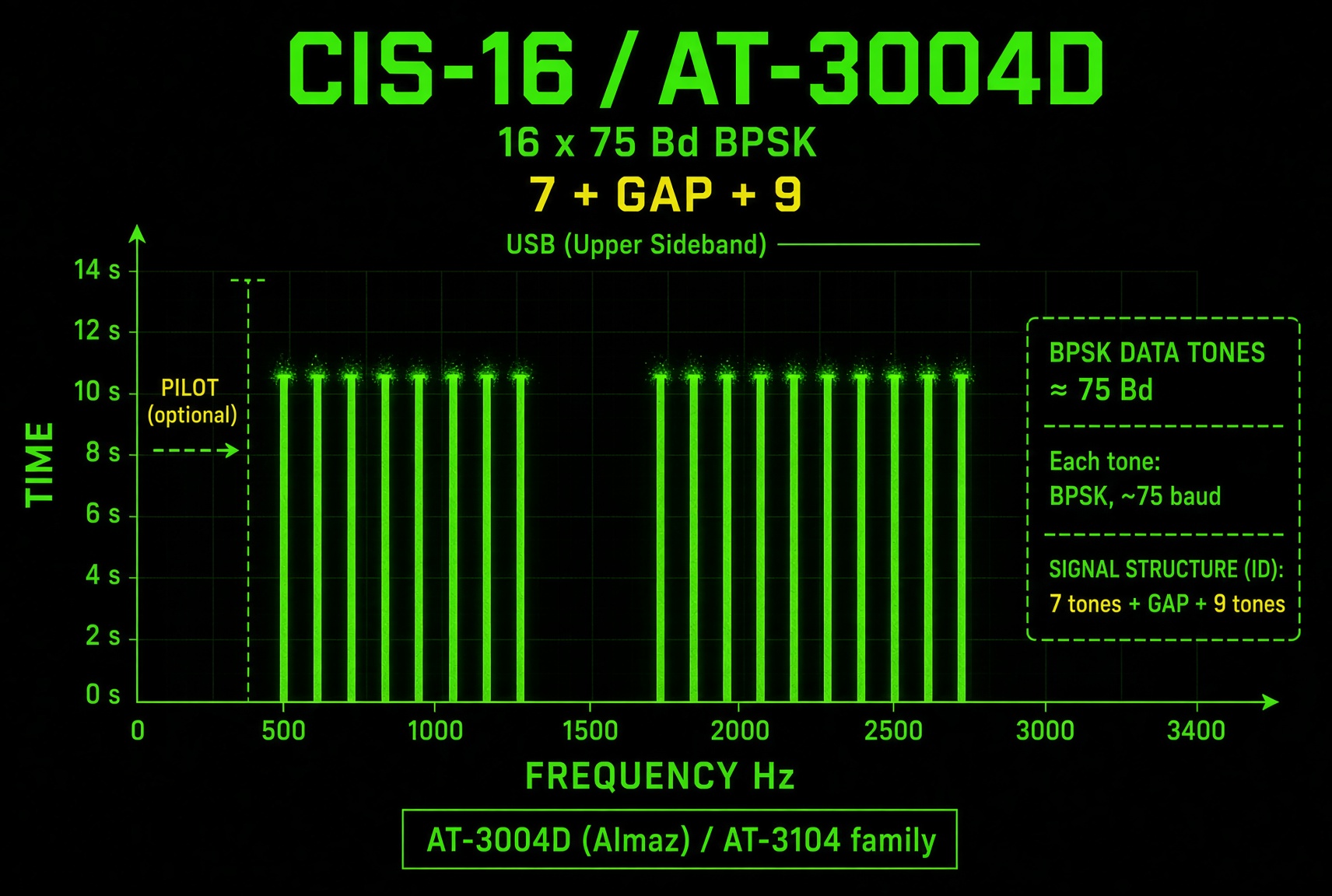
CIS-16 is the monitoring name for a sixteen-tone BPSK HF modem waveform. The working alias is CIS 16×75 Bd: sixteen sub-channels, each 75 baud, BPSK. Bandwidth of the pack is about 2.7 kHz in USB. Catalogue range 3–30 MHz.
Hardware is inferred, not plated. Sigidwiki and the AT-3004 / AT-3104 watchers treat it as a mode off a modified AT-3004D or AT-3104 — same Almaz Rostov family as CIS-12 and CIS-20, not a new radio. That is a good working guess. It is not a factory brochure line the way “20-channel mode” is printed for AT-3104.
The ID that actually matters on a waterfall is structural: the sixteen teeth are not a flat comb. They split into a lower group of seven and an upper group of nine with a visible gap between them.
WHAT THE WATERFALL LOOKS LIKE
On USB:
— Sixteen parallel BPSK bars in a ~2.7 kHz pipe.
— A hole in the middle of the pack: seven tones, gap, nine tones. That split is the recognition mark. CIS-12 is twelve even teeth. CIS-20 is twenty even teeth plus a 3300 Hz pilot. CIS-16 is the broken comb.
— Standby / idle: the fence thins or sits quiet; traffic fills the sixteen bars at 75 Bd.
— A 3300 Hz Almaz-style pilot is not the published hallmark of this mode. Do not require one to call CIS-16. If a loud 3300 Hz line is present, you may be looking at CIS-12 / CIS-20 instead — count teeth and look for the 7/9 gap.
Sound: a slower, narrower buzz than CIS-12 (75 Bd vs 120 Bd, BPSK only). The ear will not give you the gap. The FFT will.
HOW THE AIR INTERFACE WORKS
Public card:
— 16 tones
— BPSK (one bit per symbol)
— 75 Bd per tone
— ~2.7 kHz occupied
Gross air rate if every tone carries unique user bits: 16 × 75 = 1200 bit/s. That happens to match an AT-3004D / AT-3104 book speed. Whether tones 1–16 are all payload, or some are service like CIS-12’s 11–12, is not in a public channel map. Do not invent one.
This is not the wide CIS MPSK-16 logged with 16 channels at 500 Bd and 2500 Hz channel spacing (duplicate data on every tone). That is a different, much fatter signal. This page is the 2.7 kHz 16×75 animal.
WHAT TRAVELS ON IT
Same class of traffic as the other Almaz combs if the box guess is right: encrypted teleprinter, vocoder, speech cipher. No public plaintext. Identification stops at the waveform.
BANDS AND WHERE IT IS HEARD
HF USB, 3–30 MHz catalogue. Same neighbourhood as CIS-12 / CIS-20 when it is on. Sigidwiki now tags the mode Inactive in the category list — meaning the monitoring corpus stopped seeing it as a daily fixture, not that a law retired it. Treat “inactive” as a logbook status, not a scrap order.
HARDWARE
Suspected: AT-3004D or AT-3104 (Almaz, Rostov-on-Don), possibly a firmware / strap variant rather than a separate product. Interfaces and power are the parent-modem figures already on the CIS-12 and CIS-20 pages (S1-I / S1-FL-BI / S1-TChR, 220 V or 27 V class).
No open photograph labeled “CIS-16 faceplate.” The gap in the comb is the field ID.
NOT THESE
CIS-12 — 12 tones, 120 Bd, 200 Hz, 3300 Hz pilot.
CIS-20 — 20 tones, 75 Bd DQPSK, 120 Hz, 3300 Hz pilot.
XPB / CIS MFSK-16 — intelligence MFSK numbers-station family, different physics.
XPA / CIS MFSK-20 — same warning.
Wide MPSK-16 500 Bd — 16 parallel PSK channels with huge spacing; not this 2.7 kHz pipe.
CAVEATS
Thinner public file than CIS-12 / CIS-20. Tone spacing in hertz is not a clean Radioscanner card on this desk — the 7+gap+9 geometry and 16×75 BPSK are the solid marks. Hardware is “possibly AT-3004/3104.” Inactive tag is a wiki category, not a General Staff memo.
STATUS
Catalogued. Rare in recent daily HF dumps compared with CIS-12. Still the page you want when the comb is sixteen BPSK bars with a hole after the seventh.
IN ONE SENTENCE
CIS-16 is a 16-tone 75 Bd BPSK HF modem waveform — likely an AT-3004D / AT-3104 family mode — recognized by a 2.7 kHz comb split 7 + gap + 9, not by the 3300 Hz pilot that marks CIS-12 and CIS-20.