WHAT IT IS
CIS-12 is the monitoring name for a Russian / Soviet HF multi-tone modem waveform. The factory boxes are AT-3004D and the later AT-3104 (also written AT-3104D). Hobby catalogues also print MS-5 and FIRE. “CIS-12” is not a GRAU index and is not painted on the front panel. It means: twelve parallel PSK channels in a standard voice-grade USB pipe, plus a pilot.
It is a modem, not a radio. The AT box sits between cipher / TTY / vocoder gear and an ordinary HF transceiver’s 300–3400 Hz audio channel. Whatever you plug into the baseband — teleprinter, speech cipher, data terminal — leaves the antenna looking like the same twelve-bar comb.
It is not true OFDM. Symbol rate is 120 Bd; tone spacing is 200 Hz. Those numbers are not orthogonal (orthogonal spacing would be 120 Hz). Each tone is generated as its own PSK channel. Radioscanner and the I5-56578 notes call it “pseudo-OFDM” for that reason.
Do not glue this page to T-230-1A Mahovik. Mahovik is a single-carrier ~1200 Bd PSK voice/data modem. Some wiki lines list T-230 under CIS-12. That mix is a catalogue error.
WHAT THE WATERFALL LOOKS LIKE
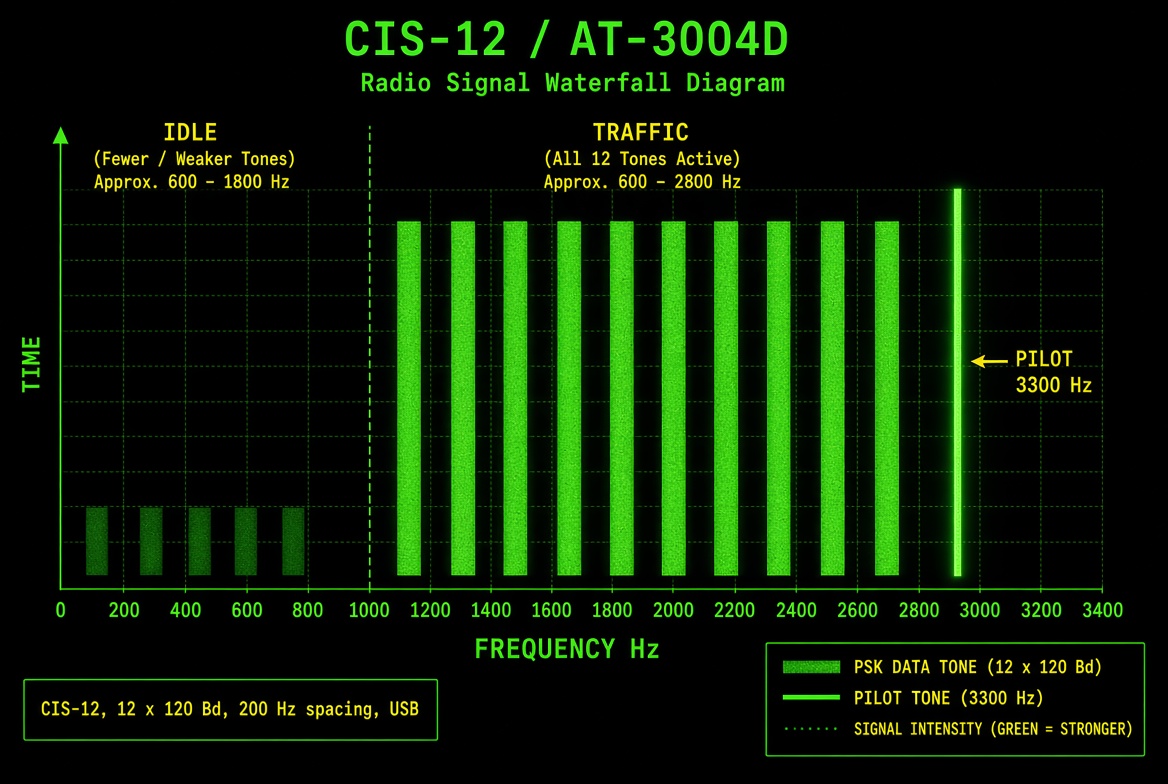
On a USB waterfall tuned so the suppressed carrier is 0 Hz audio:
— Twelve parallel tracks, about 200 Hz apart, filling roughly 600–2800 Hz depending on how the operator centered the set.
— A thin, continuous, unmodulated line at +3300 Hz. That pilot is the ID. If the pilot is not at 3300, you are not tuned to the suppressed carrier.
— Idle: comb thins, some tones drop or sit quiet; pilot usually stays. A 3-tone idle and a “standby” look are logged.
— Traffic: all (or most) of the twelve bars fill and shimmer at 120 Bd. PSK-2 looks cleaner than PSK-4 on a coarse FFT.
— Bandwidth of the useful packet plus pilot is about 2.7–3.1 kHz. ITU heard as J7D. A rarer dual-sideband twin is about 7 kHz (B7D).
Sound: a nasal buzzing fence, not a single FSK tweet and not a 36-tone Piccolo ripple. The 3300 Hz whistle sits above the buzz if your filter is wide enough.
HOW THE AIR INTERFACE WORKS
Twelve subcarriers. Each runs 120 Bd DBPSK (PSK-2) or DQPSK (PSK-4). An offset-QPSK flavour that does not flip 180° is also logged. Wavecom’s working card: 12 × 120 Bd, center of the pack near 1800 Hz audio, pilot +3300 Hz from the suppressed carrier.
Channel use on the AT-3004D notes: tones 1–10 carry user data, tones 11–12 are inspection / service. Aggregate user rate is therefore about 1200 bit/s in PSK-2 and 2400 bit/s in PSK-4 on those ten channels. Factory sheets for AT-3004D list 1200, 2 × 1200, and 2400 bit/s. Monitor pages that print “4800 bps maximum” are counting every tone as payload or quoting a later / wider mode. Treat 1200 / 2400 as the AT-3004D book numbers.
AT-3104 keeps the 12-tone picture and adds a 20-tone mode (the thing monitors call CIS-20: twenty DQPSK tones at 75 Bd, same 3300 Hz pilot). Same family, different comb. Do not log a 20-bar signal as CIS-12.
Partial combs exist. A 9-tone / “3-out-of-12” AT-3400D / AT-3104 layout has been recorded on USB. Eleven tones and a missing pilot have been logged as a fault or a variant. The 3300 Hz line is still the first thing to look for.
Sync: AT-3004D literature — lock in ≤2 s, hold sync ≥1 hour with the path gone, frequency trim ±0.5 Hz, tolerate ±50 Hz radio error. That is a modem spec, not a claim that every circuit on 7 MHz is that clean.
WHAT TRAVELS ON IT
The waveform does not advertise plaintext. Factory text: used mainly with encryption apparatus. Inputs seen or stated: service teleprinters, vocoders, speech-cipher boxes, formalised command sets (AT-3004D notes 33 service commands that can replace the main payload). What a Wavecom or Rivet decode dumps is bits or hex, not a readable order. That is expected.
Idle is still useful: it parks the frequency and proves the path. Traffic bursts sit inside ordinary HF nets — army, other power ministries, and circuits that share the same Almaz modem family. 2022-onward music-loop HF nets have carried CIS-12 on a sibling channel (example logs: digital on 7667 kHz next to the hymn loops). That is the modem on a broadcast-style feed, not a new waveform.
BANDS AND WHERE IT IS HEARD
Designed for a standard HF SSB telephone channel (300–3400 Hz audio). The RF frequency is whatever transmitter you hang on the modem — Almaz sheets say “depends on the attached transceiver.” Monitor range cited from the low hundreds of kHz through 30 MHz. Daily meat is HF USB, especially 6–15 MHz, including long-duration occupants inside amateur allocations (7 / 14 MHz class logs are routine in IARUMS newsletters).
The same baseband can ride multiplex / radio-relay telephone channels, not only raw HF. If you hear the comb on a VHF link it is still this modem, not a VHF-native waveform.
HARDWARE
AT-3004D — FGUP Almaz, Rostov-on-Don. HF modem for 1200 / 2×1200 / 2400 bit/s in a 300–3400 Hz channel. Single or dual paths (space or frequency diversity). Service talk on the information channel, link-quality analysis, remote control. Interface S1-I. Power: 220 V 50 Hz, 115 V 400 Hz, or 27 V DC. Temperature sheet −50 to +50 °C. Precious-metal inventories list sub-blocks UA 030, ME 205, ME 207 — ordinary rack electronics, not a unique antenna.
AT-3104 — Almaz successor. 1200 and 2400 bit/s on HF SSB; simplex, half-duplex, duplex. Seven delivery variants around apparatus SA286 and block VA119. End-instrument interface S1-FL-BI (GOST 27232-87); radio interface S1-TChR (GOST 23578-79). 220 V 50/60 Hz, 115 V 400 Hz, or 21–33 V DC. Draw ≤20 W DC / ≤25 VA AC. −40 to +50 °C, continuous. Factory claim versus AT-3004D: 20-channel mode, faster processors / FPGA, smaller box.
AT-3400D appears in later logs as another box that can emit the 12-tone (and odd partial-tone) picture. Treat it as the same waveform family until a separate handbook page exists.
On the air the modem is invisible. You see the transceiver, the antenna, and this comb. Identification is the waterfall plus 120 Bd / 200 Hz / 3300 Hz, not a serial plate.
NOT THESE
CIS-20 — AT-3104 twenty-tone mode, 75 Bd, same pilot. Different page.
T-230-1A Mahovik — one PSK carrier, ~2.1–2.5 kHz, ~1200 Bd. Different page.
CROWD-36 / Serdolik — 36 MFSK tones in 10+11+11 groups. Different page.
CIS-36-50 / BEE — narrow FSK, navy. Different page.
Link-11 — NATO CLEW; CIS-12 has been logged sitting on top of it. Different animal, same 3 kHz neighbourhood.
CAVEATS
CIS-12 / MS-5 / FIRE are listener names. Tone-to-channel maps and “4800 bps” versus 1200/2400 come from mixed monitor and factory sheets — this page prefers the Almaz rates. T-230 on CIS-12 wiki lines is a naming collision. Partial-tone and missing-pilot recordings exist; they do not rewrite the stock 12+pilot picture. No public decode of the cipher payload.
STATUS
Still on HF in the 2020s. AT-3104 is the current factory generation in open catalogues; AT-3004D combs remain the thing most logs still say “CIS-12” about. Same 3300 Hz whistle either way.
IN ONE SENTENCE
CIS-12 is the air picture of the Almaz AT-3004D / AT-3104 HF modem — twelve 120-Bd PSK tones at 200 Hz spacing plus a 3300 Hz pilot in a 3 kHz USB channel — a baseband pipe for encrypted teleprinter, vocoder, or data, not a radio and not T-230 Mahovik.