WHAT IT IS
CIS OFDM HDR is the monitor name for a Russian HF high-data-rate OFDM family. The number in the mode name is the count of data carriers. The three modes logged as a set are CIS-45, CIS-60 and CIS-93. The same ladder continues as CIS-112 (own card) and CIS-128 / Corvette (already on this site). Factory stencil unpublished. HDR is just “High Data Rate.”
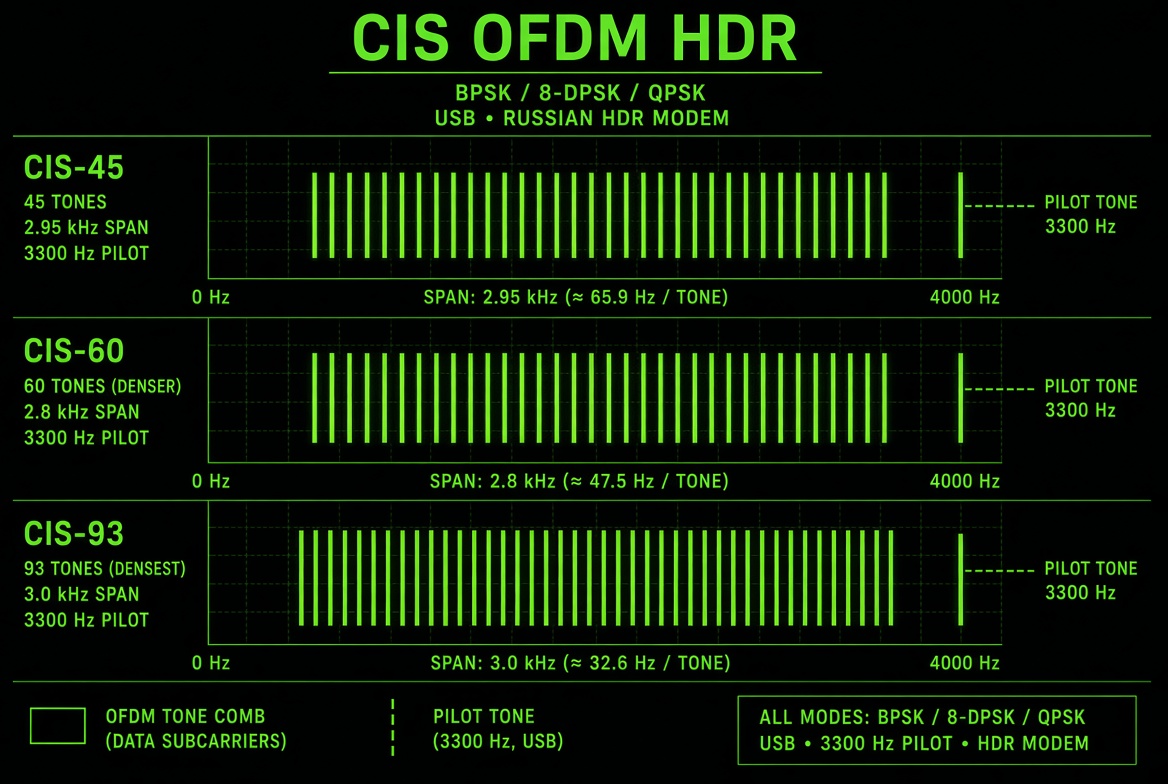
All three share one visual: a dense PSK-OFDM grate in a standard USB voice channel, plus an unmodulated pilot at 3300 Hz from the suppressed carrier — the same pilot habit as CIS-12 / CIS-16 / CIS-20, not the 10 kHz Perelivt slab and not the CIS-128 centre-hole split.
WHAT THE WATERFALL LOOKS LIKE
A solid comb filling most of 2.8–3.0 kHz, then a lone spike at 3300 Hz. Idle and traffic look similar; traffic just phases the teeth. Burst and continuous both exist (CIS-45 version 1 is often burst). USB.
HOW THE AIR INTERFACE WORKS
Published monitor / survey numbers (Sigidwiki, I-56578, a Ukrainian HDR-family table). Treat bit-rate columns as one published set, not a factory sheet.
CIS-45 — 45 tones, ~2950 Hz, spacing 62.5 Hz. BPSK. 40 Bd (~1800 bit/s) or 33.33 Bd (~1500 bit/s). Symbol ~25 ms (Tu 16 ms, Tg 9 ms). Pilot two channels above the top data tone.
CIS-60 — 60 tones, ~2800 Hz, spacing 44.44 Hz. 8-DPSK (π/8-DPSK8) at 35.555 Bd (~2133 bit/s); a 30 Bd QPSK book also logged. Symbol ~28.125 ms (Tu 22.5 ms, Tg 5.625 ms). Pilot three channels above the top data tone. Voice chat then a switch from DPSK-4 to DPSK-8 has been heard on the same net.
CIS-93 — 93 tones, ~3000 Hz, spacing 31.25 Hz. QPSK. 22 / 22.222 Bd (survey table ~2046 bit/s; some cards quote a higher raw figure). Symbol ~45 ms (Tu 32 ms, Tg 13 ms). Pilot four channels above the top data tone. I-56578 treats CIS-45 as a lightweight of this 93-tone modem.
CIS-112 (next grate, not drawn here) — 112 tones, ~2.9–3.0 kHz, DQPSK ~22.22 Bd, 3300 Hz pilot. Preamble: 7 sparse tones (channels 1, 7, 33, 49, 65, 81, 97), then 56 odd-channel tones, then the 112-tone data fill.
BANDS AND WHERE IT IS HEARD
HF USB, 3–30 MHz. Military / agency HDR traffic. IARU lists CIS-60 as a CIS MIL OFDM that walks into amateur allocations.
HARDWARE
Unpublished “HDR modem” class. Needs a clean ~3 kHz USB path. Not an AT-3004 12-tone box and not the 10 kHz Perelivt modem.
NOT THESE
CIS-12 / 16 / 20 — parallel PSK teeth + 3300 Hz pilot, 200 Hz class spacing, AT-3004D family.
CIS-128 / Corvette — 64 + dead centre + 64, 3.1 or 6.1 kHz, often opened by CIS-3000.
CIS-3000 — single 8-PSK slab, the ALE, not an OFDM grate.
Perelivt / MFSK-68 — 10 kHz MFSK + 8-PSK insert.
CIS OFDM-121 — burst 121-channel grate, different arrangement.
CAVEATS
Bit-rate columns disagree between Sigidwiki revisions and the HDR survey table. Log tone count, spacing, and the 3300 Hz pilot first. No public factory name.
STATUS
Active on HF. CIS-60 and CIS-93 are the ones most often copied in amateur bands.
IN ONE SENTENCE
CIS OFDM HDR is the Russian 3 kHz PSK-OFDM family — 45, 60 or 93 data tones plus a 3300 Hz pilot — the middle of the ladder that ends at CIS-112 and CIS-128, not CIS-12 and not Perelivt.