WHAT IT IS
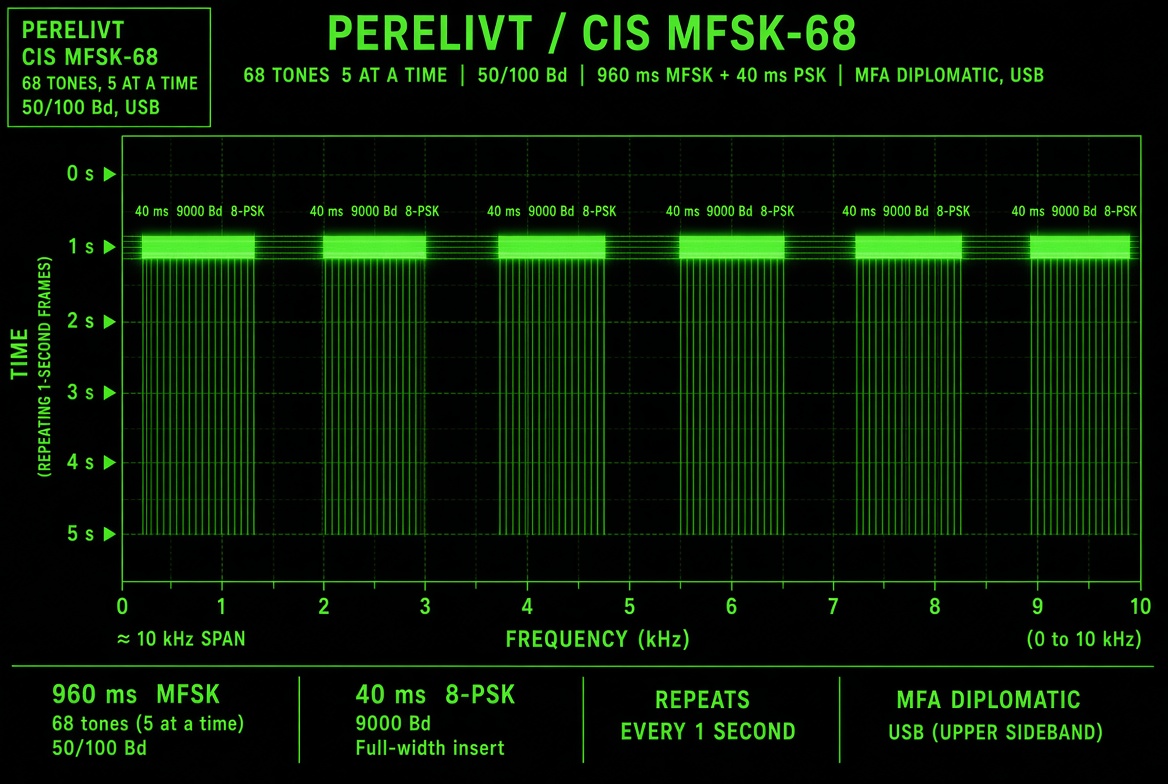
Perelivt (Переливт — monitor name; factory name unpublished) is the Russian MFA wide HF data waveform catalogued as CIS MFSK-68. It is not Crowd-36 and not a 3 kHz Almaz comb. It occupies about 10 kHz: a 68-tone MFSK bed (five tones live at once) with a short 8-PSK insert once per second.
Role: diplomatic point-to-point traffic after a wake-up. X06 / Mazielka often runs first (or from the same modem). CIS-3000 is logged as the ALE / handshake for this family and for CIS-128. Priyom treats Perelivt as the circuit X06 is waiting for.
WHAT THE WATERFALL LOOKS LIKE
A fat green slab ~10 kHz wide. Most of each second is a dense MFSK grate. Once a second a bright full-width PSK stitch flashes across the same slice. USB. Logged spots include 7659, 10367, 13441, 14700, 16107, 18280 kHz — examples, not an allocation table. Band card: ~7.6–18.3 MHz.
HOW THE AIR INTERFACE WORKS
One-second frame:
— 960 ms MFSK: 68 tones in the alphabet, 5 tones per symbol, 50 or 100 Bd.
— 40 ms 8-PSK insert at 9000 Bd (~1440 bits per stitch, 3 bits/symbol).
Tone-count reports also say 64 or 66 (MFSK-64 32+32 at 45 Bd appears in I-56578 notes; YouTube labels use 66). Treat 68 as the catalogue name and 64/66 as count slop or submodes until a factory sheet exists. CIS-3000 and CIS-128 sit on the same diplomatic modem story; they get their own pages.
WHAT TRAVELS ON IT
Encrypted MFA files. The selcal (X06) names the embassy; Perelivt carries the load. No public decoder prints plaintext. Hobby ID is the 10 kHz grate plus the one-second PSK flash.
HARDWARE
Unpublished diplomatic HF modem. Same rack is suspected for X06 + Perelivt + CIS-3000. Needs a transmitter and antenna that will pass 10 kHz, not a 2.7 kHz AT-3004 voice-channel box.
NOT THESE
CROWD-36 / Serdolik — 1.4 kHz 10+11+11 MFSK, 40 Bd. Older diplo pipe.
X06 / Mazielka — six flute tones, selcal only.
CIS-12 family — 2.7 kHz PSK comb + 3300 Hz pilot.
CIS OFDM HDR (45/60/93) — ~3 kHz OFDM, different page.
CIS-3000 / CIS-128 — related suite members, not this grate.
CAVEATS
Perelivt is a monitor word. 68 vs 66 vs 64 is unresolved in open sources. “Seen after X06” and “same modem” are observer inferences. 10 kHz needs a wide SDR window or the grate looks like two signals.
STATUS
Active on MFA HF. The live wide pipe next to the X06 wake-up.
IN ONE SENTENCE
Perelivt / CIS MFSK-68 is the Russian MFA 10 kHz data waveform — 68-tone MFSK at 50/100 Bd with five tones live, plus a 40 ms 9000 Bd 8-PSK insert every second — the wide circuit X06 calls, not Crowd-36 and not CIS-12.