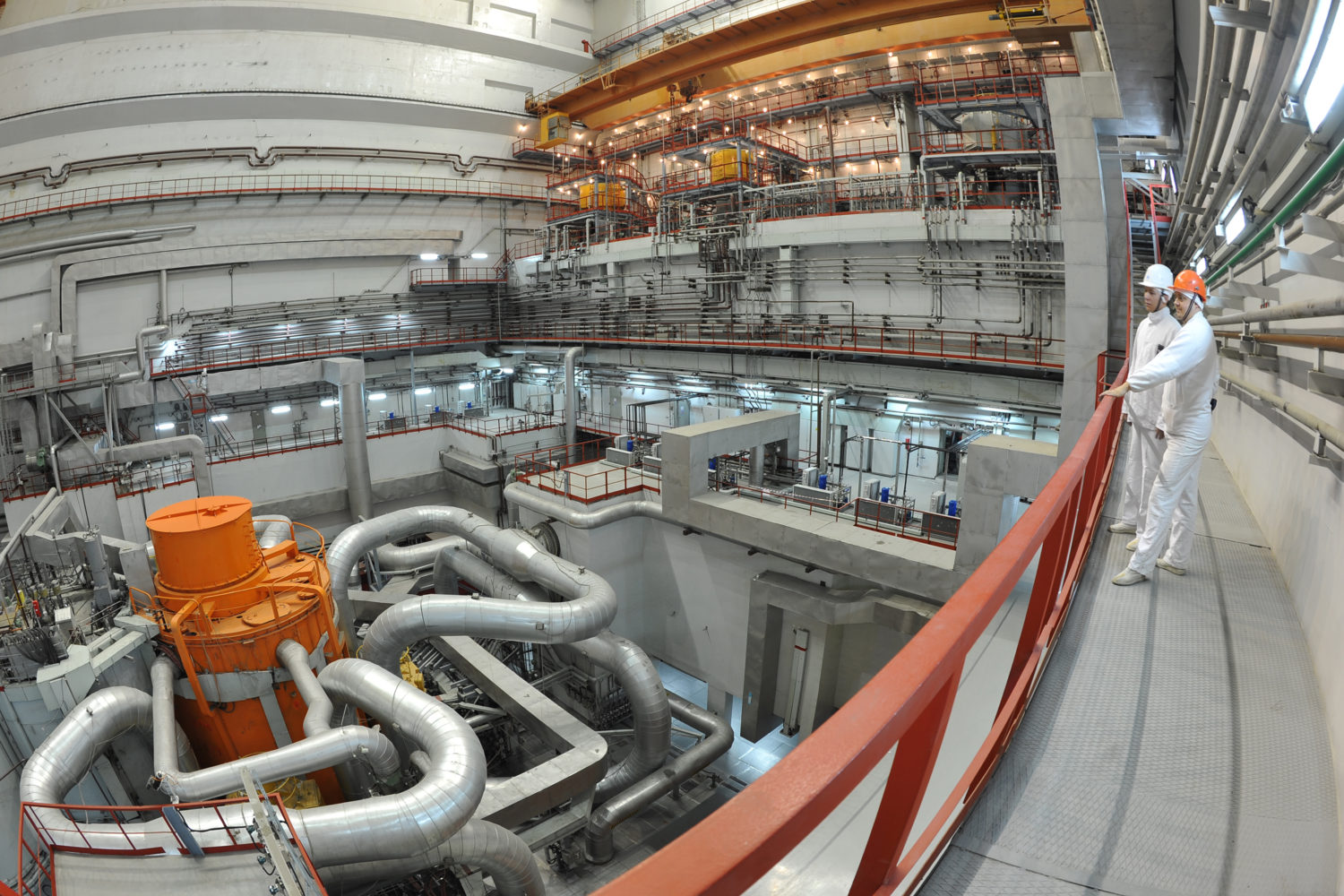
WHAT “BOR” MEANS
BOR is Быстрый Опытный Реактор — Fast Experimental Reactor. The number is thermal power in megawatts. The machine everyone means is BOR-60 at the Research Institute of Atomic Reactors (NIIAR / RIAR) in Dimitrovgrad.
It is not a BN plant. BN means Быстрый Натриевый — Fast Sodium — the power-reactor line (BN-350, BN-600, BN-800, planned BN-1200). BOR is the small, viciously hot test reactor that taught Russia how to live with liquid sodium and then kept testing the fuels and steels those bigger plants needed.
The older Obninsk machines were called BR (Быстрый Реактор): BR-1, BR-2, BR-5, later rebuilt as BR-10. Same family, earlier and smaller.
WHY SODIUM AND WHY FAST
A thermal reactor (VVER, RBMK, Western PWR) slows neutrons with water or graphite so U-235 fissions easily. A fast reactor does not. Neutrons stay energetic. That lets the core fission plutonium efficiently, turn U-238 into more plutonium (breeding), and burn minor actinides that thermal reactors barely touch.
Water is a poor coolant for that job. It slows neutrons and would boil or need huge pressure at the temperatures you want. Liquid sodium melts at 98 °C, boils near 883 °C, carries heat extremely well, and does not moderate much. You can run the primary loop near atmospheric pressure and still take heat out at 500-plus °C.
The costs are real. Sodium burns in air and explodes in water. It is opaque, so you cannot look into the pool. It becomes radioactive (Na-24) in the core, so you use at least two sodium loops: a radioactive primary and a clean secondary, then a water-steam third loop to make electricity. A leak from secondary sodium into the steam generator is the classic accident you design against.
HOW A BOR-CLASS PLANT IS LAID OUT
Core. A compact hexagonal lattice. On BOR-60 the core is only about 40–45 cm high and 40 cm across. Power density can hit about 1,000 kW per litre — many times a VVER. Fuel pins are thin (about 6 mm with 0.3 mm cladding). A standard driver assembly holds 37 pins. Around 85–114 core assemblies, plus blanket assemblies of depleted UO2 or steel, plus seven control-rod positions.
Fuel has been highly enriched uranium oxide or mixed uranium-plutonium oxide (MOX). Axial blankets of UO2 sit above and below the fissile column. Breeding ratio of the whole BOR-60 machine is low (under 0.3). It is a burner and a test bed, not a commercial breeder.
Sodium. Two primary-side loops take sodium through the core. Inlet about 310–330 °C, outlet up to about 500–530 °C. Flow through the reactor up to 1,100 m³/h. Velocity in the core up to 8 m/s. Secondary sodium loops pick up the heat in intermediate heat exchangers. A third water-steam circuit feeds steam generators and a small turbine (up to 12 MWe). There is also an air heat exchanger so the plant can dump heat without making power.
Neutrons. Peak flux about 3.5–3.7 × 10^15 n/cm²·s. A large share of those neutrons are above 0.1 MeV. Mean energy in the core is a few hundred keV. That spectrum ages steels and fuels in a few years the way a power reactor would in decades. Sodium void reactivity on BOR-60 is negative (about −0.05 to −0.07 Δk), which is kinder than some large BN cores.
What you actually do with it. You do not buy BOR-60 for the 12 MW on the grid. You hang experimental pins and whole assemblies in the lattice, irradiate them, then cut them apart in hot cells. Driver fuel, cladding steels, absorbers, vibro-packed fuel, nitride fuel for BREST and BN-1200 mock-ups, even materials aimed at VVER life extension and fusion — all of that has sat in this core.
THE LINEAGE
BR-1 / BR-2 (Obninsk, 1950s). Zero-power then ~100 kWt. Plutonium metal, mercury coolant at first. Proof that a fast spectrum was a machine, not a blackboard.
BR-5 (Obninsk, 1959). Europe’s first sodium-cooled fast reactor with real power: 5 MWt. First fuel PuO2, later uranium carbide, later PuO2 again. In 1973 it was rebuilt as BR-10 (10 MWt). Last campaigns used uranium nitride. Shut for good on 4 October 2002.
BOR-60 (Dimitrovgrad, 1968–69). Scientific lead: IPPE (Obninsk). Chief designer: OKB Gidropress. General designer: VNIPIET. Built at NIIAR. Physical start-up 1968. Heat through an air cooler in December 1968. Electricity to the Ulyanovsk grid by the end of 1970. Design life was 20 years. By 2017 it had about 275,000 hours at power. Licence extended to 31 December 2028.
BN-350 (Aktau, Kazakhstan, 1972–1999). First commercial-scale sodium fast plant in the Soviet line: power plus desalination.
BN-600 (Beloyarsk-3, 1980– ). The world’s longest-running industrial sodium fast reactor. Still on the grid.
BN-800 (Beloyarsk-4, 2015– ). MOX-fuelled power unit.
BN-1200 / BREST-OD-300. Next commercial sodium plant and the lead-cooled demonstration plant. Nitride pins that look like BREST and BN-1200 fuel have already been irradiated in BOR-60.
MBIR (Dimitrovgrad). Multipurpose fast research reactor. 150 MWt, about 55 MWe. Design flux about 5.3 × 10^15 n/cm²·s. Design life 50 years. Extra loops for lead, lead-bismuth, or gas experiments. Physical start targeted 2027, energy start 2028. Construction more than 80% complete in early 2026.
WHY BOR-60 MATTERED
Sodium technology: pumps, purification, leak detection, steam-generator leaks, draining, fire fighting, and the fact that you can run the same primary sodium for fifty years if you keep it clean. Fuel: oxide, carbide, nitride, vibro-packed, weapons-Pu MOX after 1981. Cladding and ducts: the steels that let BN-600 and BN-800 keep their pins intact came out of this core. Continuity: when France’s Phénix and Superphénix, Britain’s PFR, Japan’s Monju, and the U.S. FFTF went dark, BOR-60 was often the only high-flux sodium test reactor still taking international irradiations.
It is not a perfect machine. The core is tiny, so you cannot mock a full BN-1200 assembly at full length. Breeding is weak. The site is old. Decommissioning means dealing with cubic metres of radioactive sodium.
HOW IT DIFFERS FROM A VVER OR RBMK
No water in the core. No big pressure vessel holding 15 MPa. No graphite. Neutrons are fast. The core is the size of a kitchen table and as power-dense as a furnace. Heat leaves through metal-to-metal sodium loops, not by boiling water on the fuel. Refuelling is offline, with the sodium still covering the core. A leak is a fire problem, not a loss-of-coolant blowdown in the PWR sense.
SIGNIFICANCE
Obninsk proved sodium. Dimitrovgrad made it industrial-grade. Shevchenko and Beloyarsk made electricity. MBIR is meant to keep a test hole in the ground after BOR-60 finally stops. Russia is the only country that went from BR-5 to a running BN-800 without abandoning the line. BOR-60 is the reason that sentence is possible.
STATUS AS OF 2026
BOR-60: still the reference Russian fast test reactor; licence through the end of 2028; retirement planned once MBIR can take the work.
MBIR: building, first operations advertised 2027–28.
BN-600 and BN-800: commercial sodium plants still generating.
BR-5/10: shut and historic.
IN ONE SENTENCE
BOR-60 is a 60-megawatt liquid-sodium fast test reactor in Dimitrovgrad that has run since 1969, burning enriched uranium and MOX in a core the size of a barrel so Russia could design BN power plants, qualify steels and nitride fuel, and keep a fast-neutron irradiation hole open while the rest of the world’s sodium test reactors shut down.