WHAT IT IS
AUTOVON was the Department of Defense’s worldwide automatic long-distance telephone network. From the mid-1960s into the early 1990s it was how a commander, a base operator, or an authorized desk could dial another military installation as if the country — and later much of the allied world — were one exchange. It carried unclassified voice. It was not a crypto net. Secure voice rode other systems (AUTOSEVOCOM and later successors). AUTOVON’s job was to be there, to be switched, and to let the important call steal the trunk from the unimportant one.
People called it the DoD’s phone company. That is fair. The government did not string most of the copper. AT&T Long Lines, Automatic Electric, Western Electric, and later Bell electronic switches did. AUTOVON was a logical network laid over hardened coaxial, microwave radio, and overseas cables, with its own numbering plan, its own four-wire switches, and a precedence scheme the public telephone network did not have.
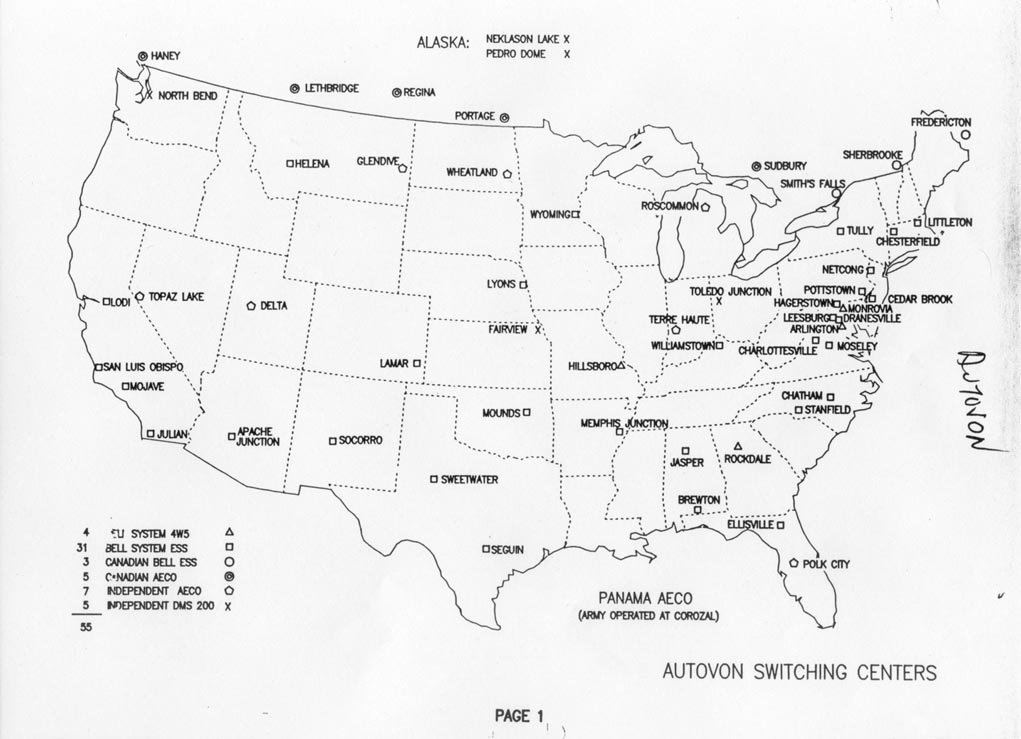
DCA (Defense Communications Agency, later DISA) managed it as part of the Defense Communications System. CONUS AUTOVON included the continental United States, Alaska, and Canada. Overseas AUTOVON covered Europe, the Pacific, the Middle East, and Panama. Together they were one global dialing fabric with local differences in routing and who owned the switch.
WHY IT WAS BUILT
Before AUTOVON each service built its own point-to-point nets and small automatic islands. The Army had SCAN (Switch Communications Automated Network / Switched Circuit Automatic Network). NORAD and Air Defense Command had their own automatic dial network. That was wasteful and brittle. In a nuclear war you do not want command circuits that die because they all meet in one city tandem.
DoD wanted a common-user long-distance voice system that:
- survived loss of cities and of a few switches - completed command-and-control calls even when the network was jammed with administrative traffic - felt like a telephone, not a radio schedule - could grow worldwide
SCAN was chosen as the seed in 1963 and renamed AUTOVON. In April 1964 SCAN and the NORAD/ADC network were formally combined. Air Defense Command voice cut over in June 1966. The doctrine was robustness: many switches, polygrid routing rather than a fragile hierarchy, buildings away from obvious targets, and preemption so a Flash call could evict a pay-record inquiry.
HOW A CALL WORKED
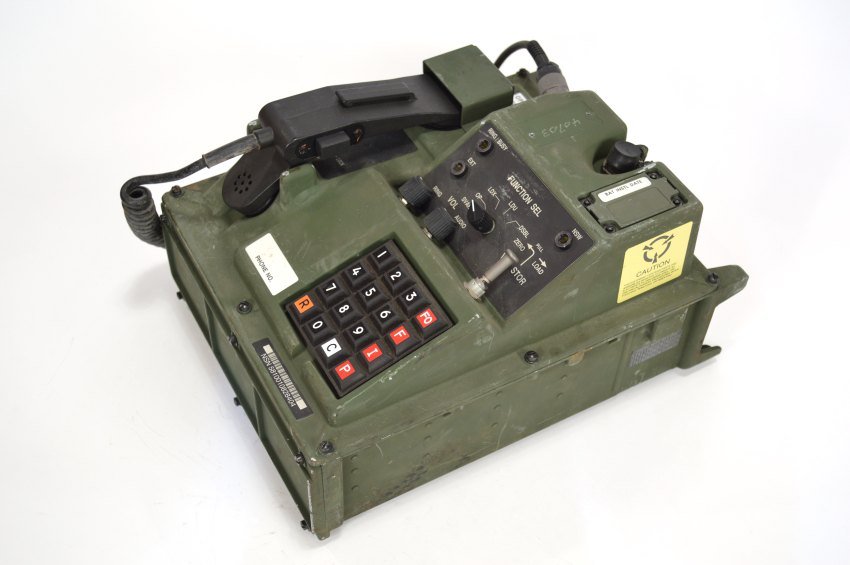
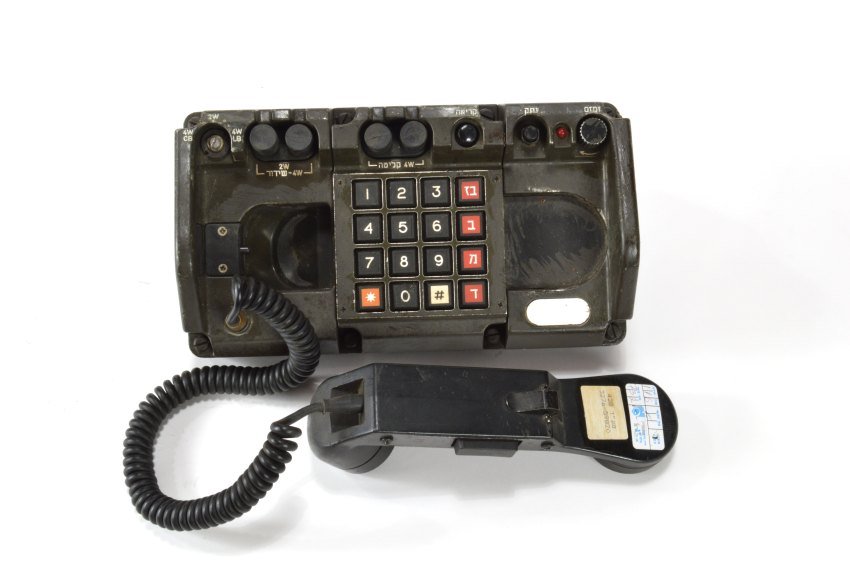
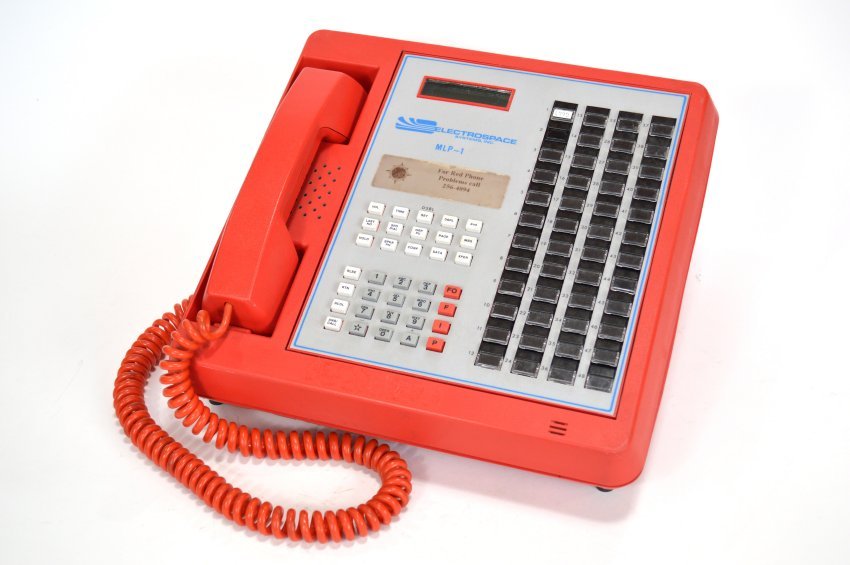
Most users reached AUTOVON through a base PBX. Selected officers had a four-wire subset on the desk — often an Automatic Electric or Western Electric instrument with extra red keys. You dialed an AUTOVON number. The access line hit a tandem. The tandem tagged the call with a precedence and hunted an idle trunk. If none was idle, a lower-precedence conversation was torn down. Both parties on the victim call heard a preemption tone (about three seconds in typical Bell practice) and were dropped. The high-precedence call reused the trunk.
Equal or higher precedence was not stolen. If every usable path was already Flash or Flash Override, the new caller got a reorder / “no circuit” treatment and a recorded announcement from a Switched Service Bureau, not a completed call. Unauthorized precedence on a line that was not classmarked for it also hit a recording: use an authorized level or get an operator.
The talking path was four-wire end to end on the backbone. Ordinary two-wire telephone plants fold transmit and receive onto one pair. Four-wire keeps them separate, which is cleaner for long-haul tandem networks, conferencing, and preemption circuitry. Bell Labs redesigned No. 5 crossbar as a four-wire machine specifically for this. Development of that 4-wire 5XB started around 1959. A four-wire ESS followed.
Civilian PSTN was not supposed to originate into AUTOVON. Reality was leakier than the briefing slides. The design intent was isolation plus controlled gateways.
MULTILEVEL PRECEDENCE AND PREEMPTION (MLPP)
This is the feature that made AUTOVON a war telephone instead of a cheap WATS line.
Five named levels. Four of them can preempt. The fifth is ordinary traffic:
- FLASH OVERRIDE (FO) — capability, not just another rank. Meant for the President, Vice President, Secretary of Defense, Deputy Secretary of Defense, Joint Chiefs, and a short list of commanders in declared emergencies (for example CINCNORAD declaring Air Defense Emergency, or a unified commander declaring Defense Condition One / Defense Emergency). FO can break even Flash. - FLASH (F) — alerts, warnings, actions with immediate bearing on national, command, or area security. Opening of hostilities, critical intelligence of attack, implementation of emergency war procedures. - IMMEDIATE (I) — vital traffic that cannot wait; preempts Priority and Routine. - PRIORITY (P) — important official traffic; preempts Routine only. - ROUTINE — everything else. No preemption power. First to die when the trunks fill.
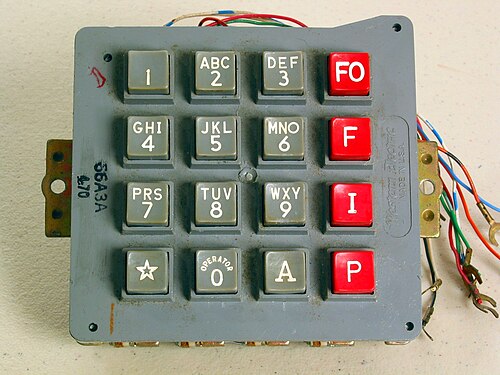
On the 16-button AUTOVON Touch-Tone set the familiar 12 keys remain. A fourth column of four red buttons on the right is FO, F, I, P from top to bottom. Those keys generate the rare DTMF “A B C D” column using 1633 Hz as the high tone:
- A 697/1633 Hz — Flash Override - B 770/1633 Hz — Flash - C 852/1633 Hz — Immediate - D (typically 941/1633 Hz) — Priority
Routine is no extra button. Authority to press the red keys was a paper and classmark problem, not a toy. Abuse wasted the only mechanism that kept command traffic alive under load.
Preemption hunted from the bottom: a Flash call looking for a trunk would take Routine first, then Priority, then Immediate. It would not take another Flash. The call is tagged on the trunk so later hunters can see what they are allowed to steal.
SWITCHES AND PLANT
CONUS tandems began as four-wire No. 5 crossbar (Western Electric) and four-wire Automatic Electric machines. Markers were more complex than a civilian 5XB because routing was a non-hierarchical polygrid: many alternate paths, not a simple class-4 pyramid. Trunk circuits carried extra logic to store precedence. After 1ESS proved itself, four-wire 1ESS replaced a large share of the crossbar in the early 1970s. Later digital machines (including 4ESS at some large nodes and eventually 5ESS in the DSN era) inherited the same MLPP idea.
Peak size is usually given as 69 switching centers around April 1971, with on the order of 8,500 interswitch trunks and 18,000 access lines in a 1980 DCA description (numbers moved with requirements). Bell Labs Record in 1968 talked about linking some 1,700 installations on 2,300 access lines when fully operational toward 1970 — an earlier, smaller snapshot. Overseas switches opened in the United Kingdom in 1969, then elsewhere in Europe, Asia, the Middle East, and Panama. Pacific centers were mostly government-owned except Hawaii, leased from Hawaiian Telephone.
Transmission was AT&T Long Lines: L-carrier coaxial (especially the hardened L-3I and later L-4/L-5 builds), TD/TH microwave, and ordinary intercity plant where that was good enough. Military traffic did not need the whole capacity of an L-4 route, so civilian long-distance overflow rode the same tubes. That dual use is why a “DoD phone company” looks like a telephone company bunker in Kansas.
Switch buildings were often underground or earth-covered, sometimes next to a Long Lines main station (Fairview, Kansas is the textbook pairing). Others sat in mountains (Cheyenne Mountain) or in ordinary above-ground shells with basements. The point of geography was distance from downtown targets and from each other, matching the same survivability tables used for Long Lines routes.
Network control could directionalize trunks, cancel alternate routes, cancel destination codes, and apply line-load control when a switch or a region was wounded. That is the peacetime equivalent of fighting congestion without waiting for FO.
WHAT IT WAS NOT
Not secure by default. AUTOSEVOCOM was the attempted secure-voice overlay; it was costly and troubled and did not replace AUTOVON as the common-user dial tone. NATO later fielded IVSN in Europe for unclassified switched voice. AUTOVON remained the big American common-user voice net until DSN.
Not the public network. Same vendors, same multiplex, different numbering, different classmarks, different legal user set.
Not immortal. Analog switches age. Fiber and stored-program digital tandems made a 1964 architecture expensive. Precedence still exists in DSN. The red-button analog world does not.
HISTORY
1959 — Bell starts four-wire No. 5 crossbar work for defense switching.
1960 — Defense Communications Agency created to run the Defense Communications System.
1963 — SCAN listed as a DoD resource and becomes the AUTOVON seed. Build-out begins.
April 1964 — SCAN and NORAD/ADC automatic networks combined as AUTOVON.
June 1966 — Air Defense Command voice cut over. Large CONUS turn-up wave (Apache Junction, Anaheim, Mojave, Pittsfield, Hagerstown, and others appear on 25 June 1966 lists).
1969 — United Kingdom switching centers open; overseas growth follows.
1971 — Peak of about 69 centers.
Early 1970s — 1ESS begins replacing 4-wire 5XB.
1982 — Office of the Secretary of Defense designates the Defense Switched Network as DoD long-distance telephone service. DSN is the digital heir: same MLPP idea, new switches.
Early 1990s — AUTOVON name and analog plant retire. Some 5ESS documentation still says “DSN was previously known as AUTOVON” because the feature set migrated.
Sites were sold, stripped, or reused. A few, like Mounds, Oklahoma, changed hands with iron still in the building.
WHY IT MATTERED
Command and control in the missile age needed a telephone that did not politely wait in queue. AUTOVON was that compromise: commercial technology, military routing, hardened buildings, and a social rule encoded in four red keys. It made global operations “as easy as a local call” only if you ignore the classmarks, the blast doors, and the fact that someone else’s conversation could vanish so yours could live.
STATUS
Dead as a named network. Living as DSN features (MLPP, four-wire access, special numbering, multifunction switches). The bunkers and the Long Lines cables that fed them are the same archaeology as the microwave skyway.
IN ONE SENTENCE
AUTOVON was the Cold War automatic military telephone network — four-wire tandems on AT&T long-haul plant — that let a Flash Override call seize a trunk from a Routine conversation so command traffic could still complete when the rest of the world was busy or burning.