WHAT IT IS
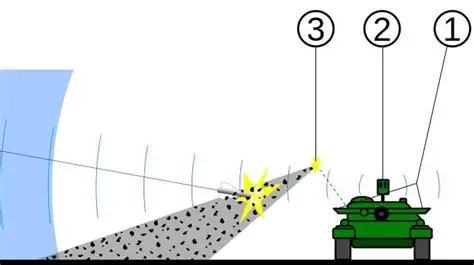
Arena-M is Russia’s modernized hard-kill active protection system for tanks: a millimetre/centimetre-wave Doppler radar watches the air around the turret, a computer decides what is a threat, and a directed fragmentation charge is fired to break the incoming warhead a few metres out. Designer is KBM Kolomna (the same shop as the original 1990s Arena). Index on late fits: T-09-A6-1. Export cousin is Arena-E.
It is not Relikt and it is not Shtora. Relikt is explosive reactive armour on the plate. Shtora is soft-kill (IR jammers and smoke). Arena throws metal. Soft-kill tries to make the missile miss. Hard-kill tries to kill the missile. Russian tanks often wear more than one of those layers; they are not the same layer.
FROM ARENA TO ARENA-M
Classic Arena (early 1990s) sat a distinctive radar “hat” on the turret roof and ringed the bustle with interceptor shafts. Handbook figures that still get copied onto every page: detect ~50 m, detonate ~1.5–2 m from the threat, engage incoming speeds ~70–700 m/s, ignore outgoing rounds / birds / small-calibre, azimuth sector ~270° on the old kit (turret traverse to cover the rest), reaction ~0.05–0.07 s, 22–26 protective rounds, ready again in 200–400 ms, mass 1,100–1,300 kg, ~30 litres of kit inside the turret, ~1 kW at 27 V, infantry danger radius printed at ~20–30 m. Unit cost in old Western notes ~$300,000 — a 1990s sticker, not a 2026 invoice.
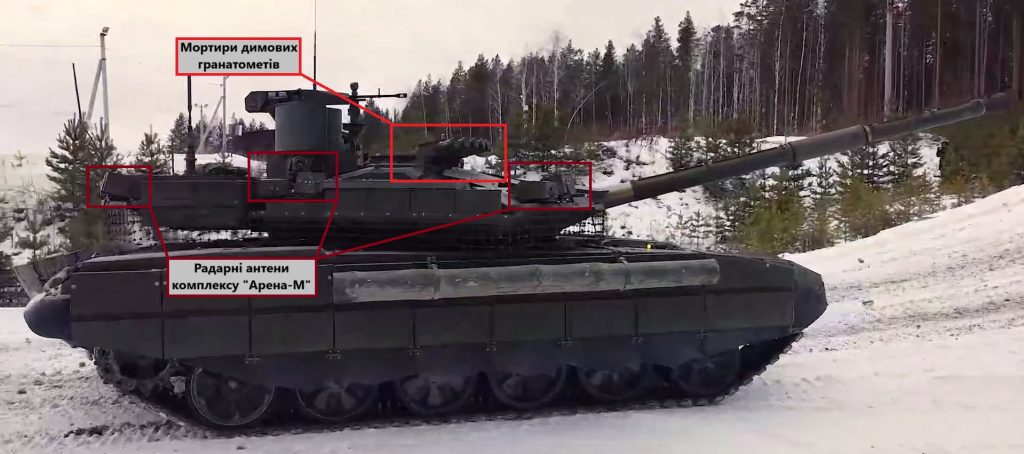
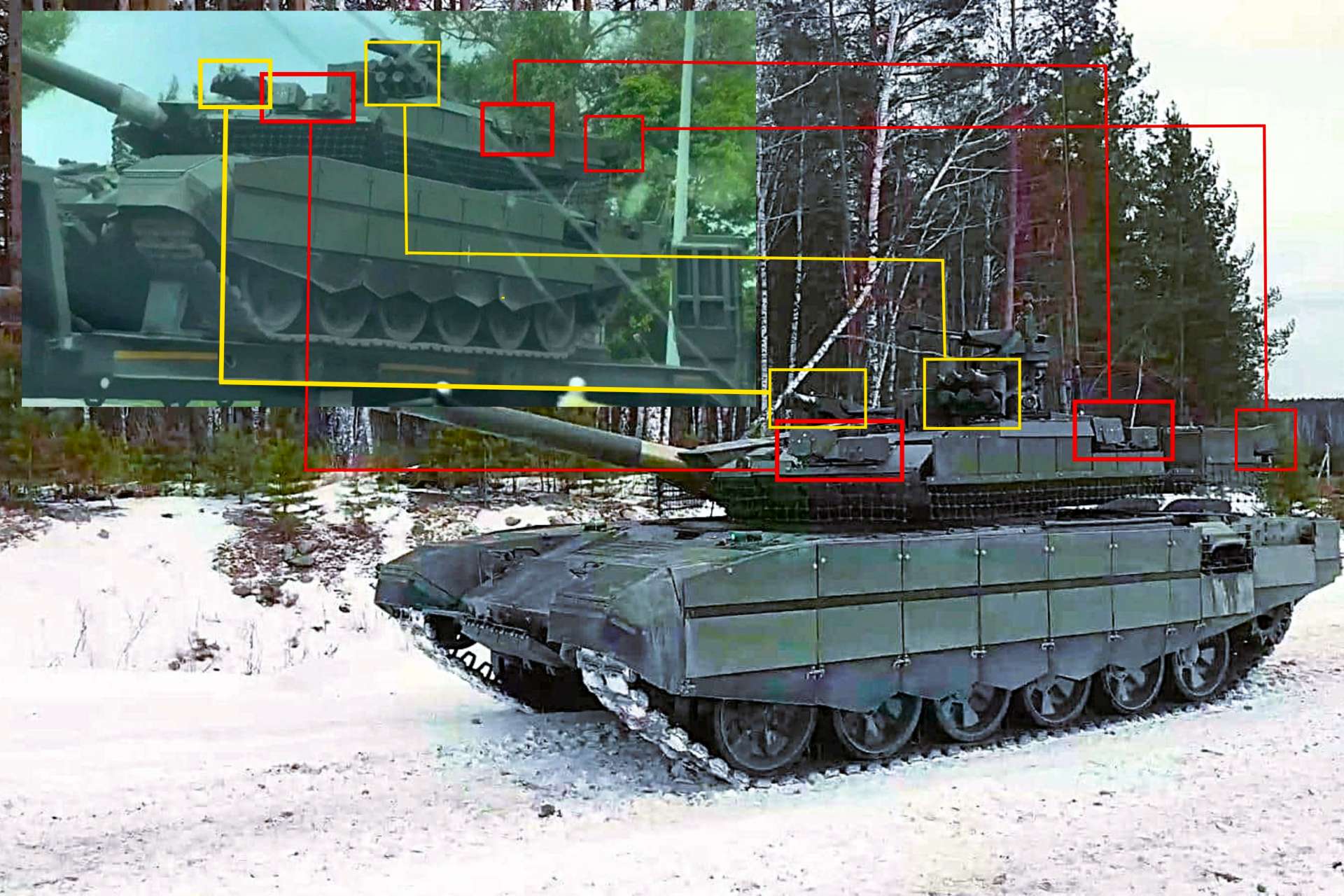
Arena-M flattens that architecture. Radar becomes several small modules on the turret (four sensor blocks, two forward and two aft, in one Polish/patent description; six paired X-band T/R modules in Damantsev’s write-up). Effectors move into side packs — commonly two banks, up to six shots each, twelve on the vehicle in the configuration that showed up in 2025–26 field photos. KBM/UVZ language still quotes the old 22–26 when they mean the family. Andrei Tarasenko and others have described work to grow the load toward 36. More shots is the obvious lesson from drones. More bulk on the turret fights engine-deck access. That tension is public.
HOW THE LOOP IS DESCRIBED
Radar sees a track in the protected bubble (~50 m class). Computer checks size and speed against the 70–700 m/s window (some later Russian claims push intercept velocity talk to 1,200 m/s — treat that as a marketing ceiling, not the 1990s card). If it looks like an ATGM, RPG grenade, or similar, the system picks the shaft whose sector covers that azimuth and fires a narrow-beam fragment warhead. Overlapping sectors are how two threats from one side get two shots. Some descriptions say two effectors per threat. Some M effectors are credited with a small impulse motor to point the fragment cone. Intercept geometry is close — tens of metres, not a hundred.
This page is the published loop, not a field manual.
WHAT THE MAKER SAYS IT STOPS
RPG-class grenades, ATGMs (TOW-2, Konkurs/Stugna/Milan family in Russian lists), gun-launched and tripod missiles in the speed gate. Maker and house experts add NLAW, Javelin, Brimstone-2, APKWS, and FPV / dropped PG-7 from hexacopters. Top-attack and 90° drop are the argument for raising the radar elevation sector — and the reason cage “visors” and Arena fight for the same sky. A visor that blanks the radar buys the drone a free lane. That trade is written in the Russian press, not invented here.
Kinetic APFSDS from a tank gun is generally outside a fragment-APS job. Claims that Arena eats DU long-rods are expert talk, not a safe handbook line. Trophy comparisons in Russian copy (“they only do subsonic, we do supersonic”) are sales.
WHAT THE FIELD HAS SHOWN
Fits on T-90M and T-72B3M/B3A were promised for years, photographed in small numbers from 2024, confirmed by UVZ/TASS language in 2025, and seen in combat footage in 2026. Open reporting on July 2026 fighting described a T-72B3A with Arena-M swatting a string of FPV drones until the magazines were empty, then taking hits from the rear. Ukrainian write-ups put one fielded load at 12 charges and the attacking side’s answer at 15–20 drones on that hull. That is the physics of a finite magazine, not a mystery.
So: the radar-and-charge loop can work against slow drones and some missiles. It is not a cloak. Saturation, top attack outside the elevation gate, rear/dead zones, and empty shafts are the documented limits. Infantry walking in the 20–30 m fragment ring is the old peacetime complaint and still true.
ON WHICH HULLS
Intended: T-90M Proryv, T-80BVM, T-72B3 / B3M / B3A. BMP-3 carried classic Arena in shows. Not every T-90M from Tagil has it — Relikt is the standard M package; Arena-M is the extra that production capacity and turret real estate allow. Skeptics in 2025 called observed hulls a handful. 2026 footage made “zero” the wrong number and “every tank” still the wrong number.
VERSUS TROPHY, AFGHANIT, DROZD
Drozd was the Soviet first hard-kill, 1980s, fixed sectors, naval-style rockets. Arena was the 1990s reset with a smarter radar. Trophy (Rafael) is the Western system with a combat record in the Middle East and on Abrams/Merkava; different effector, different magazine math. Afghanit is the T-14 set — not a bolt-on for a T-72 turret. Arena-M is the thing you can actually weld onto a Tagil or Omsk rebuild without waiting for Armata.
STATUS
In limited field use on T-72B3-family and some T-90M as of 2026. Combat has confirmed intercepts and confirmed empty racks. KBM is being asked for more effectors and a taller radar fence. Until the magazine and the elevation match the drone war, Arena-M is a useful layer, not a substitute for Relikt, discipline, and not parking in the open.
IN ONE SENTENCE
Arena-M is Kolomna’s hard-kill APS — turret radar plus a dozen-odd fragment charges — that can break an RPG or an FPV a few metres out and then go silent when the shafts are empty, which is why it is showing up on T-90M and T-72B3M and why twelve shots is the number everyone is arguing about.