WHAT IT IS
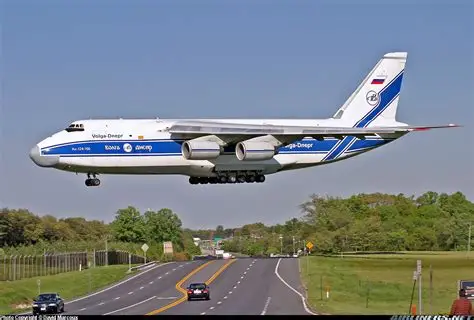
The Antonov An-124 «Руслан» (Ан-124 «Руслан», “Ruslan”; design-bureau code «изделие 400», “Product 400”; NATO reporting name Condor) is a four-engine, double-deck, high-wing strategic heavy transport designed by the Antonov design bureau (ОКБ имени О. К. Антонова) in Kyiv, then in the Ukrainian SSR. It first flew on 24 December 1982, and Russian and English sources date entry into service to 1986–1987. It is the heaviest cargo aircraft in regular operation since the destruction of its six-engine derivative, the An-225 «Мрія» (Mriya), in February 2022. English Wikipedia also calls it the largest military transport aircraft still in service.
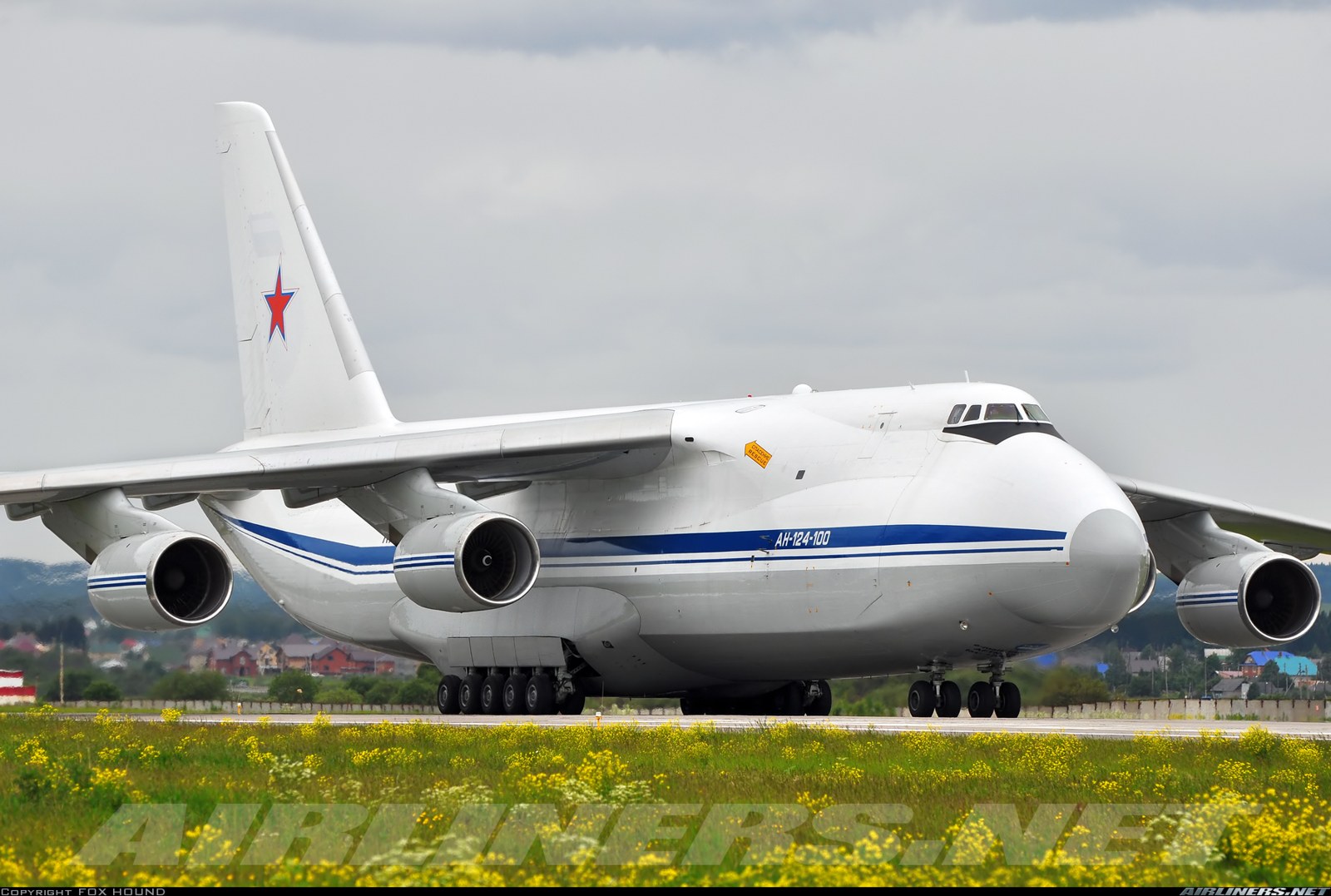
The type was built for the Soviet Military Transport Aviation (Военно-транспортная авиация, ВТА) to carry heavy vehicles, missiles and other outsize loads over intercontinental distances. Its recognisable features are a hinged visor nose and a rear ramp, so that vehicles can drive through, a kneeling multi-strut landing gear with 24 wheels, a supercritical wing, and a conventional single fin. The civil version, the An-124-100, was certified on 30 December 1992 and has carried outsize freight for commercial operators, NATO and space-launch companies ever since.
Production is usually given as 55–57 airframes in total, built at two plants: the Kyiv Aviation Production Association (КиАПО, later Aviant) in Ukraine and the Ulyanovsk Aviation Industrial Complex (УАПК, later Aviastar-SP) in Russia. The two operator groups are now on opposite sides of a war: Ukraine’s Antonov Airlines flies its An-124s from Leipzig, Germany, while the Russian Aerospace Forces (ВКС России) operate the military fleet and Russian industry services it without Ukrainian participation.
DEVELOPMENT
Background. By the 1970s the VTA had only about 50 turboprop Antonov An-22 aircraft as heavy lifters, and a 1975 CIA analysis (cited by English Wikipedia) concluded that the USSR could not match the US in long-range heavy lift. Russian Wikipedia traces the idea back to a Soviet decree of 21 July 1966 that set a goal of 100–120 tonne payloads. Two preliminary designs were drawn up: the six-engine An-126 (140 t) and the four-engine An-124 (120 t). On 2 February 1972 a Council of Ministers commission chose the four-engine design, then coded «изделие 200». A full-size mock-up was built in 1973, but Oleg Antonov decided on a complete redesign under the code «изделие 400»; the government decree for the new aircraft came in early 1977 (No. 79-23, per Russian Wikipedia). Design work is dated to 1971 by English Wikipedia; sources differ on the exact start because of these earlier studies.
People. Pyotr Balabuyev was general designer of the bureau from 1984 to 2005 (Russian Wikipedia). Viktor Tolmachev was lead designer from 1971 and chief designer-project leader for the An-124 and An-225 from 1986.
Design method. Russian Wikipedia describes a comprehensive “КЦП-124” programme, the first of its kind in the USSR, with 540 layouts analysed by computer and 185 models tested in wind tunnels, 44 full-scale test rigs, about 3,500 test structures and roughly 135,000 hours of rig testing. The aircraft introduced several firsts for a Soviet heavy aircraft: a supercritical wing, a fly-by-wire system (a hybrid with mechanical backup), a navigation suite built around a digital computer, a “kneeling” landing gear, and an on-board automated monitoring system (БАСК). The programme involved more than 100 enterprises across the USSR; the Tashkent Chkalov plant made wing panels and centre section, and large parts were moved on An-22 aircraft (Russian Wikipedia).
Engine. The D-18T was developed by the Zaporozhye design bureau ЗМКБ «Прогресс» (Ivchenko-Progress; English Wikipedia credits the Lotarev design bureau that became Progress). Russian Wikipedia says the first D-18 concept was based on the American General Electric TF39 of the C-5A, that a British purchase of Rolls-Royce RB211 engines in 1976 fell through, and that the D-18 was finally derived from the domestic D-36. Bench testing of the D-18T began only about three months before first flight. These are Russian-language accounts of the origin and should be read as such.
Rollout and first flight. The first aircraft was rolled out on 24 October 1982. It flew on 24 December 1982 from the Kyiv factory airfield with crew V. I. Terskiy and A. V. Galunenko as pilots, navigator A. P. Poddubny, flight engineers V. M. Vorotnikov and A. M. Shuleshchenko and radio operator M. A. Tupchienko (Russian Wikipedia). On landing the nose gear suffered shimmy that broke a gear door and linkages. Flight testing then ran from Gostomel (Hostomel): 141 flights and 251 hours in the first stage to September 1983, then state joint trials from November 1983. A second aircraft, No. 01-03, joined in late 1984. In the eighth flight of the state trials an engine surge destroyed a turbine wheel and the aircraft landed at Uzin. The Paris Air Show of 1985 was the type’s first appearance in the West, followed by a series of record flights (see NOTABLE CARGO AND RECORDS). The test act was signed in December 1986.
Entry into service. The first military unit was the 566th Military Transport Aviation Regiment (566-й втап) at Seshcha, which received its first two aircraft in February 1987 (Russian Wikipedia; English Wikipedia says 1986 for service entry). A second regiment, the 235th, formed at Seshcha on 25 January 1989; Russian Wikipedia gives 28 aircraft in the first regiment by 1989. The type was formally adopted by order of the Supreme Commander on 28 March 1991 (Russian Wikipedia). A parachute-drop test programme from 1989 led to limits on dropping personnel through the rear door, which was judged unsafe; the aircraft was cleared for landing-mode unloading only.
Production. The plan was to build the aircraft in parallel at two plants. According to Russian Wikipedia, Kyiv (КиАПО) built 17 by 1994, and Ulyanovsk (УАПК) built 33 between 1985 and 1995. Other Russian-language sources, including the Aviastar-SP website cited by Interfax, give 36 Ulyanovsk-built aircraft, so the plant totals are not consistent. After 1995 serial production stopped at both plants because of the economic situation. Kyiv completed a leftover airframe, No. 03-03, which was sold to Maximus Air Cargo of the UAE in 2003; Ulyanovsk completed three eighth-series aircraft: RA-82079 (2000, Volga-Dnepr), RA-82080 (2004, Polet) and RA-82081 (2004, Volga-Dnepr). Russian Wikipedia gives 56 built including one static-test airframe; English Wikipedia says 57 (with a citation-needed tag). Production years are given as 1982 or 1984 to 2004.
Civil certification. The civil An-124-100 was tested from 1990 to 1992 under the civil airworthiness standard НЛГС-3 (266 flights, 732 hours). During one of these flights on 13 October 1992 the nose radome and then the entire hinged nose section failed at maximum dynamic pressure, and the aircraft crashed near Kyiv (see accidents below). The certificate was issued on 30 December 1992.
AIRFRAME AND CARGO COMPARTMENT
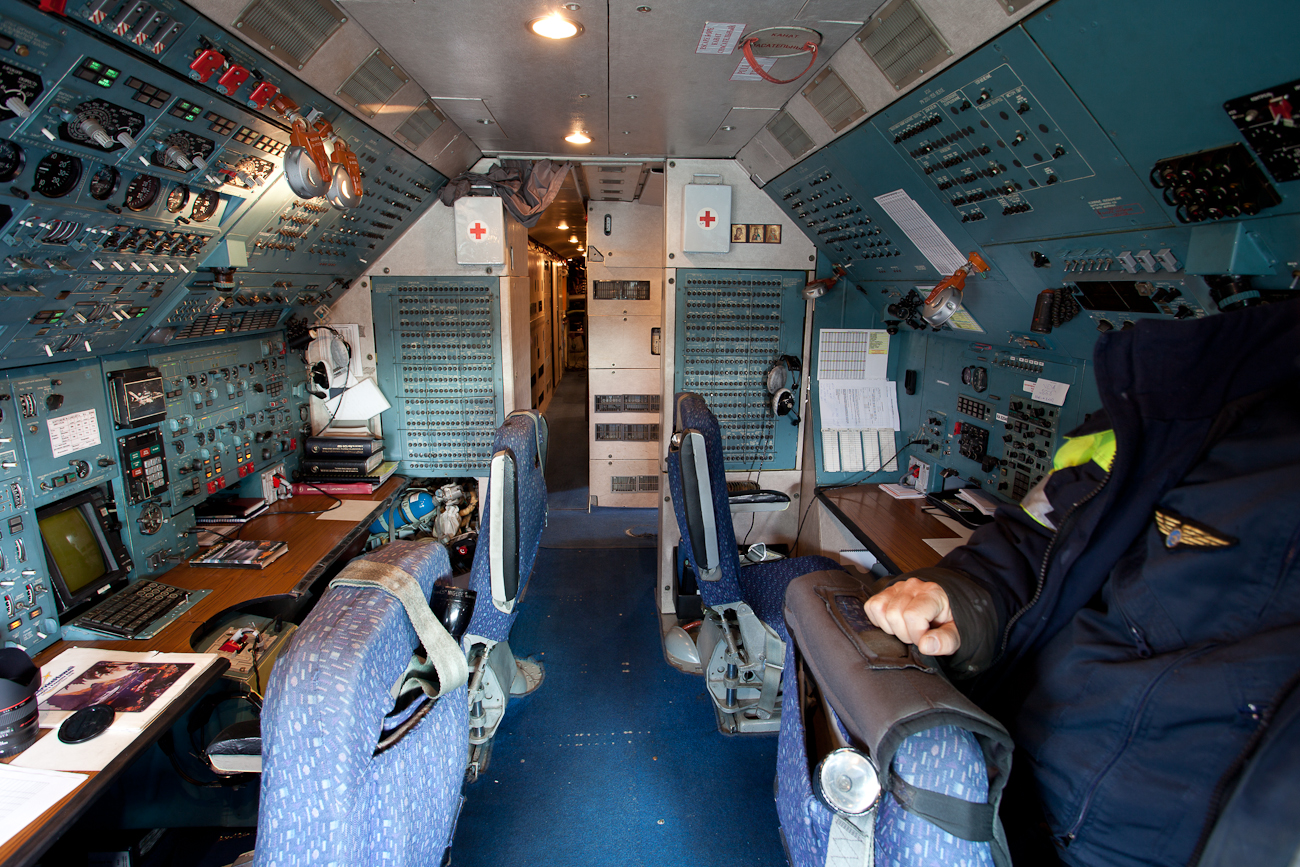
Layout. The An-124 is a four-engine turbofan high-wing aircraft with a swept supercritical wing, a single-fin tail and two decks. The lower deck is the cargo compartment; the upper deck holds the flight deck, a rest cabin for the relief crew and a cabin for accompanying personnel (Russian Wikipedia). Aluminium alloys are the main structural material, with limited steel and titanium. English Wikipedia, citing a 1986 CIA assessment, says carbon-fibre composites make up about 5% of the structure weight and that the cargo-deck floor is titanium. The layout resembles the Lockheed C-5 Galaxy, with a slightly shorter fuselage, a larger wingspan and a conventional tail instead of the C-5 T-tail; English Wikipedia says the An-124 can carry a 17% larger payload.
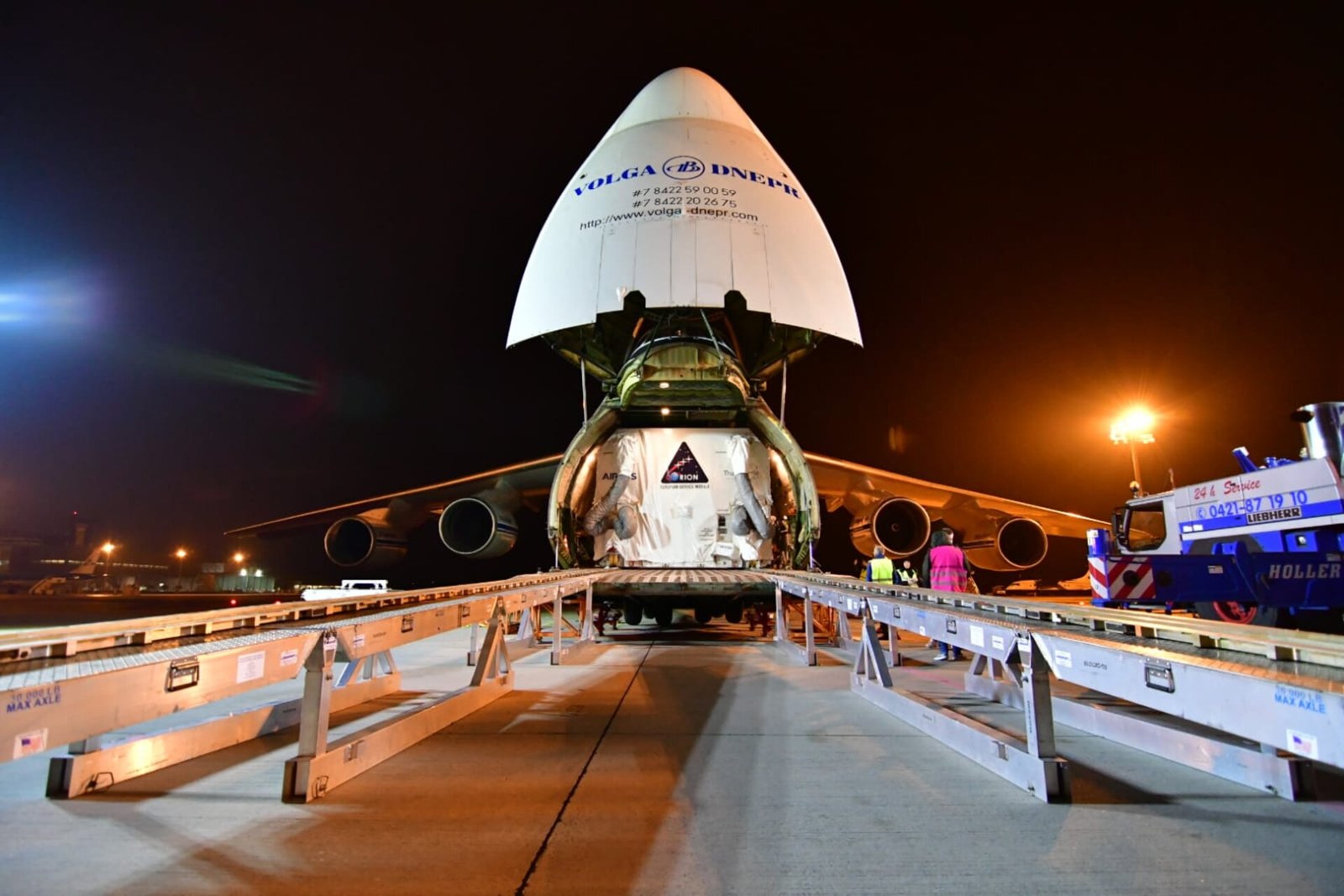
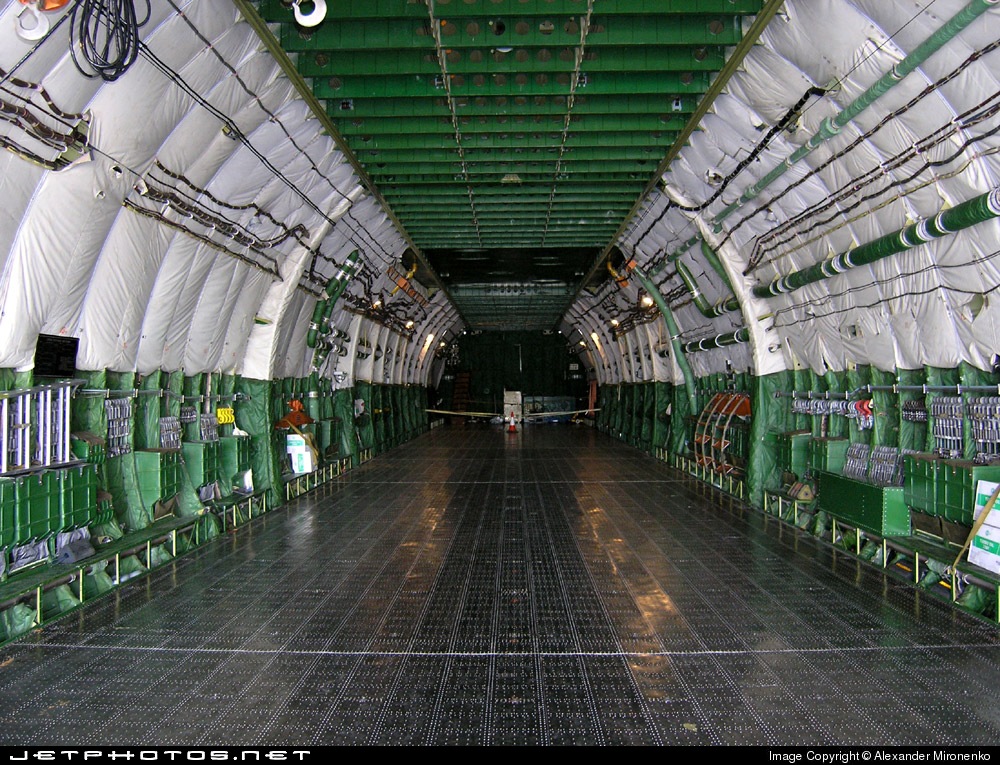
Nose and rear doors. A defining feature is two cargo openings: a hinged visor nose at the front and a rear ramp, so cargo can be loaded or unloaded at both ends at once and vehicles can drive through (Russian Wikipedia and Antonov). Each door opening is given as 6.4 × 4.4 m (Russian Wikipedia). For loading, the nose gear kneels using screw jacks in the legs, which also changes ground clearance and fuselage angle (the «РВП» height-adjustment system in Russian sources).
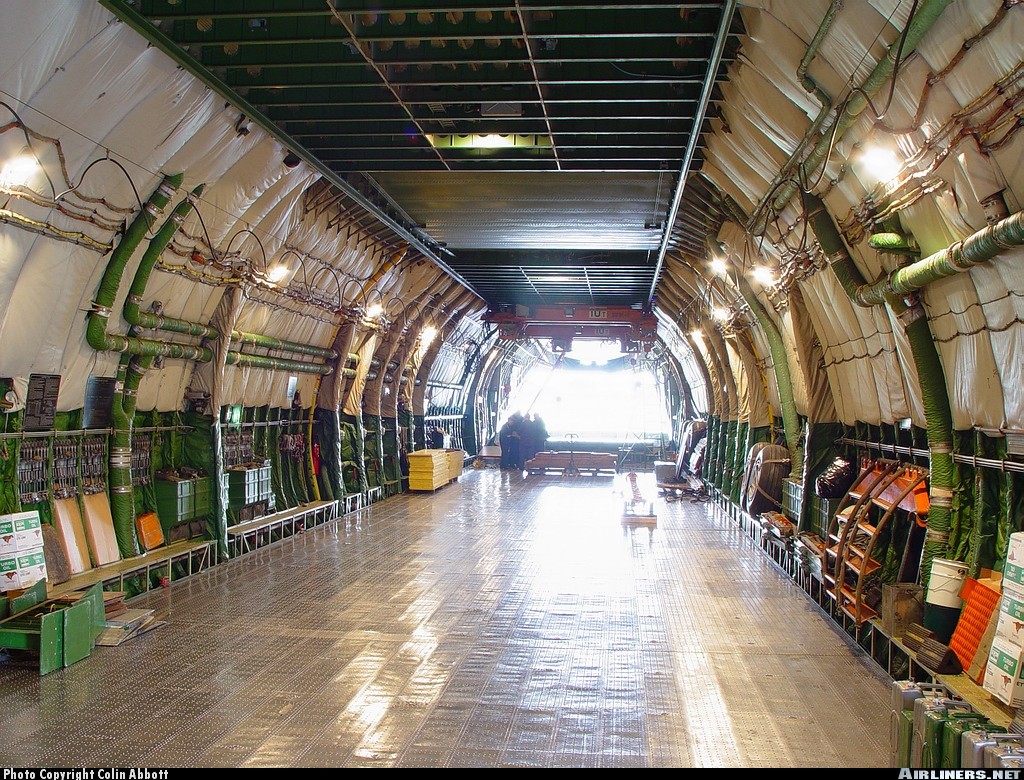
Cargo hold. Russian Wikipedia gives a hold 36.5 m long, 6.4 m wide and 4.4 m high with a volume of 1,050 m³; English Wikipedia gives 36 × 6.4 × 4.4 m. Both agree on the width and height. The hold is pressurized, but the pressure is limited (24.6 kPa, per English Wikipedia), and Russian sources say it should not be kept at normal cabin pressure without need. Because of this the aircraft is seldom used for passengers or paratroops. Russian Wikipedia says the aircraft was theoretically cleared for up to 440 paratroopers or 880 equipped soldiers, but see the parachute restriction under DEVELOPMENT.
Cranes and loading equipment. Russian Wikipedia gives on-board travelling bridge cranes with a combined capacity of 20 tonnes (two cranes of 10 t each), and says mono-loads of up to 50 t can be carried without special permission. English Wikipedia instead says an overhead crane can lift up to 30 tonnes and that items up to 120 tonnes can be winched aboard. These figures conflict and the crane capacity should be treated as roughly 20–30 t depending on source and configuration.
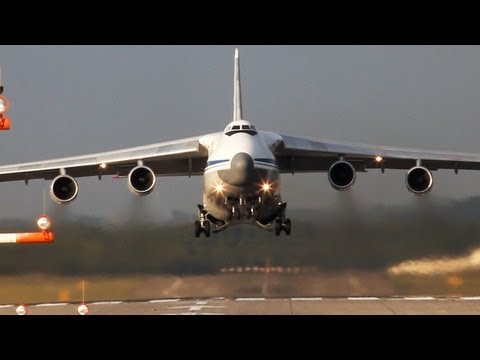
Landing gear. The tricycle gear has five shock-absorbing struts per main leg with paired wheels, the first and last of which steer to ease taxiing, and two struts on the nose leg, for 24 wheels in total (Russian and English Wikipedia). The gear allows operation from unpaved strips. Main-wheel brakes are disc brakes with forced air cooling.
Wing and fuel. The wing is a swept box with inner and outer flaps, slats, and spoilers. The fuel system comprises 13 integral tanks in the wing, in four groups of three feeding one engine each plus a zero-stage tank that is normally not filled; fuel is TS-1, RT or Jet A-1. Pressure refuelling is through four connectors in the main-gear fairings. English Wikipedia states the aircraft cannot refuel in flight. Hydraulic pressure is 210 kgf/cm² with four main systems fed by eight NP-107 pumps (Russian Wikipedia).
Systems. Two TA-12 auxiliary power units sit in the main-gear fairings, giving ground power, air and engine starting, and can be used in flight to 9,000 m. The cabins are pressurized from engine bleed air through two turbo-coolers. English Wikipedia notes that APU exhaust requires pavement protection at some airports.
COCKPIT AND CREW
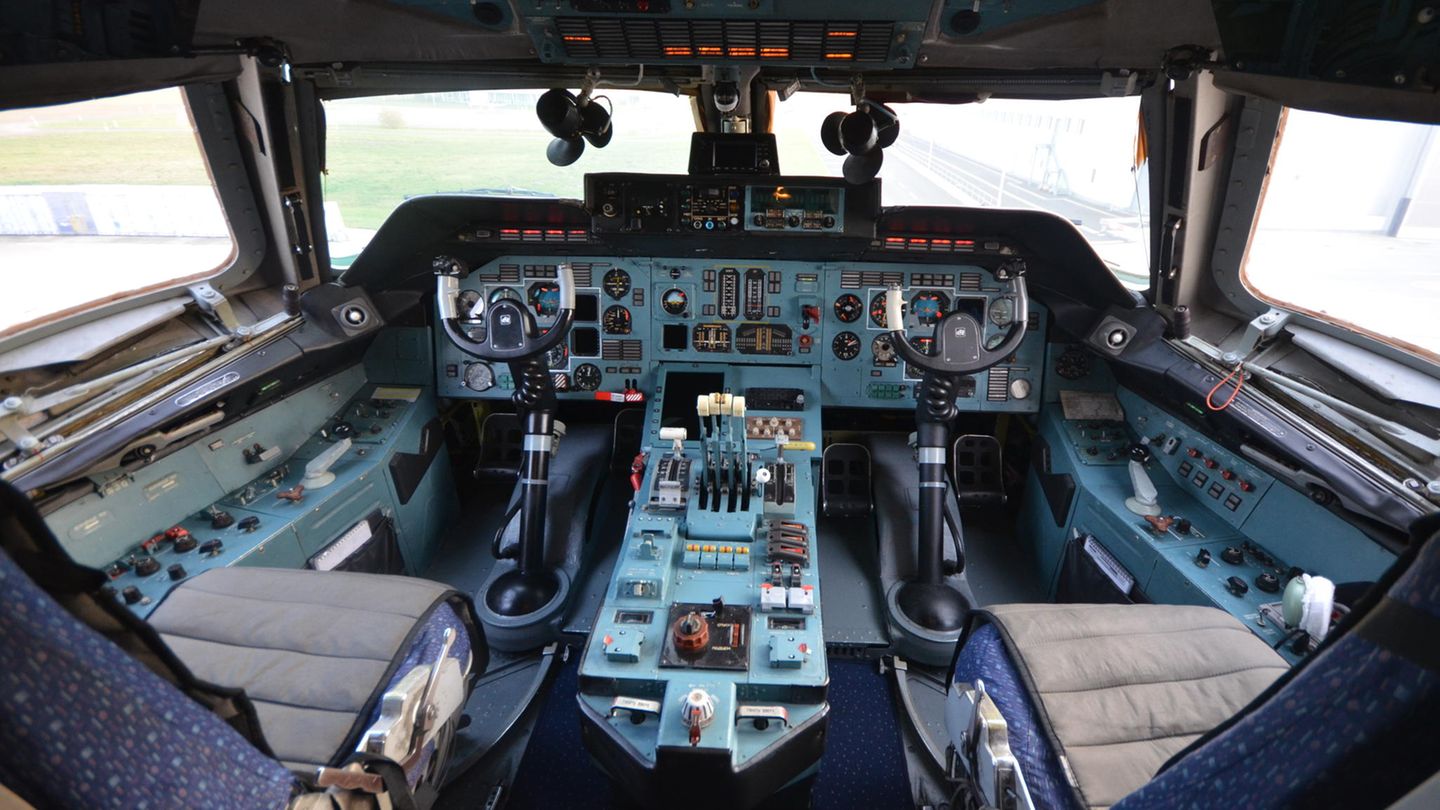
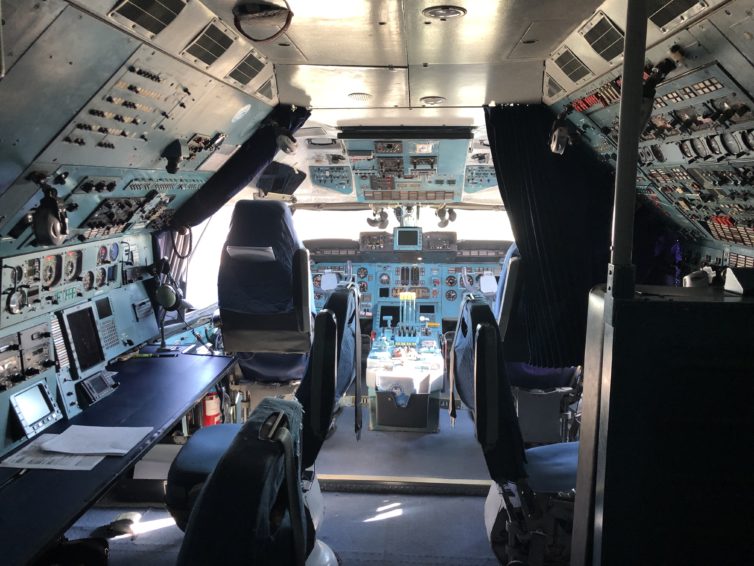
Crew. Russian Wikipedia, quoting the An-124-100 flight manual, lists eight crew positions: commander, co-pilot, navigator, senior flight engineer, flight engineer for equipment (бортинженер по АО), radio operator and two loading-equipment operators (loadmasters). English Wikipedia lists the same eight. The upgraded An-124-100M reduces the flight crew from six to four (Russian Wikipedia); English Wikipedia says Volga-Dnepr’s modernization allowed four-person operation, down from six or seven. In all sources the flight crew proper is six on the original aircraft, and the two loadmasters travel in addition.
Layout. The flight deck is at the front of the upper deck, with the pilots seated side by side and the navigator, flight engineers and radio operator at stations behind them. Behind the flight deck is a cabin for the relief crew (seven seats per the Russian flight manual data) and a cabin for accompanying personnel with 21 seats; Russian Wikipedia gives these as 7 + 21 passenger places. English Wikipedia says the pressurized upper deck can hold 88 passengers aft of the flight deck. These differ because they describe different layouts: 28 in the standard fit, 88 in an extended passenger arrangement. Movement between the upper and lower decks is by a pair of folding ladders (English Wikipedia). Pilots quoted by the Transportation Safety Board of Canada are reported to call the aircraft light on the controls and easy to fly for its size.
Controls. The controls use a partly fly-by-wire system with mechanical backup, using tubular rods and cables with irreversible hydraulic actuators and redundant hydraulic circuits. There is a stability augmentation system for pitch and yaw and an autopilot system САУ-3-400 with a quadruple-redundant computing part (Russian Wikipedia). The type was also the first Soviet aircraft with an on-board automatic monitoring system covering about 1,000 points.
ENGINES
Powerplant. The An-124 has four D-18T (Д-18Т) three-shaft high-bypass turbofans from Ivchenko-Progress (ЗМКБ «Прогресс», Zaporozhye, Ukraine), built by Motor Sich (Мотор Сич) according to Russian Wikipedia. Take-off thrust is about 229.85 kN (23,430 kgf) each, the bypass ratio is 5.6, and each engine has an electronic control system and thrust reverser. English Wikipedia gives 226.8 kN for the An-124-100M data table and a range of 238–250 kN elsewhere in the text; these figures should be read as approximate. The An-124-100M-150 uses the uprated D-18T series 4 at about 25,400 kgf (about 249 kN) according to Russian Wikipedia.
Starting and accessories. Engines are started by air from the APU or a running engine, with turbostarters; each engine drives two NP-107 hydraulic pumps and a 60 kVA generator (115/200 V, 400 Hz).
Re-engining ideas. Aviation Week reported in 2018 (via English Wikipedia) that GE Aviation studied CF6 engines for a Volga-Dnepr subsidiary, and a Russian-Ukrainian-era proposal, the An-124-200, would have used General Electric CF6-80C2 engines; neither was built. A planned Russian new-build version was to use the PD-35 (ПД-35) engine of about 33–40 tonnes-force thrust per Rossiyskaya Gazeta, or 35 tf per English Wikipedia; the PD-35 was not yet in service in the sources I found. The D-18T has been produced in Ukraine, and Russian sources since 2022 say its spare parts and deep overhaul are now done in Russia (TASS via AEX, October 2023, citing a source close to the VTA). I could not verify that independently.
AVIONICS
Flight and navigation. The An-124 uses the К-124 «Купол-124» flight-navigation-sighting system (изделие А-820): the A-821 control computer system based on the ЦВМ-80-4000, the А-825 piloting system, a three-channel A-826 inertial navigation system, air-data units (СВС-72), a ground-proximity system (ССОС) and the САУ-3-400 automatic control system (Russian Wikipedia). The system supports automatic approach to ICAO category 1; category 2 is listed as not enabled.
Radar and navigation aids. Two radars are combined in the А-822 complex: А-822-10 forward-looking and А-822-20 ground-mapping. Other equipment includes the АНС-3 astro-navigation system, two ARK-22 radio compasses, a Doppler speed-and-drift meter (ДИСС), radio altimeter, RSBN short-range navigation, and the long-range radio navigation receiver А-723 (RSDN, Omega, Loran-C and other systems). TCAS-2000 is listed on the Russian Wikipedia table.
Civil and modernized versions. The An-124-100 has changed communications equipment and instruments calibrated in feet and knots. Volga-Dnepr’s modernization in the early 2000s changed avionics to allow a four-person crew (English Wikipedia). A proposed An-124-115M would use Rockwell Collins avionics, and the An-124-102 concept from TsAGI would use an EFIS flight deck. The Russian military modernization of the An-124-100M type is described under RUSSIAN AIR FORCE FLEET AND MODERNIZATION.
SPECIFICATIONS
Figures are for the An-124-100 unless stated and differ by source. Where two sources disagree, both are given. Sources: Russian Wikipedia (flight manual РЛЭ Ан-124-100), English Wikipedia (Jane’s All the World’s Aircraft 2006–07, Volga-Dnepr), Antonov.
Crew: 8 including 2 loadmasters (flight crew 6, or 4 on An-124-100M). Length: 69.1 m. Wingspan: 73.3 m. Height: 21.08 m. Wing area: 628 m². Aspect ratio: 8.6 (English Wikipedia).
Empty weight: 178,400 kg (Russian Wikipedia) or 181,000 kg (English Wikipedia, An-124-100M). Maximum take-off weight: 392,000 kg (Russian table for the An-124-100) or 402,000 kg (English table for the -100M, and the figure Russian Wikipedia gives for the certified weight of the -150 version); the -150 version is quoted at up to 420 t. Maximum landing weight: 330,000 kg (English Wikipedia). Fuel: about 212,350 kg (Russian table) or 210,172 kg (English table).
Payload: 120,000 kg for the An-124-100; 150,000 kg for the An-124-100M-150 (standard military configuration also quoted at up to 150 t by English Wikipedia). Cargo hold: about 36–36.5 m × 6.4 m × 4.4 m, 1,050 m³ (Russian Wikipedia).
Powerplant: 4 × D-18T, about 229.85 kN (23,430 kgf) each; two TA-12 APUs.
Maximum speed: 865 km/h. Cruise: 800–850 km/h at about 9,000–12,000 m. Approach speed: 230–260 km/h (English Wikipedia). Service ceiling: 11,600 m practical (Russian Wikipedia) or 12,000 m maximum certified (English Wikipedia). Take-off run at maximum take-off weight: about 3,000 m; landing roll at maximum landing weight: about 900 m (English Wikipedia). Reverse thrust is fitted.
Range: Russian Wikipedia quoting Antonov: 4,800 km with maximum payload and 7,500 km with 80,000 kg. English Wikipedia (Volga-Dnepr data): 3,700 km with maximum payload, 8,400 km with 80,000 kg, 11,500 km with 40,000 kg. For the -100M-150, Russian Wikipedia gives 3,200 km with 150 t and 11,900 km with 40 t, and 5,400 km with 120 t. Ferry range is about 14,000 km (English Wikipedia). The different figures reflect different loads, fuel reserves and operating rules and cannot be reconciled from the sources.
Design life: Russian Wikipedia, citing the Oruzhie Rossii agency, gives an assigned life of 50,000 flight hours, 10,000 flights and 50 years for the An-124-100, after the original 24,000 hours or 25 years were extended. Russian sources written in 2025 say the existing aircraft’s resource should last to about 2040 (www1.ru); that is a general statement, not an official programme figure.
VARIANTS
Ан-124 (изделие 400): the base military transport version.
Ан-124-100: the civil version with part of the military equipment removed, a modified К-124 system, new communications and instruments in feet and knots. Certified 30 December 1992.
Ан-124-100М: Russian Wikipedia describes it as the An-124-100 with modernized avionics and a crew reduced from six to four. The designation is used in Russian sources also for the military modernization in Ulyanovsk (see below). Antonov objected in August 2019 that a Russian-built modification should be given a new designation without “Ан” (Lenta.ru, via Russian Wikipedia).
Ан-124-100М-150: payload raised to 150 t, maximum take-off weight up to 420 t, D-18T series 4 engines, offered by Antonov in 2004. The prototype was built in 2004 in Kyiv from early production aircraft No. 01-06, which had flown 12,000 hours (Russian Wikipedia). Russian Wikipedia lists UR-82009, the Hostomel aircraft, as a -100M-150, and English Wikipedia says one An-124-100 was converted.
Ан-124-100-150: the same payload increase without the avionics changes. Aircraft listed by Russian Wikipedia as -150 or -100-150 include RA-82078 and RA-82081.
Proposals that were not built: An-124-130, -135, -200 (CF6-80C2), -210 (joint with Air Foyle for the UK Short Term Strategic Airlifter, Rolls-Royce RB211-524H-T engines; the competition ended with the Boeing C-17), -300 (said by English Wikipedia to have been ordered by the Russian Aerospace Forces in 2020; I could not confirm this from a second source), An-124-102 «Слон» (Slon, “Elephant”) from TsAGI with a new composite wing, PD-35 engines and a larger fuselage, presented at MAKS 2017 and wind-tunnel tested in 2019–2020, and the tanker concept An-124-KC (entered with US partners in the US Air Force tanker competition and eliminated in the first round, per Russian Wikipedia).
Related type: the An-225 «Мрія» (see RELATION TO AN-225 MRIYA).
NOTABLE CARGO AND RECORDS
1985 payload record. On 26 July 1985 the first aircraft (No. 01-01), flown by Vladimir Terskiy with Aleksandr Galunenko as co-pilot, lifted 171,219 kg to 2,000 m. FAI record 4186 (Group 3, turbojet) lists this as “greatest mass carried to height of 2 000 m”, status ratified but superseded. FAI record 4185 lists an altitude of 10,750 m with a 170,000 kg payload, from the same date. Antonov states that 21 world records were set in the single flight. Some sources describe the 171,219 kg payload as being lifted to 10,750 m; the FAI database shows 171,219 kg at 2,000 m and 170,000 kg at 10,750 m.
Distance. English Wikipedia says that in May 1987 an An-124 flew 20,151 km without refuelling in 25 h 30 min with a take-off weight of 455,000 kg (that line is tagged citation-needed; aircraftinformation.info gives the same distance, dated 6–7 May 1987, as a closed-circuit record). On 1 December 1990 an An-124 (No. 05-07) started a round-the-world flight Melbourne–South Pole–North Pole–Melbourne with stops in Brazil, Morocco and the USSR: 50,005 km in 72 h 16 min of flying time, recorded in the Guinness Book of Records, with 7 world records set (Russian Wikipedia).
Commercial loads (as reported in the sources): 152-tonne Euclid mining truck, Vladivostok to Polyarny, December 1985 (two flights); an 80-tonne turbine runner from Kharkiv to Tashkent, May 1986; 140 tonnes of equipment for the first Pink Floyd concert in Moscow, May 1989 (Russian Wikipedia); a 125-tonne chemical reactor from Paris to Doha in October 1997, 140 tonnes with rigging (Russian Wikipedia, citing Volga-Dnepr); a 109-tonne locomotive from Canada to Ireland in 2001, and an earlier IE 201 locomotive to Dublin in June 1994 (English Wikipedia); the Obelisk of Axum, Rome to Ethiopia in April 2005, in three flights; Putzmeister concrete pumps to Japan for the Fukushima reactors in April 2011; and an 87,000 lb die tool for Ford F-150 production in May 2018.
Other uses. United Launch Alliance used An-124s to move Atlas V stages; An-124s moved SpaceX payload fairings and satellites to Kourou (English Wikipedia, with Ukrinform). Russian Wikipedia says an An-124 delivered an S-400 system to Khmeimim in Syria on 25 November 2015 (citing Lenta.ru). By 2013 the type had visited 768 airports in over 100 countries (Antonov, via English Wikipedia). In August 2010 nine athletes in Ulyanovsk pulled a 195-tonne An-124-100 a distance of 6.39 m in 13.47 seconds for a record (RIA Novosti, via Russian Wikipedia).
Humanitarian. On 3 March 2023 an Ukrainian An-124 delivered 101 tonnes of aid to Turkey after the earthquakes (Espreso TV, US Air Force release), and German Bundeswehr withdrawal equipment was flown from Mazar-i-Sharif to Leipzig by An-124s in 2021.
OPERATORS
Russian Aerospace Forces (ВКС России, Military Transport Aviation). The 566th Military Transport Aviation Regiment (566-й втап) and the 235th (235-й втап, moved to Ulyanovsk-Vostochny in 1994–95 per Russian Wikipedia). The Military Balance 2024 lists 10 An-124 in the VKS (Russian Wikipedia). Fleet details are in the section RUSSIAN AIR FORCE FLEET AND MODERNIZATION.
Volga-Dnepr Airlines (Волга-Днепр, Ulyanovsk, Russia). The largest civil An-124 operator until 2022, with 12 aircraft in late 2020 (English Wikipedia). Kommersant reported on 19 January 2026 that three of its eleven An-124 remained airworthy and four were detained abroad (see UKRAINE WAR AND SANCTIONS).
Antonov Airlines (Авіалінії Антонова, Antonov Design Bureau; Ukraine). Seven An-124-100 in 2020 (English Wikipedia); six at Leipzig/Halle as of 2025–2026 according to LVZ and aeroTELEGRAPH. Antonov Logistic SALIS GmbH serves the NATO and EU SALIS programme from Leipzig, with two An-124-100 on standby; the contract was signed in 2019 and extended to the end of 2026 (company website).
Maximus Air Cargo (UAE): one aircraft, UR-ZYD (ex-Kyiv airframe No. 03-03), listed as operational by English Wikipedia in 2020 and by Russian Wikipedia’s register. Polet (Полёт, Voronezh): two aircraft, now stored at Ulyanovsk. Libyan Arab Air Cargo: two aircraft; 5A-DKN was destroyed at Tripoli in June 2019 (shelling or an air strike, sources vary) and 5A-DKL is listed as stored at Kyiv. Russian Wikipedia’s register also lists one aircraft with Silk Way Airlines (Azerbaijan), which I could not confirm elsewhere.
SALIS. The NATO Strategic Airlift Interim Solution chartered An-124s from Antonov Airlines and Volga-Dnepr for up to 18 countries from 2006. Two aircraft were kept on full-time charter at Leipzig/Halle with two more at six days’ notice and two at nine days’ notice (English Wikipedia and NATO). Volga-Dnepr is reported to have left the joint venture in 2018 (CargoForwarder Global, which says this was presumably under pressure from Moscow).
RUSSIAN AIR FORCE FLEET AND MODERNIZATION
Original fleet. Russian Wikipedia’s register lists the aircraft built for Soviet and Russian military transport aviation, of which the great majority are in Russian hands. Of the roughly 50 production aircraft, about 25–28 were in the VTA in the early 1990s (28 aircraft in the 566th regiment in 1989; 26 aircraft moved to Ulyanovsk with the 235th by February 1995). Since 1999 the aircraft have been operated “on condition” (по техническому состоянию, Russian Wikipedia). Many aircraft were later placed in storage at Seshcha, Ulyanovsk-Vostochny and elsewhere, some for lack of engines or missed overhauls (Kommersant Samara, 2023).
Fleet size estimates. Numbers differ widely by source and by what is counted. The Military Balance 2024 lists 10 An-124 in the VKS (via Russian Wikipedia). English Wikipedia’s statement that the VKS operates the type does not give a number. Russian Wikipedia’s register table lists about 11 VTA aircraft as airworthy and about 11 more as stored at Seshcha, but that table is undated and has not clearly been updated for 2022 onward. CargoForwarder Global (August 2025) refers to “supposedly ten” An-124 operated by the Air Force. Treat the figure of about 10 flying military An-124 as an estimate, with additional aircraft in storage whose airworthiness is unknown. I found no official Russian figure.
Overhaul and upgrade at Aviastar-SP. Since 2014 and the end of the Russian-Ukrainian cooperation, repair and modernization of Russian-built Ruslans has been done by Aviastar-SP in Ulyanovsk alone (Russian Wikipedia, citing the company’s service page). Russian Wikipedia says that 22 VTA aircraft were scheduled for modernization, and that by December 2014 the Air Force had received 10 modernized aircraft: RA-82013, 82014, 82030, 82032, 82035, 82037, 82038, 82039, 82040 and 82041 (the page lists them as having passed major overhaul between 2010 and 2015). Janes reported on 2 December 2014 that Russia had completed an initial An-124 upgrade programme. The modernization in Russian sources covers the fuselage and wing, navigation system, landing gear, avionics, some on-board units and an increase in payload (Russian Wikipedia). It was described in the media as a modernization to “An-124-100M” standard. In 2020 Aviastar-SP repaired six aircraft without Ukrainian assistance (www1.ru, September 2025). English Wikipedia says that in late 2017 several An-124 were upgraded in Ulyanovsk and three were scheduled to return to flight in 2018 (tagged citation-needed).
New-build ideas, 2004–2019. In 2004 Antonov offered the An-124-100M-150. In August 2007 Russia and Ukraine signed an agreement on resumed serial production, with Volga-Dnepr planning to buy up to 100 aircraft by 2030 (Lenta.ru via Russian Wikipedia). A UAC and Ernst & Young business plan of June 2008 said at least 40 firm orders were needed, with production at Aviastar from 2012 at one or two aircraft per year, and a 2008 unit price of 150–160 million dollars; orders reported in 2010 included 3 for the Russian Ministry of Defence and 40 for Volga-Dnepr. In May 2009 UAC said it did not plan to build any in 2009–2012, and in late 2009 President Medvedev ordered production resumed (Kommersant via Bloomberg). The Russian-Ukrainian intergovernmental agreement of 17 December 2013 on state support was conditional on an order book that would cover the cost. On 15 August 2014 Deputy Minister of Industry and Trade Yuri Slyusar said the joint project was no longer on the agenda (Janes and Vzglyad). Since 2014 Russia has done the work alone.
2018–2019. On 2 June 2018 the VTA commander Vladimir Benediktov said resuming production was being “regularly considered”. In June 2018 Aviastar-SP posted a tender worth 9.5 million rubles to assess whether its assembly tooling could build the An-124 and an An-124-100M, and whether part of it could be removed to make room for the Il-76MD-90A and Il-276 (AviaStat and Interfax, with Interfax citing a source). Deputy Prime Minister Yuri Borisov said on 30 July 2018 that research for a new super-heavy transport to replace the Ruslan would start after 2025 and that there was no plan to resume An-124 production, though the existing fleet would be modernized (Russian Wikipedia). Antonov said in June 2018 that modernization was impossible without Ukrainian participation, and in January 2019 Ukroboronprom said Antonov would restart production without Russian parts; Antonov’s president said in April 2019 that restarting production “made no sense” at that time.
2022 to 2024. The Ukraine war ended any supply from Ukraine, including Motor Sich D-18T engines and Antonov’s technical support. In 2022 the Russian Ministry of Industry and Trade proposed 15.4 billion rubles for the restoration and modernization of 11 aircraft: eight Tu-204/214, two Il-96-400T and one An-124-100, owned by UAC structures and a leasing company, for Red Wings, Volga-Dnepr and Aviastar-TU (aviation21.ru, a secondary source). The same source says the restoration of airworthiness for these aircraft, originally planned for 2024, was postponed to 2027 because of component delays and the need to modernize production capacity; I treat this as an unconfirmed report. On 11 October 2023 Defence Minister Sergei Shoigu visited Aviastar (by then PJSC Il, Aviastar branch, part of UAC and Rostec) and said that by 2025 the number of An-124 “should be doubled” because Russia now has engines and capacity to modernize them (Ministry of Defence, via IA REX and Rossiyskaya Gazeta). VTA commander Benediktov told him that the Russian PD-35 or the D-18T could be fitted to prospective heavy transports and modernized An-124-100 aircraft; TASS reported, citing a source close to the VTA, that the engine would be chosen competitively between the two and that D-18T spares were now made in Russia. Kommersant Samara commented that experts read the order as restoring stored aircraft rather than new construction, and that the PD-35 would be ready for installation only toward the end of the decade. The MoD, PJSC Il and UAC did not comment. I did not find any report that the “doubling” goal was met.
2025 to 2026. www1.ru wrote in September 2025 that, as of that month, the production restart discussed since 2018 had not been carried out, citing the cost of production, the state of production facilities and shortage of skilled staff. A Russian government statement reported by www1.ru on 19 June 2026 says Aviastar produces the Il-76MD-90A in flow production and carries out repair and servicing of aircraft “including super-heavy An-124”, and also takes part in Il-114-300 and MS-21 cooperation. This confirms ongoing overhaul and no serial An-124 line. On 27 March 2025 an An-124-100 at Mineralnye Vody had a landing-gear fire on landing with 32 people aboard, none hurt (Kommersant, via Russian Wikipedia). The ownership of the Volga-Dnepr An-124 fleet is also changing: in August 2025 its founder Aleksei Isaikin announced the transfer of the company’s assets to the state, which would give the state access to three more An-124 (CargoForwarder Global); I could not confirm that this has been completed.
What is not confirmed. As of the sources available, I found no confirmed new-build An-124, no confirmed start of An-124-100M serial production in Ulyanovsk, no confirmed first flight of a PD-35-powered Ruslan, and no official count of the VTA’s airworthy An-124. Possible successors in the heavy class are the TsAGI «Слон» concept (see VARIANTS) and the PD-35 engine, neither with a confirmed in-service date in the sources I used. Antonov has stated that Russian use of the “Ан” designation for the modified aircraft is not agreed. Any statement that Russia “will restart” An-124 production should be read as a statement of intent from officials or anonymous sources, not as a programme with a delivery schedule.
UKRAINE WAR AND SANCTIONS
Hostomel, 24 February 2022. Antonov’s home airfield at Hostomel (Antonov Airport, about 30 km from Kyiv) was one of the first objectives of the Russian invasion and was the scene of the Battle of Antonov Airport. The company’s facilities, the sole An-225 and several other aircraft were destroyed or damaged. An-124 UR-82009 (c/n 19530501008) was damaged; English Wikipedia says it was confirmed destroyed by Russian artillery, while Key.aero in 2025 says it was damaged and remains at Hostomel, and Russian Wikipedia says it was damaged in the fighting. The sources conflict, and “damaged” is the safer statement.
Antonov Airlines. Five An-124-100 were already abroad or were moved to Leipzig/Halle in 2022, where they have been based since (Key.aero; English Wikipedia says they were diverted at the end of commercial flights). A sixth, UR-82073, was undergoing modernization at the Antonov Serial Production Plant at Svyatoshyno (Kyiv) and was flown to Leipzig/Halle on 11 July 2025 (Key.aero, aeroTELEGRAPH). The company now maintains the fleet in its own hangar at Leipzig and plans a new hangar by mid-2027 (aeroTELEGRAPH). Antonov Airlines aircraft carry names with “Be brave like …” and a Ukrainian city, for example UR-82072 “Be brave like Kherson”, UR-82007 “Mykolaiv”, UR-82029 “Bucha” and UR-82073 “Irpin” (aeroTELEGRAPH).
Sanctions and airspace closure. The EU closed its airspace to Russian operators on 28 February 2022 (EU Regulation 833/2014 as amended). Volga-Dnepr was sanctioned by Canada, the EU, the UK and the US in 2022–2024 (Kommersant, 19 January 2026). Three Volga-Dnepr An-124 were in Leipzig/Halle for maintenance at the time and have been grounded there since; the engines were removed during that maintenance and their present location is unclear (tagesschau/WDR, Luftraum Ost). The airport spokesman said the owner kept paying parking fees. Some reports say the aircraft were also seized by a court in a dispute between Antonov and the Russian aviation authority (Ilyashev & Partners, April 2022, via Luftraum Ost); I did not confirm that independently. In Canada an An-124 stranded at Toronto Pearson was ordered seized by the Government of Canada on 9 June 2023 (Global Affairs Canada).
Volga-Dnepr after 2022. Kommersant reported on 19 January 2026 that of 11 An-124 the company had three with valid airworthiness, with four of the eleven under arrest abroad, and five Il-76; the group’s Boeing freighters had stopped flying, and the AirBridgeCargo certificate was revoked in July 2025. Of the four arrested abroad, three are those at Leipzig/Halle and the fourth is presumably the Toronto aircraft; that match is my inference, not stated by the source.
Russian military use. The ВКС An-124 fleet was used for heavy lift inside Russia and abroad before 2022; English Wikipedia and Russian Wikipedia describe earlier use for NATO supply, but in the sources I found there is no detailed, reliable account of An-124 use in the war itself. I have therefore not included any.
Antonov and Russia. After 2014 Antonov had already cut cooperation and in September 2016 its president threatened to ban Russian An-124-100 flights abroad if owners refused Antonov’s service (Russian Wikipedia). From 2022 Russian-built and Russian-serviced aircraft are in separate worlds: Ukrainian aircraft are maintained in Germany and Ukraine, and Russian ones by Aviastar-SP, with D-18T spare parts reportedly now produced in Russia (TASS source, 2023).
STATUS
Total fleet. About 55–57 were built, of which five or six were lost in accidents or in war: CCCP-82002 (1992), RA-82071 (1993), RA-82069 (1996), RA-82005 (1997), 5A-DKN (2019), with RA-82042 badly damaged in 2020; Russian Wikipedia said six had been lost as of May 2021. Hostomel UR-82009 is damaged. English Wikipedia counts five hull-loss accidents with 97 fatalities as of November 2020.
Accidents. 13 October 1992: the second prototype, CCCP-82002, crashed during certification trials near Kyiv after the nose failed at high dynamic pressure; Russian Wikipedia says eight crew died; English Wikipedia says eight of nine. 15 November 1993: RA-82071, an Aviastar aircraft, hit a mountain near Kerman, Iran, with 17 killed. 8 October 1996: RA-82069 crashed at San Francesco al Campo near Turin on a go-around, killing five people (two crew and three on the ground per Russian Wikipedia; English Wikipedia says four fatalities). 6 December 1997: RA-82005 of the VTA crashed in a residential area of Irkutsk after losing engines on take-off, with all 23 aboard and 45 on the ground killed; it carried two Su-27 fighters (Russian Wikipedia). 13 November 2020: RA-82042 of Volga-Dnepr suffered an uncontained engine failure after take-off from Novosibirsk and ran off the runway on landing; Volga-Dnepr then grounded its fleet and the first aircraft returned to service by 29 December 2020. 27 March 2025: landing-gear fire at Mineralnye Vody (no injuries).
Operators today. Estimates only, with the caveats above: Antonov Airlines six at Leipzig; Volga-Dnepr three airworthy in Russia plus three at Leipzig and one other detained abroad (Kommersant, January 2026); Maximus Air Cargo one; VTA about 10 flying as an estimate; some further airframes in storage in Russia. I did not find a reliable single count of the world’s airworthy An-124 fleet in 2026, and any total in the range of 20–30 is my own arithmetic from these sources.
Future. No restart of production is confirmed in Russia or Ukraine (see RUSSIAN AIR FORCE FLEET AND MODERNIZATION). Russian officials have talked about modernization with new engines and about an eventual replacement outside the “Ан” family; no flying successor exists in the sources I found. Antonov Airlines is expanding its Leipzig base, while its parent company has said that an own restart would be difficult.
RELATION TO AN-225 MRIYA
The An-225 «Мрія» (“Dream”; NATO: Cossack) is an enlarged derivative of the An-124, ordered in 1984 to carry the Buran orbiter and Energia rocket parts. Antonov stretched the fuselage with barrel sections ahead of and behind the wing, built a new wing centre section, fitted six D-18T engines instead of four, a 32-wheel main gear and a twin tail, and removed the rear ramp and door to save weight (English Wikipedia). Its first flight was on 21 December 1988; only one aircraft was completed, with a second airframe partly built. Maximum take-off weight was 640 t. The An-225 shared the visor nose and kneeling gear, and its flight deck was largely identical to that of the An-124 apart from the controls for two extra engines.
The completed An-225 (UR-82060) was destroyed during the Battle of Antonov Airport; Ukroboronprom announced its destruction on 27 February 2022. Later photographs and video showed the forward fuselage burned out. In May 2022 President Zelensky announced a plan to complete the second airframe, and in November 2022 Antonov confirmed a plan at an estimated 500 million dollars; no funding or completion date is given in the sources I used, and it is not known whether the rebuilt aircraft will fly.
For the An-124 the An-225’s loss means the Ruslan is the heaviest aircraft in regular cargo service. The two types are also linked by their engines: all six of the An-225 engines were removed in 1994 for use on An-124 aircraft when the An-225 was stored (English Wikipedia).
IN ONE SENTENCE
The An-124 Ruslan is Antonov’s four-engine, double-deck, 120–150 tonne heavy airlifter of 1982 with a visor nose, rear ramp, kneeling gear and D-18T engines, built at Kyiv and Ulyanovsk until 2004, now split between Antonov Airlines flying from Leipzig under NATO contract and a Russian Air Force and Volga-Dnepr fleet kept alive by overhaul at Aviastar-SP, with no new-build confirmed in either country.