WHAT IT IS
29B6 Container (29Б6 «Контейнер») is a Russian bistatic high-frequency over-the-horizon radar for long-range air surveillance. It was designed by NPK NIIDAR (the same institute behind Voronezh-DM) under chief designer Valentin Strelkin, built with Pravdinsky Radio Plant / Almaz-Antey, and is operated by the 590th independent radio-technical node of the Aerospace Forces. The first set looks west from two sites about 300 km apart: a transmitter near Gorodets in Nizhny Novgorod Oblast and a receiver field near Kovylkino in Mordovia. Experimental duty began 2 December 2013. Combat duty is dated 1 December 2019.
It is the post-Duga generation of Russian sky-wave OTH. It is not a Voronezh early-warning radar, not Don-2N, and not a Krug HF-DF ring. Those listen or look by other physics. Container transmits, skips off the ionosphere, and listens for the faint backscatter from aircraft, cruise missiles, and — in Ministry language — other aerospace objects including hypersonic ones, at published ranges of about 3,000 km (developer talk has used 6,000 km) and altitudes to about 100 km.
HOW OVER-THE-HORIZON RADAR WORKS
A microwave search radar sees in a straight line. The Earth curves. Beyond a few hundred kilometres a low aircraft is under the radio horizon. Two ways exist to go around that curve.
Surface-wave OTH. At low HF or MF, a vertically polarized wave can cling to a conducting surface — especially seawater — by diffraction and follow the curve for a few hundred kilometres. Good for maritime surveillance. Not the 3,000 km air picture Container advertises. Some catalogue pages mis-label 29B6 as surface-wave; the range, altitude, and geometry are sky-wave.
Sky-wave OTH (OTH-B, backscatter). In the HF band, 3–30 MHz, a wave launched obliquely into the ionosphere is refracted, not reflected like a mirror. Electron density increases with height through the D, E, and F regions (roughly 60–100 km, 100–125 km, and 200 km and up). The refractive index falls as electron density rises. At some height the ray bends over and comes back down, illuminating a patch of Earth and air hundreds to thousands of kilometres away. A small fraction of that energy scatters from an aircraft or the ground, goes back up, refracts again, and returns to a receiver. That two-hop path is the radar.
The ionosphere is not a fixed dish. It changes with time of day, season, solar cycle, and magnetic weather. Daytime D-layer absorption kills the lower HF. Night, the F layer rises and skip distance grows. The usable frequency for a given range therefore moves. An OTH radar must sound the ionosphere continuously and hop frequency to keep the skip landing on the wanted sector. That is why Container, like Duga before it and like Jindalee or ROTHR in the West, lives in a wide HF slice rather than on one channel.
Resolution is poor by microwave standards. Wavelengths are tens of metres. Arrays must be hundreds of metres to kilometres long to form a usable beam. Range is inferred from time delay along a crooked, moving path, so ionospheric models and frequent calibration are part of the radar, not extras. Clutter from the ground illuminated by the same skip is enormous; Doppler and adaptive processing pull moving aircraft out of that floor. A dead zone exists in front of the site: energy has not yet come back down. For Container that inner hole is published at about 900 km.
Bistatic layout — transmitter far from receiver — keeps the receiver from being deafened by the local pulse and lets each site be optimized. Monostatic OTH exists; 29B6 is not that design.
THE 29B6 PLANT
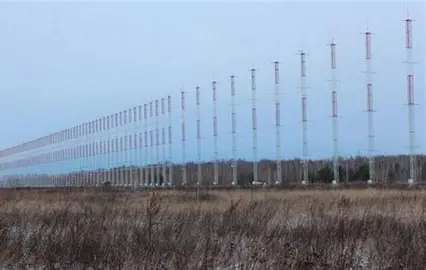
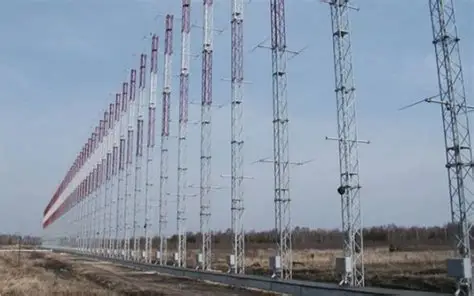
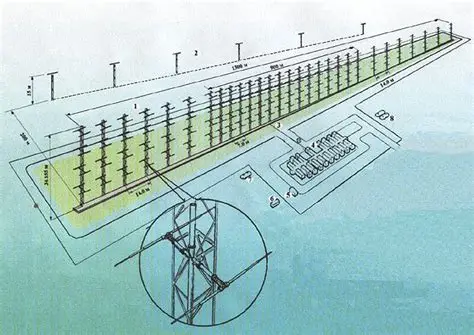
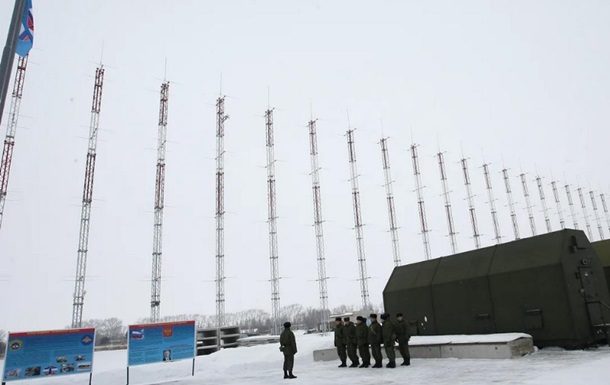
Receiver, Kovylkino, about 8 km south-west of town (53°59′N, 43°51′E class): 144 masts, each 34 m high, on a field 1,300 m long and 200 m deep. Inner section 900 m wide with 7 m mast spacing; two outer sections 200 m each with 14 m spacing. Some descriptions put three such arrays in an equilateral triangle so the node can look through a wide sector without slewing a dish. Electronics are in transportable containers — the origin of the name.
Transmitter, near Gorodets (56°41′N, 43°29′E class), originally about 300 km from the receiver: 36 masts, array width about 440 m.
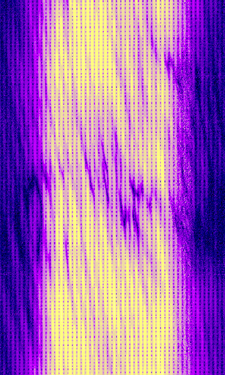
Band: 3–30 MHz. Amateur intercepts of the operational waveform cluster around 9.2–19.7 MHz. Pulse repetition is commonly given as 50 per second (some write 40–50); secondary notes discuss adaptive PRF from about 25 pps (longer instrumented range) to 100 pps (shorter, finer). Pulse bandwidth is about 14 kHz with frequency modulation on the pulse (FMOP). The sound on a shortwave receiver resembles Duga’s “woodpecker” — a regular knock — for the same reason: a high-power HF pulse train.
Published coverage of the first site: sector 180° at first light, planned then stated 240°; range about 3,000 km against air targets, 100 km altitude ceiling; simultaneous tracks in Ministry copy up to 5,000. Developer range talk of 3–6,000 km appears in 2019 briefings. Minimum range ~900 km. Cost of the first system in older reporting: about 10 billion rubles.
HISTORY
Soviet sky-wave OTH was Duga (5N77, NATO Steel Yard), the large “woodpecker” of the 1970s–80s, tied to missile-warning ambitions and later shut down. Container is the clean-sheet successor for air-breathing and aerospace warning, not a rebuilt Duga face. NIIDAR design work with Pravdinsky KB is dated through the late 1990s. Construction and testing of the first article ran from about 2002 to 2013 under OKR at Granit (Ryazan) and related yards.
2 December 2013: experimental combat duty at Kovylkino. State trials were still being discussed as forthcoming in 2015. 1 December 2019: combat duty. The look is west and south-west — NATO’s eastern air approaches and the south-western theatre in official phrasing.
A second Container was reported under construction from 2021 near Zeya, Amur Oblast, for the Far East. Kaliningrad has been named as a planned European-enclave site. Armada-class analysis has mentioned a notional fleet of up to twelve; that is a planning ceiling, not a built count. As of 2026 open tallies, two operational-class sites is the careful number, with others planned.
WHAT IT IS FOR — AND WHAT IT IS NOT
It is an early-warning air picture at ranges no Voronezh or 91N6 can see around the curve: mass takeoffs, raid tracks, some cruise-missile and high-altitude paths. Low radar-cross-section aircraft are part of the sales case because HF wavelengths are large compared with stealth shaping designed against X-band. That is physics, not a guarantee. Ionospheric weather can close the path; the 900 km hole is real; a fix from OTH is coarser than a microwave track and is used to cue other sensors, not to put an S-400 missile on the jet by itself.
It is not SKKP’s catalogue shop (that is Noginsk-9). It is not Krug HF-DF (that only listens). It is not Duga returned to life. The woodpecker sound is a family resemblance, not the same transmitter.
STATUS
The Kovylkino–Gorodets pair remains the published operational Container. Eastern and Kaliningrad follow-ons are in the open plan. The radar is a fixed strategic field. Its product is a long, weather-dependent look into European and south-western airspace, folded into the same warning family as the Voronezh line but working by skip instead of line of sight.
IN ONE SENTENCE
29B6 Container is NIIDAR’s bistatic HF sky-wave OTH radar — Gorodets talking, Kovylkino listening — that bends a 3–30 MHz pulse off the ionosphere to see aircraft beyond the horizon at about 900–3,000 km, which is why it looks like a kilometre of masts and sounds like a woodpecker.