WHAT IT IS
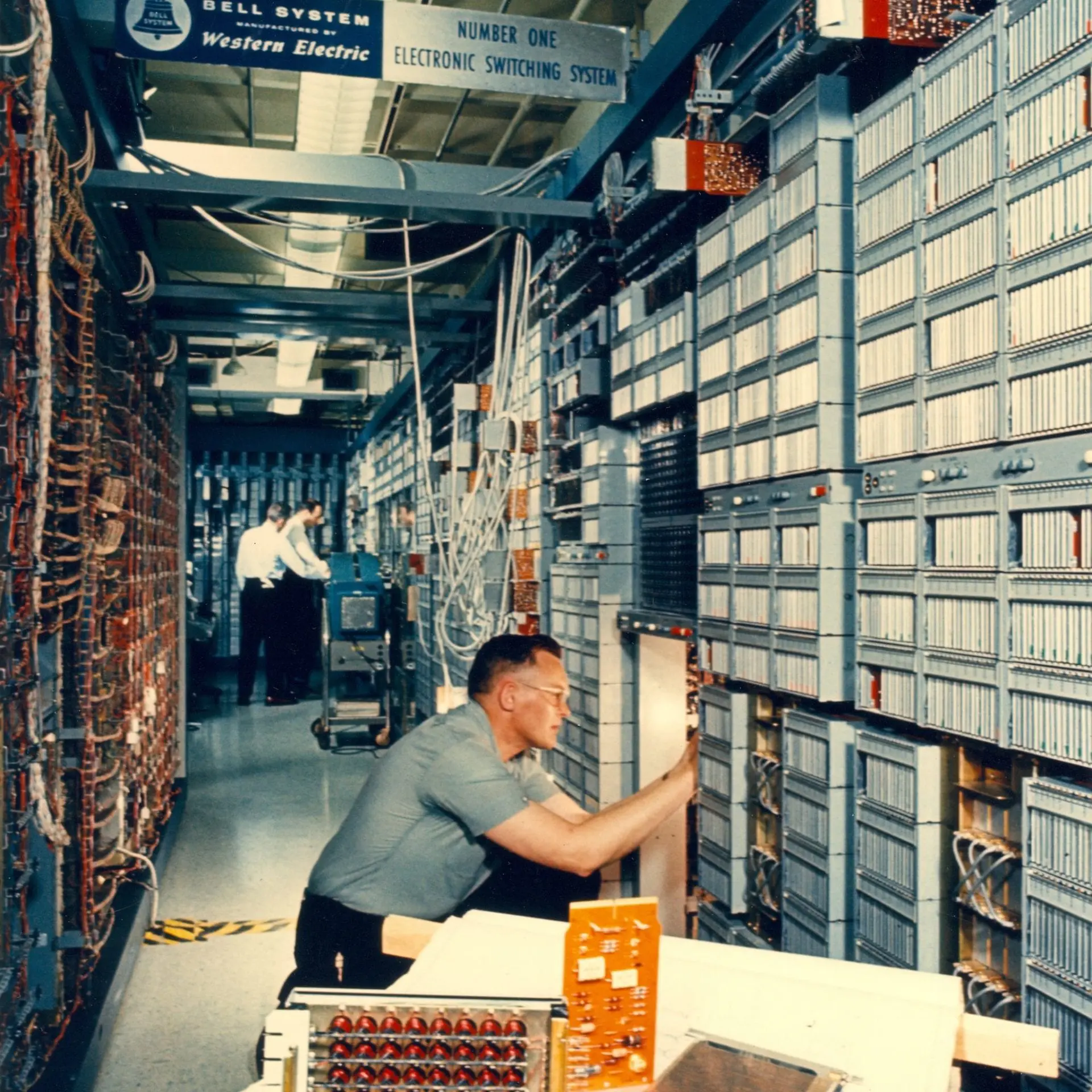
The No. 1 Electronic Switching System (1ESS, spoken “one E-S-S”) is the Bell System’s first large commercial stored-program-control local telephone exchange. Western Electric built it. Bell Laboratories designed it. The first office cut over at Succasunna, New Jersey, 12:01 a.m. 30 May 1965 (dedication traffic two days earlier; some popular accounts print the 25th).
It is electronic in the control. The talking path is still analog metal: a matrix of ferreed reed-relay crosspoints, not PCM time slots. A duplicated central control reads a twistor program store, writes a ferrite-sheet call store, and pulses the network into a metallic connection that holds until teardown. That split — computer in the head, reeds in the fabric — is the whole machine.
1A ESS (1976) keeps the same network and most of the peripherals and drops in the faster 1A processor (the same family that also runs 4ESS). Call capacity roughly doubles. Remreed switches and disk appear on the later frames. Software stays in the 1ESS instruction set so an in-service 1ESS can be retrofitted without rewriting the office.
WHAT IT IS USED FOR
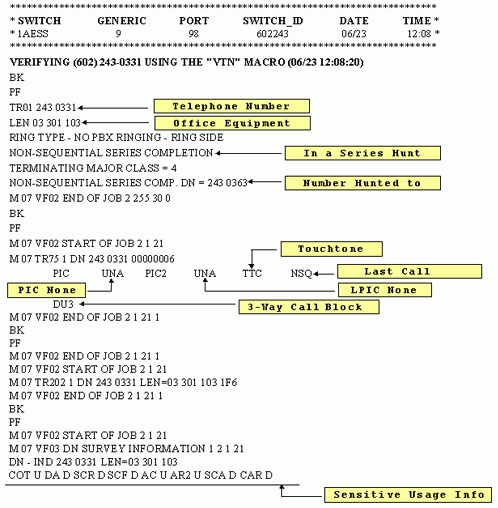
Metropolitan and large-suburban Class 5 local service: 10,000 to about 65,000 lines per office in the original planning band, heavy traffic. Basic POTS plus the first mass custom-calling set that electromechanical offices could not sell cheaply — call waiting, call forwarding, three-way, speed calling — because those features live in software and translation tables, not in wired logic on every line.
Some 1/1A offices also did toll and tandem work. From 1978–79 they grew Common Channel Interoffice Signaling (CCIS) and joined the stored-program-controlled long-distance network that 4ESS was built to anchor. AUTOVON used a 1ESS-derived plant for parts of the military switched voice net before DSN.
It is not a digital switch. Voice never becomes bits inside the 1ESS fabric. 4ESS (toll, 1976) and 5ESS (local digital, 1982) are the PCM machines. 2ESS / 2BESS were the smaller suburban SPC cousins.
HOW A CALL MOVES
1. Off-hook. Line scanner (ferreed or later remreed scan points) sees the loop. Central control writes a call record in call store and returns dial tone from a service circuit.
2. Digits. Dial pulse or DTMF receivers collect the register. Unlike step-by-step, the fabric does not walk with each digit. The processor waits for a complete number, then looks up translations in program-store permanent data: class of service, routing, custom features.
3. Path hunt. A network map in call store holds busy/idle bits for every link. Control hunts an idle path through line switch → junctor → trunk or called-line switch, then operates the ferreed crosspoints with a short current pulse. The reeds latch magnetically. No holding current on the speech path.
4. Supervision and billing. Answer, AMA tickets (later tape on 1A), ringing, tones, three-way bridges — all service circuits the processor attaches and releases. On-hook clears the map and pulses the reeds open.
Overload behavior was the early surprise: an ESS that ran out of real-time tended to collapse as a whole rather than degrade line by line the way a crossbar did. Later generics and the 1A processor hardened that.
HARDWARE
Central control (CC). Duplicated processors, matched and switched. Original No. 1 processor: discrete transistor logic, hierarchical state machine, ~13,000 logic circuits / ~60,000 semiconductors in one published count for the control complex. Cycle on the order of microseconds; program-store and call-store cycles were 5.5 µs and run in antiphase so one store fetches while the other addresses. Busses are transformer-coupled twisted pairs, duplicated, terminated at the last frame.
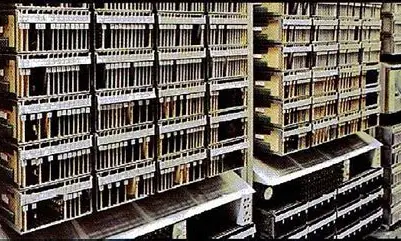
Program store — permanent-magnet twistor. Read-mostly “ROM.” 131,072 words × 44 bits per store (6 Hamming + 1 parity, ~37 instruction bits, typically 22-bit address). One store ≈ 5.8 million bits in 16 accordion-folded modules. Data lives as tiny magnets on aluminum cards (64 × 44-bit words per card). Cards are pulled in stacks of 128 and written offline on a motorized magnet writer — you do not poke the running program. That is why Bell called the memory immortal and why a software generic change was a card-pulling party.
Call store — ferrite sheet. Read/write. 8,192 words × 24 bits per frame (196,608 bits). Destructive readout, coincident current, 5.5 µs cycle, specified 32–115 °F and 40-year life. A ~10,000-line office needed two or more stores; a 65,000-line heavy office could stack toward 40. Later 1ESS work replaced ferrite sheets with ~850,000 ferrite cores in some redesigns. Call store holds transient call records, the network map, AMA buffers, TTY buffers, queues.
1A processor. Faster gates (5–10 ns class), writable memory as well as ROM, magnetic tape for reload and AMA, disk on later offices. Instruction-compatible with No. 1 so a live office can swap brains. Execution rate quoted four to eight times the No. 1 processor. First 1A in service January 1976 — as the control of a 4ESS in Chicago — then as a native 1A ESS (Franklin office, Chicago, October 1976) and as a retrofit (San Francisco Folsom Street, January 1978).
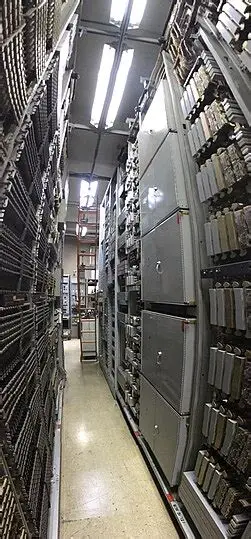
Switching fabric. Ferreed: a reed capsule whose contacts are latched by a ferrite remnant, packaged as 8×8 (and other) arrays, wire-wrapped into grids. Sixteen 8×8 grids give a line full access to 1,024 junctors in the textbook drawing. Morris, Illinois (experimental electronic office, late 1950s) had tried a gas-tube fabric; it worked and lost on loss, noise, and economics. Succasunna kept SPC and put metal back in the path. 1A-era remreed is the smaller, cheaper latching reed that cut relay count.
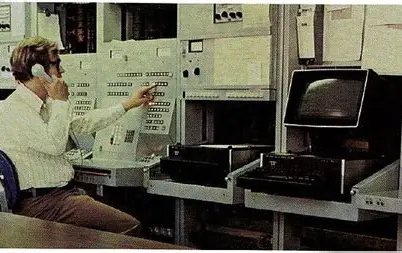
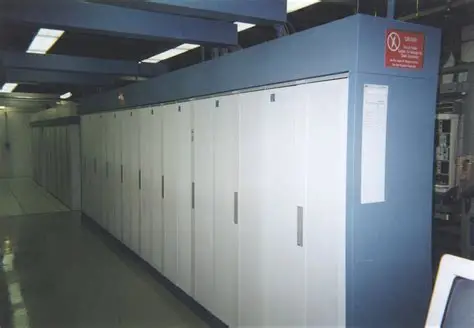
Peripherals. Line-switch frames, trunk frames, junctor frames, scanners, signal distributors, service circuits (tone, ringing, conference, coin), master control console, teletypewriters, later CCIS signaling terminals. Popular Science / Telephone World component dump for an early office: ~160,000 diodes, ~55,000 transistors, ~266,000 resistors/capacitors/other on plug-in packs. Development cost figures in 1965 press: 2,000 man-years and $100 million in one story; $500 million over ten years in another. Treat those as period publicity, not a GAAP line.
Duplication is the religion: two CCs, two buses, paired stores, diagnostic programs that isolate a pack and take it offline. The office was specified to stay up through a unit failure.
WHERE THEY WERE
Every large Bell operating-company city. First commercial: Succasunna CO, Hunter Street and Route 10, Roxbury Township, New Jersey — still a telephone building. Holmdel Labs held the design-test 1ESS before cutover. Second commercial wave 1966 in Maryland; New York and California followed. Kappel’s 1965 line was “a new office every working day in the early 1970s.”
By 1974: about 475 No. 1 ESS offices, 5.6 million lines. By 1983: 1ESS + 1A ESS together over 1,800 entities, over 53 million lines — then the largest electronic switching plant on earth, about half of Bell subscriber lines. 1A ESS first outnumbered 1ESS that year. The 1A processor is credited with avoiding on the order of 300 additional new 1ESS buildings.
Late survivors clustered in legacy BellSouth and Southwestern Bell territory: Atlanta metro, St. Louis metro, Dallas–Fort Worth. Last published office: Odessa Lincoln, Odessa, Texas (ODSSTXLI), cut from 1A ESS to a Genband G5/G6 packet switch around 3 June 2017. Succasunna’s own 1ESS died 28 September 1991 (5ESS) / some local notes say 1992.
WHAT REPLACED THEM
Same generation, more capacity: 1A processor retrofit, remreed, CCIS generics, equal-access software after the 1982–83 divestiture (thousands of SPC offices had to present Feature Group D to competing IXCs by 1986).
Digital local: Western Electric / AT&T 5ESS (first 1982, local time-division, distributed modules). Northern Telecom DMS-100. Siemens EWSD in some BOCs. Those three were already leaving production while 1A ESS frames were still earning money — the analog SPC office outlived its digital replacements’ factory life.
Packet / IMS: Genband G5/G6 and later softswitches with TDM trunking only, the Odessa pattern. AT&T told Alcatel-Lucent it would not renew 1A support past the mid-2010s; the last Naperville 1A lab came down in 2015; remaining offices were emptied by 2017.
Toll sibling: 4ESS (and later N4E) took the long-distance SPC/digital job. 1/1A stayed the big-city line switch until the copper Class 5 itself started to vanish.
PLACE IN THE STACK
Before: panel, step-by-step, No. 1 and No. 5 crossbar — wired logic, sleeve leads as memory, features that cost iron. Morris trial: SPC idea, gas-tube fabric, vacuum leftovers. After: 1A brain in the same ferreed hall; 4ESS digital tandem; 5ESS digital local; packet Class 5. The thing 1ESS invented that never went away is the stored program itself — translations on disk, features as generics, not as a new relay frame.
CAVEATS
Cutover calendar: 30 May 1965 is the Bell Laboratories Record / dedication night; 25 May appears in local anniversary copy. Dollar and man-year totals are 1965 press. Line-count planning bands (10k–65k) are design envelopes, not a cap every office hit. “Last 1AESS” is the last known North American wire center in public write-ups (Odessa). A forgotten frame in a cellar would not change the retirement program.
STATUS
Gone from the PSTN. Twistor cards and ferreed grids survive in museums and collector frames. The building at Hunter and Route 10 is still a CO. The architecture — duplicated stored-program control over a switching fabric — is every Class 5 that followed, including the 4ESS page already on this site.
IN ONE SENTENCE
No. 1 ESS, cut over at Succasunna in May 1965 and grown into 1A ESS in 1976, is Bell’s first mass stored-program local exchange — twistor program store and ferrite call store driving a ferreed analog fabric — that put custom calling in software, served tens of millions of lines, and was replaced office-by-office by 5ESS, DMS-100, and finally packet switches through 2017.